Introduction
The global DeFi revolution continues to evolve at unprecedented speed, and in 2026, Solana DeFi Development is taking center stage. Known for lightning-fast transactions, low fees, scalable architecture, and a robust developer ecosystem, Solana has become one of the top choices for building decentralized finance applications. Whether you’re a startup, fintech enterprise, or an organization exploring blockchain innovation, understanding how Solana DeFi works is critical for building the next-generation of decentralized applications. In this guide, we break down how it works, explore core components such as smart contracts and on-chain programs, and walk you step-by-step through the development workflow.
Why Solana for DeFi in 2026?
Solana stands out among modern blockchains because of its unique high-performance architecture. Unlike Ethereum, where network congestion often increases transaction costs, Solana delivers:
- 65,000 transactions per second (TPS)
- Near-zero fees (fractions of a cent)
- Sub-second block confirmation
- High scalability for enterprise-grade DeFi apps
- Parallel transaction execution using Sealevel
For businesses that want reliable, scalable, and cost-efficient decentralized solutions, Solana presents a major competitive edge.
Build Your Solana DeFi Platform Today
How Solana DeFi Development Works: A Step-by-Step Breakdown
Below is a complete overview of the Solana DeFi development lifecycle, from planning to deployment.
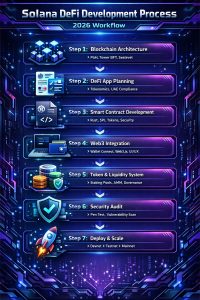
Step 1: Understanding Solana Blockchain Architecture
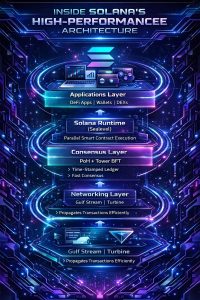
Before creating Solana DeFi apps and DeFi development services in UAE, developers must understand the underlying Solana Blockchain architecture that powers its speed and scalability. The core components include:
Proof-of-History (PoH)
Solana’s innovation—Proof-of-History—creates a cryptographic time-keeping system that sequences transactions before they enter the blockchain. This reduces node processing time and increases throughput.
Tower BFT
Solana uses an optimized version of PBFT (Practical Byzantine Fault Tolerance), which relies on PoH timestamps instead of communication-heavy consensus cycles.
Gulf Stream
A mempool-less transaction forwarding technique improves responsiveness and scalability.
Sealevel Parallel Runtime
Unlike Ethereum, which processes smart contracts one by one, Solana’s Sealevel executes thousands of smart contract instructions simultaneously — ideal for high-frequency DeFi operations like swaps, lending, staking, and liquidity farming.
Step 2: Designing the Solana DeFi Application
During this stage, businesses define:
- Core DeFi functionality
- Target user base
- Tokenomics structure
- Smart contract logic
- Liquidity mechanisms
- Compliance requirements in the UAE
Common types of Solana DeFi apps include:
-
Decentralized Exchanges (DEXs)
AMM-based trading with low fees and high-speed liquidity swaps.
-
Lending & Borrowing Platforms
Collateralized loans, staking pools, and yield farming ecosystems.
-
Synthetic Assets & Stablecoins
Tokenized fiat, commodities, or financial instruments.
-
Automated Yield Optimization Tools
Bots and smart contracts that auto-rebalance user portfolios.
Step 3: Building Solana Smart Contracts (Programs)
Solana DeFi apps rely on smart contracts, but unlike Ethereum’s Solidity, Solana smart contracts (called Programs) are developed using Rust, C, or C++.
Why Rust for Solana DeFi Development?
- Memory safety
- High performance
- Zero-cost abstractions
- Ideal for finance-grade applications
Developers use the Solana Program Library (SPL) to integrate ready-made modules like:
- Token creation
- Wallet interaction
- Liquidity pools
- Decentralized governance
- Staking and rewards
This speeds up development and ensures high security and interoperability. Also, to keep in mind are the wallet standards that define how these apply in general usage.
Launch a Future-Ready Solana DeFi App
Step 4: Integrating Web3 Frontend Components
Once Solana smart contracts are ready, developers integrate them with a user-friendly UI.
The common tools that help in Web3 development services include:
- Solana Web3.js — to interact with on-chain programs
- Phantom, Solflare, Ledger wallets — for authentication
- React or Next.js — for building responsive interfaces
Key integrations include:
- Wallet connection
- Transaction history
- Real-time token balances
- Smart contract instructions
This layer determines how users interact with your DeFi platform and DeFi data, making UI/UX crucial for adoption.
Step 5: Token Development & Liquidity Mechanics
Most Solana DeFi app development UAE require custom tokens — usually SPL tokens, comparable to ERC-20 tokens on Ethereum.
Token Features
- Minting/burning
- Staking rewards
- Governance voting
- Collateralization
Liquidity Management
Liquidity pools enable swaps and yield distribution. Solana’s low fees make it easier to attract liquidity providers.
Step 6: Security Audits and Penetration Testing
Security is the most critical aspect of DeFi development.
Audits include:
- Smart contract vulnerability testing
- Flash loan attack prevention
- Liquidity pool attack simulations
- Transaction replay protection
- Access control validation
Given the UAE’s regulatory focus, especially in Dubai’s Virtual Asset Regulatory Authority (VARA), compliance and user protection are essential.
Step 7: Deployment & Scaling
Deployment involves:
- Uploading Solana programs to the mainnet
- Testing on Devnet and Testnet
- Setting compute budgets
- Configuring RPC (Remote Procedure Call) nodes
- Enabling continuous monitoring dashboards
High-usage DeFi platforms in 2026 often require customized RPC nodes for performance optimization.
Solana DeFi Development Use Cases for UAE & Dubai in 2026
Blockchain adoption in Dubai and the UAE is growing through government initiatives and pro-innovation regulations. Solana blockchain is becoming a top choice for:
DeFi Payment Systems
Fast, low-cost payments for businesses and remittances.
Tokenized Real Estate Investments
Fractional property ownership and automated rental income distribution.
Islamic DeFi (Sharia-Compliant Products)
Halal yield-generating instruments built with transparency and automated governance.
Supply Chain Financing
Smart contract-enabled invoice factoring and vendor payments.
Techfyte can support all of the above through enterprise blockchain development services.
Scale Your Financial Innovation with Solana
FAQ: Solana DeFi Development
1. What makes Solana ideal for DeFi development?
Solana is ideal for DeFi development because it offers ultra-fast transactions, extremely low fees, and a highly scalable architecture. Its Proof-of-History consensus mechanism and Sealevel parallel runtime allow thousands of smart contract operations to run simultaneously, making it perfect for high-frequency trading, lending, staking, and liquidity platforms. Developers also benefit from Solana’s mature toolset, active ecosystem, and enterprise-friendly performance.
2. How much does Solana DeFi development cost in UAE?
Solana DeFi development costs in the UAE typically range from AED 35,000 to AED 300,000+ depending on the project’s complexity, features, smart contract security needs, integrations, and UI/UX requirements. Basic DeFi apps cost less, while DEX platforms, lending protocols, and liquidity engines require advanced development and auditing, increasing overall cost.
3. How long does it take to develop a Solana DeFi app?
The development time for a Solana DeFi app usually takes 8 to 24 weeks. Smaller applications with basic tokenomics and simple smart contracts can be delivered in 2–3 months, while complex DeFi platforms—such as DEXs, multi-chain bridges, lending platforms, or automated yield engines—require more time for development, testing, audits, and security optimization.
4. What tools are used for Solana smart contracts?
Solana smart contracts (Programs) are primarily built using Rust, along with essential tools such as:
- Solana CLI for local development and deployment
- Solana Web3.js for frontend integration
- Anchor Framework for structuring and testing programs
- SPL libraries for token management, staking, and liquidity modules
- Solana Program Library (SPL) for reusable DeFi components
These tools streamline development, testing, and integration for DeFi applications.
5. Is Solana suitable for enterprise-grade DeFi applications?
Yes. Solana’s high throughput, low-latency infrastructure, expandable architecture, and predictable transaction costs make it highly suitable for enterprise-grade DeFi apps. Its scalability supports millions of daily transactions, while strong security and parallel execution allow financial institutions, fintechs, and UAE-based enterprises to launch full-scale decentralized platforms with confidence.
For an in-depth technical breakdown of Solana’s architecture, you can also refer to our sister company’s high-performance Solana DeFi architecture guide.
Concluding Note
Solana’s high-speed architecture, low fees, scalable infrastructure, and robust developer ecosystem make it one of the most powerful platforms for DeFi development Dubai in 2026. Whether you want to build a DEX, a crypto lending platform, liquidity pools, tokenized financial products, or enterprise-grade DeFi applications, Solana offers unmatched performance and reliability. Businesses in the UAE, especially in Dubai’s rapidly growing fintech sector, can gain a strategic advantage by embracing Solana-powered decentralized finance solutions. For accurate Solana blockchain consultation, reach out to us.