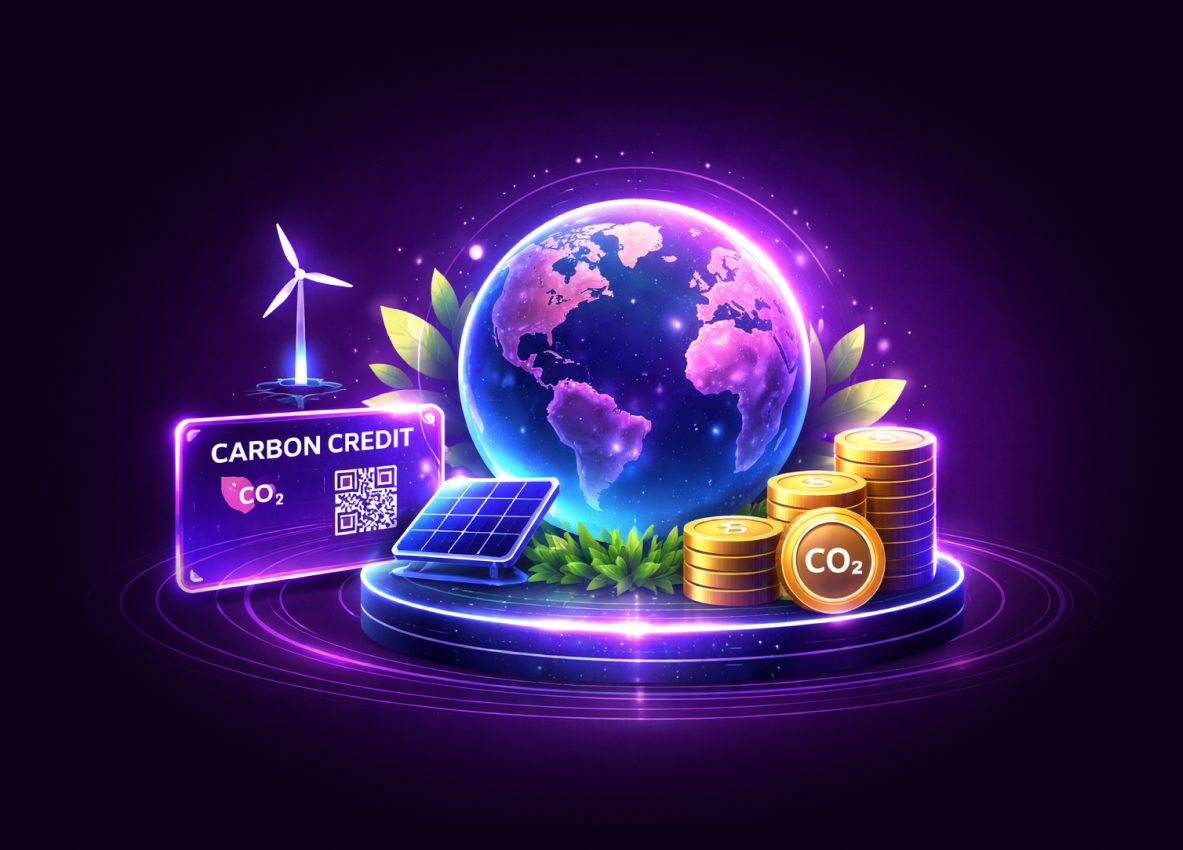
Carbon Credit Blockchain Development

Tokenized Carbon Credits for a Net-Zero Future

Launch decentralized carbon credit platforms that leverage smart contracts to tokenize, trade, and retire verified carbon assets. Techfyte enables future-ready climate finance solutions designed for Web3-native sustainability ecosystems.

  • On-Chain Environmental Assets
  • Decentralized Carbon Marketplaces
  • Interoperable Climate Tokens

Explore Carbon Platforms
Samsung
Swiggy
Hughes
Microsoft
PG
Stanford
Samsung
Swiggy
Hughes
Microsoft
PG
Stanford

What Is Carbon Credit Tokenization?

Carbon credit tokenization converts verified carbon credits into blockchain-based digital tokens. Each token represents a real, validated reduction or removal of greenhouse gases emitted into the atmosphere (GHG). Verified carbon credits are backed by verified greenhouse gas reductions, ensuring tracking, transparency, and reliability. Unlike traditional carbon markets, tokenized carbon credits are managed through the use of smart contracts on a distributed ledger, allowing for the seamless issuance, transfer, trading, and retirement of carbon credits on-chain without any intermediaries involved. In this new and improved model, not only is there enhanced efficiency and liquidity/market accessibility, but the environmental integrity of the carbon credits will also be maintained.

  • Carbon credits on-chain
  • Permanent verification record
  • Ownership is securely recorded on-chain
  • Transparent issuance and retirement
  • Audit-ready emissions tracking

Why Is Carbon Credit Tokenization Key to Business Strategy?

As sustainability commitments and regulatory pressures increase, organizations require reliable, transparent mechanisms to offset emissions and demonstrate climate accountability. Carbon credit tokenization introduces efficiency and credibility into environmental markets by reducing opacity and friction in credit ownership and transfer.

For enterprises, sustainability platforms, and climate-focused startups, tokenized carbon credits enable real-time visibility into environmental assets, improved capital efficiency, and seamless integration with digital finance ecosystems. Businesses can unlock new revenue models while supporting verifiable climate impact.

market-transparency

Improved market transparency

market-liquidity

Increased carbon market liquidity

counting-risks

Reduced double-counting risks

global-accessibility

Global accessibility and scalability

automated-complience

Automated compliance and reporting

Integrate Carbon Credit Tokenization into Your Business Strategy

Enhance transparency, streamline compliance, and unlock new revenue opportunities while supporting measurable climate impact.

Plan Your Tokenization Strategy

Value-Driven Benefits of Carbon Credit Tokenization

Carbon credit tokenization is revolutionizing the issuance, management, and trading of carbon credits by introducing transparency, speed, and global accessibility to the carbon credits industry.

expanded-market

Expanded Market Access

Fractional credits have lowered the barrier of entry allowing for greater participation across all sectors of the marketplace.

transparent

Transparent and Verifiable Impact

On-chain records of carbon credit transactions, including issuance and transfers, enable open auditing and provide verifiable data.

improved-liquidity

Improved Liquidity

Tokenized carbon credits facilitate seamless trading across digital marketplaces and allow for improved price discovery mechanisms.

faster-settlement

Faster Settlement and Lower Costs

Smart contracts facilitate the automation thereby eliminating transaction delays, intermediaries, and operational costs related to the trade.

automated-credit

Automated Credit Retirement

Retirement and removal of the tokens from the on-chain record permanently removes the associated carbon credit and prevents duplicate use.

regulatory-esg

Regulatory and ESG Readiness

Records are more secure than traditional paper-based systems, compliance with government regulations, auditing, and ESG reporting is cheaper.

interoperability

Interoperability Across Ecosystems

Seamlessly integrates with decentralized finance (DeFi) protocols, ESG platforms, and enterprise bookkeeping systems.

market-integrity

Stronger Market Integrity

Blockchain records make it feasible to reduce the likelihood of fraud and create greater trust within the carbon credit trading community.

How Does Carbon Credit Tokenization Really Work?

Tokenizing carbon credits merges environmental integrity through certification with automated blockchain.

01

Credit Verification & Certification

Credits are validated through established registries and standard methodologies.

02

Token Issuance Smart Contracts

Valid credits are created into digital tokens with metadata stored in the token.

03

Ownership & Transfer Logic

Smart contracts facilitate transfer of credits while maintaining the credit's absolute origin.

04

Marketplace & Trading Layer

Tokens can be exchanged on regulated or private trading platforms.

05

Retirement & Burn Mechanisms

When used for offset action, credits are permanently removed from the blockchain.

06

On-Chain Transparency

All events throughout the credit lifecycle are recorded in a way that cannot be changed.

07

Compliance & Policy Controls

Smart contracts dictate how credit/offset can be used, who can use it, and any regulatory obligations.

08

Integration & Data Oracles

Oracles can transmit verifiable information about credits from registries to other external locations in a secure manner.

Our Carbon Credit Tokenization Development Services

We provide carbon credit tokenization development services to help businesses design, create, and build blockchain-based carbon credit platforms that demonstrate environmental integrity.

token-supply

Carbon Token Architecture Design

We work closely with businesses to build custom token models that conform to registry standards and meet sustainability goals and build scalable and interoperable platforms.

smart-contract

Smart Contract Development & Auditing

We develop and review smart contracts to ensure they are secure and can be used for issuing, trading, and retiring carbon credits.

Registry

Registry & Oracle Integration

We integrate businesses carbon credit platforms with ORACLES and registries. This ensures that businesses have reliable data when making decisions regarding carbon credits.

expanded-market

Carbon Marketplaces & Trading Platforms

We provide businesses with a compliant B2B and B2C carbon marketplaces and trading platforms that include trading engines and access controls.

Compliance

Compliance & Risk Management

We create systems for businesses to prevent double-counting and fraud and to ensure they are compliant with applicable regulations.

maintanance

Ongoing Maintenance & Optimization

After launching a platform for a business, we will continue monitoring, upgrading, and improving the platform so it continues to perform reliably and consistently over time.

multi-chain

Cross-Chain Carbon Assets

By enabling multi-chain tokenization, we provide businesses with the opportunity to reach a larger audience and to ensure carbon credits can be easily traded across multiple platforms.

Analytics

Analytics & ESG Dashboards

Real-time dashboards are available for businesses to track their carbon use and to provide reports regarding ESG impact metrics through auditable means.

Carbon Credit Blockchain Solutions

Our solutions support diverse climate and sustainability use cases.

Carbon Marketplaces

Carbon Marketplaces

Climate Finance Protocols

Climate Finance Protocols

Offset Management Systems

Offset Management Systems

Sustainability Reporting Tools

Sustainability Reporting Tools

Green Asset Exchanges

Green Asset Exchanges

Partnering with Industries to Maximize Value from Carbon Credits

We enable businesses to manage and monetize carbon credits efficiently, creating transparent, auditable systems. This drives measurable climate impact while supporting long-term industry growth.

Manufacturing

Manufacturing

Tokenized systems make it easier for manufacturers to track emissions, manage credits, and maintain clear records across large-scale operations. Improved transparency and streamlined reporting help support sustainability goals without disrupting production efficiency.

  • Production of goods and materials
  • Factory and plant operations
  • Use of machinery and equipment
  • Large-scale industrial processes
Transportation

Transportation

Transportation companies generate emissions across fleets and logistics operations. Digital carbon credit systems help track impact, manage offsets, and support sustainability goals while maintaining efficient movement of people and goods.

  • Movement of people and goods
  • Road, rail, air, and sea transport
  • Logistics and delivery services
  • Fleet and travel operations
Agriculture

Agriculture

Farming and land-based activities produce measurable environmental impact across crops and livestock. Carbon credit systems support better tracking, encourage sustainable practices, and help farmers participate in climate initiatives.

  • Farming and crop production
  • Livestock and dairy operations
  • Food supply and processing
  • Land and resource management
Construction & Real Estate

Construction & Real Estate

Modern construction and real estate projects are moving toward more sustainable development models. Carbon credit systems enable clearer accountability and support responsible growth across buildings and infrastructure.

  • Building residential and commercial spaces
  • Infrastructure and development projects
  • Property ownership and management
  • Urban and land development
Technology & Services

Technology & Services

Technology and service providers manage large-scale digital and operational activities that contribute to emissions. Structured carbon credit management helps align sustainability goals with everyday business operations.

  • Software and digital services
  • IT and support solutions
  • Business service providers
  • Platform-based service delivery

Manufacturing

Manufacturing

Tokenized systems make it easier for manufacturers to track emissions, manage credits, and maintain clear records across large-scale operations. Improved transparency and streamlined reporting help support sustainability goals without disrupting production efficiency.

  • Production of goods and materials
  • Factory and plant operations
  • Use of machinery and equipment
  • Large-scale industrial processes

Transportation

Transportation

Transportation companies generate emissions across fleets and logistics operations. Digital carbon credit systems help track impact, manage offsets, and support sustainability goals while maintaining efficient movement of people and goods.

  • Movement of people and goods
  • Road, rail, air, and sea transport
  • Logistics and delivery services
  • Fleet and travel operations

Agriculture

Agriculture

Farming and land-based activities produce measurable environmental impact across crops and livestock. Carbon credit systems support better tracking, encourage sustainable practices, and help farmers participate in climate initiatives.

  • Farming and crop production
  • Livestock and dairy operations
  • Food supply and processing
  • Land and resource management

Construction & Real Estate

Construction & Real Estate

Modern construction and real estate projects are moving toward more sustainable development models. Carbon credit systems enable clearer accountability and support responsible growth across buildings and infrastructure.

  • Building residential and commercial spaces
  • Infrastructure and development projects
  • Property ownership and management
  • Urban and land development

Technology & Services

Technology & Services

Technology and service providers manage large-scale digital and operational activities that contribute to emissions. Structured carbon credit management helps align sustainability goals with everyday business operations.

  • Software and digital services
  • IT and support solutions
  • Business service providers
  • Platform-based service delivery

Turn Carbon Credits into Business Advantage

Maximize value from carbon credits by improving tracking, offsets, and sustainable growth.

Maximize Carbon Impact

Tokenized Carbon Credit System Development Flow

Our methodology is designed to provide users with seamless token architecture as well as execute smart contract transactions and incorporate analytics into a reliable carbon credit platform.

Strategy & Sustainability Modeling

Strategy & Sustainability Modeling

We develop an effective tokenization framework by reviewing your environmental objectives, necessary compliance requirements, and sources of carbon credits.

01
02

Development & Smart Contract Implementation

We build and validate your token contracts based on secure verification integrations and trading logic while keeping scalability in mind.

Development & Smart Contract Implementation
Deployment & Ongoing Support

Deployment & Ongoing Support

We ensure availability after your platform launches to monitor, update, and optimize as the volume of transactions and adoption grows.

03

Why Choose Techfyte for Carbon Credit Tokenization Company?

Techfyte is a carbon credit tokenization solution provider that focuses on transparency, compliance with regulations, and integrity. We will help businesses take advantage of the emerging market for digital carbon credits.

Deep Climate & Blockchain Expertise

Deep Climate & Blockchain Expertise

We have extensive operational experience with multiple sustainability platforms, token standards, and environmental data systems. Thus, we can deliver technically accurate carbon credit tokenization solutions.

Security & Integrity First

Security & Integrity First

By ensuring appropriate smart contract development, auditing, and packaging processes, we can guarantee that you can trust and rely on your carbon credit tokenization platform.

Full Lifecycle Support

Full Lifecycle Support

Techfyte supports your carbon credit tokenization project from initial certification to full compliance, ensuring a scalable, future-ready, and sustainable platform.

Carbon Credit Tokenization FAQs

Carbon credit tokenization refers to the conversion of authenticated carbon credits into digital tokens built upon blockchain technology. The benefit of this change is that it provides an opportunity for easy ownership, trading, retirement and full traceability of carbon assets in the global market.

By using mechanisms such as on-chain retirement, immutable audit trails and transparent record keeping, double counting is addressed, which means that every carbon credit can only be used once and is fully traceable.

Timeframes for delivering a carbon tokenization platform vary with factors such as complexity of the platform, number of integrations needed or additional custom features. However, most projects can be completed within a matter of months with continued support for maintenance, optimization and scalability.

When appropriately designed tokenized carbon credits can meet compliance & legality due to their alignment with existing carbon registry standards, international regulations & ESG reporting frameworks.

Tokenized carbon credits can be used by enterprises in pursuit of ESG objectives, sustainability initiatives & compliance. Tokenized carbon credits allow businesses to deliver a verified measurable climate impact effectively.