Key Takeaways:
- Core Value: A transparent and secure AI model that distributes data ownership, governance, and intelligence across networks.
- Comprehensive Services: End-to-end capabilities covering data sharing, AI model marketplaces, compute infrastructure, and token incentives.
- usiness Benefits: Reduced centralized risk alongside improved trust, compliance, and scalable collaboration.
- Industry Use Cases: Real-world adoption across finance, healthcare, logistics, gaming, IoT, and digital economies.
- Future Trends: A foundational layer for Web3, autonomous agents, and tokenized intelligence with cloud computing.
Artificial intelligence is in a shift to a new era; while significant advances are being made with AI technology and its functions. A rising concern exists over the ownership of data, centralized control of data, non-transparency of models and monopolising power associated with AI. To address these issues, the development of decentralized AI platforms is growing rapidly. Decentralized AI combines blockchain, distributed computing, and machine learning to remove centralized control.
By 2026, decentralized AI is expected to become foundational infrastructure for Web3 applications and autonomous agents and next generation digital economies. In this blog post we discuss the top decentralized AI platforms emerging by 2026, their functionality, usage and importance in applications for both businesses and developers.
What Is a Decentralized AI Platform?
Decentralized AI platforms are ecosystems where AI models, data, and compute are built and shared across distributed networks without centralized control.
These platforms distribute the ownership and decision-making power for AI across a worldwide network as opposed to a few large corporations controlling multiple AI Platforms.
The platforms provide access to decentralized Web3 AI platforms, blockchain AI platforms, decentralized Web3 token incentives, and decentralized distributed computing networks to enable collaborative, secure and open, and machine learning solutions. Many decentralized machine learning platforms support the real-world use of decentralized AI through their own digital marketplaces for buyers and sellers to exchange data, models and services.
Contributors (developers, data providers and node operators) who support modern AI crypto projects using decentralized AI platforms are rewarded appropriately in crypto for their contributions.
Overall, they create transparency, collaboration, resiliency and fairness for all participants in the ecosystem, thus influencing the future direction of decentralized AI.
Why Decentralized AI Is Gaining Momentum in 2026
In 2026, multiple trends are coming together to make decentralized AI projects more appealing to those wishing to develop new types of applications or systems. As these projects move forward from experimental concepts to real-world implementations, there are several factors driving their momentum.
1. Centralized AI Risks
All of the centralized models of AI have created many risks in terms of both trust in the technology and transparency of the data. When one organization holds all of the data needed to train and deploy an AI system, the ability to trust in the system becomes limited and the resilience of the AI-based applications becomes very fragile. Developers and businesses are now looking at decentralized machine learning platforms to reduce the amount of systemic risk due to the limitations of centralized models of AI.
2. Web3 Infrastructure Maturity
The development of improved scalability in blockchain technology, efficient decentralized storage solutions and interoperability between various protocols, has made AI-based platforms on the Web3 infrastructure much more viable. Improvements in network speeds, reductions in transaction costs, and an increase in tooling have enabled AI platforms on the blockchain to provide a more effective way for multiple parties to collaborate on building models and for secure data exchanges.
3. Tokenized Incentives
Through providing effective crypto-economic models to incentivize data sharing, model training, and validation, large-scale innovation across AI-based projects is occurring at an unprecedented rate today. This is achieved by aligning rewards with meaningful contributions from participants and creating decentralized networks that naturally scale.
4. Rise of Autonomous AI Agents
AI agents perform their functions in an independent manner and therefore can only coexist within a decentralized environment to eliminate potential bottlenecks in control. The decentralized infrastructure allows independent AI agents to interact with each other, coordinate and complete their function without having to use an intermediary.
5. Regulatory & Trust Pressures
Decentralization creates greater auditability and the ability for users to control their own data, which is in response to the increasing number of pressures around regulation, compliance, and trust. Providing transparency in governance and verifiable usage of data builds trust with end users, enterprises, and regulators.
These two drivers combined will lead to decentralized AI becoming an integral part of the digital infrastructure ecosystem by 2026.
Key Features of Decentralized AI Platforms
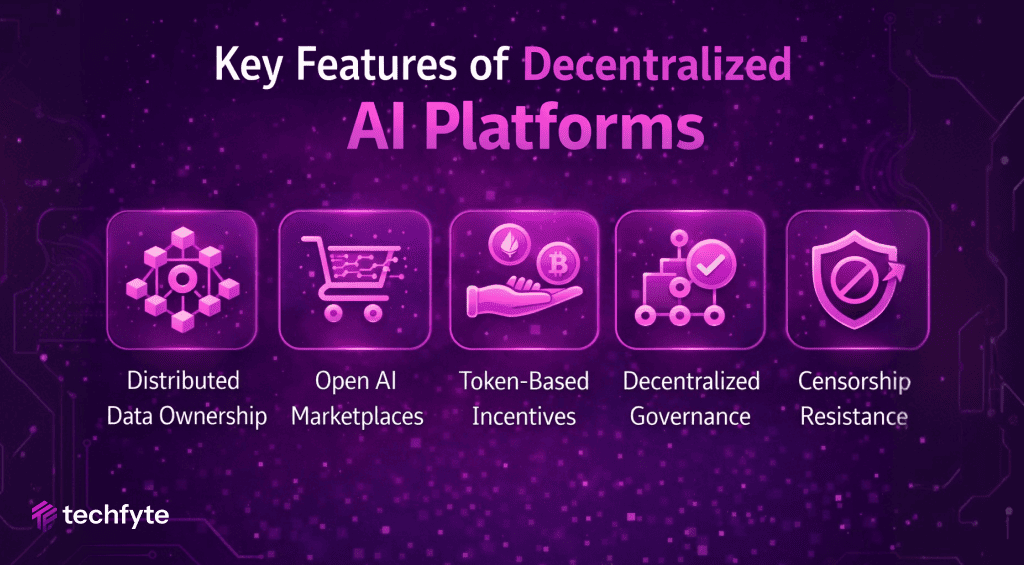
While the specifics of individual implementations differ, there are also many attributes that typically characterize most blockchain or decentralized AI applications:
Distributed Data Ownership
Instead of yielding total control over one’s information to centralized entities, users have the ability to retain ownership of their data by either sharing, selling or keeping it private, but still benefitting machine learning applications that are decentralized.
Open AI Marketplaces
Users of such solutions can buy, sell, or license various models, datasets and machine learning services from each other via an Open AI Marketplace. This facilitates the collaboration of developers globally and the realization of diverse use cases within multiple industries.
Token-Based Incentives
All major networks utilize their own native tokens to incentivize users to participate truthfully, provide high-quality models, and help to secure the network. These economic incentives have fueled the growth and development of multiple leading AI crypto networks.
Decentralized Governance
Users can collectively influence the future direction and policy choices of the network by participating in decentralized autonomous organizations (DAOs) and voting that is recorded on the blockchain. This mechanism for decentralization allows for the transparency of how decisions are made regarding the ongoing evolution of decentralized AI applications.
Censorship Resistance
Since there is no entity that has the authority to alter or influence the decision-making process of a decentralized network, users of such platforms are protected from arbitrary network shutdowns, restriction of access to their information, or interference with the use of the network’s machine learning models. Therefore, many people believe decentralized AI networks will provide a more reliable source of intelligence and an environment where such networks can be trusted.
The combination of these five characteristics results in the establishment of large-scale, trust-minimized ecosystems for AI applications which ensures the continued growth and development of decentralized AI.
Top Decentralized AI Platforms to Watch in 2026
In this section, you will find a number of leading decentralized AI projects being developed in the present day that are also shaping the future of top Web3 AI projects.
1. SingularityNET: One of the earliest and arguably the most successful and certainly the most recognized are Singularity NET which is a global marketplace for AI services.
Key Features
- Global AI service marketplace
- Interoperable AI agents
- Cross-chain supportUse Cases
- AI APIs for Enterprises
- Robotics/automation
- Healthcare diagnostics
Why It Matters
SingularityNET enables open, collaborative AI development at scale, making it a key pillar of the decentralized AI ecosystem. |
2. Fetch.ai: The Fetch.ai project enables autonomous economic agents to perform tasks automatically, negotiate with one another and optimize processes independent of any central authority.
Key Features
- AI agents
- Decentralized coordination layer
- Automated smart contractsUse Cases
- Smart cities
- Optimizing supply chains
- Automating DeFi Investment strategies
Why It Matters
Fetch.ai enables the connection of existing, ‘real world’ computer systems to distributed, autonomous (non-human) intelligent systems to deliver real business value and therefore are key to all future decentralized AI use cases.
3. Ocean Protocol: Ocean Protocol allows individuals to share data while remaining secure and private.
Key Features
- Tokenized data assets
- Compute-to-data privacy model
- On-chain data marketplacesUse Cases
- Training AI models
- Monetizing enterprise data
- Healthcare and research
Why It Matters
Data is the fuel powering AI and using Ocean Protocol. It alleviates one of the largest bottlenecks in providing decentralized AI to companies looking for solutions through machine learning.
4. Numerai: Numerai is a global hedge fund that provides funding based on the predictive abilities of data scientists using artificial intelligence models.
Key Features
- Tournament-based model staking
- Cryptographic model evaluation
- Incentive-aligned predictionsUse Cases
- Quantitative finance
- Crowdsourced machine learning solutions
Why It Matters
Numerai is a model for proving the superiority of decentralized AI compared to traditional, centralized approaches in environments with a high degree of risk and potential for loss.
5. Bittensor: Bittensor’s peer-to-peer network enables competition and collaboration of AI models.
Key Features
- Proof of intelligence
- Ranking and rewarding of models
- Open participation in the networkUse Cases
- Language models
- Knowledge networks
- Research collaboration
Why It Matters: Bittensor is significant because it provides a new way of measuring and rewarding intelligence, which is central to the future of decentralized AI.
6. Gensyn:
Gensyn focuses on decentralized GPU compute for AI training and inference.
Key Features
- Distributed marketplace for compute
- Verifiable of ML training process
- Cost-efficient scalingUse Cases
- Large model training
- AI startups and researchers
Why It Matters
Gensyn addresses the scarcity of compute resources, a major bottleneck in AI, by decentralizing them.
7. Cortex:
Cortex integrates AI models directly into smart contracts.
Key Features
- On-chain AI inference
- dApps enhanced by AI
- Deterministic executionUse Cases
- Predictive DeFi
- AI-powered NFTs
- Automated decision systemsWhy It Matters
Cortex expands the capabilities of smart contracts by combining logic with intelligence.
Comparison of Leading DeAI Platforms
| Platform | Primary Use Case | Token | Key Strength |
|---|---|---|---|
| SingularityNET | AI services marketplace | AGIX | Open AI economy |
| Fetch.ai | Autonomous agents | FET | Real-world automation |
| Ocean Protocol | Data sharing | OCEAN | Secure data monetization |
| Numerai | Financial AI | NMR | Incentive-aligned ML |
| Bittensor | ML networks | TAO | Proof of intelligence |
| Gensyn | AI compute | GENSYN | Scalable training |
| Cortex | On-chain AI | CTXC | AI smart contracts |
Real-World Use Cases of Decentralized AI
Decentralized AI platform applications already have a positive impact in a number of industries:
- Financial Services: Fraud detection, automatic trades, risk modelling.
- Healthcare: Privacy-Protected Diagnostics & Research.
- Supply Chain Management: Predictive Logistics/Optimization
- IoT and Smart Cities: Autonomous/coordinated resource usage.
- Creative AI: Decentralized content creation, royalties paid on an ongoing basis.
- Real Estate: Fractional ownership, liquidity via tokenization
- Sustainability: Carbon credit tracking and tokenized environmental assets
These examples demonstrate tangible examples of how to use Decentralized AI, in use cases users will be able to see beyond just theory.
Benefits of Decentralized AI Platforms
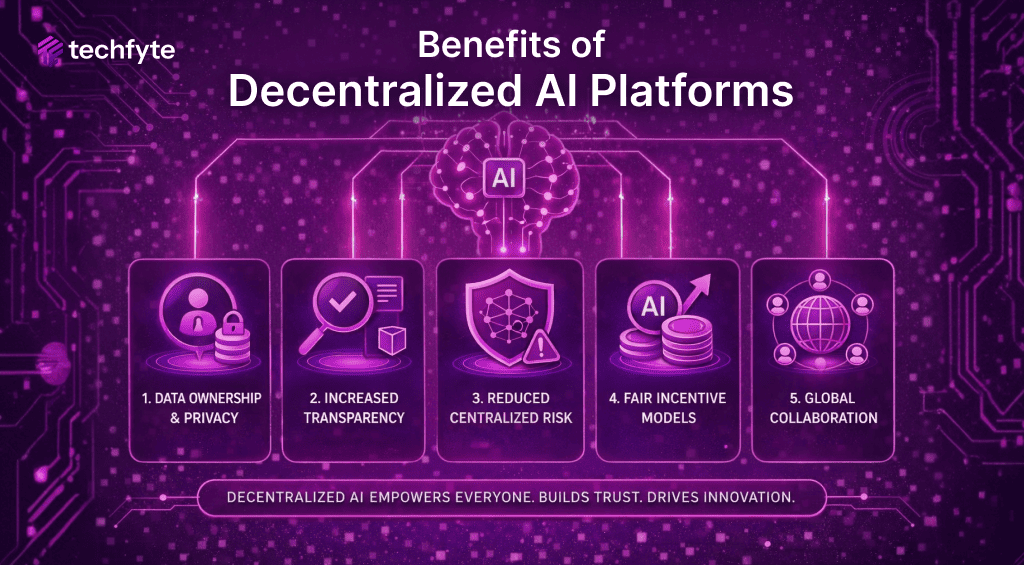
There are numerous advantages of AI platforms which bring together AI through the use of Blockchain technology (this means everything is created with respect for the communities involved). Here are some of those main benefits:
- Data Ownership & Privacy
Through using an AI platform, users keep their own data instead of giving it up to a centralized third-party. This means there is little chance of sensitive data getting into the wrong hands or having an issue due to the fact that all processing and storage will be done off-chain.
- Increased Transparency
AI models, how they are trained, decision-making logic, and overall use of them can all be audited with a blockchain. This will eliminate the “black-box” phenomenon that many people associate with AI and build confidence in this technology.
- Reduced Centralized Risk
A decentralized AI platform’s use of distributed computing and data storage will have no single points of failure, eliminating the risk of data manipulation and/or censorship concerns.
- Fair Incentive Models
The AI platform utilizes token-based incentives to reward data providers and model developers and compute providers creating balanced, sustainable AI ecosystems.
- Global Collaboration
Developers and organizations from all over the globe can support and provide contributions in the form of models, datasets, and computing resources without requiring centralized approval.
Challenges of Decentralized AI Adoption
There are a number of challenges related to the adoption of decentralized AI even though it has great promise. Some of these challenges include scaling limitations, difficult user onboarding experiences, regulatory uncertainty, performance trade-offs, and a lack of interoperability between the different platforms they operate on.
However, rising innovation throughout the ecosystem and AI crypto projects must continue making steady progress toward addressing all of these challenges. Advances in infrastructure, usability and cross-chain integration are propelling towards real-world, scalable use cases.
Future of Decentralized AI Platforms
The next phase of decentralized AI will be defined by:
AI Agents: Autonomous agents that operate in networks without centralized control.
Tokenized Intelligence: AI models as assets on-chain that are measurable in value.
IoT & Edge Integration: AI running on devices located at the network edge.
Market Growth: Industry analysts anticipate a dramatic rise in blockchain AI platform usage due to companies beginning to adopt it.
Decentralized AI is expected to be as foundational as cloud computing was.
Decentralized AI Development Services
The growing acceptance of AI is motivating companies to find partners that can help them develop and implement these new technologies. Development services now span the entire range of devolved AI capabilities from building Web3 based platforms for AI to deploying ML model instances:
- DeAI architecture custom to your organization
- Blockchain integration
- Training & deploying AI models
- Designing tokenomics for use in your environment
- Develop security and governance policies/protocols
For organizations that are looking to prepare their AI strategy for the future, investment into decentralized AI development is quickly becoming a necessary component for remaining competitive in today’s marketplace.
To Sum Up
The ongoing evolution of AI is raising an emergence of a wide range of new ways for AI to be created, controlled, and utilized in society. By 2026, decentralized AI initiatives will represent the heart of Web3 AI solutions, blockchain-based AI solutions, and decentralized machine-learning ecosystems. This will create an opportunity for consumers globally to have a clear understanding of how their data will be used. There are many AI-based crypto projects that provide funding to autonomous agents along with other real-world examples. These examples are transitioning from proof-of-concept to actual economic impact. The future will be driven by collective collaboration, tokenized intelligence, and trust-minimized networks, as such, early investment in leading Web3 AI solutions will not only be a breakthrough technological opportunity for customer-facing businesses/developers, but also a powerful competitive advantage.
Frequently Asked Questions (FAQ)
What are decentralized AI platforms?
Decentralized AI platforms are ecosystems of Artificial Intelligence technologies developed via the use of distributed networks and blockchain technology and are free from centralized control.
Which are the top decentralized AI projects in 2026?
Some of the most notable AI projects in 2026 are : SingularityNET, Fetch.ai, Ocean Protocol, Numerai, Bittensor, Gensyn, and Cortex.
How does blockchain support AI development?
Blockchain allows AI systems to be created in a secure manner by enabling proper coordination between parties, providing benefits for participation in an AI system. This is through transparent incentives, enabling data ownership, and providing a way of establishing decentralized governance of the AI system.
Are decentralized AI platforms secure?
The platforms are secure; when created properly, they enhance security through cryptography, distributed validation of process results, and by minimizing the potential for a single point of failure.
What industries can benefit from decentralized AI?
Decentralized AI would benefit finance, healthcare, logistics, IoT, smart cities, gaming, and other creative fields.
How can businesses build decentralized AI solutions?
Businesses can partner with companies that specialize in AI development to assist them in the design of an architecture, integration of blockchain technology, and deployment of scalable AI models.