



Key Takeaways
- Core Concept: Blockchain derivatives are financial contracts whose value depends on underlying crypto or tokenized assets, executed via smart contracts without middlemen.
- How They Work: Platforms like GMX, dYdX, and Hyperliquid integrate collateral management, pricing, and liquidation automatically, enabling fast, secure, and transparent trading.
- Types & Uses: Includes futures, perpetual swaps, options, and synthetic assets. Used for hedging, yield strategies, arbitrage, and institutional trading.
- Benefits: DeFi derivatives improve capital efficiency, composability, transparency, and 24/7 market access while reducing counterparty risk.
- Future Trends: Growth will come from on-chain equities, tokenized RWAs, full trade lifecycle automation, cross-chain liquidity, institutional adoption, ZK scaling, and regulated access layers.
What are Derivatives?
To get a better grasp of what derivatives are in blockchain, start with the basic idea that a derivative is a financial contract whose value is based on an underlying asset like Bitcoin, Ethereum, or even real-world assets that have been tokenized. These tools are similar to futures, options, and swaps, except they use smart contracts instead of brokers and are carried out on decentralized networks.
The structure is still comparable to how things work in traditional finance. For instance, a wheat farmer can lock in prices on the CME (Chicago Mercantile Exchange) by using futures. A trader can do the same thing with Bitcoin perpetuals on sites like dYdX. The main difference is how things are done. DeFi uses code and collateral-backed mechanisms instead of middlemen.
Blockchain development derivatives fix big problems with traditional markets:
- Counterparty Risk: Gone with collateral up front
- Settlement Delay: Went down from T+2 cycles to about 12 seconds
- Opacity: Gone, replaced by complete on-chain transparency
This change is shown by adoption. According to crypto derivatives market data, monthly trading volume exceeds $3 trillion, far surpassing spot markets. This shows how derivatives are becoming more important in the DeFi ecosystem because of the need for leverage and hedging.
How DeFi Derivatives Work
To understand how smart contracts make derivatives trading possible, you need to look at how different parts work together in real time. Platforms like GMX, dYdX, and Hyperliquid integrate collateral management, pricing, and liquidation into a single automated system, representing advanced DeFi development services in practice.
Audited Smart contract systems work as both a custodian and an execution engine at the foundation layer. For example, when a trader puts 1,000 USDC into a GMX vault, the contract locks the collateral and figures out the size of the position based on leverage. A 10x trade instantly makes a $10,000 position, which is tracked completely on-chain.
It is very important for oracles to keep prices accurate. Chainlink, Pyth, and Redstone are examples of networks that collect data from many exchanges and send it to smart contracts. This makes sure that the prices of derivatives are based on real market conditions. Problems in this layer, such the bZx hack in 2020, show how important oracle integrity is to the system.
Liquidation makes sure that the whole system is solvent. This is the formula that governs it:
Liquidation Price = Entry Price × (1 ± 1 / Leverage × Collateral Ratio)
There are five steps to liquidation:
- The trader puts down 1.5 ETH (about $3,000) as collateral.
- Starts a long position of 10x at $2,000
- The size of the position is now $30,000.
- Price lowers and margin goes below the limit of about $1,850.
- Liquidators seal the deal and get a fee of 1% to 2%.
Liquidators are either bots or traders who are paid to keep the system stable. Their presence guarantees that no position is undercollateralized.
The last step is settlement. Clearinghouses like DTCC are used by traditional systems, which might take days to finish trades. On the other hand, DeFi settles in seconds. Once a transaction is confirmed, it is final and can’t be changed or contested.
Types of Crypto Derivatives
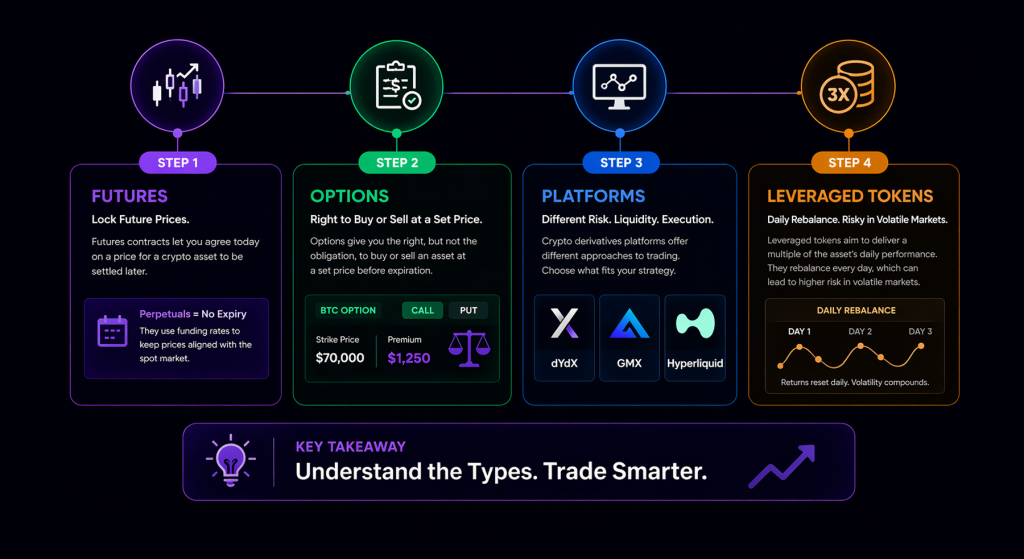
The types of crypto derivatives futures options swaps mirror traditional markets but are adapted for blockchain execution.
- Future Contracts: Futures contracts let traders agree on a price for a future date. A trader depositing $5,000 on the dYdX derivatives exchange can control a significantly larger leveraged position using perpetual contracts. But perpetual swaps are the most popular type of exchange in the crypto markets. These contracts don’t have an end date; instead, they use funding rates to stay in line with market pricing. For instance, if Bitcoin is trading above spot, longs may pay shorts 0.01% every 8 hours.
- Options: Options provide traders more freedom since they give them the right, but not the responsibility, to buy or sell an asset at a certain price. The Synthetix protocol pioneered synthetic assets, enabling users to gain exposure to assets like Tesla stock without directly owning them.
- Platforms: The architecture of decentralized derivatives trading platforms such as dYdX, GMX, and Hyperliquid significantly impacts risk, liquidity models, and execution efficiency.
- Leveraged tokens: Leveraged tokens are different from perpetuals since they rebalance every day, which might cause them to lose value in markets that are volatile. On the other hand, perpetuals keep their exposure going through funding rates.
Benefits of Blockchain Derivatives
The benefits of DeFi derivatives over traditional finance come from changes to the structure that go beyond just making things work better. By getting rid of middlemen and putting logic directly into smart contracts, these systems change how trade, collateral, and settlement work. They provide a more open, cost-effective, and accessible financial environment than traditional derivatives markets.
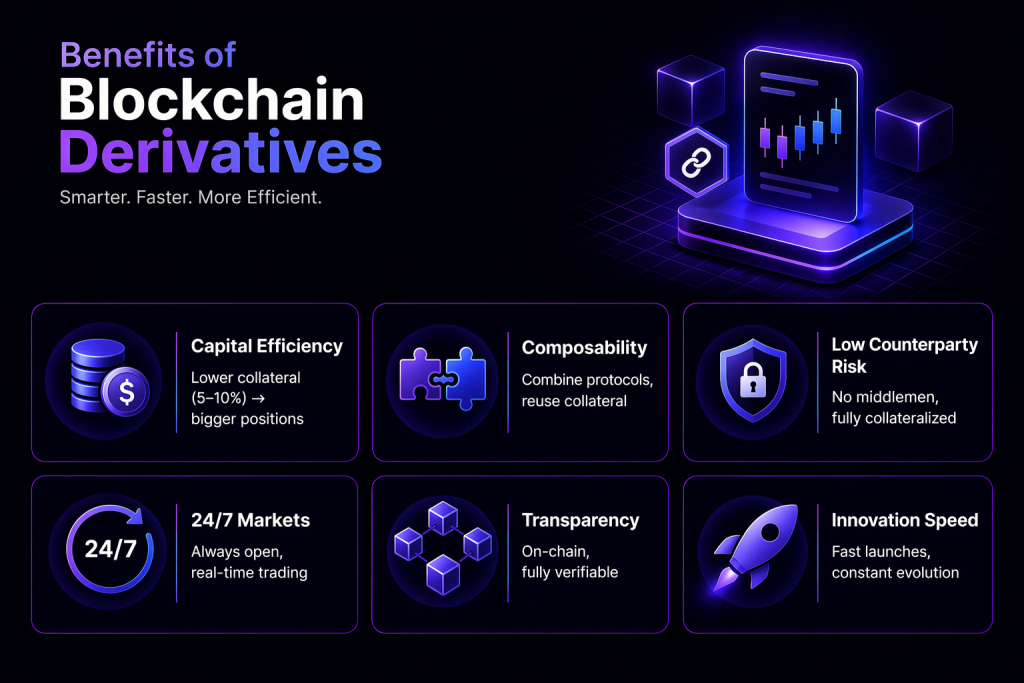
- Capital Efficiency
- Traditional markets require 15–20% margin, while DeFi allows 5–10% collateral
- Lets traders oversee bigger positions with less money
- Lower margin requirements make better use of funds.
- Continuous liquidation procedures lower the risk to the system as a whole.
- Traders can better manage their exposure.
- Composability
- Users can put together different DeFi protocols into one plan.
- For example, you can stake ETH to get stETH, which you can then use as collateral for derivatives.
- Put staking and trading together in one flow
- Use collateral on more than one platform
- Create complex, tiered financial plans
- Reduced Counterparty Risk
- Takes away the need for middlemen like brokers or clearinghouses
- There is no possibility of a broker going bankrupt, unlike with Lehman-type disasters.
- Positions are fully backed by collateral.
- No rehypothecation of user funds
- 24/7 Markets
- DeFi markets never close, unlike traditional exchanges.
- Trading is always available across time zones.
- Immediate response to global macro events or changes in the market
- Transparency
- On-chain, you can see all positions and transactions.
- Public access to levels of collateral and liquidations
- Financial activity that can be checked and verified
- Innovation Velocity
- You can quickly launch new financial solutions.
- Faster testing than in traditional finance
- Derivatives models and use cases are always changing.
Real-World Use Cases
The blockchain-based financial derivatives use cases go much beyond only short-term trading and betting. More and more people are using these products as useful financial tools for managing risk, making money, and getting into other markets. As DeFi infrastructure gets better, derivatives are becoming necessary for both individual traders and institutional participants to make the most of their capital and keep their risk in check.
Hedging:
A Bitcoin miner that makes 500 BTC a month can short BTC everlasting contracts to set a price that won’t change. This makes sure that the company always makes money, no matter how the market changes. This is like how commodity producers protect themselves in traditional markets.
Yield Strategies:
Traders use delta-neutral tactics on platforms like GMX by holding ETH and shorting ETH perpetuals at the same time. This lets them make money while keeping their exposure to price changes to a minimum.
Synthetic Market Access:
Users can trade things like Tesla shares (sTSLA) without having to open a brokerage account thanks to protocols like Synthetix. This gives people all over the world direct access to conventional markets through DeFi.
Arbitrage:
When exchanges don’t charge the same prices, it opens many opportunities. For instance, if BTC is worth $60,500 on Binance and $60,300 on dYdX, traders can make money by trading between the two exchanges.
Institutional Trading:
Companies like Jump Crypto and Wintermute use DeFi derivatives to provide liquidity, make markets, and take advantage of price differences. This makes the market deeper and more efficient.
Tokenized RWAs as Collateral:
Platforms like Centrifuge RWA Platform and Ondo Finance use asset tokenization to bring real-world assets such as invoices and Treasury bills on-chain, enabling their use as collateral in derivatives trading.
74% Market Gap (Equities):
Research shows that equities derivatives are a 74% untapped market opportunity, which means that on-chain derivatives in traditional asset classes have a lot of room to develop.
DeFi vs Traditional Derivatives
The two systems have very different ways of charging for things. Traditional derivatives include a lot of middlemen, which means fees of 0.1% to 0.5%. On the other hand, DeFi platforms usually have cheaper rates.
Assumptions about trust also differ. Traditional systems depend on institutions such as CME and DTCC, which are supported by rules and regulations. Smart contracts and openness are what DeFi is based on.
| Feature | DeFi Derivatives | Traditional Derivatives |
|---|---|---|
| Access | Permissionless | Restricted |
| Settlement | Instant | T+2 |
| Transparency | On-chain | Opaque |
| Custody | Self-custody | Broker |
| Trading Hours | 24/7 | Limited |
| Regulation | Fragmented | Structured |
| Asset Access | Crypto + synthetics | Multi-asset |
| Bankruptcy Recourse | None | SIPC/FDIC |
Risks and Challenges
Blockchain derivatives provide new types of risk that need to be well understood.
- One of the major worries is still smart contract weaknesses. The Bybit exploit in 2025, widely covered as a reported major crypto exchange exploit, highlighted how infrastructure weaknesses can lead to billion-dollar losses.
- There are other concerns that are specific to each platform. Hyperliquid lost over $4 million because of trade imbalances, which shows that even complex systems can be affected.
- Another big risk is manipulating Oracle. In low-liquidity situations, attackers can change price feeds, which might lead to wrong liquidations.
- When liquidity is fragmented, it spreads capital across many platforms, which makes the market less deep and increases slippage.
- When prices change quickly in markets with minimal liquidity, this is called gap risk, and it can lead to unanticipated losses.
- Regulatory arbitrage makes things less certain because different places have different rules.
- There are also other concerns, like as MEV, where validators change the order of transactions to make money, and crypto shadow banking, where uncontrolled financial activity creates systemic risk like it did before 2008.
Future of Derivatives in Web3
Blockchain derivatives will change in the future as they become more connected to traditional finance, have better infrastructure, and more institutional capital comes in. What we see today is still early-stage experimentation, but it’s apparent that derivatives are becoming the main way to execute Web3 finance, not just a way to trade.
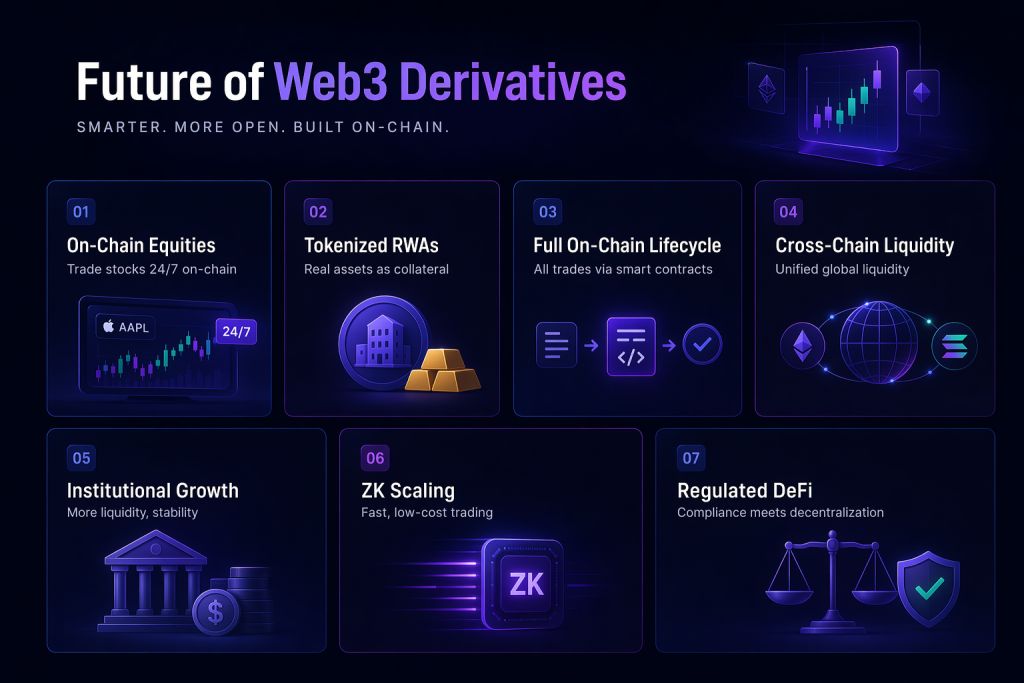
The following are the main trends that will shape this change:
1. On-Chain Equities
One of the biggest changes will be that derivatives will go from crypto to stock markets around the world.
Geography, brokerage accounts, and rules make it hard to buy equities like Tesla or Apple today. With Web3, perpetual contracts on stocks can get rid of these limits completely.
- Users will be able to trade stock exposure through perpetual swaps, which are akin to BTC or ETH perps.
- No need for brokers, custodians, or market hours
- Markets are open all the time and all around the world.
Instead of opening a brokerage account, a customer might just link a wallet and trade a Tesla perpetual on a protocol like dYdX. Oracle networks like Pyth or Chainlink would keep the prices up to date.
This makes stocks programmable financial tools that anybody with an internet connection can use.
2. Tokenized RWAs as Collateral
Real-world assets (RWAs) are becoming one of the most essential parts of the next generation of DeFi derivatives. Platforms focused on asset tokenization allow you to convert traditional financial instruments into blockchain-based tokens.
Protocols like Centrifuge, Maple, and Goldfinch are already making tokens:
- Corporate invoices
- Private credit
- US Treasury bills
People can utilize these assets as collateral for derivatives trading, which connects traditional finance with DeFi.
For instance:
- A user puts tokenized US Treasuries into Ondo
- Uses them as security on a derivatives platform
- Starts a leveraged ETH stake
This brings in:
- Collateral with less volatility than crypto
- Leverage arrangements that are more stable
- Risk frameworks for institutions
Over time, this will greatly lessen the need for unstable crypto collateral like BTC or ETH.
3. Full Trade Lifecycle Tokenization
In conventional finance, a single derivatives trade has many levels:
- Execution (exchange)
- Clearing (clearinghouse)
- Settlement (custodian)
- Reporting (regulators)
This whole lifecycle is coming together in Web3 into one smart contract system.
- Trade execution happens on-chain
- Margin is managed automatically
- Settlement is instant
- Reporting is inherently transparent
This gets rid of:
- Delays in reconciliation
- Extra costs of running a business
- Dependencies on the other party
The end result is a fully automated financial stack, where programming takes care of the whole process, from starting a deal to settling it.
4. Cross-Chain Liquidity
One of the problems with DeFi derivatives right now is that liquidity is spread out over different chains and platforms.
For instance:
- ETH perps on Arbitrum (GMX)
- BTC perps on dYdX V4 on Starknet
- Liquidity is spread out throughout ecosystems.
Future infrastructure will make it possible to combine liquidity from several chains, which will:
- Order books that work together across chains
- More efficient pricing
- Less slippage
These are some of the technologies that are making this happen:
- Protocols for cross-chain messaging (LayerZero, Wormhole)
- Layers of shared liquidity
- Chains that work with apps
This will turn derivatives markets from small, separate pools into networks of liquidity that are connected all over the world.
5. Institutional Adoption
One of the most significant things that helps growth is institutional participation.
Companies like Jump Crypto, Wintermute, and Cumberland are already working with DeFi derivatives. But compliance, custody, and risk standards make it harder for more people to use it.
As infrastructure gets better:
- Institutions will be able to use on-chain derivatives that have compliance layers.
- Custody solutions will get better (for example, Fireblocks and MPC wallets).
- Risk models will be more in line with existing norms.
This will bring:
- More liquidity
- Narrower spreads
- Markets that are more stable
Over time, DeFi derivatives could create a separate institutional market that competes directly with CME and other established exchanges.
6. ZK Scaling for Derivatives
Scalability is very important for trading derivatives because it needs to be able to handle a lot of transactions quickly.
This is where Zero-Knowledge (ZK) rollups come in.
Things like these:
- dYdX V4
- Hyperliquid
are putting together systems where:
- Thousands of exchanges happen off-chain.
- Proofs are sent on-chain to be checked.
- Maintaining security without giving up speed
This makes it possible:
- Performance of a near-centralized exchange
- Less expensive transactions
- Guarantees for on-chain settlement
ZK scaling will make it possible to conduct derivatives markets for institutions entirely on-chain.
7. Regulated DeFi Derivatives
Regulation isn’t going away; it’s changing.
The next step for DeFi derivatives will probably be regulated access layers, which include
- On-chain identity systems help users finish KYC.
- Institutions engage with pools that they have permission to use.
- At the protocol level, compliance is built in.
This makes a mixed model:
- Compliance on the front end (KYC, AML)
- Decentralization of the back end (settlement, smart contracts)
These kinds of systems will let
- Banks and hedge firms can take part
- Regulatory alignment between different areas
- Less legal uncertainty
DeFi won’t get rid of regulation; instead, it will take it in and add it to code.
Frequently Asked Questions (FAQ)
1. In the world of blockchain technology, what are derivatives?
Blockchain derivatives are financial contracts whose value comes from a cryptocurrency or tokenized asset. Smart contracts carry out these contracts, so there is no need for brokers or clearinghouses to act as middlemen.
2: How do DeFi derivatives work?
Decentralized finance (DeFi) derivatives use smart contracts to manage collateral, oracle networks like Chainlink and Pyth to get accurate prices, and automated liquidation processes to make sure they stay solvent. Settlement happens on-chain in just a few seconds.
3: How safe are crypto derivatives?
These risks include weaknesses in smart contracts, the possibility of oracles being manipulated, losses from liquidation, and hacks that only affect certain platforms. The safety of protocols depends on how well they are designed, how well the audits are done, and how well user risks are managed.
4: Can you give me some examples of derivatives that are used in blockchain?
Futures contracts, perpetual swaps, options, and synthetic assets are all common examples in this context. dYdX (futures), GMX (perpetuals), and Synthetix (synthetics) are all platforms that offer these kinds of financial tools.
5: What do oracles do in blockchain derivatives?
Oracles send smart contracts real-time price data from outside markets. This makes sure that prices for trade execution, margin assessments, and liquidations are always correct. Without reliable oracles, derivatives contracts don’t work properly.
6: How do smart contracts make it easier to automate the settlement of derivatives?
Smart contracts do real-time calculations of profits and losses, enforce margin requirements, and make it possible for funds to be automatically distributed when positions close. This means that manual reconciliation or clearinghouses are no longer needed.
7: What makes crypto derivatives different from regular derivatives?
Crypto derivatives work in a decentralized way, with markets that are always open, quick settlement processes, and on-chain mechanisms that make everything clear. Standard derivatives rely on centralized organizations, limited trading hours, T+2 settlement periods, and systems that aren’t very clear.
8: What is crypto shadow banking?
Crypto shadow banking includes lending, leverage, and derivatives that happen in decentralized finance (DeFi) without any rules. These operations don’t have to follow the rules set by traditional bank charters or capital reserves, which could lead to systemic risks similar to those seen in the shadow banking sector before the 2008 financial crisis.
9: Can real-world assets be used in DeFi derivatives?
Yes. Centrifuge and Ondo Finance are platforms that turn real-world assets, like invoices and US Treasury bills, into tokens. These tokenized assets can then be used as collateral for derivatives trading, which connects traditional finance with decentralized finance (DeFi).
Conclusion
Blockchain derivatives are changing from niche financial tools to the building blocks of Web3 finance. They make global markets faster, more open, and more efficient by replacing middlemen with smart contracts.
This change also makes things more complicated at the same time. Both traders and businesses need to know about collateral models, oracle systems, liquidation processes, and systemic concerns like MEV and shadow banking. As tokenized real-world assets and institutional capital join the ecosystem, derivatives will probably become the main part of decentralized financial infrastructure.
For companies looking to participate in this evolution, investing in advanced DeFi development services and scalable blockchain infrastructure development will be critical to building secure and high-performance derivatives platforms.
