AI Agent Infrastructure for Orchestrating Scalable, Autonomous Enterprise Systems
Transform fragmented automation into coordinated intelligence with AI Agent Infrastructure built for enterprise-scale autonomous agent systems and operational control.
- Agent Orchestration
- Lifecycle Management
- Inter-Agent Communication











What is AI Agent Infrastructure?
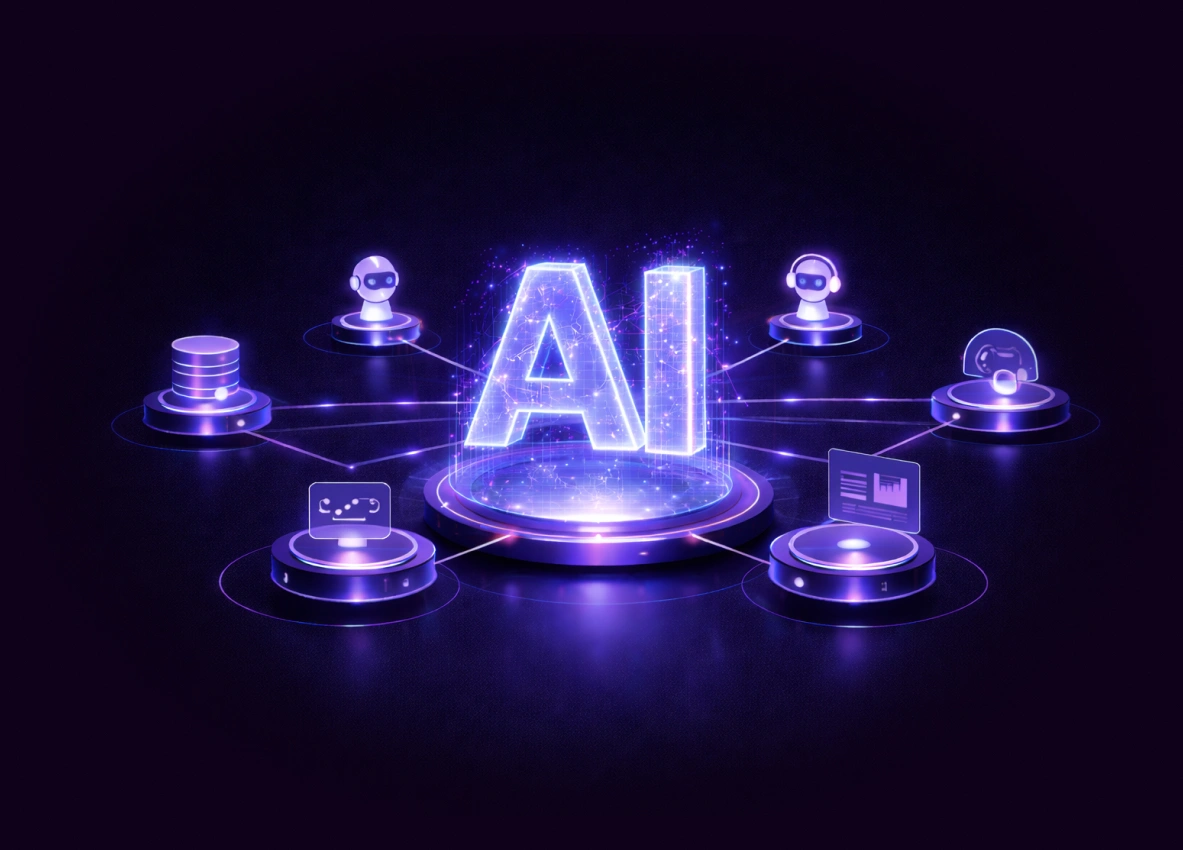
The AI Agent Infrastructure is the basic framework that lets autonomous agents work, grow, and collaborate effectively in production environments. The ML pipeline development makes it easier to manage model workflows while AI Agent Infrastructure provides the necessary runtime and coordination. It also offers control for intelligent agent frameworks to work well in real-world situations.
- Agent Runtime Environment
- Orchestration Layer
- Memory & State Management
- Tool & API Integration
Why Enterprises Need AI Agent Systems
AI agent systems are becoming critical for automating businesses because they make it possible for intelligent execution to occur in complex environments. They are like enterprise AI assistants or DAO infrastructure in that they provide the coordination layer that is necessary for operations that can grow and run on their own.

Automate Complex Workflows
Enterprise AI agent systems make multi-step processes easier by combining different APIs and platforms. This turns rigid workflows into a flexible, smart automation framework.

Scale Autonomous Operations
Move from pilot programs to full-scale production with distributed AI agents that can handle thousands of tasks at once in an AI systems architecture that can grow and change.

Reduce Human Intervention
Agents self-correct, retry failed actions, and only escalate problems when absolutely necessary. This cuts down on the need for manual supervision and lowers operational costs.

Enable Real-Time Decisions
Use low-latency execution for tasks that need quick responses so that AI agent systems can make and carry out decisions in less than a second.

Unify Disparate Systems
Agents work as a dynamic integration layer, connecting old systems with new APIs to make it easy for all parts of an enterprise ecosystem to talk to each other.

Avoid Vendor Lock-In
Orchestrate agents from any provider (AWS, Google, Microsoft, OpenAI, open-source) through a single, neutral control plane. No proprietary agent ecosystems, instead just interoperability.
Ready to Deploy Autonomous AI Agents?
Discuss Your Use CaseBenefits of Scalable AI Agent Infrastructure
Scalable AI agent infrastructure allows enterprises to transition from static automation to dynamic, real-time execution. This advancement empowers automation through AI agents that can act, adapt, and intelligently scale within complex environments.

Horizontal Scalability
Deploy numerous agent instances across distributed nodes, facilitating scalable AI agent systems that can manage dynamic workloads without experiencing performance degradation.

Sub-Second Latency
Enable AI agents to make real-time decisions and perform time-sensitive actions with sub-second response times within a high-performance AI infrastructure.

Fault Tolerance
Guarantee reliability through integrated redundancy, agent replication, and seamless failure recovery within distributed environments that facilitate uninterrupted operations.

Multi-Agent Coordination
Facilitate intelligent workflow automation by implementing task decomposition and enabling parallel execution among coordinated agent teams within intricate, scalable AI agent systems.

Observability Built-In
Achieve comprehensive insight into agent decisions, tool interactions, and communication pathways, guaranteeing traceability and enhancing performance across robust AI infrastructure.

Cost-Effective Automation
Achieve a reduction in operational costs by 30-50% through the implementation of automation via AI agents. This approach is enhanced by insights derived from predictive analytics solutions and guarantees secure execution.
Understanding How AI Agent Infrastructure Works
Gaining insight into the functioning of AI agent infrastructure necessitates a comprehensive perspective on the AI agent workflow. This involves the integration of orchestration, reasoning, and execution into a cohesive AI agent architecture that is thoroughly elucidated.
Agent Instantiation
Initialize agent instances by assigning predefined roles, permissions, and capabilities, thereby establishing the groundwork for a scalable AI agent architecture within distributed environments.
Goal Decomposition
Decompose intricate objectives into organized sub-tasks, facilitating an efficient decision-making process for AI agents operating within coordinated workflows across multiple agents.
Tool & API Selection
Agents dynamically choose the suitable tools, APIs, or data sources according to the specific requirements of the task during the agent orchestration process.
Action Execution
Agents perform tasks through the invocation of services, data queries, or workflow triggers, frequently enhanced by custom LLM development and integrated with agentic process automation.
Memory Update
Document outcomes and context in both short-term and long-term memory, facilitating continuity and knowledge acquisition throughout iterative AI agent processes.
Orchestration & Handoff
Facilitate efficient communication within multi-agent systems by transferring context, results, and responsibilities among agents to support multi-step, collaborative execution.
Our AI Agent Development Services on Offer
Our AI agent development services deliver end-to-end AI agent infrastructure solutions, extending beyond traditional AI development services and standalone enterprise AI assistants to enable scalable, production-grade autonomous systems.
Custom Agent Architecture Design
Create a custom architecture for AI agents that includes clear roles, established ways for them to talk to each other, and memory systems that are made for high-performance, distributed environments.

Agent Orchestration Platform
Create strong agent orchestration platforms with advanced task routing, dependency management, and execution engines to make it easier for complex AI agent workflows to run.
Multi-Agent System Development
Design and build coordinated multi-agent systems that can handle complex, parallel workflows in enterprise AI agent solutions and change to fit changing environments.

Tool & API Integration Layer
Use secure and scalable interfaces when making AI agent platforms to make it easier for agents to work with internal systems, third-party APIs, and data pipelines.

Agent Lifecycle Management
Make it easier for agents to be deployed, scaled, monitored, updated, and retired automatically to make sure that performance stays consistent in the ever-changing world of AI agent infrastructure solutions.

Enterprise AI Agent Solutions
Offer AI agent solutions that are customized for businesses in regulated fields, taking into account compliance, security, and a strong, always-on infrastructure.

AI Agent Consulting
Provide strategic consulting to find automation opportunities, create agent roadmaps, and build scalable AI agent platforms that are in line with business goals.

Agent Memory Systems
Create and use persistent and contextual memory layers that let agents keep information, customize interactions, and make better decisions over time.

RAG & Knowledge Integration
Integrate retrieval-augmented generation pipelines with enterprise knowledge bases to make agents more accurate, cut down on hallucinations, and make it easier to get information in real time.

Agent Monitoring & Observability
Set up observability frameworks to keep an eye on agent decisions, tool use, performance metrics, and communication flows so you can debug and improve them.

Security & Governance Layer
Create strong infrastructure solutions for AI agents that include role-based access, data privacy controls, audit logs, and compliance frameworks that are made for enterprise use.

Multi-Modal Agent Development
Create agents that can handle text, voice, and visual inputs to make interactions better on chat platforms, voice assistants, and integrated enterprise interfaces.

Autonomous Workflow Automation
Make advanced workflow automation systems that use agents to carry out full business processes with less help from people.

Edge & Distributed Agent Deployment
Use agents in the cloud, on-premises, and at the edge to make sure that operations that are spread out over many locations have low latency and can grow as needed.
Our AI Agent Infrastructure Solutions at a Glance
AI agent infrastructure solutions enable distributed, autonomous execution across enterprise systems, similar to how ML pipeline development powers data workflows and multi-chain infrastructure supports blockchain ecosystems.

Enterprise Workflow Automation

Real-Time Incident Response

Customer Service Agent Teams

Data Pipeline Automation

Multi-Agent Research Systems

IT Operations (AIOps)
Industries Our AI Agent Infrastructure Serves
AI agents can work on their own and intelligently automate a wide range of tasks in many fields, from real estate tokenization to cross-chain smart contracts. This makes it possible for complex workflows, quick decision-making, and operational effectiveness that can grow.

Financial Services
Autonomous agents help find fraud, execute trades, and keep an eye on compliance by making decisions in real time and following the rules.
- Fraud detection
- Trade execution
- Compliance automation

Healthcare
To increase and improve patient outcomes, deploy agents to handle patient triage, schedule appointments, and automate clinical workflows.
- Patient triage
- Schedule automation
- Clinical workflows

Manufacturing
Use agent-based predictive maintenance, quality control, and supply chain coordination to make production more efficient and cut down on downtime.
- Predictive maintenance
- Quality control
- Supply chain

Retail & E-commerce
Agents help with personalized recommendations, inventory management, and automated customer support. All of these things make the user experience better and the business run more smoothly.
- Personalized recs
- Inventory management
- Support automation

Telecommunications
Set up automated troubleshooting processes, network monitoring agents, and churn prediction systems to make sure service quality stays high and customers don’t leave.
- Network monitoring
- Churn prevention
- Auto-troubleshooting

Logistics & Supply Chain
Use route planning agents, warehouse coordination systems, and real-time delivery tracking in distributed logistics networks to make operations run more smoothly.
- Route optimization
- Warehouse coordination
- Delivery tracking

Energy & Utilities
Use agents to manage the grid, do predictive maintenance, and automate demand response to keep energy distribution stable and make it more efficient.
- Grid management
- Maintenance prediction
- Demand response
Financial Services
Autonomous agents help find fraud, execute trades, and keep an eye on compliance by making decisions in real time and following the rules.
- Fraud detection
- Trade execution
- Compliance automation
Healthcare
To increase and improve patient outcomes, deploy agents to handle patient triage, schedule appointments, and automate clinical workflows.
- Patient triage
- Schedule automation
- Clinical workflows
Manufacturing
Use agent-based predictive maintenance, quality control, and supply chain coordination to make production more efficient and cut down on downtime.
- Predictive maintenance
- Quality control
- Supply chain
Retail & E-commerce
Agents help with personalized recommendations, inventory management, and automated customer support. All of these things make the user experience better and the business run more smoothly.
- Personalized recs
- Inventory management
- Support automation
Telecommunications
Set up automated troubleshooting processes, network monitoring agents, and churn prediction systems to make sure service quality stays high and customers don’t leave.
- Network monitoring
- Churn prevention
- Auto-troubleshooting
Logistics & Supply Chain
Use route planning agents, warehouse coordination systems, and real-time delivery tracking in distributed logistics networks to make operations run more smoothly.
- Route optimization
- Warehouse coordination
- Delivery tracking
Energy & Utilities
Use agents to manage the grid, do predictive maintenance, and automate demand response to keep energy distribution stable and make it more efficient.
- Grid management
- Maintenance prediction
- Demand response
Build Production-Ready AI Agents with Confidence
Start Your ArchitectureAI Agent Infrastructure Development Process
Our AI agent consulting services employ a systematic, production-ready methodology that integrates machine learning pipeline development techniques with formal verification principles to ensure both reliability and scalability.

Discovery & Design
Recognize potential areas for automation, establish the roles of agents, and develop communication protocols that are in accordance with business goals and system specifications.
Build & Integration
Implement orchestration layers, integrate enterprise tools and APIs, and establish robust memory systems to support a scalable, high-performance agent infrastructure.


Testing & Rollout
Conduct simulations of multi-agent scenarios, execute load testing, and implement deployment strategies with continuous monitoring to guarantee performance, reliability, and operational stability.
Why Choose Techfyte for AI Agent Infrastructure
Techfyte, a leading AI agent development company, offers production-grade agent architecture designed for corporate automation, scalability, and dependability thanks to our blockchain and AI expertise.

Deep Agent Expertise
Our group specializes in creating and implementing sophisticated agent systems, such as memory-driven architectures and orchestration frameworks.

Enterprise-Grade Security & Compliance
Techfyte maintains SOC 2 Type II certification, GDPR compliance, and HIPAA-ready infrastructure audited annually by independent third parties.

Flexible Integration
Our solutions guarantee compatibility across intricate enterprise technology stacks by integrating easily with APIs, legacy systems, and custom tools.