



Key Takeaways
- Core Concept: AI-first companies are businesses where artificial intelligence is the core system driving products, decisions, and workflows. Without AI, the product cannot function.
- How They Work: These companies use continuous learning loops, real-time data, and autonomous agents to run workflows with minimal human involvement.
- Key Difference: Unlike AI-enabled companies, AI-first companies build entire products and operations around AI, not just using it as an add-on feature.
- Growth Drivers: Rapid growth is driven by falling inference costs, multimodal AI, agentic systems, and increasing enterprise adoption of AI-native workflows.
- Market Shift: The industry is moving from traditional SaaS to AI-first models, where value comes from learning systems rather than static features.
- Leading Players: Companies like OpenAI, Anthropic, and DeepMind are leading this transformation.
- Benefits & Challenges: AI-first models offer lower costs, faster scaling, and strong data advantages, but face challenges like data quality, talent shortages, and regulatory complexity.
- Future Outlook: The future points to autonomous companies, open model competition, and the rise of Generative Engine Optimization (GEO), where businesses optimize to become direct AI-generated answers.
The most valuable firms in 2026 won’t merely be the ones that use AI, but the ones that have been substantially transformed to put AI at the center. In this new paradigm, software is not bound by fixed laws, but rather learns, changes and evolves continuously. After deployment, products become more useful, workflows become autonomous and the customer experience moves from reactive to predictive.
This is the ascension of AI-first companies, entities where intelligence develops and expands over time. Their edge is not only speed or automation but learning velocity. The system improves with every engagement where every data point strengthens the defense wall. The difference between them and traditional firms is that they are exponentially growing, powered by intelligence, not just scaling linearly.
What is an AI-First Company?
An AI-first company is one whose product is driven by an AI-based operating system. Without the model, the product cannot function
This is very different from AI-powered or AI-enabled enterprises where AI improves existing operations (recommendations, automation, analytics), but the product still works without it. There are no fallbacks in AI-first systems. The AI is the product, not the feature.
The defense here is profound. These organizations build defensibility through data, model performance, and feedback loops, not just code. As McKinsey & Company observes, top firms are moving towards AI-native operating models where the process of decision-making itself becomes algorithmic and continually optimized.
Key Characteristics of AI-First Companies
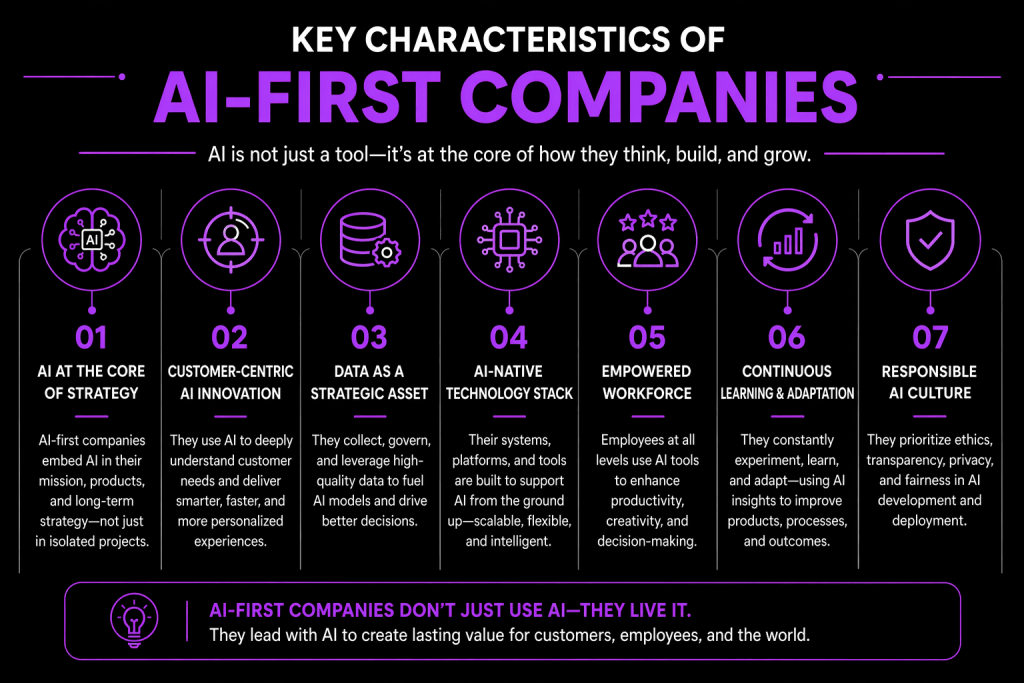
- Models as the Product Core
Value is generated by models producing outputs and not predefined logic. - Continuous Learning Loops
Systems retrain and improve from live user interactions. - Data Flywheel Effects
More usage → better models → stronger retention → more usage. - Minimal Human-in-the-Loop
Humans supervise; machines execute and decide. - API-Native, Composable Systems
Built for orchestration across tools, agents, and services. - Real-Time Personalization
Every experience is dynamically generated per user context. - Model Fine-Tuning as a Feature
Custom intelligence per enterprise or use case becomes standard. - Outcome-Driven Design
Focus shifts from interfaces to delivering decisions and results.
AI-first companies don’t just outperform but redefine how value is created in the digital economy.
Why AI-First Companies Are Growing Rapidly in 2026
AI-first companies are not just growing, they are absorbing entire markets. The numbers make this shift undeniable. The global AI market is projected to surpass $214 billion in 2026, with long-term expansion accelerating toward multi-trillion scale and a projected 30%+ CAGR through 2033. In contrast, traditional SaaS, once the dominant model, is growing at a far slower ~13–18% CAGR, signaling a structural shift in where value is created.
More importantly, capital is following this shift. In 2025, over 60% of global venture capital flowed into AI companies, fundamentally reshaping startup economics and prioritization. By 2026, investors are increasingly concentrating capital into AI-native businesses with proven models, rather than feature-driven SaaS platforms.
This rapid acceleration is driven by four critical trends:
- Falling inference costs
The cost per query is coming down with hardware improvements and model optimization, allowing AI to scale beyond just exploration. - Multimodal adoption
Text, image, video and voice are all coming together in unified platforms, creating completely new product categories. - Agentic AI maturity
Systems are moving from passive aides to autonomous agents that can plan, execute, and iterate on tasks. - Regulatory clarity
In the biggest markets, new frameworks are emerging that reduce ambiguity and give companies more confidence to roll out AI systems.
At the same time, the behavior of enterprises is changing. AI isn’t a feature anymore, it’s becoming the primary budget line item. Spending is moving from legacy tools to AI-native systems. This is a bigger shift: from “AI features” added to software to AI-native workflows where entire processes are rethought around intelligence.
| Category | 2024 | 2026 |
|---|---|---|
| AI Market Size | ~$136B | ~$214B |
| VC Allocation to AI | ~30–40% | 60%+ |
| SaaS Growth Rate | ~20% | ~13–18% |
| AI Adoption | Experimental | Mission-critical |
| Product Strategy | AI as feature | AI as workflow |
AI-first companies are scaling faster because they are not competing on features but are competing on learning systems. And in 2026, that difference is everything.
Emerging AI-First Companies to Watch
Beyond the big players, a new crop of AI-first startups is emerging with sharper focus and faster iteration cycles. These organizations are often under three years old, natively based on modern model architectures, and structured around specific, high-value workflows rather than horizontal platforms. They focus on precise intelligence in specific domains rather than chasing general-purpose AI, which allows for speedier product-market fit and more defensibility.
Techfyte
Category: Developer-First AI Infrastructure / Vertical AI for Technical Teams
Techfyte is emerging as a developer-first AI company focused on building production-ready AI systems, not just prototypes. Its approach centers on enabling enterprises to deploy custom AI agents, domain-specific LLMs, and scalable ML pipelines tailored to real-world workflows.
Unlike AI-enabled platforms, Techfyte’s solutions are built such that AI is the execution layer itself, from decision making to automation, thus, making it a true AI-first architecture.
Why It Matters in 2026: Platforms that mesh infrastructure with execution layers will define the speed of adoption as enterprises move toward autonomous systems. Techfyte’s expertise in AI agent infrastructure and custom LLM development is indicative of the trend towards model-driven, completely autonomous systems in enterprises. For example, Techfyte’s AI agent infrastructure enables organizations to create bespoke agents to run multi-step workflows across CRM, ERP and support systems without manual orchestration.
Make Your Business AI-First
DeepSig
Category: Neuro-Symbolic AI
DeepSig is pushing the boundaries of neuro-symbolic AI by integrating deep learning with logical reasoning to increase accuracy in complicated, high-stakes scenarios.
Why It Matters in 2026: Pure LLM techniques are hitting reliability constraints, and hybrid reasoning systems are increasingly crucial for enterprise-grade AI.
Adept AI
Category: Agentic Process Automation
Adept AI is designing systems that can use software like humans, so AI agents can do multi-step workflows across tools without special connections.
Why It Matters in 2026: Moving from APIs to interface level automation provides tremendous opportunity to improve enterprise productivity.
Cognition AI
Category: Autonomous Coding Agents
Cognition AI is changing the way software is developed, with fully autonomous coding agents that can write, debug and deploy applications independently.
Why It Matters in 2026: Development itself is becoming AI -native, cutting schedules and eliminating reliance on massive engineering teams.
Top AI-First Companies Leading the Future in 2026
The leaders of 2026 are not merely inventing better models, they are redefining how software itself is created, delivered, and scaled. It’s not that these companies have AI that’s different, it’s how they’ve built it into their operating systems. Intelligence is not a feature overlay in an AI-first organization. It is the underlying core execution engine underpinning every product, workflow, and decision.
We are now seeing a shift from tools that assist humans to systems that replace entire workflows. Now the customer support is autonomous. Research becomes continuous. When scaled, decision making is probabilistic and data-driven. These organizations don’t provide static features, they ship learning solutions that get better with every engagement.
The companies below are the clearest manifestation of this change. Each is designing systems where AI is not optional but is the product itself. It does so because without it, the value proposition disappears altogether.
1. OpenAI
Category: Frontier Models + Agents
OpenAI’s growth with GPT-5 suggests a transition from conversational AI to full agent orchestration systems. These systems can autonomously plan, perform and improve multi-step projects across tools and contexts.
2026 Moat: Vertical integration across models, APIs, and agent ecosystems, creating deep platform lock-in.
2. Anthropic
Category: Enterprise LLMs
Anthropic’s Claude 4 is fast becoming the default corporate paradigm, particularly in areas where safety, interpretability and compliance are paramount. It’s designed to be regulated intelligence, not raw output.
2026 Moat: Safety-first architecture combined with enterprise-grade governance and trust.
3. DeepMind
Category: Research + Robotics
DeepMind’s Gemini Ultra 2 ventures into real-world intelligence systems from software, combining reasoning, multimodal understanding and robotics.
2026 Moat: Integration of AI across digital and physical domains-software + robotics convergence.
4. Mistral AI
Category: Open + Edge AI
Mistral is in the forefront of building efficient and deployable models, with a focus on on-premise, edge, and sovereign deployments. This puts it in a good position in regulated contexts.
2026 Moat: High-performance lightweight models aligned with sovereignty and compliance needs.
5. Glean
Category: Enterprise Knowledge AI
Glean turns internal company search into context-aware knowledge systems, giving employees synthesized insights instead of raw documents.
2026 Moat: Proprietary enterprise data graphs and contextual retrieval intelligence.
6. Harvey
Category: Vertical AI (Legal)
Harvey is transforming legal workflows by making AI the primary execution layer for drafting, research and compliance tasks, reducing the need for hands-on involvement.
2026 Moat: Deep domain fine-tuning on legal datasets and workflow-specific intelligence.
7. Sierra
Category: Agentic CX
Sierra develops full-stack autonomous customer experience systems, replacing legacy support tools with AI agents that can handle whole customer journeys.
2026 Moat: Ownership of entire CX workflows, not just conversational interfaces.
8. Hugging Face
Category: Open AI Infrastructure
Hugging Face has become the default ecosystem for open AI, empowering developers to design, fine-tune and deploy models at scale across industries.
2026 Moat: Massive open-source network effects and developer adoption.
Industries Being Transformed by AI-First Companies
AI-first enterprises aren’t simply optimizing industries; they’re re-architecting them around intelligence systems. The change is from software that facilitates work flows to systems that own and execute them autonomously. Accenture analytics reveal that firms that embed AI at the core are realizing far larger efficiency advantages and faster innovation cycles.
Healthcare
AI-first systems are enabling diagnostic agents that continuously analyze patient data along with AI-driven drug discovery models that find promising compounds in weeks rather than years. These systems go beyond help to real-time clinical augmentation.
By the end of 2026, healthcare will be evolving to continuous AI-assisted care, where diagnosis and treatment suggestions will be generated proactively. To get a deeper understanding on how intelligent systems are formed Neuro-symbolic AI systems integrate reasoning with learning.
Real Estate
AI is revolutionizing the real estate industry with automated valuation engines and lease negotiation agents that can process market signals, tenant behavior and contract terms in real-time. Decision-making moves from human intuition to data-driven optimization.
AI-driven pricing and negotiating will become increasingly commonplace in real estate transactions by 2026, lowering friction and time-to-close.
Gaming
AI-first game businesses are designing dynamic NPCs who learn from player activity, and landscapes that are procedurally created and grow in real time. These are non-linear, adaptive gameplay experiences.
By the end of 2026, games will transform into fully AI-produced ecosystems, where content, stories, and interactions are generated on-demand in a continuous fashion.
Fintech
In AI-first fintech systems, risk is continuously assessed across numerous data sources by real-time fraud detection models and autonomous credit underwriting agents. This would replace static scoring with live intelligence systems.
In 2026, financial decisions will be based on ongoing, AI-powered risk evaluations, allowing for quicker, more precise approvals. This is driven by scalable infrastructures like predictive analytics solutions and ML pipeline development that assure ongoing model improvement.
E-commerce
AI-first commerce systems are launching autonomous negotiation agents and hyper-personalized shopping journeys where pricing, recommendations and offers are adjusted in real time per user.
By the end of 2026, e-commerce will be AI-powered marketplaces, in which all interactions are tuned dynamically for conversion and retention.
Benefits of the AI-First Business Model
AI-first organizations aren’t only more efficient , but they are structurally more profitable and defensible. What they have going for them is that they replace human-driven processes with learning systems that improve over time, which reduces costs while raising quality of their output.
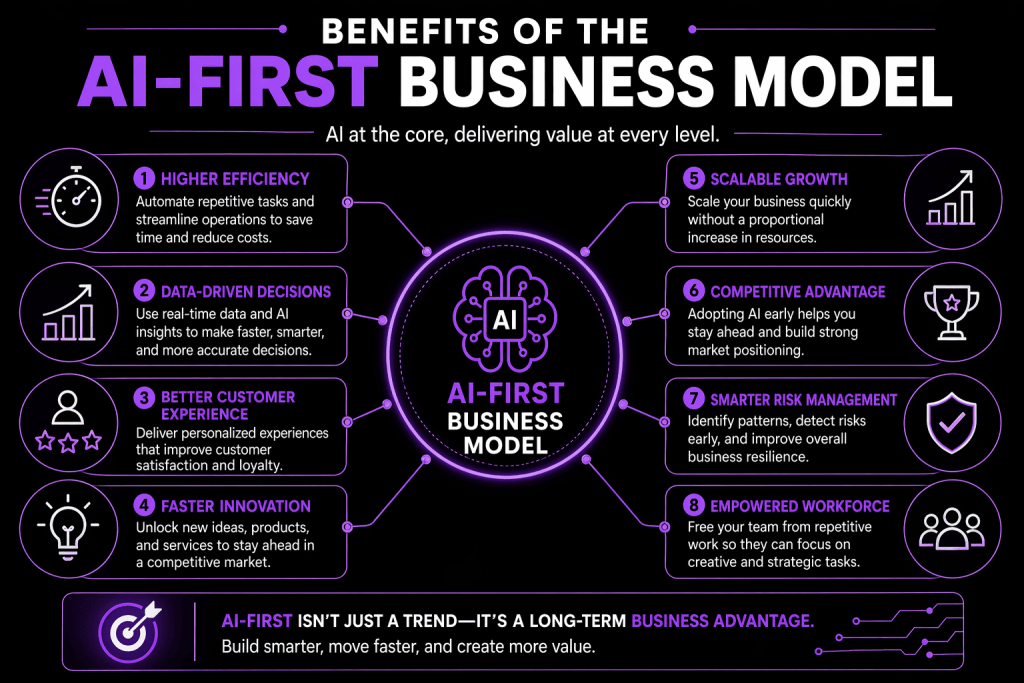
- Lower Marginal Cost per Decision
Once in production, AI systems may make thousands of decisions at near-zero marginal cost, greatly increasing unit economics relative to human-dependent activities. - Faster Iteration Cycles
AI-first products are built through continuous learning loops not release cycles – enabling you to experiment, deploy and optimize fast. - Defensible Data Moats
Each encounter adds to private datasets, making the models better, producing competitive advantages that reinforce themselves and are tough to copy. - Higher Valuation Multiples
Investors are attracted to AI-first companies for their capacity to scale and generate compounding intelligence, typically granting them premium valuations over traditional SaaS models. - Customer Lock-In via Personalization
Real time personalization offers highly personalized experiences that lock consumers in more difficultly, as the system becomes optimally tuned to their behavior.
Technologies Powering AI-First Companies
AI-first enterprises are built on a stack of emerging technologies that provide intelligence, autonomy and scalability across applications.
- Large Language Models (LLMs)
The core reasoning engines behind these are models like GPT-5, Claude 4 and Gemini 2. These are used for generating material, decision making and performing multi-step tasks. - Natural Language Processing (NLP)
Techniques such as sentiment analysis and entity resolution allow systems to understand and act on unstructured data, powering conversational and analytical workflows. - Computer Vision
Real-time vision systems have many application areas like video-based agents, surveillance intelligence, automated quality assessment etc. - Automation (Agentic Workflows / RPA 2.0)
AI agents are moving beyond rule-based automation, delivering adaptive, goal-oriented systems that can execute complex workflows across tools and platforms. - Federated Learning
This enables AI models to learn from decentralized data sources without needing to share raw data, thus ensuring privacy and compliance.
In 2026, federated learning will become critical for industries handling sensitive data, supported by services like federated learning systems. - Neuro-Symbolic AI
Neuro-symbolic systems combine neural networks and logic to improve the accuracy and explainability of decisions.
This hybrid approach is attracting attention in complex areas and is being investigated by neuro-symbolic AI systems.
How to Choose the Right AI-First Company for Your Business
Choosing an AI-first partner is less about features and more about fit with your data, workflows and limits. A poor decision often leads to costly rework later.
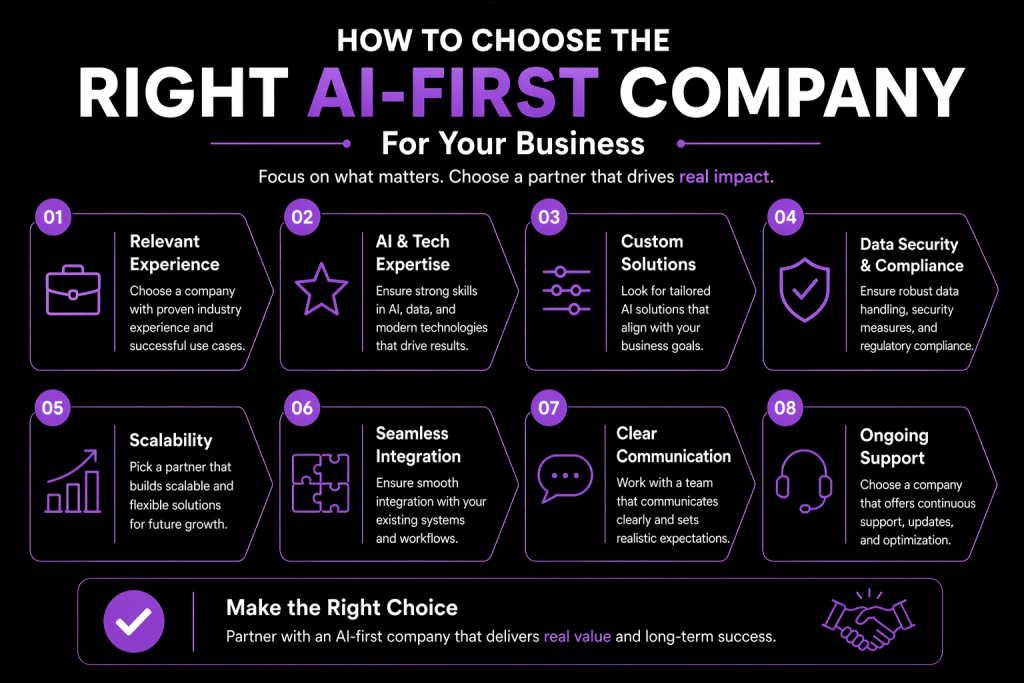
- Proprietary Data Fit
The vendor should be able to leverage your internal datasets effectively, since real value comes from domain-specific intelligence rather than generic models. - API Reliability & Ecosystem
AI-first systems rely heavily on APIs. Evaluate uptime, integration flexibility, and orchestration capabilities, especially for multi-agent workflows. - Latency Requirements
Use cases such as fraud detection or customer agents require real-time response systems, not delayed inference pipelines. - Compliance & Data Governance
Privacy sensitive companies need to focus on secure architectures such as enterprise AI assistants operating within regulated settings. - Vendor Lock-In Risk
Avoid rigid ecosystems. Look for partners that have modular, composable solutions that enable switching models and hybrid deployments.
Cost of Building AI-First Products and Solutions
The cost of building AI-first systems varies based on complexity, scale, and level of customization:
- $50K – $150K → Focused micro-agents (task-specific automation, support workflows)
- $150K – $1M → Integrated AI systems with multiple workflows and data pipelines
- $1M – $10M+ → Advanced platforms with proprietary models, orchestration layers, and enterprise-grade deployments
A significant change in 2026 is the drastic reduction of inference prices, due to optimized architectures and increased hardware efficiency. This is making AI cheaply feasible at scale across sectors.
But success is about laying the appropriate foundation. AI-powered decision systems and predictive analytics solutions allow enterprises to transition from testing to production-grade intelligence.
Ready to Estimate the Cost of Your AI-First Solution?
Challenges in Building AI-First Companies
There’s a lot of promise, but establishing AI-first companies presents deep structural and operational challenges that go far beyond traditional software development:
- Data Scarcity & Quality Issues
The quality of AI systems is wholly dependent on the data they are trained on. In most businesses, the domain data is fragmented, noisy, or insufficient, which reduces the accuracy of the model. Even worse, cleaning and labeling high-quality datasets is time-consuming and expensive, particularly in specialized businesses. - Evaluation Complexity
AI does not produce deterministic outcomes like traditional software. Performance measurement involves continual evaluation frameworks, human feedback loops, and probabilistic scoring systems. What “works” in testing can be broken in production by edge cases or changing data patterns. - Talent War
Building AI-first solutions demands a rare breed of ML engineers, data scientists and AI product thinkers. The demand for this talent is outstripping supply, so companies are paying more and taking longer to build in-house capabilities. - Regulatory Uncertainty
AI regulations are growing quickly, especially in areas such as the use of data, explainability and responsibility. Companies should not only build systems that are performant but also auditable and compliant. Often this means additional layers such as governance models and secure designs. - Commoditization of Foundation Models
As powerful base models become readily available, it’s getting tougher to differentiate on “just using AI”. The advantage then moves to how organizations optimize models, embed them into their operations and exploit private data. - Infrastructure & Scaling Complexity
As you scale AI systems, there are problems around latency, cost control, model versioning, and deployment pipelines. Without strong systems, it’s hard to keep up performance in the real world.
Future of AI-First Companies Beyond 2026
The path of AI-first enterprises indicates that what seems cutting-edge now will become fundamental in 2029. The next wave isn’t incremental. It’s a fundamental reworking of how firms do business, compete and grow.
- The First Fully Autonomous AI Company
We shall see an emergence of a company in 2027-2029 where core operations run without human intervention, from client acquisition and support to product iteration and financial optimization. Governance will be done by humans but execution will be done by coordinated AI agents across platforms. - Open-Weight Models Match Frontier Performance
The difference between closed and open models will shrink drastically. Open-weight ecosystems will achieve near-parity with frontier models through distributed innovation and fine-tuning at scale. That will redistribute power from centralized suppliers to enterprises that can adjust and deploy models fastest in their domain. - AI-First M&A Wave Accelerates
To remain competitive, incumbents will aggressively purchase small, highly specialized AI-first firms. These purchases won’t be about teams, they will be about data, models and ownership of workflow. Expect a wave of AI-driven consolidation across industries.
The Rise of GEO (Generative Engine Optimization)
As AI-native search platforms like Perplexity, SearchGPT, and Gemini become primary discovery layers, traditional SEO will evolve into GEO-Generative Engine Optimization.
Instead of ranking pages, companies will optimize for being the answer itself. This means structured knowledge, authoritative content, and systems that can be parsed, trusted, and surfaced directly by AI agents.
AI-first companies will have a natural advantage here-they already produce machine-readable intelligence, not just human-readable content.
Frequently Asked Questions (FAQs)
-
What is an AI-first company?
An AI-first company is a business where artificial intelligence is the core system driving products, decisions, and workflows. Without AI, the product cannot function.
-
How are AI-first companies different from traditional companies?
Traditional companies use AI as a feature, AI-first companies build entire workflows and decisions around AI technology.
-
What are examples of AI-first companies?
Companies like OpenAI, Anthropic, and emerging players in vertical AI are leading examples of AI-first organizations.
-
Why are AI-first companies growing rapidly?
They scale faster and have lower marginal costs, constant learning and automation, and can outperform traditional SaaS models.
-
Which industries have the most AI-first companies?
Healthcare, fintech, gaming and e-commerce are the fastest adopters. These are data-rich businesses which offer automation.
-
How do AI-first companies make money?
They monetize through subscriptions, usage-based APIs, and outcome-based pricing models that are generally performance- or efficiency-based.
-
What technologies do AI-first companies use?
Their work is based on LLMs, NLP, computer vision, and complex systems such as federated learning services and AI agent infrastructure.
-
Are AI-first companies suitable for startups?
Yes, it’s startups that benefit the most as they can build AI-native solutions from the ground up, free from legacy constraints.
-
How can a company become AI-first?
Investing in data pipelines, re-architecting workflows for AI, and deploying solutions such as enterprise AI assistants for automation and decision-making.
-
What is the future of AI-first companies?
AI-first companies will be self-improving, autonomous companies that continuously optimize operations and dominate the market.
-
How is Techfyte approaching AI-first differently?
Techfyte’s goal is to create production-ready AI systems for real-world workflows, including agents and domain-specific intelligence, and infrastructure rather than general AI tools. The solutions include AI agent infrastructure and predictive analytics solutions.
Concluding Note
What we are witnessing is not just a technological change but a fundamental one. Organizations are shifting from AI-augmented processes, where AI helps inform human decision making, to AI-native systems where AI takes over from beginning to end. This shift is changing the way things are produced, how decisions are made and how firms scale.
What was once an experiment has become an expectation. Enterprises are no longer wondering whether they should be adopting AI, they’re reorganizing around it. Startups aren’t adding AI, they’re building it in. And whole businesses are being reconfigured around intelligence.
The question is not which companies will survive the AI transformation, but which will be rebuilt in time. Will yours?
Build an AI-First Business Before the Market Moves Ahead
