



Key Takeaways
- Real-world asset (RWA) tokenization is rapidly emerging as a multi-trillion-dollar opportunity, expected to reach ~$16 trillion by 2030, reshaping global finance.
- Tokenization converts physical and intangible assets into blockchain-based digital tokens, enabling easier ownership, transfer, and management.
- Fractional ownership lowers entry barriers, allowing investors to access high-value assets like real estate, art, and private equity with smaller capital.
- Blockchain-powered tokenization delivers higher liquidity, faster settlement (T+0), and reduced reliance on intermediaries, improving overall market efficiency.
- Smart contracts introduce programmability, automating compliance, dividend distribution, governance, and reporting processes.
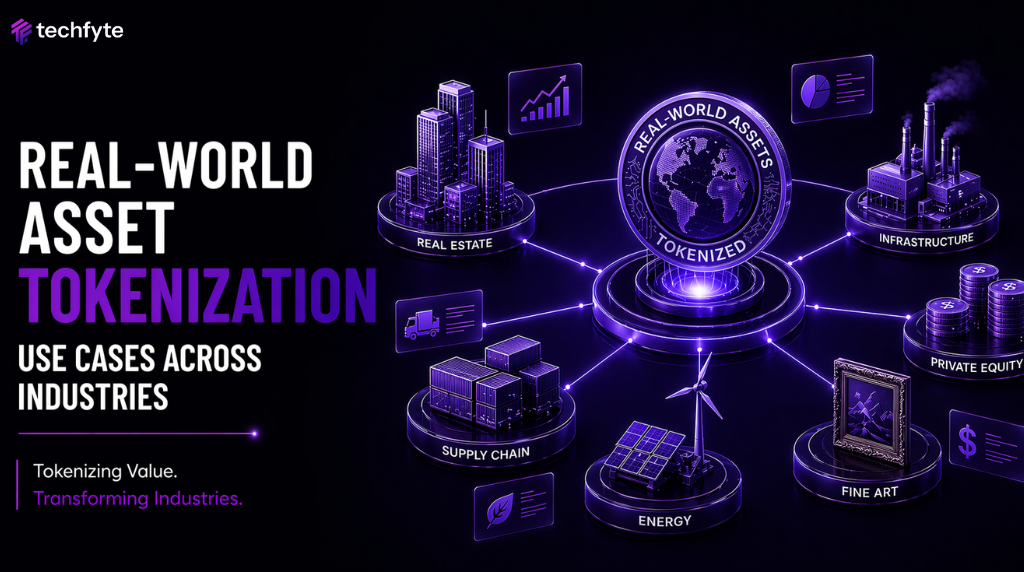
- RWA tokenization is already transforming industries including real estate, commodities, private credit, carbon markets, and supply chain finance.
- Institutional adoption is accelerating due to benefits like yield diversification, operational efficiency, and collateral mobility across markets.
- Despite challenges such as regulation, liquidity depth, and oracle reliability, rapid infrastructure advancements and regulatory clarity are driving mainstream adoption.
Introduction
Tokenization of real-world assets is quickly becoming one of the most disruptive movements in global banking, with projections pointing to a $16 trillion market opportunity by 2030. At the heart of this evolution are the real world asset tokenization use cases, transforming how traditional assets are held, exchanged, and funded across borders. Tokenization enables real estate, commodities, intellectual property and private equity to exist in a digital form on blockchain networks. Businesses are increasingly adopting asset tokenization solutions to digitize ownership and unlock liquidity across global markets.
Tokenization is the process of converting real and intangible assets into blockchain-based tokens that can be issued, exchanged and managed with unparalleled efficiency, in layman’s terms. This change is fueling new fractional ownership models on the blockchain that allow investors to access high-value assets with much reduced capital requirements. At the same time, institutions are looking at asset backed tokens explained by programmable financial instruments that automate compliance, settlement, and income distribution.
It is not just a technological momentum, but a structural one. Tokenized assets offer a host of benefits to the financial sector such as higher liquidity in often illiquid markets, decreased reliance on intermediaries, faster settlement times, and greater transparency. Such efficiencies are further complemented by scalable infrastructure such as Avalanche subnet which enable high throughput asset tokenization ecosystems. As capital markets go digital, RWA tokenization is narrowing the divide between traditional finance (TradFi) and decentralized finance (DeFi), opening new levels of global participation.
What Is Real-World Asset Tokenization
Tokenizing real-world assets: This involves transforming ownership rights of physical or intangible assets into digital tokens on a blockchain. These tokens reflect value, rights or claims on underlying assets such as real estate, commodities or financial instruments. Modern systems generally have adjustable tokenization layers for different asset classes, usually built on modular frameworks such as the Cosmos SDK. The blockchain architecture that powers tokenization is well documented by groups like World Economic Forum which highlights how it will revolutionize global financial markets.
Real-world asset tokenization is essentially about representing, dividing and trading assets in a more flexible and accessible way in the real world. Ownership has traditionally been documented on paper or through a centralized registry . With blockchain , ownership and transactions are on a secure , immutable and transparent ledger . That’s where real world asset tokenization use cases are key, demonstrating how traditional assets may be converted into programmable financial instruments.
Asset backed tokens explained: better understood if you know that each token is usually associated with an underlying asset or a pool of assets, which guarantees that its value is covered by the real-world economic activity. Such tokens might represent anything from shares in a commercial facility to units of gold in a vault, or even revenue streams from intellectual property. To achieve standardization and interoperability, these tokens are generally designed in accordance with token standards engineering techniques defining compliance, ownership and transfer logic.
Fungible vs Non-Fungible Tokenization
A key distinction in tokenization lies between fungible and non-fungible assets:
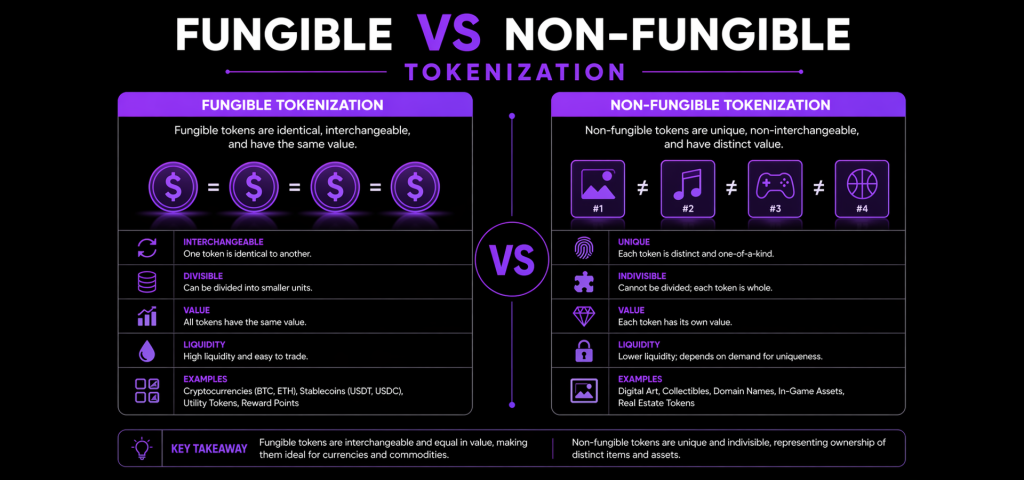
- Fungible Tokenization:
Assets are divided into uniform, interchangeable units. For example, a commercial building could be split into thousands of tokens, each representing an equal ownership stake. The model allows fractional ownership of high-value assets on the blockchain, improving their accessibility and liquidity. - Non-Fungible Tokenization:
Each token represents a unique asset or ownership right. This is typical in assets such as fine art, rare collectibles, or unique real estate assets where not all units are fungible.
Both models have wider benefits for tokenized assets in finance such as bespoke investment structures, increased liquidity and more efficient use of capital.
As the adoption grows, knowing these basic concepts are crucial before moving onto the mechanics behind implementation. The next section explains the process of RWA tokenization in detail.
How RWA Tokenization Works on Blockchain
Blockchain asset tokenization process turns traditional assets into programmable digital instruments that can be issued, traded and managed globally. While implementations are asset class and jurisdiction-specific, the core architecture is a structured, repeatable flow driven by smart contracts for asset tokenization.
Step 1: Asset Identification & Legal Wrapper
The process starts with identifying the underlying asset and defining its legal form.
This ensures the token has enforceable rights tied to real world ownership.
- The asset is evaluated (real estate, fund, commodity, IP).
- A legal wrapper is created (SPV, trust, or custodial structure).
- Ownership rights are mapped to digital tokens.
This step sits between traditional finance and blockchain, providing compliance and investor protection. Deploying asset structures can be done using chain-agnostic frameworks like chain abstraction, allowing for seamless interaction across multiple blockchains, for interoperability across ecosystems.
Step 2: Smart Contract Minting
Once the legal framework has been put in place, blockchain-based smart contracts are utilized to create tokens. The most widely deployed smart contracts that enable tokenization are on platforms like Ethereum that have pioneered programmable financial infrastructure.
- Smart contracts define ownership, transfer rules, and compliance.
- Tokens are minted to represent shares or units of the asset.
- Logic enables automation (dividends, interest, governance).
This is where asset tokenization smart contracts enable programmability and financial operations can be run without intermediaries These token contracts can be further optimized using gas-optimized smart contracts to reduce transaction costs and improve execution efficiency at scale.
Step 3: Distribution & Custody
Once the tokens are minted, they are distributed to the investors and handled via a secure digital infrastructure.
- Tokens are distributed via private placements or marketplaces.
- Investors hold assets in digital wallets or custodial platforms.
- Secondary trading enables liquidity and price discovery.
This is where real world asset tokenization use cases become viable, allowing fractional ownership, global participation and continuous trading across markets. More advanced solutions also include multi-chain wallet development solutions for secure storage, transfer and management of tokenized assets across networks.
Key Benefits of Tokenizing Real-World Assets
Tokenization is not just a technological upgrade—it fundamentally reshapes how assets are owned, accessed, and managed. The benefits of tokenized assets in finance are particularly evident in traditionally illiquid sectors like private equity and real estate, where high entry barriers and long lock-up periods have historically limited participation. Real-world asset tokenization is emerging as one of the most significant shifts in global finance, with Boston Consulting Group projections widely cited by Ripple estimating a $16 trillion market opportunity by 2030.
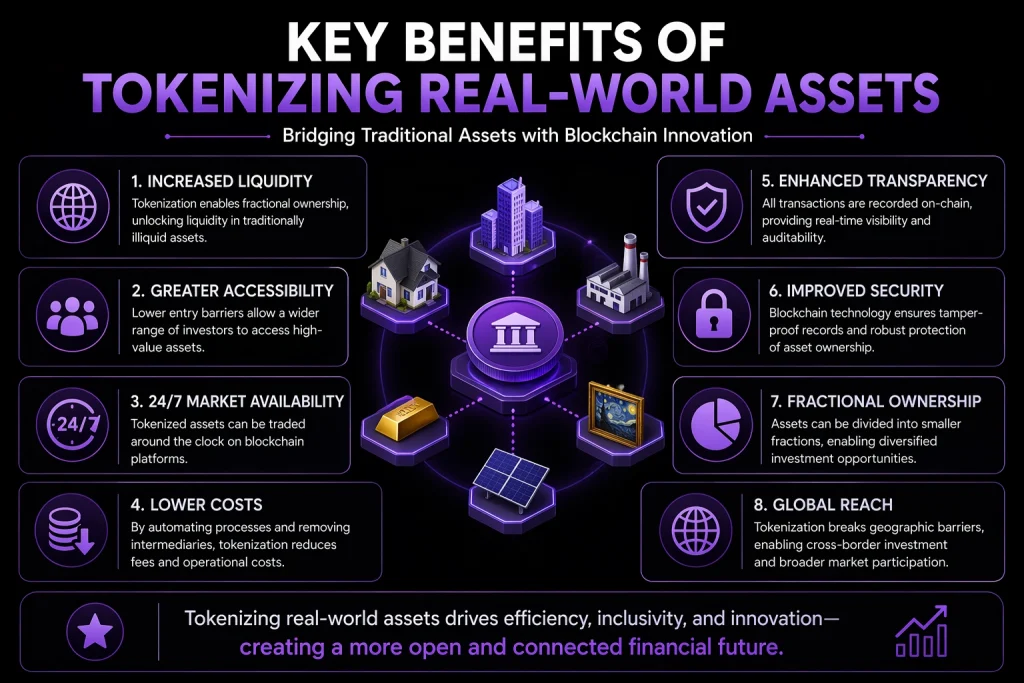
Unlocking Liquidity in Illiquid Markets
Private equity funds and real estate investments generally involve multi-year commitments and limited exit options.
Tokenization introduces:
- Reducing Capital Barriers, Fractional Ownership
- Quicker exit through secondary markets
- Liquidity on a continuous basis instead of locked capital
The ability to transform liquidity is especially powerful when paired with platforms that support real estate tokenization, enabling the fractional ownership of traditionally illiquid real estate assets.
Lowering Investment Barriers
Traditionally, high ticket sizes have been a barrier for a large percentage of global investors.
- Smaller allocations for premium assets
- Easier to diversify across asset classes
- International participation broadens investor pools
Programmable Financial Operations
One of the most powerful advantages is automation through smart contracts.
- Automated dividend and yield distribution
- Real-time compliance enforcement
- Transparent ownership tracking
It reduces operational overhead, while increasing trust and efficiency.
Enhanced Efficiency with Digital Infrastructure
Modern asset management systems built on blockchain technology eliminate manual processes and fragmented data silos.
- Real-time settlement and reconciliation
- Reduced reliance on intermediaries
- Immutable audit trails
Traditional vs Tokenized Asset Management
| Feature | Traditional Asset Management | Tokenized Asset Management |
|---|---|---|
| Liquidity | Low; long lock-up periods (PE, real estate) | High; fractional and tradable ownership |
| Settlement Time | T+2 to T+7 days | Near-instant (T+0) |
| Accessibility | High capital requirements | Fractional entry, global access |
| Operational Cost | High (intermediaries, paperwork) | Lower via automation and smart contracts |
As institutional adoption accelerates, tokenization is becoming a foundational layer for next-generation financial infrastructure. Thus, combining efficiency, transparency, and global accessibility into a single unified system.
Use Cases of RWA Tokenization Across Industries
When you explore use cases of real life asset tokenization across industries you get to see the actual power of blockchain. Tokenization is changing how wealth is created, moved and accessible internationally, from commodities to credit markets. Centrifuge and Ondo Finance are modern RWA tokenization systems and protocols that are providing compliant, scalable infrastructure for institutional-grade assets, boosting the adoption.
Below are the most prominent industry applications:
1. Commodities (Gold, Oil)
Tokenization of commodities on blockchain enables the digital representation and trading of actual assets like gold and oil with high liquidity.
- Fractional gold units backed 1:1 are available for purchase by investors
- Eliminates storage and logistical issues
- Allows for round-the-clock trading globally
Example: Paxos Gold (PAXG) is a digital asset backed by physical gold held in vaults, with each token representing one fine troy ounce.
2. Art & Collectibles
Fractionalization makes high-value artworks and rare collectibles available to a wider investor base.
- Allows multi-million dollar assets to be co-owned
- Enhances liquidity in normally illiquid markets
- Provides transparent provenance tracking
Example: Masterworks tokenizes blue-chip art, so investors can acquire shares in works by artists like Banksy.
3. Private Credit & Bonds
Tokenization is revolutionizing debt markets to make fixed-income instruments more efficient and accessible.
- Fractional access to corporate bonds and private credit
- Automated interest payouts through smart contracts
- Reduced issuance and settlement time
Example: Ondo Finance offers tokenized exposure to U.S. Treasuries, bringing institutional-grade yield products on-chain.
Corporate Bond Case Study: Siemens €60 Million Digital Bond
In February 2023, Siemens AG issued a €60 million digital bond on the Polygon blockchain, one of the first tokenized corporate bonds by a large international company under Germany’s electronic securities laws (eWpG). The one-year bond was oversubscribed by institutional investors including DekaBank, DZ Bank and Union Investment. Settlement was near real-time (T+0) with wholesale CBDC from the Bundesbank. The issuance underlined that tokenization is no longer the domain of small crypto projects, but is being adopted by Fortune 500 companies as a way to reduce administrative costs, eliminate paper-based processes and accelerate settlement cycles.
4. Carbon Credits (ESG Assets)
Digitalizing carbon markets can help boost transparency and remove inefficiencies.
- Carbon offsets that are verifiable and traceable
- Less possibility of duplicate counting
- Greater global liquidity for ESG assets
Example: Toucan Protocol turns carbon credits into tokens, allowing environmental assets to be freely traded on the blockchain.
5. Supply Chain Finance
Tokenization enables invoices and receivables to become liquid financial instruments.
- Businesses receive operating finance faster
- Less fraud because of transparent records
- Settlement of trade transactions in real time
Example: Centrifuge helps businesses to tokenize invoices and unlock liquidity via decentralized pools.
These application examples prove that tokenization is not only limited to crypto-native assets but also penetrates deep into traditional finance. As infrastructure evolves, industries will turn to integrated solutions like multi-chain wallet development to securely manage and transfer tokenized assets across ecosystems.
Tokenized Real Estate: A Major Use Case
Real estate is one of the most meaningful applications of tokenization across all asset types. Tokenized real estate investment blockchain platforms are emerging and are fundamentally transforming the face of property ownership and investment globally.
Traditionally, buying in the best real estate markets such as New York, London or Dubai, involves huge capital, often millions of dollars, and long lock-in periods, as well as complicated legal processes. This represents a huge hurdle for both individual and institutional investors wanting to diversify.
Tokenization solves this denomination problem directly. Investors may now become involved with as little as $1,000 through fractional ownership using blockchain instead of spending $5 million to join a $50 million commercial property. The property is tokenized into digital tokens, with each token representing a part of ownership, rental income and possible appreciation.
This shift introduces several structural advantages:
- Increased Liquidity: Property tokens can be traded on secondary markets by investors, instead of having to wait years for exit possibilities.
- Global Accessibility: Cross-border involvement without the friction of traditional banking.
- Automated Income Distribution: Rental yields provided through smart contracts.
- Transparency: Ownership history and transaction history are immutable.
Moreover, tokenized real estate ecosystems are slowly being connected with decentralized exchange development frameworks which allows for frictionless trading and price discovery of property-backed tokens.
Real-World Case Study: St. Regis Aspen Resort
Among the most prominent and first instances of real estate tokenization is the St. Regis Aspen Resort in Colorado. The ownership shares of this premium hotel were tokenized and sold as “Aspen Coins” in a Regulation D 506(c) offering in 2018. Each token represented an indirect equity interest in the hotel, giving accredited investors exposure to a premier hospitality asset without having to buy the whole thing. The tokenization was carried out utilizing the ERC-884 token standard on Ethereum and illustrated how blockchain may provide liquidity and fractional ownership of institutional-grade real estate. The sale raised $18 million and established a precedent for future real estate tokenization ventures worldwide.
Tokenization is turning real estate into a liquid, programmable and internationally accessible asset class; from luxury apartments in Manhattan to commercial office space in Dubai, unleashing value formerly locked away for a limited group of high-net-worth investors.
RWA Tokenization for Institutional Investors
Institutional adoption is gaining momentum, as RWA tokenization for institutional investors has progressed from experimental to infrastructural. Banks, asset managers and funds are increasingly looking at tokenisation as a method to modernise issuance, trading and custody yet maintain regulatory integrity.
Why are institutions getting involved now?
1. Yield Enhancement
Institutions now have access to more diversified yield streams that were difficult to package or distribute in the past.
- Tokenized treasuries, private credit and real estate give consistent revenue.
- Structured products can be tailored and sold worldwide.
- More effective allocation of capital across marketplaces.
Case Study: Private Equity Tokenization: Hamilton Lane on Securitize
Securitize has tokenized a section of Hamilton Lane’s Global Private Assets Fund, a global private markets investment business with $920 billion-plus in assets under administration and supervision. Hamilton Lane introduced tokenized feeder funds on the Polygon and Solana blockchains, reducing the minimum commitment from millions of dollars to as low as $20,000. This gives qualified investors who previously were locked out of institutional-grade private markets due to high capital requirements and liquidity constraints wider access to private equity exposure. The effort shows how tokenization can help big asset managers democratize access while remaining fully compliant with regulations using KYC/AML-embedded smart contracts.
This is why RWA tokenization for institutional investors is increasingly linked to fixed-income innovation and yield-bearing on-chain instruments.
2. Operational Efficiency
Tokenization dramatically lowers friction in traditional banking procedures.
- Almost immediate settlement (T+0 versus T+2+)
- Automated reporting & reconciliation
- Less dependence on middlemen
These efficiencies come from programmable infrastructure powered by smart contracts and backed by RWA tokenization platforms and protocols such as Centrifuge (private credit), Ondo Finance (tokenized treasuries) and institutional custody providers such as Fireblocks.
3. Collateral Mobility
The ability to transition and reuse capital with ease is one of the most attractive benefits.
- Tokenized assets can be used as collateral on multiple platforms
- Collateralization in real-time decreases counterparty risk
- Enables composability of DeFi and TradFi systems
This unlocks a new layer of capital efficiency where assets are no longer static but dynamically utilized across financial ecosystems.
4. Compliance-Ready Infrastructure
Institutions want to be tightly aligned with regulation and this is now being built into tokenised systems.
- Legal wrappers (SPVs, trusts) secure enforceable ownership rights
- Compliance regulations enforced by smart contracts (KYC/AML, transfer limitations)
- Regulators have full transparency with audit trails
Institutional deployments are increasingly using asset tokenization development frameworks for regulatory compliance, scalability, and secure lifecycle management.
Challenges in Real-World Asset Tokenization
Tokenization is still maturing as a financial infrastructure layer, while adoption is speeding up. The issues aren’t barriers, but symptoms of a maturing ecosystem where technology, legislation and market structure are merging.
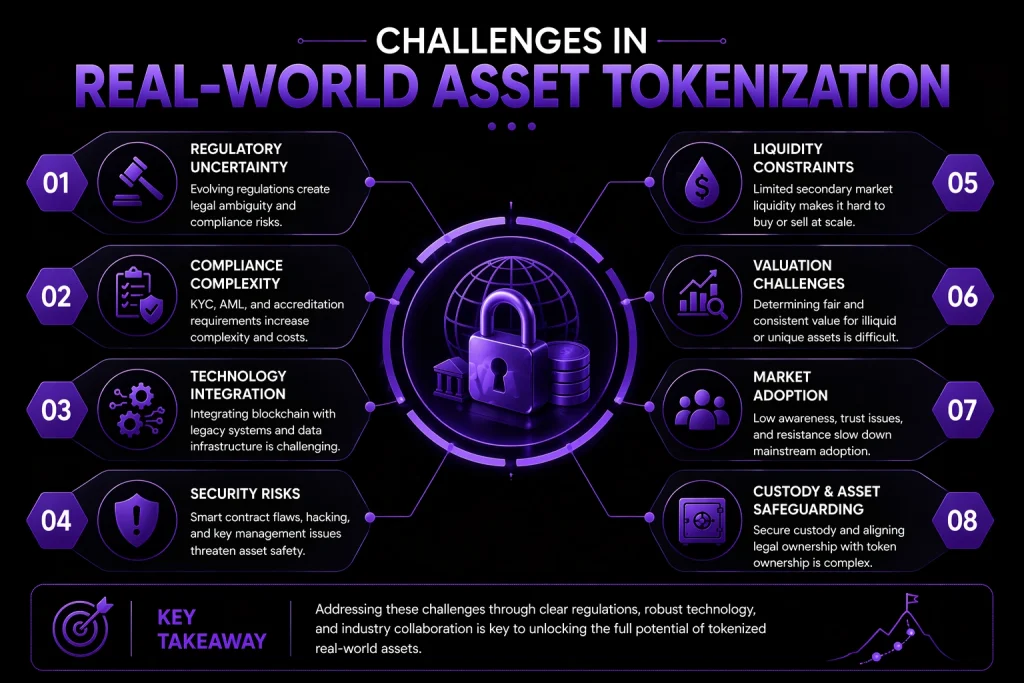
Key Challenges and Industry Responses
| Challenge | Industry Response / Solution |
|---|---|
| Regulatory Fragmentation (Global) | Jurisdictions are creating clearer frameworks (e.g., MiCA in Europe). Legal wrappers and a compliance-first token approach is the standard. |
| Liquidity Depth (Secondary Market) | Development of regulated marketplaces and integration with decentralized exchange development ecosystems to facilitate continuous trading and price discovery. |
| Oracle Reliability (On-Chain/Off-Chain Link) | Utilizing decentralized oracle networks (e.g., Chainlink) for verified, tamper-resistant feeds of real-world data. |
| Custody & Security | Institutional-grade custody solutions (Fireblocks, BitGo) and multi-sig wallet architecture decrease risk and increase asset security. |
Additional Context
- Regulation is evolving, not blocking innovation:
Governments and regulators are actively shaping frameworks rather than restricting adoption. - Liquidity will follow infrastructure:
With increased institutional capital, secondary markets will deepen spontaneously. - Technology risks are being actively solved:
Reliability is rapidly improving with Oracle networks, custody providers and standardized protocols.
Future of RWA Tokenization
The next phase of financial evolution will be defined by the merging of traditional finance (TradFi) and decentralized finance (DeFi), with tokenization as the bridge between the two. As we move into 2026 and beyond, institutions are no longer questioning if they should implement tokenization, but how fast they can embed it into their fundamental systems. Industry data, as well as forward-looking analysis such as Ripple’s tokenization insights, point to tokenized assets becoming a basic layer of global banking.
We are already seeing the emergence of blockchain-based asset management solutions that combine issuance, trading, compliance and reporting into a single programmable layer. These solutions will enable real-time settlement, automated compliance and frictionless cross-border money movements at a scale that current infrastructure cannot sustain.
At the same time, the financial products will be more and more modular. Tokenized treasuries, real estate, commodities and private credit will be aggregated into dynamic portfolios traded across interoperable ecosystems and regulated through smart contracts. This will free up continuing liquidity and change the way capital is deployed across the world.
What really changes is the ease of access and the efficiency. Markets will be transparent, liquid, global and no longer segmented and opaque. As infrastructure develops, firms and investors should seek out RWA tokenization platforms and protocols to remain competitive in this new financial market. AI development services are increasingly used alongside tokenization to enable predictive analytics and automated asset management.
Frequently Asked Questions (FAQs)
1 What is real-world asset tokenization?
Real-Asset Tokenization is the conversion of tangible or intangible assets into digital tokens on a blockchain. Such tokens can be bought, sold or controlled digitally. These tokens represent ownership or rights . Many tokenized assets are also backed by stable value mechanisms similar to stablecoins used in the crypto economy.
2 How does RWA tokenization work?
Assets are legally created, tokenized with smart contracts and distributed to investors on blockchain platforms. Transactions and ownership are recorded on-chain and are public.
3 What are the benefits of tokenized assets in finance?
Tokenization increases liquidity, reduces the settlement time, enables fractional ownership and increases transparency. It also cuts operational costs with automation.
4 What types of assets can be tokenized?
You can tokenize real estate, commodities, bonds, private equity, art, and carbon credits. Tokenized assets can also be used to create advanced financial instruments such as blockchain-based derivatives. Any asset with definable ownership rights becomes a candidate.
5 Are tokenized assets regulated?
Yes, tokenized assets are regulated by existing financial regulations. Compliance is enforced by legal wrappers, KYC/AML processes and programmable smart contracts.
6 What is the difference between stablecoins and tokenized RWAs?
Stablecoins are digital currencies pegged to fiat value, and tokenized RWAs are ownership interests in real-world assets. RWAs are exposures to the underlying asset, stablecoins are mainly a payment vehicle.
7 How do I invest in tokenized real estate?
Investors can buy tokenized real estate on special platforms that enable fractional ownership. The cost of entry is lower on these platforms than it is for traditional property investments. Tokenization platforms often facilitate these investments by providing fractional ownership and liquidity.
8 What role do oracles play in RWA tokenization?
Oracles connect blockchain systems to external data (e.g., asset prices, events). They guarantee that contracts (smart contracts) are performed on the basis of accurate and validated external data.
9 Can private equity funds be tokenized?
Yes, private equity funds can be tokenized, which means they can be broken down into smaller pieces, with the advantage of more liquidity and automatic dividends. This expands access to previously illiquid investments.
10 Which blockchain is best for asset tokenization?
There’s no one blockchain to rule them all, but Ethereum, Solana and Avalanche are common, depending on scalability, cost and compliance. It depends on the use case.
Concluding Note
The tokenization of real-world assets is no longer a theoretical invention. It is a structural change in the way financial markets operate. Tokenization involves digitizing, programming and liquidating ownership to transform asset classes from private credit to real estate.
With institutional adoption accelerating and infrastructure maturing, the gap between traditional finance and digital finance will only continue to close. Early adopters of these organizations will have a big edge in efficiency, accessibility and worldwide reach. With the evolution of financial institutions, the advanced architecture on Cosmos SDK blockchain development will enable scalable and flexible ecosystems for tokenized assets.
Isolated systems will not build the future of banking, but interconnected, programmable ecosystems powered by blockchain. Today, understanding and using real-world asset tokenization use cases will be key to participate in tomorrow’s financial markets.
