



Key takeaways:
- Tokenization ≠ on‑chain title deeds: Most systems today issue property tokens that represent beneficial ownership in an SPV/fund, not cryptographic title to the building.
- Fractional property ownership means slicing economic value and yield rights into tokens, enabling global investors to participate with small amounts of capital.
- Tokenized REIT‑style wrappers are the most common “legal‑friendly” structure: a corporation or SPV owns the real estate; tokens represent rights to income and gains.
- Polygon + ERC‑3643 is often the best fit for compliance‑first teams, combining EVM‑compatibility with identity‑linked, permissioned transfers.
- Real estate smart contracts usually combine ERC‑20‑compatible token patterns with ERC‑3643/ERC‑1400‑style controls for KYC, whitelisting, and jurisdiction filters.
- Rental income is typically distributed as stablecoins (USDC/USDT), either via push‑style airdrops or pull‑style claims, with gas‑costs and UX driving the design choice.
- Oracle risk, on‑chain title myths, and liquidity mismatch are the three biggest investor‑level risks; platforms must anchor legal claims in SPVs, not just tokens.
- Techfyte helps bridge legal and tech by designing compliant token‑economics, building real estate smart contracts, integrating KYC, and creating investor‑facing dashboards.
Introduction
The $300T real estate market remains fragmented across lawyers, registrars, and local compliance regimes. Blockchain doesn’t eradicate these facts, but it does make ownership arrangements, transfers and reporting programmable. Tokenization is infrastructure for making real estate globally accessible, auditable and operationally efficient, a trend that is highlighted by OECD housing market data. This guide breaks down the discrepancy people conflate: the vision of on-chain title deeds vs. the reality of property tokens today. Investors seldom get a direct transfer of title in the land registry. Instead, users buy a token reflecting an economic or beneficial ownership stake in a legal wrapper (SPV) that holds the asset. For builders, it’s crucial to align token design with these legal limits. Explore Techfyte’s blockchain development services and ensure your architecture fits from day one. This blog will help you understand how to tokenize real estate on the blockchain, with every minute detail covered.
What Is Real Estate Tokenization?
Tokenization is the process of reflecting rights on real estate as tokens on a blockchain (be it rental income, profit participation or appreciation). The core premise is fractional ownership of assets. That is, breaking down the economic value of an object into smaller units. That doesn’t necessarily mean the legal title itself is on-chain.
- Property Token: Provides its holder with a claim to income or equity of a corporation affiliated with the property.
- On-Chain Title Deed: The blockchain record itself is legally valid as a proof of ownership. This is aspirational in most places as land registries are archaic systems.
The most common compatible wrapper is the tokenized REIT or a similar SPV structure. Regulators are familiar with this approach because REIT structures are well understood in traditional finance. To put it simply, the operational layer is the blockchain and the enforceability layer is the legal entity. To design dedicated issuance flows, teams usually start with Techfyte’s real estate tokenization development services or a more generic asset tokenization architecture.
Why Tokenize Real Estate? Key Benefits for Investors & Developers
Tokenization creates distinct value for different stakeholders.
| Investor Benefits | Developer / Issuer Benefits |
| Fractional property ownership provides the chance to get worldwide exposure without the funds needed to purchase the entire property. | Tap investors outside of local brokers and high-net-worth people. |
| 24/7 Liquidity Potential: Potential basis for secondary trading within the regulations of the platform. | Automated Operations: Programmable cap tables, transfer restrictions, and dividend logic reduce manual back-office work. |
Investors can also reduce concentration risk via smaller investments in a property token. The benefit to issuers is programmability, or the ability to insert compliance regulations within real estate smart contract code, not spreadsheets. This concept is in line with the compliance-first platform approach outlined in Techfyte’s asset tokenization services.
How Real Estate Tokenization Works: The Full Process Explained
Tokenization is a dual‑track system that combines legal workflows and blockchain‑based execution. In practice, investors rarely transfer titles directly in the land registry. Instead, a legal wrapper (often an SPV or tokenized‑REIT‑style fund) holds the asset, and the property token represents economic rights over that entity.
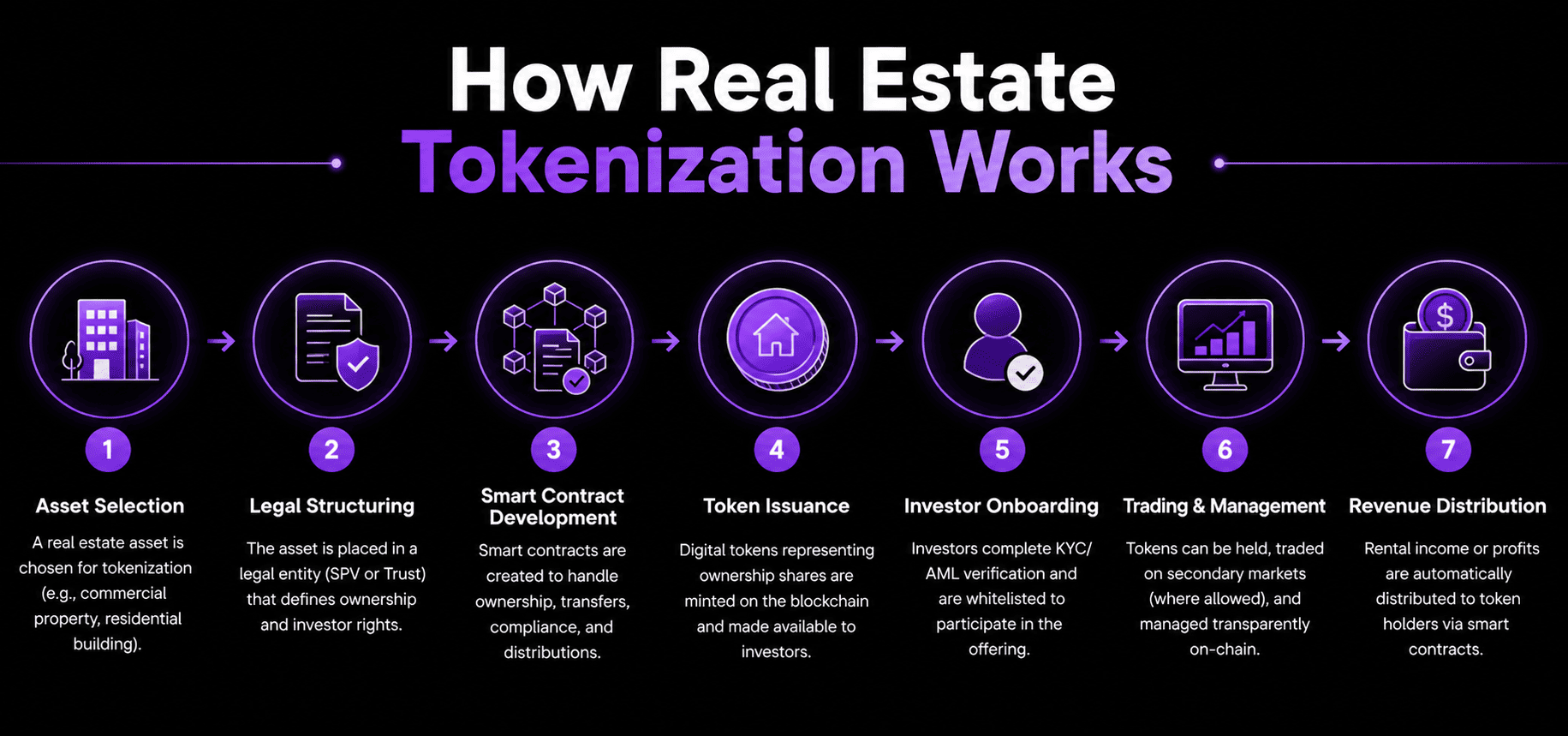
Here’s the full flow, split into Developer View and Investor View for each step:
| Step | Developer View | Investor View |
| 1. Structure Asset | Create SPV/trust. Tokenise revenue/equity share. | Your rights and responsibilities: yield, vote, redemption. |
| 2. Verify Data | Legal diligence, valuation and oracle configuration for NAV and rent feeds. | Look at disclosures, fees and cashflow estimates. |
| 3. Compliance Stack | Implement KYC/AML, whitelisting, jurisdiction filters. | Complete identity verification and suitability checks. |
| 4. Deploy Tokens | Deploy the real estate smart contract governing minting, transfers, and payouts. | Connect wallet and subscribe to the offering. |
| 5. Distributions | Automate stablecoin yield calculations and reporting. | Claim or receive distributions and watch the dashboard. |
| 6. Secondary Market | Integrate approved trading venues with compliance guardrails. | Pursue liquidity where locally allowed. |
Global Reality Check: In most jurisdictions today, the token represents beneficial ownership in an SPV rather than a direct mutation of the local land registry. Choosing the right blockchain architecture is critical, whether using Cosmos SDK-based blockchain networks.
Choosing the Right Blockchain for Real Estate Tokenization
The choice depends on whether you prioritize regulated issuance or high-frequency retail transfers.
| Blockchain | Best For | Compliance Fit |
| Ethereum / Polygon | Institutional-grade issuance and regulated assets | Strongest support for ERC-3643 and identity-based controls. Polygon reduces gas fees to onboard retail customers. |
| Solana | Retail trading at high frequencies | Compliance is usually handled at the application layer; transaction costs are very low. |
| Permissioned EVM | Bank-led networks and private consortia | Weaker public liquidity, but maximum privacy and strong policy control. |
For most companies designing compliant fractional property ownership products, Polygon is the best blend of EVM compatibility, cheap cost, and ERC-3643 support. That method is also one that teams analyzing chain-specific UX and gas trade-offs might consider along with Techfyte’s Polygon zkEVM development expertise.
Legal & Regulatory Requirements Before You Tokenize
Before you write a single line of smart‑contract code, you must determine the economic substance of the token. In practice, a property token that entitles holders to rent, appreciation, or profit‑sharing is almost always viewed as a security, not a utility. This triggers:
- Mandatory KYC/AML for investors,
- Wallet whitelisting and on‑chain restrictions,
- Transfer limitations and jurisdiction‑specific exemptions.
That legal-first framing works hand-in-hand with Techfyte’s smart contract development and auditing workflow and additional formal security checks such as Techfyte’s formal verification services.
That’s exactly what ERC-3643 is for. It allows permissioned transfers with identity-linked eligibility checks through ONCHAINID, letting issuers enforce country restrictions on-chain. For the underlying transfer logic, refer to Ethereum’s official ERC-3643 standard.
Smart Contracts & Token Standards: ERC-3643, ERC-1400 Explained
When you tokenize real estate, the real estate smart contract is the backbone of the system. It governs how tokens are minted, how they transfer, and how yield and governance rules are enforced. Two standards stand out for compliant, global‑friendly issuers: ERC‑1400 and ERC‑3643.
- ERC-1400 (Security Token Standard): Introduces partitioned balances and forced transfers to enable legal compliance such as court orders. The ERC-1400 security token standard is a practical reference.
- ERC-3643 (Permissioned Token for RWAs): Identity-aware transfers using ONCHAINID. The real estate smart contract verifies eligibility before settlement, so that only verified investors can possess the property token. See ERC-3643 implementation docs.
Pro Tip: Most production stacks are hybrid. They employ ERC-20 to be compatible with wallets but ERC-3643 logic for transfer control. Most teams using this strategy start by building a combination of identity checks, admin controls, and audit preparedness. Security and efficiency can be improved using gas-optimized smart contract development.
How Fractional Ownership Works in Tokenized Real Estate
Fractional property ownership is the core UX benefit of real‑estate tokenization. It means splitting the economic value, rental‑income rights, and sometimes governance‑rights of a single asset into smaller, liquid units.
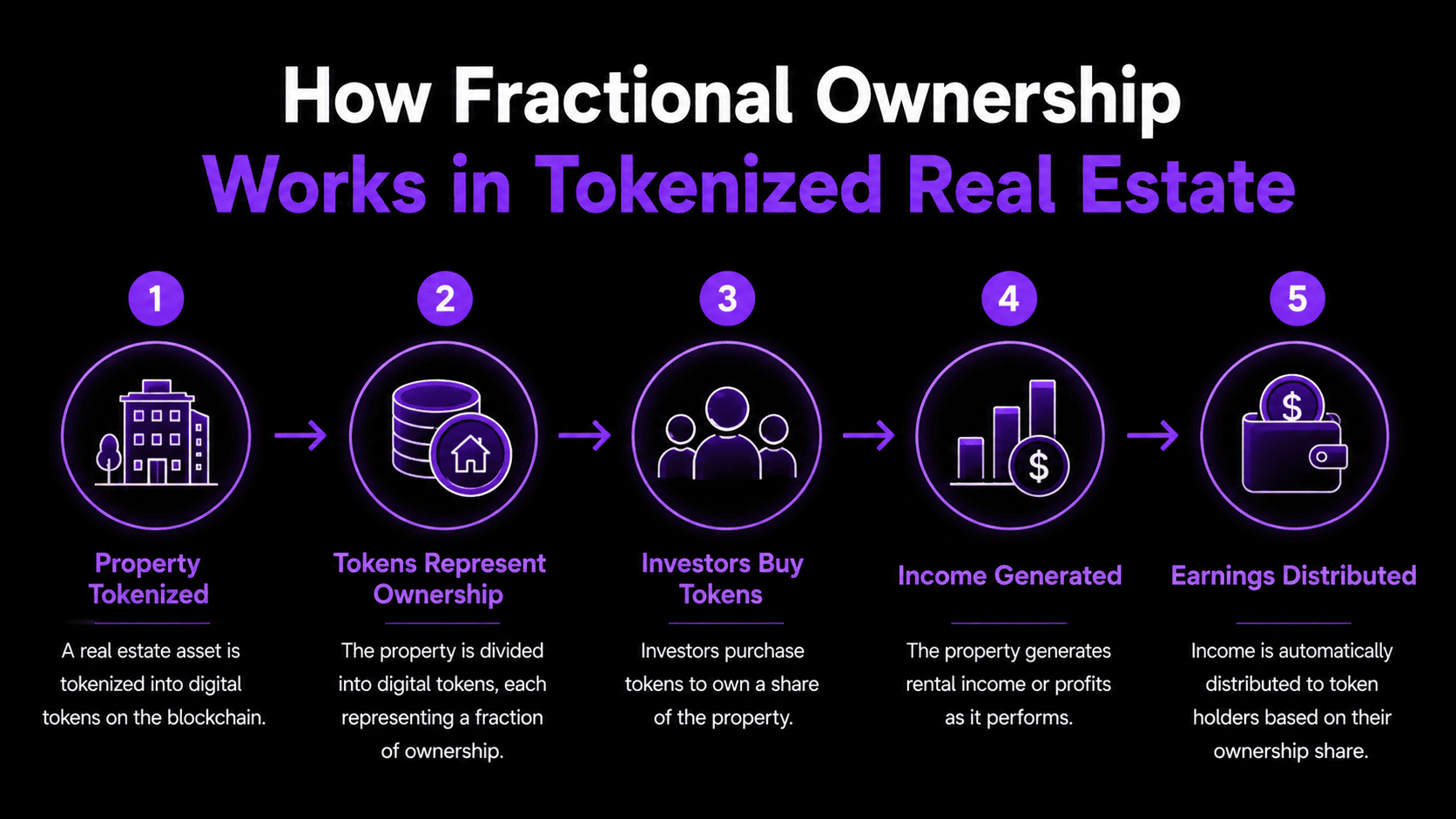
A brilliant example is: A $5M property is tokenized into 100,000 tokens. One token = $50 of stock value + pro-rata portion of rental yield.
This is fractional ownership of property as a slice of economics . It does not give the right to change the locks or to administer the property on a day to day basis. The token allows for the subdivision and administration of rights, but does not modify local property law. When building investor-facing experiences, issuers will commonly combine this concept with Techfyte’s real estate tokenization platform method.
How Rental Income & Yield Gets Distributed to Token Holders
- Push Model (Airdrop): Platform takes fiat rent, converts it to USDC and transfers to holders. It’s heavy on gas but clear.
- Pull Model (Claim): USDC is deposited in a smart contract, and holders call claimDividend() This makes it more gas efficient for large holder bases.
Stablecoins like USDC and USDT have become the de facto standard for cross-border yield distribution since they settle more quickly and more inexpensively than many international wires. This broader context is reflected in OECD work on stablecoins and financial stability.
Real Estate Tokenization Platforms: Top Options Compared
When you tokenize real estate, you don’t have to build everything from scratch. There are three main platform‑style paths, each with different trade‑offs for developers, issuers, and investors.
Below is a concise, global‑oriented overview of the main options, plus where Techfyte fits in the stack.
| Option | Best For | Differentiator |
| Techfyte (Custom Build) | Funds requiring custom compliance and payout logic | Real estate smart contract logic tailored to your needs, not templates. |
| White-Label Template | Fast market entry | Lower cost but limited flexibility. |
| Open Marketplace Clone | Concept validation | Limited customization for advanced compliance needs. |
Techfyte is the choice for teams that do not want to force a complex issuance model into a rigid product template.
How to Launch Your Real Estate Tokenization Project with Techfyte
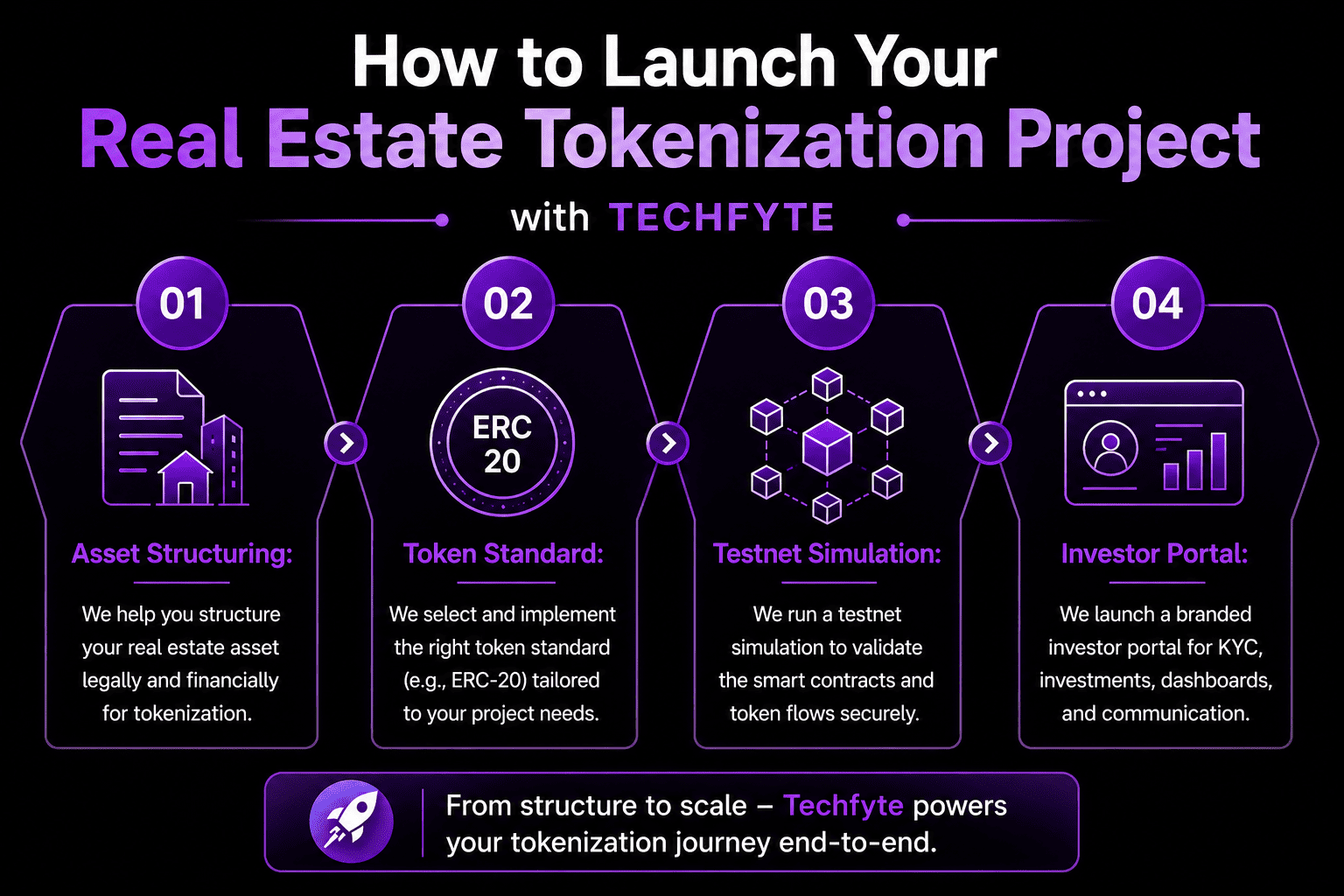
- Asset Structuring: Choose the wrapper (e.g. SPV, tokenized REIT) and check that it fits the jurisdiction.
- Token Standard: Use ERC-3643 for institutional compliance, or lighter contracts for retail participation.
- Testnet Simulation: Pressure-test fractional property ownership logic, transfers and stablecoin rewards.
- Investor Portal: Roll out KYC integration, dashboards, and admin tools.
Risks & Challenges in Real Estate Tokenization
- Oracle Risk: The blockchain takes the data it receives and processes it. Incorrect token payouts if rental income is misreported off chain. Mitigation involves multi-sig treasury controls and independent reporting.
- The On-Chain Title Deed Myth: A property token is a claim on a legal corporation, not a cryptographic key to the building. If the SPV files for bankruptcy, This is the most important danger for investors to comprehend.
- Liquidity Mismatch: Tokens can be traded 24/7 yet the underlying building can take months to sell. Transferability is not the same as guaranteed exit liquidity.
Frequently Asked Questions (FAQs)
1. What is the minimum investment for tokenized real estate?
There is no universal minimum. Tokenization reduces barriers to access compared to direct acquisition, however there are still minimums that are dependent on the issuer.
2. Which blockchain is best for property tokenization?
Polygon and Ethereum are generally the preferable option for regulated ERC-3643 compliance, but Solana can be a good fit for high-frequency retail volume.
3. Is tokenized real estate legally recognized?
Yes, generally regulated financial interest in an SPV or fund. It’s seldom a direct on-chain mutation of the land registration title deed.
4. How long does it take to tokenize a property?
Simple projects can take weeks. Institution-grade structures can take months as legal diligence dictates the timeline.
5. How is rental income distributed to token holders?
Usually via stablecoin rewards, e.g. USDC, either pushed out or claimed via smart contract automatically.
6. What risks should investors know about?
The biggest concerns include platform failure, inaccuracy of off-chain data and the legal distinction between direct title and token rights.
7. How does Techfyte help tokenize real estate?
Techfyte offers smart contract creation for real estate, KYC integration, audit-ready architecture, and investor portal design.
8. What is the difference between fractional property ownership and a tokenized REIT?
Fractional property ownership spreads the economic exposure; a tokenized REIT is a particular legal wrapper that holds the assets.
9. What is ERC-3643 and why does it matter for property tokens?
It’s a permissioned standard that checks on-chain so only confirmed investors can own the property token.
10. Can a real estate token act as an on-chain title deed today?
No. It’s beneficial ownership, not the operating land record in most jurisdictions.
11. What happens if the tokenization platform shuts down?
If the legal structure was correct, then the documents of the underlying SPV or trust should preserve the claims of the investors.
12. How are global KYC and AML handled for property tokens?
Through wallet whitelisting and identification frameworks like ONCHAINID, which is key to ERC-3643 style compliance.
