



Key Takeaways:
- Core Value: AI-First companies embed AI deeply into their operations, making it the core operating system rather than just a tool. They focus on intelligent automation, real-time decision-making, and autonomous workflows.
- Scope of Functionality: AI-First companies integrate AI into every part of their operations, from data pipelines and model serving to automated feedback loops. This helps them outperform traditional companies by enabling faster, data-driven decisions.
- Business Impact: AI-First companies experience exponential growth and efficiency improvements. Their business processes are faster, cost-effective, and more adaptable, enabling them to scale at a fraction of the cost of traditional companies.
- Adoption Across Sectors: Industries such as finance, logistics, retail, healthcare, and SaaS are seeing the most significant impact from AI-first strategies, benefiting from faster decision-making, reduced operational costs, and enhanced customer experiences.
- Future Trends: The future of AI-First enterprises lies in the growth of autonomous ecosystems, where AI agents interact with systems, smart contracts, and decentralized governance. These companies will increasingly rely on agentic workflows to automate processes and drive innovation.
By 2026, the conversation is no longer about whether a company uses AI. It is about how deeply AI is embedded into its operating model. Businesses investing in AI Development Services are going beyond experimenting and re-engineering operations around intelligent automation, real-time decision making and autonomous workflows. Many of these transformations are powered by custom LLM development that enables domain-specific intelligence.
According to McKinsey’s State of AI report, many firms still struggle to go from AI pilots to scalable commercial impact.
While old corporations are still trying to attach ChatGPT to old workflows, AI‑native organizations are redesigning their DNA. This blog explains why the gap is becoming a chasm, and how you may close it before your business is left behind.
What Is an AI‑First Company?
An AI-First company is an organization where artificial intelligence is not a tool, but the operating system. In these firms, data pipelines, model serving, and automated feedback loops are treated as first-class citizens. This is why many enterprises now rely on AI Agent Infrastructure to connect models, tools, memory, APIs, and business workflows into one execution layer.
AI‑First Company Meaning and Examples
There are two common forms of AI-first businesses:
- AI‑Native: Companies created from the ground up with AI at its heart (e.g., a fintech that uses AI to do real‑time credit risk scoring).
- AI-transformed: Incumbents that have rebuilt their basic operations around AI (e.g., a retailer that uses AI to auto-negotiate supplier contracts and manage inventories in real-time).
Unlike “AI‑adjacent” firms (which use AI for analytics and reporting), AI-first companies use AI for execution, with models making decisions and humans reviewing them as needed.
To dive deeper into the benefits of AI-first strategies, check out our related blog on AI-First Companies. Decisions are made by models, and humans review them as needed, immediately feeding them back into the system to create a continuous learning loop. That’s what makes AI‑native companies different from legacy systems in 2026.
Traditional Business Models: Limitations in 2026
Traditional enterprises also have a structural disadvantage; AI debt. This is the expense of not building the right data infrastructure, workflow architecture and model operations upfront. Limited ML Pipeline Development capacity leaves AI initiatives stranded in pilots instead of scaling to production effect.
Major constraints in 2026 are:
- Siloed Data: Customer Data in CRM, Supply-Chain Data in ERP, Finance in Excel. AI does not work in isolation. Advanced approaches like federated learning services can help unify insights without centralizing sensitive data.
- Manual handoffs: Humans export, clean and upload data. By the time a report is produced the window of opportunity has closed.
- Org Inertia: Legacy KPIs (Hours worked) vs AI-driven efficiency (Autonomous resolutions).
A traditional company in 2026 is not just slower; it is often blind to what is happening in real time. It depends on retrospective dashboards, while AI-first companies use predictive systems to anticipate changes and act before competitors notice the shift.
AI‑First vs Traditional Companies: Key Differences
AI-First companies don’t wait for monthly reports. They employ real-time data and Predictive Analytics Solutions to predict demand, spot risk, optimize pricing and automate choices before their competitors even know there is an issue.
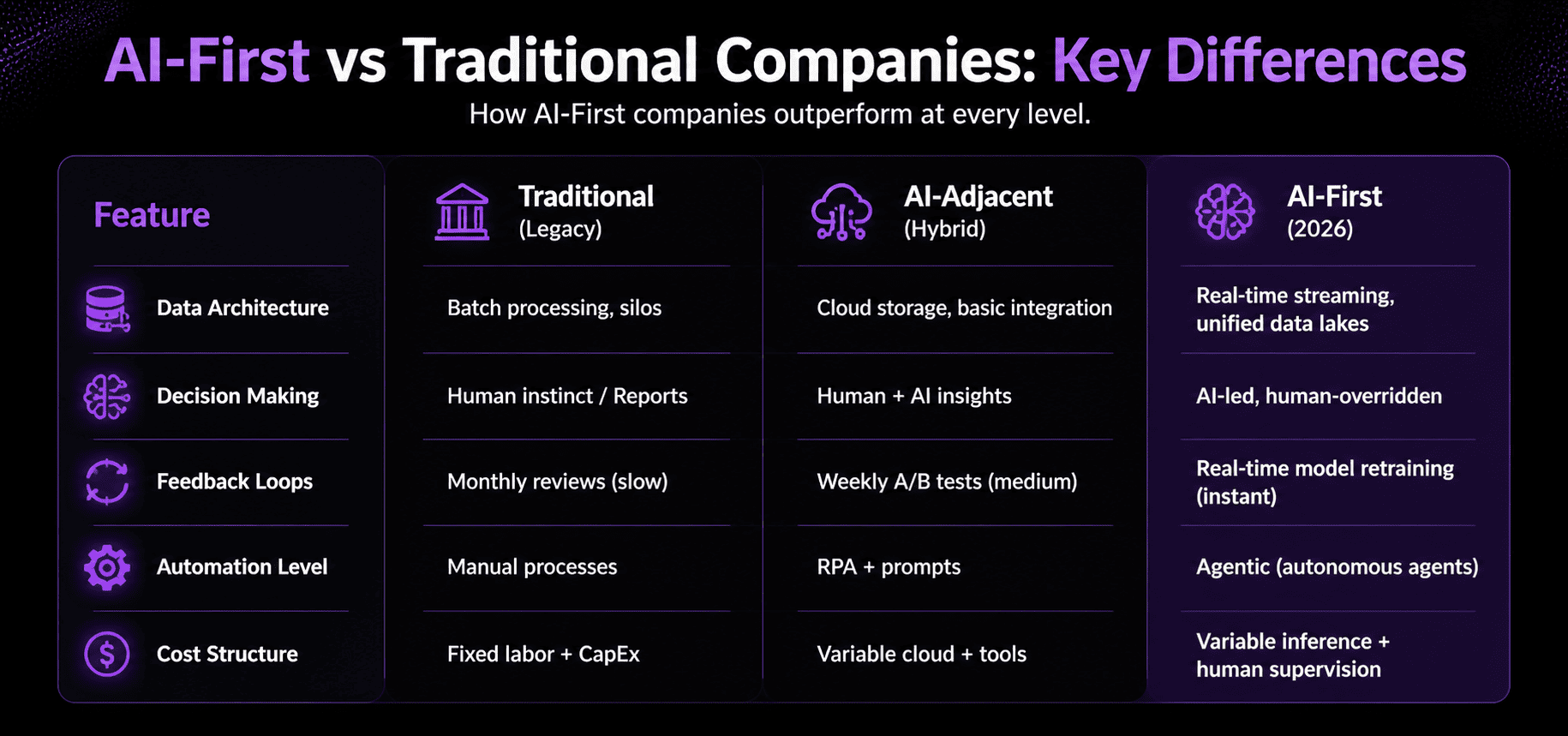
Not only are these disparities about productivity, but are also about architecture, autonomy and feedback loops.
The productivity contrast between AI and traditional workflows is stark:
- A typical loan officer may close 10 loans in a day.
- An AI adjunct officer might handle 50 with a copilot.
- An AI-first approach might process 10,000 of these and only flag 50 for human review.
This is the core of AI automation vs manual processes business impact in 2026.
Why AI‑First Companies Are Scaling Faster
The gap is widening fast because of compounding feedback loops:
- The Data Flywheel:
More users → more data → better models → better product → more users. - The Experimentation Loop:
AI-First companies execute thousands of A/B tests at once. No single test approved in a Monday meeting by traditional corporations, AI writes hypotheses, deploys variants, analyzes findings and iterates.| - Cost Structure:
AI automation brings the marginal cost per transaction down to almost zero. Traditional businesses have linear expenses (greater income = more hires). AI-First companies have exponential scale with almost linear expenses. In many cases, this is further enhanced by AI-based smart contract generation to automate execution layers.
McKinsey’s work on the economic potential of generative AI demonstrates that it has the potential to generate meaningful productivity improvements in customer operations, software engineering, sales, marketing, and R&D.
The Math Behind the Gap: By the Numbers (2026 Data)
Let’s put hard numbers on the impact of AI on business efficiency and cost reduction.
Traditional Company (Linear Scale):
- Revenue: $10M → $20M
- Headcount: 100 → 200 (costs double)
- Decision latency: 3 days (emAIl chAIns + meetings)
- Error rate: 5% (human fatigue)
AI‑First Company (Exponential Scale):
- Revenue: $10M → $20M
- Headcount: 100 → 110 (AI absorbs 90% of growth‑driven work)
- Decision latency: 3 seconds (real‑time inference)
- Error rate: 0.8% (models don’t get tired; only drift)
The Widening Gap Formula (2026):
Gap = (Data Velocity × Model Iterations) ÷ Human Bottlenecks
In 2026, AI-First companies will execute roughly 200× more tests every quarter than traditional companies. Even if only 10% succeed, their learning speed is unstoppable.
A practical example makes this even clearer: A Fortune 500 retailer using an AI-first supply chain reduced stockouts and inventory holding costs significantly, while a competitor relying on manual forecasting missed real-time demand signals. That difference is exactly what impacts cost efficiency and business resilience.
How AI Is Transforming Business Operations (Architecture + Agentic)
The change is under the hood to be seen. hese systems are increasingly powered by integrated AI-blockchain solutions that ensure transparency and automation.
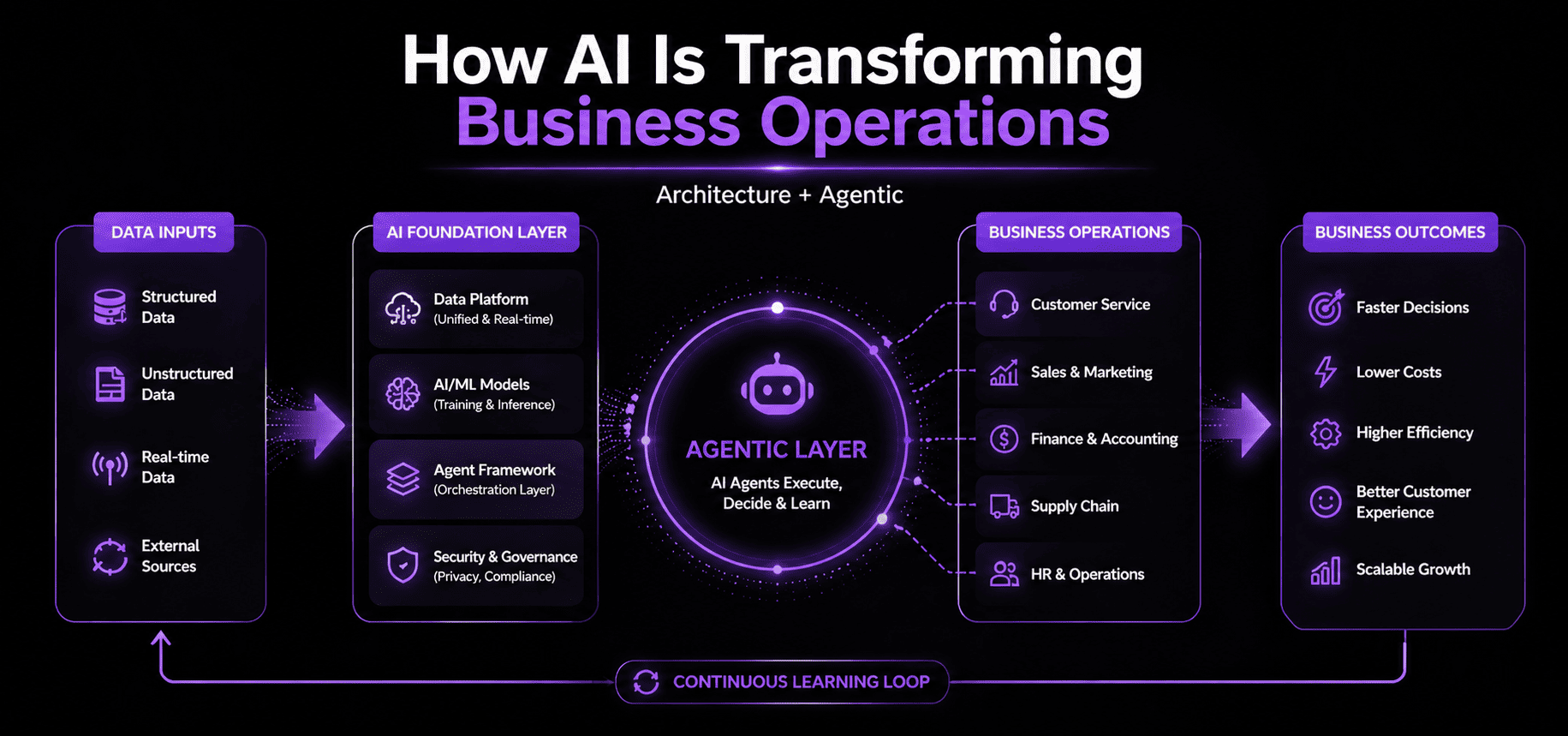
Three basic levels of AI powered business transformation case studies:
The Architecture Shift
- Traditional: App → Database → Report (batch).
- AI‑First: Event stream → Feature store → Model inference → Action → Feedback loop (real time).
Agentic Workflows: The 2026 Breakthrough
The biggest 2026 advantage is not chatbots. It is agentic workflows. Techfyte’s AI agent infrastructure aligns with this shift by connecting AI models to tools, memory, APIs, and business logic.
An agentic workflow is different from a chatbot because it includes:
- Memory: It remembers past decisions.
- Tools: It can query APIs, run SQL, send emAIls.
- Planning: It breaks “negotiate contract” into 12 sub‑steps.
- Reflection: It reviews its own work and improves.
This process can be audited using on-chain AI training logs for transparency and compliance.
In customer support, for example, a traditional workflow may take 20 minutes per ticket. An AI-adjacent workflow may reduce that to 1 minute with approval. An AI-first agentic workflow can read the ticket, research the answer, respond, and update the knowledge base automatically, leaving humans to handle only edge cases. To understand how AI and blockchain integration can revolutionize your operations, check out our detailed service offerings on AI-Blockchain Solutions.
Real‑World Examples of AI‑First Companies (Case Studies)
Logistics
A traditional logistics team may route 50 trucks manually over several hours. An AI-first logistics system can route thousands in real time by factoring in traffic, weather, delivery priority, and fuel usage. That kind of automation dramatically reduces fuel waste and improves service levels. For decentralized solutions that connect multiple blockchains, learn about our Cross-Chain Smart Contracts service.
Software Development
AI-adjacent teams may use copilots to write code faster. AI-first software teams go further by using agents to review pull requests, generate tests, and suggest architectural improvements based on telemetry. That is how deployment cycles become dramatically faster.
Retail
Traditional retailers often rely on quarterly forecasting. AI-first retailers use real-time demand sensing. If a product trend goes viral, the AI system can trigger procurement actions within minutes rather than waiting for a planning meeting. That is why AI native companies outperform legacy systems in volatile markets. Incorporating Web3 technologies can empower your digital transformation – explore our Web3 Development services to get started.
AI Adoption Strategy for Enterprises (The Roadmap)
To become AI-First, you need a clear enterprise AI adoption strategy roadmap. Don’t try to boil the ocean in 2026.
Phase 1: AI-Aware
- Audit data debt “Where are your silos?”.
- Run parallel pilots (AI and humans side by side, no authority).
- Objective: Demonstrate ROI on a single workflow (e.g. invoice processing).
Phase 2: Adjacent AI
- Create a feature store.
- Enable workflows with human review.
- Train business unit “prompt engineers.”
Phase 3: AI-First
- Grant models codify authority (e.g., “AI can process refunds up to $50 without review”).
- Use agentic swarms for repetitive jobs.
- Shift from cost reduction to revenue generation (AI-based pricing, cross-sell, and market discovery).
The best AI transformation strategy for enterprises in 2026 is not to start with a giant transformation program. It is to start with a workflow, prove the value, and then scale outward.
Challenges in Becoming an AI‑First Company
And governance becomes crucial as soon as AI systems are making decisions. Neuro-Symbolic AI Systems combine statistical AI with rules, logic and explainability, to mitigate hallucination and reasoning risk for enterprises. The road is not a rosy one. The risks are real:
Common challenges
- AI debt and model drift: Models degrade as market conditions change. Without monitoring and retraining, performance drops quickly.
- Governance and hallucinations: Businesses need guardrails, audit trails, and compliance checks.
- The talent trap: AI-first companies need hybrid roles, not just data scientists.
- Legacy integration: Old systems often cannot connect directly to modern AI workflows.
For regulated industries, AI-first transformation also requires traceable decision logs and stronger risk frameworks. That is why standards such as the NIST AI Risk Management Framework and the EU AI Act matter.
Future of AI‑Driven Enterprises in 2026 and Beyond
The Stanford AI Index Report gives valuable insights into AI investment, model development, business acceptance, and the larger economic transition to AI-enabled systems. The future of AI-enabled enterprises and automation is heading towards autonomous ecosystems. These ecosystems are often governed by algorithmic governance systems for rule-based automation.
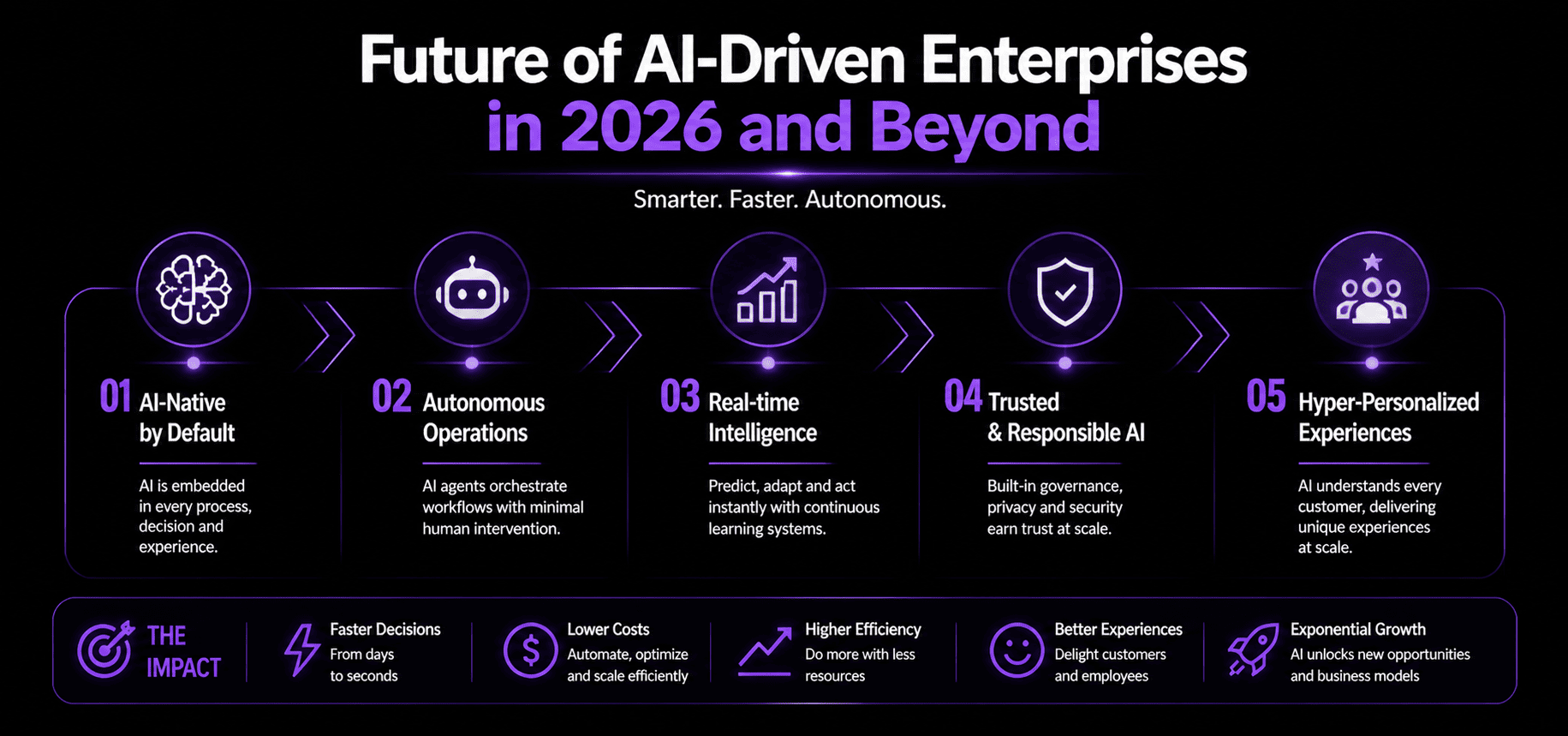
- Agentic Mesh: Sales AI and Supplier AI deal without human lawyers Autonomous organizations will start to be populated by AI agents that interact with financial systems, smart contracts and decentralized governance layers. Businesses looking at this future can use DAO Infrastructure Development to empower programmable decision making and automated operational rules.
- Outcome-Based Pricing: Per-Seat Software Is Dead. Future enterprise software pricing based on effective automation outcomes.
Traditional firms will continue as regulated utilities. But in consumer tech, finance, logistics and SaaS, AI-First is the only way to survive.
How to Transition from Traditional to AI‑First
Most companies fail because they try to “boil the ocean”. Instead do this 10 week sprint.
Weeks 1-2: Data Mapping & Audit
- What are your top 3 manual workflows (invoice matching, lead routing, inventory reorder)?
- Map every data source (even the Excel files on Sharon’s desktop).
- Deliverable: “Data debt” scoring sheet.
Weeks 3-4: Parallel Operation
- Choose a single workflow (e.g., customer support ticket triage).
- Build a simple LLM pipeline to run with people.
- Accuracy, speed, and cost are measured.
- Don’t turn it on yet. Just measure.
Weeks 5-6: Human-in-the-Loop (AI-adjacent)
- Give AI “recommend” powers (human clicks OK).
- Time saved versus manual work
- Train your team to supervise, not work.
Weeks 7-8: Shift to Agentic
- Add tools (AI queries CRM, knowledge base, inventory APIs)
- Eliminate “approval” for low‑risk actions (e.g., scripted responses).
- Watch every move. Log every edgecase.
Weeks 9-10: Scale & Embed
- Move from one workflow to three.
- Build an AI Playbook for the rest of the org.
- Hire your first AI Hybrid (a domAIn expert who can tune prompts and guardrails).
Critical Success Factor:
Change your review cycle. Traditional reviews ask: “What did you do this week?”
AI-First reviews ask: “What did your agents automate this week? How did the model fail? What data was lacking?”
AI transformation strategy for organizations 2026 comes down to this: Begin with process, not strategy. Strategy derives from working code, and measurable results.
Frequently Asked Questions
1. What is an AI‑first company?
An AI-first company is one in which AI is the operating system that forms the core, not a bolt-on technology. Machine learning is the default for decisions, workflows, and data pipelines.
2. How do AI‑first companies differ from traditional companies?
Traditional organizations rely on intuition and batch reports. AI-First firms rely on real-time models and autonomous agents. The difference is data architecture, feedback loop speed, and automation depth.
3. Why are AI‑first companies growing faster?
Because of compounding feedback loops. More data → better AI → better products → more users → more data. This exponential loop is impossible for linear‑cost traditional businesses to match.
4. Can traditional companies become AI‑first?
Yes, but they have to go through an AI-adjacent phase. What’s needed is a multi-year roadmap to consolidate data, upskill individuals, and gradually give models decision-making ability.
5. What industries benefit most from AI‑first strategies?
Finance (risk, trading) Logistics (routing, warehousing) retAIl (demand forecasting) Healthcare (diagnostics, admin) SaaS (DevOps, customer support) Any industry having a high rate of data velocity.
6. What are the challenges of becoming AI‑first?
Key issues are AI-debt (bad legacy data), model drift, regulatory compliance, hallucinations, and hybrid talent (domAIn + ML).
7. What is an “AI‑adjacent” company?
A hybrid model where humans employ AI tools (copilots) to work quicker but AI cannot operate autonomously. Most AI changes stall here because they never give anyone power to execute.
8. How do AI agents change workflows in 2026?
Agents are autonomous. Instead of a human clicking a button to generate a report, an agent observes a metric, creates the SQL, runs the analysis, and pushes the fix; without being instructed to do so. This is agentic workflows in 2026.
9. How much cost reduction can AI actually deliver?
AI-First companies experience a 40–70% drop in marginal transaction costs. For digital services such as customer support, expenses can approach $0 beyond inference compute time.
10. What is the biggest risk of rushing into AI‑First?
Autonomy without state. If your procurement AI gets a taste for $10,000 worth of paperclips because of a faulty cost function, you have a very expensive mess.
