



Key Takeaways
- Zero-knowledge proofs enable trust without data exposure
They allow verification of information without revealing the underlying data, redefining how privacy works in digital systems. - ZK is transforming blockchain into a private, verifiable computing layer
Instead of just transparent ledgers, blockchains can now support confidential and secure interactions. - They solve two major challenges: scalability and privacy
ZK powers zk rollups ethereum scalability while enabling privacy in blockchain using zk proofs. - ZK Rollups are the backbone of Web3 scaling
By batching transactions and submitting a single proof, they drastically increase throughput and efficiency. - Gas fees are significantly reduced through batching and compression
This is a key reason behind the rise of zk scaling solutions for web3. - Real-world adoption is already happening across DeFi, identity, and gaming
From private swaps to zero knowledge identity verification, ZK is actively shaping modern applications. - Challenges still exist but are rapidly being solved
Issues like computational cost, circuit complexity, and centralization are improving with ongoing innovation. - The future of ZK is universal adoption across Web3
From zkML to recursive proofs, ZK is set to become the default infrastructure layer for a secure and scalable internet.
Introduction
Imagine being able to prove you know a secret, but ever giving away the secret itself? In a modern age predicated on data exchange, this premise sounds nearly contradictory. But it is exactly what current cryptography makes possible, and it changes the way trust works online.
Zero knowledge proofs are a sort of cryptography in which something can demonstrate a statement without sharing any information. It validates without explaining the “why” or the “how,” in layman’s words.
This idea, first created in the 1980s, has been reborn as the backbone of today’s blockchain innovation. It underpins zk based blockchain protocols unlocking two of the main hurdles in Web3 – privacy and performance. As systems move beyond the simple notion of transparency, zero-knowledge technology is becoming the underlying technology for the next foundational layer of Web3 technology.
As businesses explore privacy-first architectures, partnering with experts in Blockchain Development Services ensures secure and scalable implementation of advanced cryptographic systems.
We’ll break down zk cryptography explained easy, explore powerful zk scaling solutions for web3, and dig into real-world zero knowledge proof blockchain use cases that are already revolutionizing the decentralized ecosystem in this book.
What Are Zero-Knowledge Proofs? A Simple Analogy
A good way to understand zero-knowledge proofs is to think visually, rather than read definitions. Imagine a “Where’s Waldo?” puzzle. You say you found Waldo, but instead of showing him straight away (and giving the answer away) you cover the whole page with a sheet of paper, with only a small cut-out window showing just Waldo. The spectator can plainly tell Waldo is there but learns nothing about where he is on the entire page. So that’s the gist of zk cryptography in a simple explanation. Showing you know something without telling what it is .
It’s built on foundational cryptographic principles such as hashing and encryption, but elevates privacy to the next level by guaranteeing that no other data is revealed in the process of verification. Modern implementations, such as those used in Ethereum zk-rollups and privacy-focused implementations such as Zcash zk-SNARKs, bring this idea to real-world blockchain applications.
For a system to be a valid zero-knowledge proof, it must satisfy three key properties:
- Completeness
If the assertion is truthful and both parties are honest, the verifier will be convinced. - Soundness
If the statement is incorrect, no dishonest prover can mislead the verifier (with probability more than insignificant). - Zero-Knowledge
The verifier learns nothing other than that the statement is true; no hidden data, no leaking.
These cryptographic foundations are increasingly being integrated into modern decentralized applications through advanced dApp Development frameworks. Together these features enable trust without transparency, the backbone of privacy-first blockchain innovation.
How Zero-Knowledge Proofs Work: The Core Flow
Two basic jobs form the basis of zero-knowledge systems: the Prover and the Verifier. The Prover does the heavy calculation off-chain, and the Verifier is usually an on-chain smart contract that quickly, efficiently verifies the output. The isolation is what makes zero-knowledge systems both scalable and private.
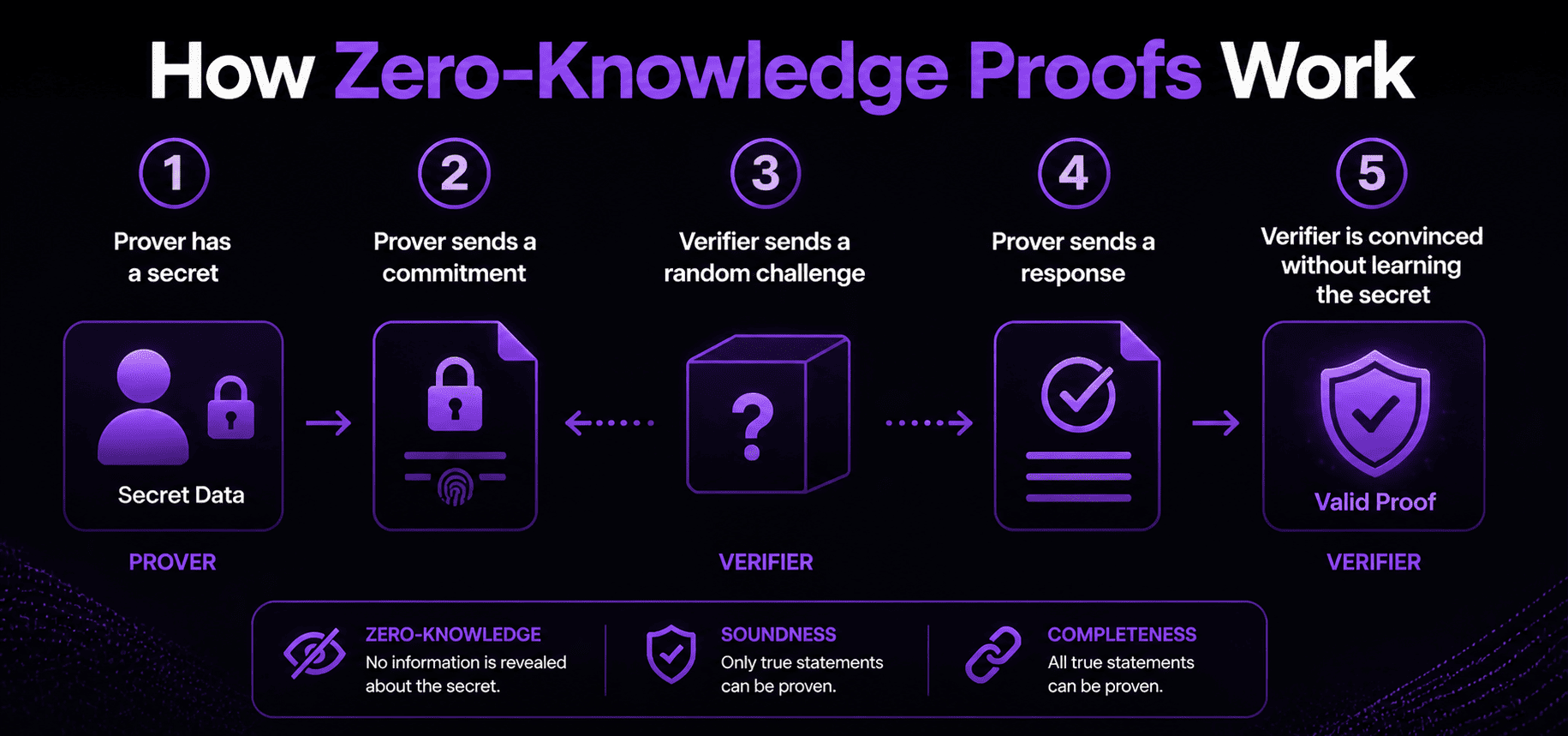
Let’s break down the process as a simple, step-by-step flow:
- User Action
A user conducts a transaction on a ZK-based application – a token transfer, a trade, or identity verification. - ZK Circuit Execution
Transaction data are processed off-chain inside a ZK circuit that encodes the rules of the system and computes if the transaction is valid. - Proof Generation
Rather than providing all the data from the transactions , the circuit generates a small cryptographic evidence that the circuit operated correctly. - On-Chain Verification
This proof is provided to an Ethereum smart contract that executes a lightweight verifyProof function utilizing standardized, open-source cryptographic primitives. - State Update
If the proof is right, the blockchain immediately changes its state. The verifier never sees the confidential data, merely assurance that the transaction is correct. This is zk cryptography explained simple in action.
The flow is the backbone of modern zk scaling solutions for web3, enabling faster, cheaper and more private interactions on the blockchain. The verification layer is typically powered by secure Smart Contract Development that ensures trustless validation of cryptographic proofs.
Why ZK Technology Matters in Blockchain
Zero-knowledge technology in blockchain is much more than just privacy in blockchain utilizing zk proofs. Its true usefulness is twofold – it tackles scalability and privacy at the same time, two pillars of the famous blockchain scalability trilemma.
Scalability
The current blockchains handle every transaction independently on-chain leading to limited throughput and higher expenses. Zero-knowledge proofs turn this model on its head. Alternatively, thousands of transactions are aggregated and compressed into a short proof, which may be submitted on-chain for verification. This greatly reduces the network load and enables high-performance systems, which is the backbone of modern zk scaling solutions for web3.
Privacy
Blockchains are by nature transparent, however not all data should be visible to everyone. ZK technology enables users to validate the correctness of a transaction or an identification attribute without disclosing sensitive information. From private payments to zero knowledge identity verification, ZK makes sure that you only reveal what you need to—nothing more.
Combined, these features make ZK proofs one of the most potent technologies driving the next generation of blockchain infrastructure.
This evolution is driving demand for scalable infrastructure solutions like Ethereum Blockchain Development that support high-performance zk-based systems.
ZK Rollups Explained: The Scalability Workhorse
ZK Rollups are among the most powerful Layer-2 developments aimed to scale Ethereum without sacrificing its security. Simply said, a ZK Rollup “rolls up” thousands of transactions, executes them off-chain, and delivers one cryptographic proof back to Ethereum. Rather than verifying each transaction on-chain, only the proof is checked, which enormously reduces the computational strain.
This is where ethereum scalability zk rollups comes to life. ZK Rollups enhance throughput from around 15 transactions per second to over 2000 TPS by relocating execution off-chain, while still relying on Ethereum for final settlement and security. You get the best of both worlds: Ethereum trust guarantees with much increased performance.
Another essential thing is how zk minimizes the gas fees. Many transactions are batched together so the cost of uploading the data to Ethereum is amortized among all those using that batch. This, coupled with enhanced data compression techniques, means that a transaction that may cost $20 on Layer-1 might reduce to roughly $0.20 on a ZK Rollup, making Web3 apps much more affordable.
Leading projects are already driving this technology forward. Protocols like zkSync Era, StarkNet, Polygon zkEVM, and Scroll are fantastic examples of zk-based blockchain protocols in operation, enabling the creation of faster, cheaper, and more scalable decentralized applications.
ZK Rollups vs Optimistic Rollups: A Detailed Comparison
When it comes to Layer-2 scalability, ZK Rollups and Optimistic Rollups are fundamentally different in the way they treat trust. The main difference is how they validate transactions. Optimistic Rollups trust that transactions are valid by default and rely on a fraud-proof system that allows any user to dispute improper transactions within a period of around 7 days. ZK Rollups, on the other hand, rely on validity proofs – mathematical evidence of accuracy that are submitted up front, eliminating objections and offering instant finality. This challenge time is crucial to the security model of rollups, as detailed in Ethereum’s official documentation on rollups.
Here is a simple side-by-side comparison:
| Feature | ZK Rollups | Optimistic Rollups |
| Core Mechanism | Validity Proofs (Cryptographic) | Fraud Proofs (Economic/Social) |
| Finality Time | Instant (once proof is verified on L1) | ~7 Days (delayed by challenge period) |
| Data Posting | Proof + compressed state diffs | Full compressed transaction data |
| Capital Efficiency | Instant withdrawals to L1 | 7-day delay for native withdrawals |
| EVM Compatibility | Growing rapidly (zkEVMs) | Fully compatible initially |
| Prover Cost | High computational cost | Low computational overhead |
That difference matters in the real world. ZK Rollups enable faster withdraws and higher security guarantees, but Optimistic Rollups are easier to execute and more developed in the tooling today. But with zkEVM technology maturing, the gap is decreasing quickly. To understand where these scaling solutions fit into larger decentralized systems, you may check out this full guide to Optimistic Rollups which relates rollup design to actual Web3 development techniques.
Benefits of Zero-Knowledge Proofs
Zero-knowledge technology is a remarkable combination of privacy, performance and security that is a fundamental aspect of modern blockchain innovation. Here’s a summary of the main benefits:
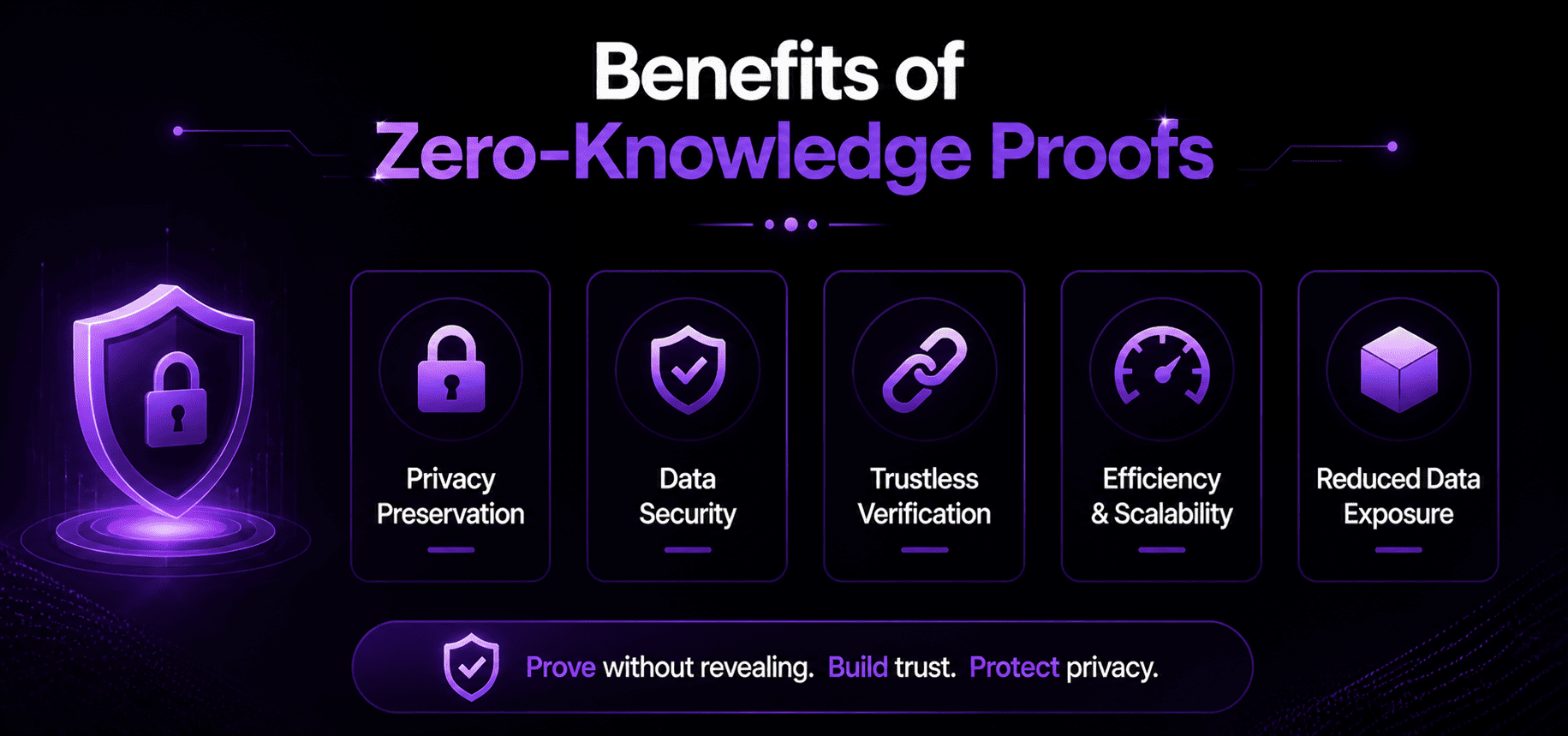
- Unparalleled Privacy
Zero-knowledge proofs allow users to prove information without revealing sensitive data. This is crucial for zero knowledge identity verification (e.g. age or credentials proof), and zk proofs in defi applications such as private trading environments or dark pools. - Massive Scalability
ZK systems improve throughput significantly by moving computing off-chain and just confirming succinct proofs on-chain. This is the secret behind the zk rollups ethereum scalability that enables networks to process thousands of transactions smoothly. - Reduced Gas Fees
ZK proofs take a lot of data about a transaction and condense it into a single proof that may be shared by numerous users. This amortization drives prices down dramatically making interactions with blockchains more cheaper. - Enhanced Security
ZK systems are based on strong cryptographic guarantees and not on trust or intermediaries. This decreases the chance of manipulation and ensures that all validated transactions are mathematically correct.
All of these features make zero-knowledge proofs a game-changer for expanding and securing Web3 environments.
Real-World Use Cases of ZK Technology
Zero-knowledge proofs are not only a theory anymore, they are actively changing the way privacy, trust, and scalability are working in Web3. Here are some of the most powerful zero knowledge proof blockchain use cases already coming to fruition in commercial situations.
DeFi: Private Swaps and Shielded Lending
Enabling private financial activity on transparent blockchains is one of the most powerful use cases of zk proofs in defi use cases. Projects such as Penumbra and Panther Protocol are establishing privacy-first DeFi ecosystems that allow users to conduct swaps or enter dark pools without exposing the details of their trades, hence reducing the risk of front-running and MEV abuse. Moreover, shielded lending models allow users to establish that they have sufficient and healthy collateral without revealing the whole makeup of their portfolio. These developments are charting the course for the next wave of decentralized finance in step with larger trends in Web3 infrastructure.
Identity: Privacy-Preserving KYC
Zero knowledge identity verification is rethinking digital identity with zero-knowledge technology. Instead of providing sensitive documents, users can prove traits like “I am over 18” or “I am a verified citizen” without revealing personal data. Projects such as Worldcoin’s World ID and Polygon ID are pioneering this area, offering secure and reusable identification layers that are compliant with regulations while safeguarding user privacy.
Web3 Gaming and Social
ZK proofs open up totally new engagement patterns in gaming and social platforms. Players can demonstrate they have finished a mission or spotted an opponent without giving out exact in-game coordinates, maintaining strategic advantage. Social platforms can also allow users to prove ties (e.g., they follow someone, they are in a group) while hiding the whole social graph. These use cases demonstrate the profound integration of ZK technology into new Web3 ecosystems and emphasize its importance in scalability and privacy-first application design.
These innovations are also unlocking new financial models such as tokenized assets through RWA Tokenization Services
Challenges of ZK Technology
Zero-knowledge proofs are changing the game for Web3, but it is crucial to be aware of the obstacles that come with this strong technology. Understanding these boundaries provides a more practical understanding of where ZK is at the moment—and where it is headed.
- Computational IntensityThe generation of zero-knowledge proofs demands substantial computational resources. Verification on-chain is fast and efficient, but proving can be slow and costly, especially for complicated transactions.
- Circuit Complexity
ZK systems use specific circuits that encapsulate business logic as mathematical restrictions. Building these circuits requires sophisticated cryptographic knowledge, which creates a high learning curve and a bottleneck for developers in the ecosystem. - Centralization Risk
In many contemporary implementations, especially rollups, the prover is run by a single individual or small group. It does add some centralization which is against the general decentralization ethos of blockchain. - The Trusted Setup Specter
Earlier ZK systems (such as some zk-SNARKs) needed a one-time “trusted setup” procedure. Violating this could compromise the integrity of the system. But newer methods like zk-STARKs and more recent zk-SNARK designs are actively trying to eliminate this necessity.
Despite these limitations, ZK ecosystems are rapidly innovating to improve efficiency, accessibility, and decentralization. Overcoming these challenges requires deep expertise in cryptographic engineering and scalable system design, often delivered through specialized blockchain development partners.
Future of ZK in Web3: The Path to Universality
Zero-knowledge technology is quickly changing from a scaling answer into the basis for a private, verifiable internet. This transition defines the future of zk in blockchain – where every interaction can be trusted without revealing sensitive data and verification becomes native to the system itself. As Web3 ecosystems evolve, this concept is increasingly linked to broader decentralized application designs.
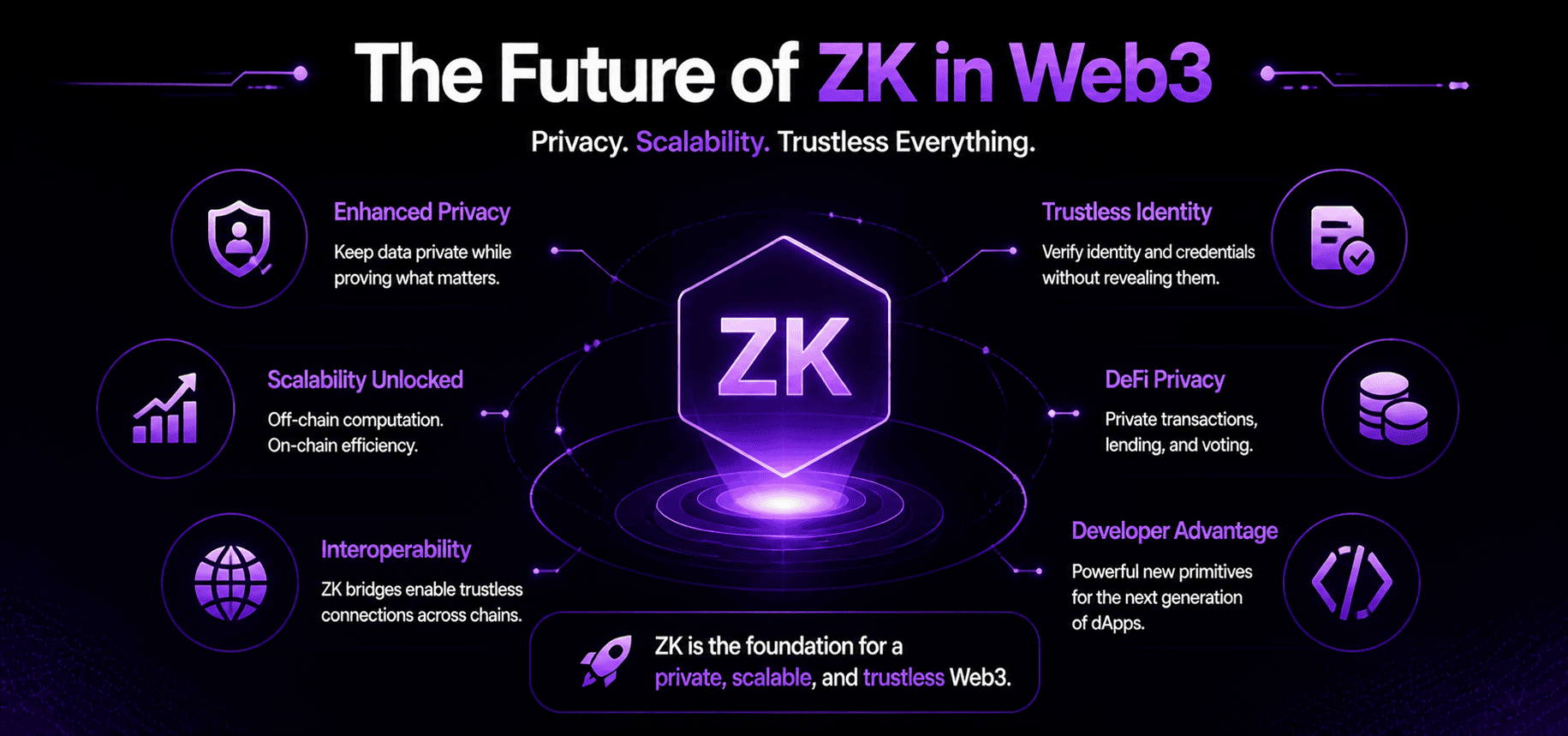
This transition is driven by several main trends:
- zkML (ZK Machine Learning)
zkML allows you to prove that a machine learning model generated a correct output without revealing the model or the user’s input data. Huge consequences for the privacy sensitive industries and in line with emerging AI-integrated blockchain systems.
- Recursive Proving
Recursive proving, sometimes called the “holy grail” of scalability, allows one evidence to verify another. This unlocks remarkable efficiency and bolsters advanced zk scaling solutions for web3, enabling chaining and compressing huge amounts of computing into a single, verifiable proof.
- ZK-Everything
The long-term objective is a future where ZK is deeply ingrained in every layer of Web3 from identification to payments, gaming and interoperability. Instead of being an add-on, ZK becomes the default standard for safe and private interactions, in keeping with broader ambitions articulated in Ethereum’s long-term scalability roadmap.
As these advances grow, zero-knowledge proofs are poised to revolutionize the relationship of trust, privacy and computing in the decentralized internet.
Frequently Asked Questions (FAQs)
Here are quick answers to the most common questions about zero-knowledge proofs.
1. What is a zero-knowledge proof in simple terms?
Zero-knowledge proof allows one to show the truth of a statement without exposing any information about it. It validates and preserves data privacy.
2. How do ZK proofs work on a blockchain?
Transactions performed off-chain and a cryptographic proof generated. This proof is validated on-chain without disclosing the data behind it.
3. Why are ZK proofs important for Web3?
They boost scalability and privacy of blockchain with zk proofs, making systems faster and more secure.
4. What are ZK rollups?
ZK rollups are layer-2 solutions that package transactions off-chain and send a single proof to Ethereum.
5. How do zk-rollups reduce gas fees on Ethereum?
zk does a great job of reducing gas fees. They group transactions and spread the cost between users.
6. What is the difference between ZK and Optimistic rollups?
ZK Rollups utilize quick validity proofs. Optimistic Rollups utilize fraud proofs and a delay period.
7. Where are ZK proofs used in crypto today?
They are applied in scaling, identification and DeFi, targeting critical zero knowledge proof blockchain use cases.
8. What are the disadvantages of zero-knowledge proofs?
They are difficult to construct, involving extensive processing and may need centralized provers.
9. Can zero-knowledge proofs be used in DeFi? Give examples.
So yes, there are defi programs that use zk proofs for private transactions like Penumbra and Panther Protocol.
10. Is zero-knowledge cryptography quantum-resistant?
Not necessarily. Newer systems like zk-STARKs are designed to be quantum-resistant.
The Verifiable Future
ZKPs are taking the blockchain from a completely transparent ledger to a private, verifiable computing platform. They change the way systems verify information, allowing trust without showing the facts. Furthermore, they directly solve two of the main problems in Web3: zk rollups for ethereum scalability to support high-performance networks and privacy in blockchain using zk proofs to securely share user-controlled data.
As adoption ramps up across DeFi, Identity, and Infrastructure, ZK technology is poised to be the default layer of the decentralized internet. The future of zk in blockchain is a world where every transaction, identity and computation is private by design and provable.
To learn how these ideas stack up against genuine financial institutions, explore our guide to blockchain derivatives and how they work.
