



Key Takeaways:
- ICO launchpads provide a secure, compliant, and transparent way to manage token fundraising campaigns.
- Modern launchpads have automated the whole fundraising process from project screening, KYC, token distribution, and vesting.
- Strong launchpad platforms come equipped with real-time dashboards, allocation controls, investor verification, and pledging systems.
- The main differences between ICO, IDO and IEO models are compliance structure, liquidity speed and investor access.
- A launchpad needs to be scalable with reliable backend infrastructure, audited smart contracts, KYC integrations and multi-chain support.
- The cost of creating an ICO launchpad in 2026 typically starts at $45,000 and can exceed $300,000 for enterprise-grade solutions.
- Launchpads generate revenue from premium investor tiers, staking pool management, success commissions and listing fees.
Introduction
By 2026, the Web3 fundraising ecosystem has evolved far beyond the early ICO frenzy. It has become more structured, compliance-driven, and investor-focused. Today’s founders are not only launching tokens; they are building complete blockchain fundraising platforms designed for global participation, scalability, and transparency.
As regulatory landscapes become stricter and investor expectations grow, ICO launchpads have become the cornerstone of modern-day token fundraising. They address key issues like the lack of uniform compliance mechanisms, fragmented access for investors, and issues of trust. Launchpads allow businesses to raise capital efficiently while protecting investors’ interests through secure allocation systems, automated smart contracts and KYC.
What Is an ICO Launchpad
An initial coin offering (ICO) launchpad is a blockchain-based platform that seeks to bring together KYC-verified investors and pre-screened projects to enable safe and compliant token sales.
Within the scope of crypto token launchpad development, these platforms act as middlemen who streamline the fundraising process through the implementation of automated smart contracts, organized processes, and integrated compliance layers. They provide basic token sale platform capabilities such as investor dashboards in real time, allocation system, whitelist management and vesting schedules.
Launchpads can be categorized into two main types: centralized and decentralized launchpad platforms. Decentralized models are based on on-chain transparency and permissionless access, while centralized platforms provide curated listings, better compliance, and tighter control.
In the end, ICO launchpads are an essential component of modern Web3 capital formation, as they help build trust and minimize friction in fundraising.
How ICO Launchpad Platforms Work
ICO launchpads have a systematic workflow that ensures transparency, compliance, and efficient fundraising. Here is a detailed explanation of the operation of contemporary platforms:
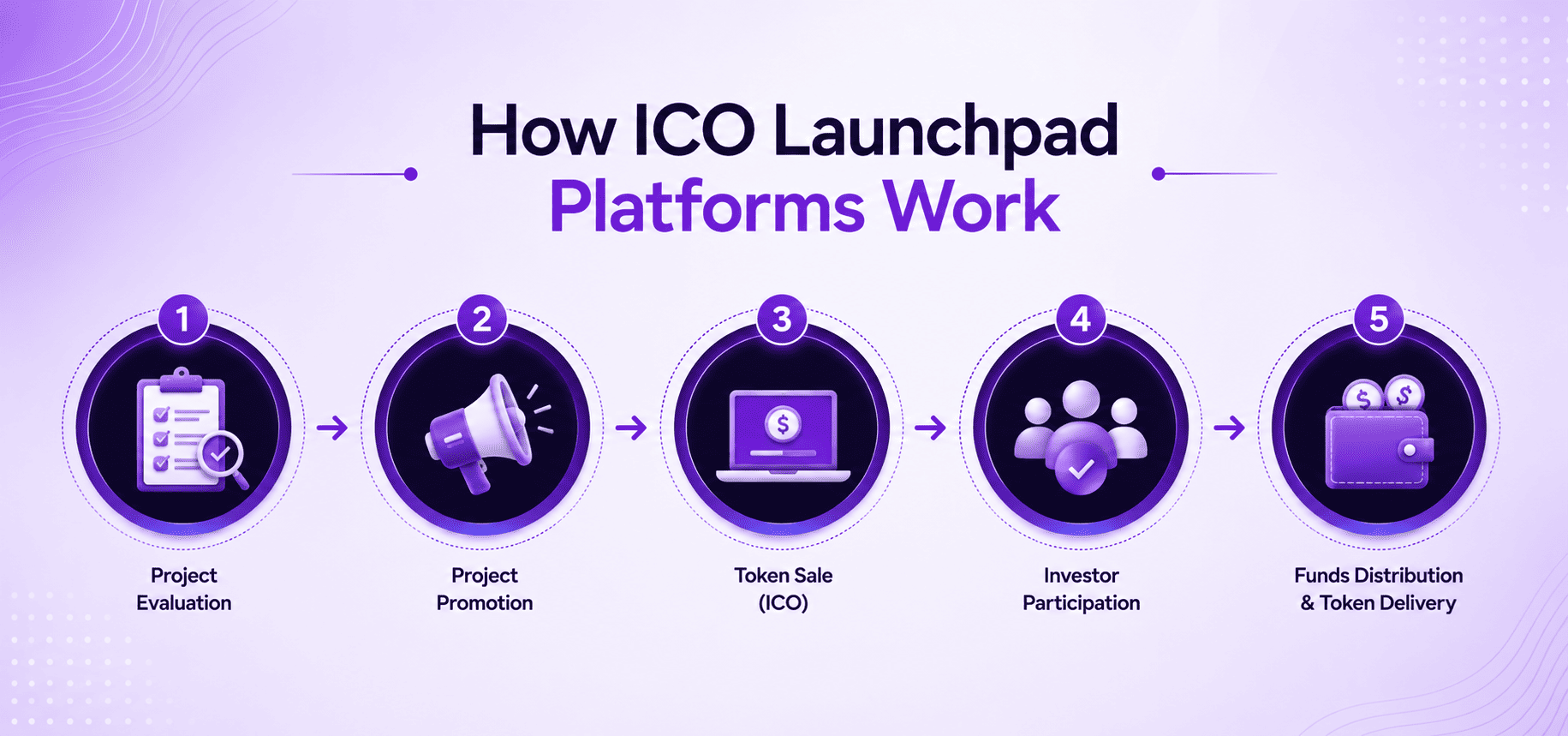
- Project Submission & Whitepaper Review
Startups upload their whitepaper, tokenomics, and project details. Before giving sanction, the launchpad team assesses feasibility, roadmap clarity and market potential. - KYC/AML Screening & Due Diligence
Launchpads KYC AML integration is performed to verify investors and initiatives This process ensures regulatory compliance and reduces the risk of fraudulent participation. - Token Allocation & Tier Determination
Investors are categorized based on their staking, holdings or whitelist requirements. Limits are placed on allocations to prevent whale dominance and to ensure equitable distribution. - Sale Execution (Fixed Price/Dutch Auction)
Token sales are carried out through predefined methodologies such as dynamic auctions or fixed pricing. Smart contract development is also part of this stage, which is critical for the launchpad to automate transactions and enforce rules. - Token Distribution & Vesting
Tokens are distributed either immediately or through vesting schedules upon sale. Vesting prevents early market flooding and guarantees long-term commitment.
This organised process allows launchpads to find a sweet spot between automation, compliance and accessibility making them a must-have in modern Web3 fundraising.
Key Features of ICO Launchpad Development
A robust ICO launchpad requires multi-layered features spanning token sale mechanics, compliance, staking, and investor management.
| Feature Category | Must-Have | Advanced |
| Token Sale Mechanics | Fixed price, time-based rounds | Dutch auction, batch auctions |
| Investor Verification | KYC document upload, AML screening | AI liveness detection, behavioral analysis |
| Liquidity Systems | Basic staking pools | Automated market maker (AMM) integration |
| Token Distribution | Manual claim portal | Automated vesting, tax reporting tools |
| Admin Dashboard | Project management, analytics | AI investor scoring, fraud detection |
Each feature category is essential for the development of a secure and scalable platform:
- Token Sale Mechanics: These govern the pricing and distribution of tokens. Price discovery and investor fairness are enhanced by sophisticated auction models.
- Investor Verification: The implementation of robust compliance measures, including KYC and AML checks, guarantees that only verified users are permitted to participate, thereby mitigating legal risks.
- Liquidity Systems: Up-to-date launchpad liquidity and staking systems promote user engagement while stabilizing the ecosystem following the launch.
- Token Distribution: The release of tokens is regulated by automated vesting mechanisms, which mitigates market volatility.
- Admin Dashboard: A robust backend enables operators to monitor activity, administer projects, and identify anomalies in real time. AI Development Services are being progressively integrated into advanced launchpads to facilitate real-time fraud detection, intelligent investor scoring, and predictive risk analysis.
Together, these token sale platform features form the foundation of a reliable launchpad. For secure execution and automation, businesses often rely on smart contract development services to build and audit these systems effectively.
ICO vs IDO vs IEO Launchpads
IDO launchpads provide fast liquidity to decentralized exchanges. IEO launchpads are token offerings controlled by exchanges. ICO launchpads are token sales on centralized platforms with verification.
When planning ido ico ieo platform development, it is important to understand the differences between these models. Each model is built to target a different part of the crypto fundraising platform comparison landscape, while still providing compliance, accessibility, and efficiency.
| Criteria | ICO Launchpad | IDO Launchpad | IEO Launchpad |
| Token Listing | Post-sale exchange listing | Immediate DEX liquidity | Exchange-native listing |
| Investor Custody | Smart contract escrow | Non-custodial wallet | Exchange custodial |
| KYC Burden | Platform-managed | Minimal to none | Exchange-handled |
| Sale Speed | 2-8 weeks | Instant to 48 hours | 1-4 weeks |
| Best For | Established projects, compliance focus | DeFi-native, community tokens | Retail investor reach |
ICO launchpads are the best option for projects that need regulatory alignment, investor protection and structured induction. They usually have more comprehensive due diligence and controlled allocation systems.
IDO models, often built on decentralized launchpad platforms, focus on speed and permissionless participation. They are widely used in DeFi ecosystems, where liquidity and community engagement are of the utmost importance.
IEO launchpads, on the other hand, leverage centralized exchanges to provide credibility, built-in liquidity, and access to a large retail investor base. However, they come with more rigorous listing requirements and greater fees.
Tech Stack for ICO Launchpad Development
A technology framework that is meticulously chosen to balance performance, security, and multi-chain compatibility is essential for the development of a scalable blockchain fundraising platform. The following is a typical structure that is employed in the smart contract development for launchpad solutions:
| Layer | Options | Purpose |
| Blockchain | Ethereum, BSC, Polygon, Solana, Avalanche | Multi-chain deployment |
| Smart Contracts | Solidity, Rust (Solana), Vyper | Token sale, vesting, staking logic |
| Backend | Node.js, Python (FastAPI), Go | API, off-chain data management |
| Frontend | React.js/Next.js, TypeScript, Web3.js/Ethers.js | Investor dashboard, wallet integration |
| KYC Providers | Sumsub, Jumio, Onfido, Persona | Identity verification |
| Oracles | Chainlink, Pyth Network | Real-time price feeds |
| Storage | IPFS, Arweave, Filecoin | Whitepaper, metadata hosting |
| Auditing | CertiK, Hacken, Trail of Bits | Security verification |
Scalability and ecosystem support are frequently achieved through the utilization of networks such as Polygon and Ethereum at the blockchain layer. Token sales, vesting schedules, and staking mechanisms are automated by smart contracts. For projects planning application-specific chains or modular fundraising ecosystems, Cosmos SDK for scalable blockchain development can also support custom blockchain infrastructure beyond standard EVM-based launchpads.
Reliable price inputs are provided by Oracles like Chainlink, while security and trust are guaranteed by auditing firms like CertiK.
ICO Launchpad Development Cost
The cost of developing an ICO launchpad can start from $45,000 for a minimum viable product (MVP) and go above $300,000 for an enterprise-grade multi-chain platform. The development schedule varies from 2 months to 9 months depending on the complexity of the project.
The entire cost of developing a crypto token launchpad is determined by the design, the depth of functionality, and the conformance requirements of the platform. Current launchpads are scalable Web3 development solutions that integrate smart contracts with real-time investor interfaces and off-chain infrastructure to provide performance, security, and scalability. Businesses can start with a lean MVP and grow into a full-featured ecosystem.
| Development Tier | Scope | Timeframe | Cost Range |
| MVP | Single-chain, core sale mechanics, basic KYC, standard UI | 2–3 months | $45,000 – $75,000 |
| Professional | Multi-chain, staking pools, advanced vesting, investor dashboard | 4–6 months | $85,000 – $150,000 |
| Enterprise | Cross-chain, AI fraud detection, custom AMM, regulatory compliance suite (MiCA/SEC), white-label | 6–9 months | $180,000 – $300,000+ |
The final development cost depends on various factors:
- Chain Complexity (EVM vs Non-EVM): Supporting several chains like Solana and Ethereum that have distinct programming styles and infrastructure increases the development burden.
- KYC/AML Provider Integration: API fees and compliance workflows are associated with third-party verification systems.
- Custom Smart Contract Logic: Launchpad needs special smart contract development to support advanced features like staking, vesting, and allocation.
- UI/UX Design Depth: A high-end investor dashboard with real-time updates and analytics adds to the front end challenge.
- Third-Party Auditing: Smart contract auditing is an important kind of validation of security but it adds to the overall cost.
Revenue Model of ICO Launchpads
ICO launchpads generate revenue through premium investor tier subscriptions, transaction-based success fees, staking pool administration, and listing fees.
Modern platforms capitalize on the core features of token sale platforms and utilize sophisticated launchpad liquidity and staking systems to generate revenue across various stages of the fundraising lifecycle.
- Project Listing Fees ($15,000 – $50,000 per project): Launchpads charge projects upfront for integration, due diligence, and visibility on the platform.
- Success Fees (5–10% of total funds raised): A performance-based fee is collected at the time of token sales, which is a percentage of the capital raised.
- Staking Pool Management: APY spreads are generated by platforms that manage staking pools that are associated with token allocations and investor categories.
- Premium Tier Subscriptions: Investors pay monthly or annual fees for Premium Tier Subscriptions, which provide them with exclusive pools, early participation, and increased allocation access.
- Token Allocation Fees: The platform reserves a portion of the tokens, which results in liquidity control and long-term upside.
The incentives between investors, platform operators, and initiatives are aligned in these models, thereby guaranteeing sustainable growth.
Tokenomics-Driven Revenue: Vesting & Liquidity Mechanics
Formula: Locked Liquidity = 20% × Total Raise + Staking Rewards (5–15% APY)
Example: A project raising $2M locks $400K in liquidity. The platform earns fees from staking pool creation and ongoing management.
As platforms continue to develop, an increasing number of them are incorporating sophisticated DeFi staking solutions to optimize yield generation and investor retention.
Security Considerations in Launchpad Development
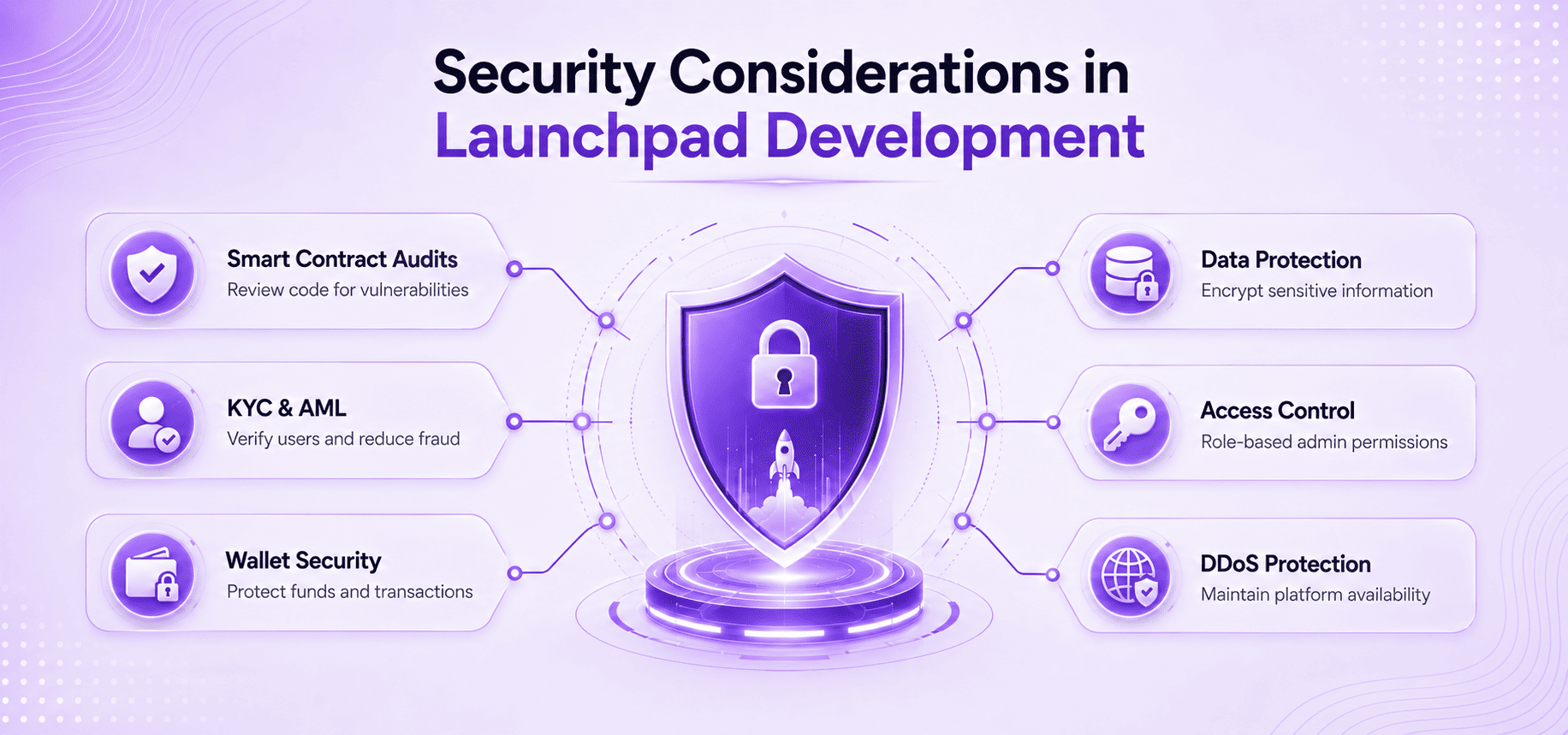
The primary security risks associated with launchpad development are regulatory noncompliance, smart contract exploits, and investor data breaches. A blockchain fundraising platform architecture that is secure must incorporate real-time monitoring systems, robust KYC AML integration in launchpads, and audited contracts.
Common Security Threats
- Reentrancy attacks on sale contracts: The exploitation of recursive calls to extract funds from smart contracts that are poorly written.
- Flash loan manipulation of token pricing: Temporary liquidity assaults are employed to distort token valuation during sales.
- Phishing attacks targeting investor wallets: Fake interfaces that are intended to take private keys and wallet access.
- Sybil attacks on KYC systems: The use of multiple fake identities to bypass allocation limits and manipulate token distribution.
MiCA/SEC Compliance Checklist (2026)
| Jurisdiction | Key Regulation | Platform Requirement |
| EU | MiCA regulation | CASP license, whitepaper notification, asset reserve |
| US | SEC Reg D/S | Accredited investor verification, filing exemptions |
| UAE | VARA | Custody rules, marketing compliance, licensing |
| Singapore | MAS PSA 2019 | DPT service provider license, AML compliance |
To mitigate risks, platforms must implement rigorous auditing, compliance frameworks, and secure infrastructure. Many also integrate solutions like formal verification systems to mathematically validate smart contract behavior before deployment.
Challenges in Building an ICO Launchpad
Major issues include high-demand token sales scaling issues, jurisdiction-based regulation, smart contract security, and lack of investor confidence post-FTX.
- Regulatory Fragmentation: Launchpads need to comply with EU (MiCA), US (SEC) and Asia (MAS/VARA) rules simultaneously. Each area has its own compliance standards, making global deployment difficult and resource-intensive.
- Smart Contract Exploit Risks: Even audited contracts can be compromised by new attack vectors. The risks in smart contract development for launchpad require further enhancements, secure coding, and continuous monitoring.
- Investor Trust Deficit: Investor Doubt Due To 2022-2024 Exchange Failures Platforms Need To Build Trust Using Clear Dashboards, On-Chain Proof Verification And Proof-Of-Reserve Procedures.
- Scalability Challenges: High-demand token sale causes gas wars, front-running, and network congestion. Very heavy traffic requires layer-2 solutions and a good design. High-demand token sales also benefit from gas-optimized smart contracts that reduce transaction costs, improve execution efficiency, and minimize congestion during peak participation.
- Liquidity Management: It’s difficult to provide enough post-sale liquidity on DEXs without manipulation. Fail to plan for liquidity and investors can get upset and prices can crash.
Addressing these challenges requires a strong blockchain fundraising platform architecture combined with compliance-first design and robust infrastructure.
How to Choose an ICO Launchpad Development Company
Choosing the proper development partner is crucial to build a secure and scalable platform.
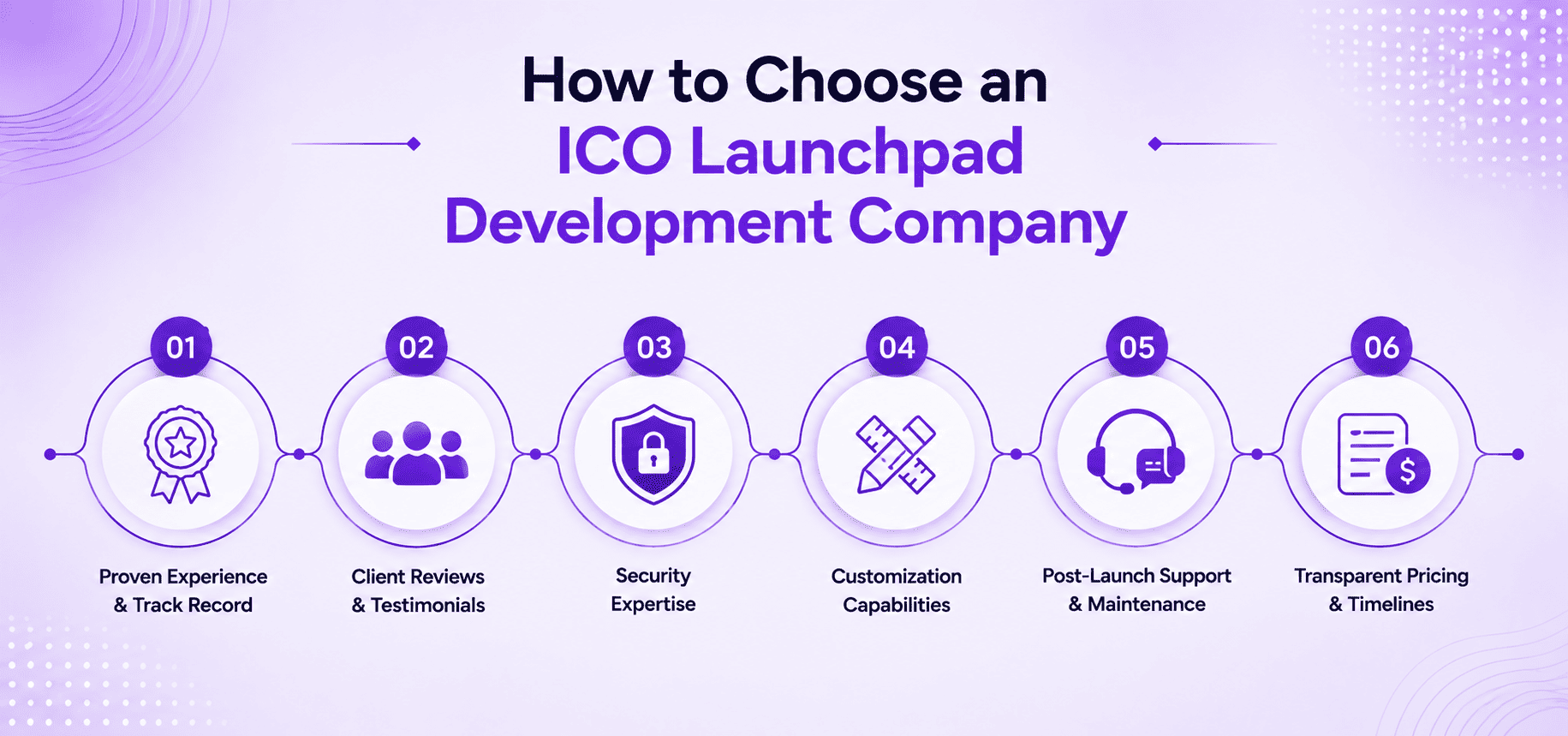
Use this checklist to assess providers:
✓ 4+ yrs experience in crypto token launch pad development
✓ Portfolio of live, audited launchpads with $10M+ raised
✓ In-house experience with Blockchain and Smart Contract Development
✓ Maintenance, upgrades, growing post-launch support
✓ Flexible development models (White label versus bespoke)
✓Multi-chain and cross-chain expertise to promote ecosystem interoperability.
In addition to technical expertise, the partner needs to have a good grasp of compliance, investor psychology and tokenomics design. Most companies use the services of professional teams that provide blockchain development services to ensure a seamless process from idea to deployment.
The appropriate partner can turn a difficult architecture into a revenue-generating fundraising platform. One the investors trust.
2026 Trends in Web3 Fundraising
The next-gen launchpads in the Web3 fundraising arena are shifting due to new technologies and investor expectations.
-
- Multi-Chain Launchpads: Cross-chain token sale platforms are being created through cross-chain protocols such as LayerZero and Wormhole.
- AI-Powered Systems: Advanced algorithms are being employed to detect fraud, score investors and provide predictive analytics. Advanced launchpad teams can also explore AI-based smart contract generation to accelerate contract prototyping, reduce repetitive development effort, and improve early-stage logic validation.
- Gamified Staking Models: NFT-based tiers and reward multipliers increase investor engagement and retention.
- Regulatory-Native Platforms: Launchpads are designing compliance engines from ground-up aligned to MiCA, SEC and VARA frameworks.
- RWA Integration: Real world asset tokenization is emerging as a prominent use case, enabling investors to engage in asset-backed fundraising opportunities.
- Multi-Chain Launchpads: Cross-chain token sale platforms are being created through cross-chain protocols such as LayerZero and Wormhole.
These trends lead to the drive towards safer, more scalable and investor friendly ecosystems, making ICO launchpads an essential feature of the future Web3 economy.
Why Choose Techfyte for ICO Launchpad Development?
Techfyte helps Web3 startups, enterprises, and tokenization businesses build secure ICO launchpads with scalable architecture, audited smart contracts, KYC/AML workflows, and multi-chain deployment support. Our team focuses on performance, regulatory readiness, tokenomics logic, and investor-first platform experiences.
Frequently Asked Questions
1. What is an ICO launchpad?
An ICO launchpad is a blockchain based platform to conduct safe token fundraising It links investors to approved projects, controls allocations and automates token distribution. Also in current crypto token launchpad creation it ensures compliance, transparency and investor protection.
2. How much does ICO launchpad development cost in 2026?
ICO launchpad development cost in 2026 usually varies from $45,000 to $300,000+. Costs are driven by features, multi-chain support, and compliance integrations. AI, staking, and cross-chain capabilities in advanced crypto token launchpad development can significantly increase the overall investment.
3. How do ICO launchpads generate revenue?
ICO Launchpads make money through a number of Monetization streams. These include listing fees, success-based commissions, staking pool spreads and premium investor tiers. There are several characteristics of token sale platforms that are meant to increase both platform earnings and investor involvement.
4. What core features differentiate top ICO launchpads?
Top ICO launchpads are distinguished by their advanced automation, compliance and user experience. Launchpads bring features like staking levels, vesting schedules, investor dashboards, and KYC AML integration to enable scalability, transparency, and safe participation for projects and investors alike.
5. What is the difference between ICO, IDO, and IEO launchpads?
The execution, custody and liquidity mechanisms are different for ICO, IDO and IEO launchpads. ICOs are centralized , IEOs are exchange-based and IDOs are DEX-based with quick liquidity . This difference matters for IDO ICO IEO platforms’ development strategy.
6. What is the typical development timeline for a custom launchpad?
Usually, it takes between 2 and 9 months to build a custom ICO launchpad. Timelines are dependent on complexity, feature set and compliance requirements. Advanced smart contract development for launchpad system and multi chain integrations takes longer to build.
7. What tech stack is recommended for ICO launchpad development?
A modern ICO launchpad must have full-stack Web3 technological platform. This covers blockchain networks such as Ethereum, smart contracts in Solidity and front end frameworks such as React. Robust architecture of blockchain fundraising platform provides scalability and performance.
8. How is KYC/AML integrated into ICO launchpads?
KYC/AML integration ensures that you meet regulatory requirements and avoids fraudulent involvement. Platforms leverage third-party APIs for verifying user identities, implementing regional limits, and tracking transactions. KYC AML integration in launchpads is important due to legal compliance and investor trust.
9. What are the most common security vulnerabilities in launchpads?
Common vulnerabilities are smart contract issues, phishing and flash loan exploits. Failing to solve these can leave finances and user data vulnerable. It is essential to ensure secure smart contract creation for launchpad systems and conduct frequent audits to prevent vulnerabilities.
10. What post-launch support does an ICO launchpad need?
Post-launch, a launchpad requires ongoing smart contract monitoring, regular security audits, compliance updates, multi-chain expansion, feature upgrades, and user support. Continuous launchpad maintenance ensures long-term security, investor trust, and platform competitiveness.
