



Key Takeaways:
-
- Web3 development allows businesses to create and deploy dApps that improve transparency, security, and user ownership via blockchain technology.
- Modern Web3 architecture is based on smart contracts, decentralized storage, Layer 1 blockchains, and Layer-2 scaling solutions.
- Web3 is currently used in industries like finance, healthcare, retail, gaming, and supply chain for tokenization, automation, secure transactions, and operational transparency.
- Businesses benefit from Web3 through programmable trust, transparent audit trails, token-based engagement models, and access to decentralized finance ecosystems.
- Key challenges faced in Web3 adoption are regulatory uncertainty, scalability limitations, user experience friction, interoperability issues, and the shortage of skilled developers.
- A potent Web3 strategy revolves around identifying real business value, selecting the right technology stack, prioritizing security and compliance, and launching scalable pilot solutions.
Introduction
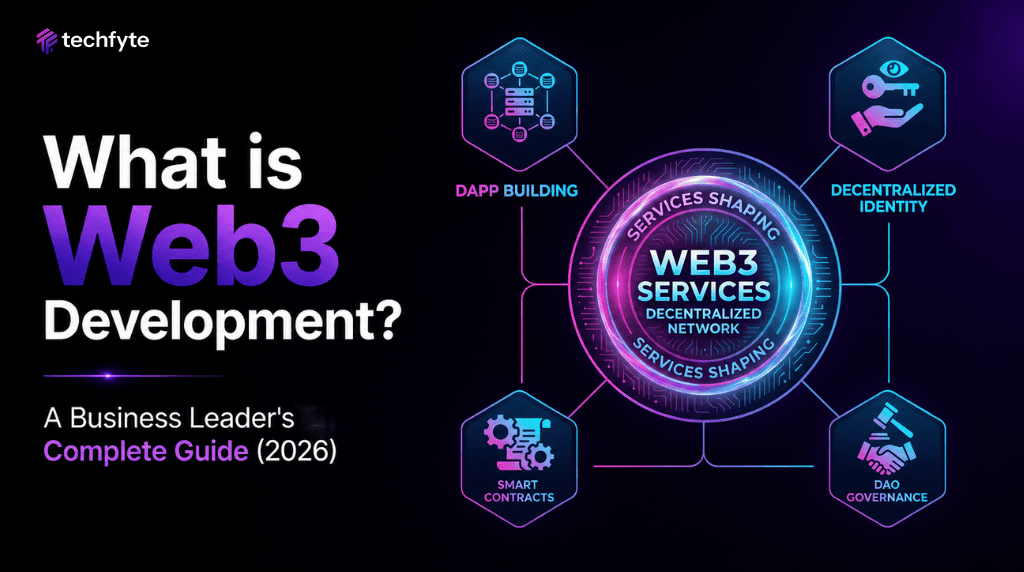
Web3 development is the process of creating decentralized applications (dApps) and systems on a blockchain that offer new ways for people and companies to connect with the internet. Web3 is not merely an upgrade of the technology, but a fundamental transformation in the way the digital world works: a more secure, transparent and user-controlled environment. In 2026, this guide explains a comprehensive guide that will explain the many components, use cases, benefits, problems, and potential strategic consequences of web3 development to your firm.
This makes it essential for companies seeking to adopt this new paradigm to understand the foundations of end-to-end blockchain development in order to effectively integrate Web3 technology into their operations.
1. What Is Web3 Development?
Web3 development involves creating decentralized applications (dApps) on the blockchain that permit peer-to-peer communication without middlemen such as centralized platforms. Web3 software leverages breakthroughs such as tokenization, decentralized finance (DeFi) smart contracts and (DEX) decentralized exchange development to facilitate secure, transparent, and non-custodial digital asset trading while empowering users to maintain control over their assets, identities, and data.
Web3 enables a decentralized web where users have full ownership of their digital assets and actively participate in platform governance.In contrast, Web2 applications rely on centralized servers managed by companies like Google, Facebook, or Amazon.The core objective of Web3 development is to provide an internet that gives customers more privacy, transparency and autonomy.
Web3 development is increasingly shaping company strategies in 2026, affecting sectors such as finance, healthcare, supply chain, gambling, and real estate, while also offering organizations new ways to create value, improve security, and innovate through tokenized assets and decentralized marketplaces.
Companies looking to bring Web3 technology into their business may struggle to select the right approach. Through Techfyte’s Web3 consulting services, organizations may explore this groundbreaking domain and capitalize on the prospects of Web3.
2. How Web3 Development Works
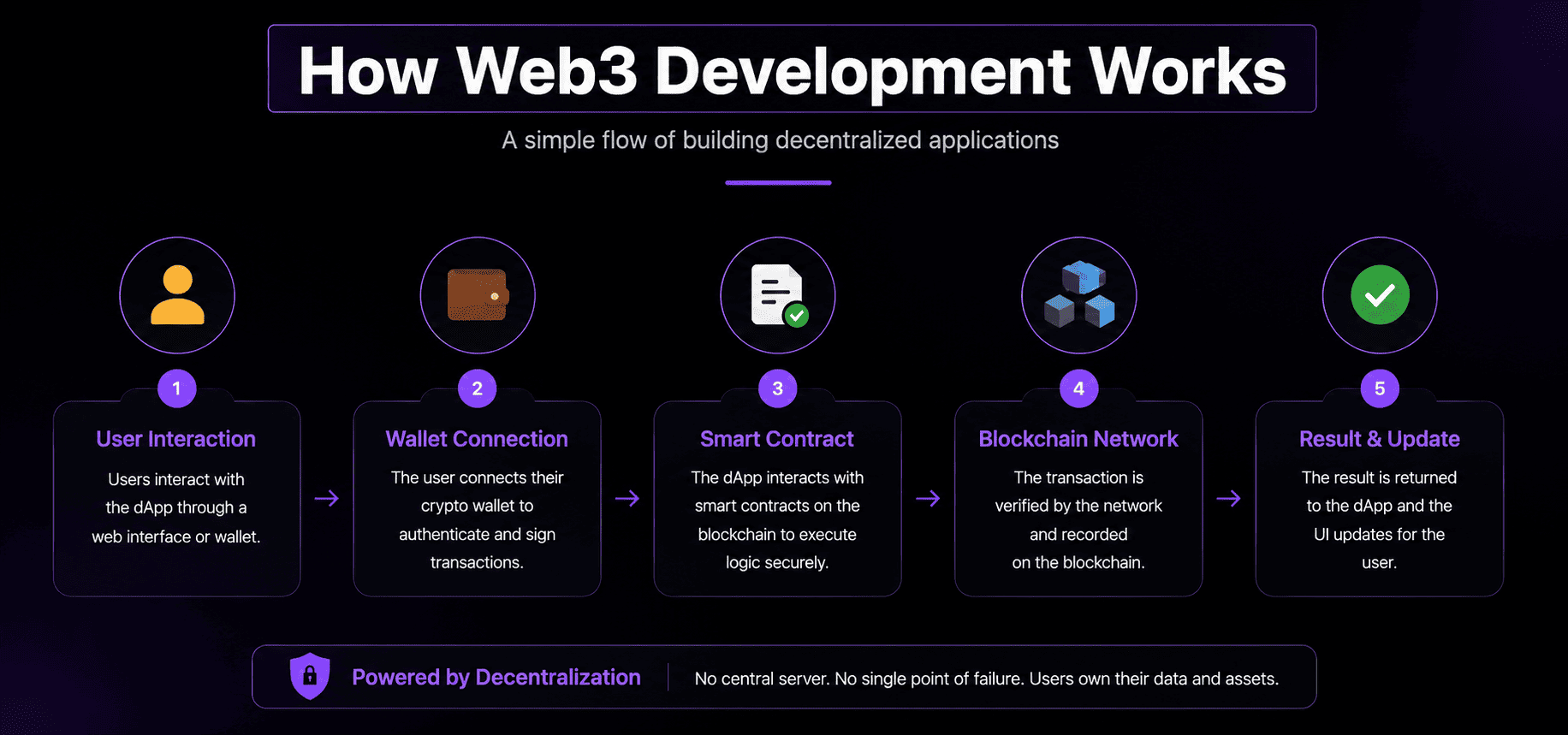
Web3 development uses blockchain, smart contracts, decentralized storage, front-end libraries for making decentralized apps (dApps). This is the way these parts work:
-
- Blockchain as the Settlement Layer
Blockchain is a self-regulating ledger of data and transactions It ensures everything is transparent and secure without middlemen. Business rules are enforced and smart contracts run on the blockchain. Learn more about how Ethereum smart contracts work in the Smart Contract Documentation from the Ethereum Foundation. - Smart Contracts: Automating Business Logic
By signing a smart contract you automatically agree to follow the rules of the contract. This technology can help make things easier for businesses and reduce the need for middlemen. Our smart contracts development guide can help you learn how to build secure and high performing smart contracts. - Decentralized Storage (IPFS/Arweave)
Decentralized storage, like IPFS and Arweave, distributes data across a network of computers. This ensures that data ownership is secure and difficult to control. This is very important for areas like healthcare, and banking where privacy and safety are of utmost importance. - Front-End Libraries: Connecting Users to Blockchain
Using front-end tools like ethers.js and web3.js, people can talk to block-chain networks. They link the user interface to the blockchain and allow the user to sign transactions, interact with contracts and connect wallets.
- Blockchain as the Settlement Layer
-
- Transaction Signing, Gas, and Consensus
Each Web3 transaction requires a private key to sign, which guarantees the safety of user interaction. Gas fees are how people are paid for doing computer work. The consensus mechanism ensures that the transactions are valid , securing the integrity of the blockchain.
- Transaction Signing, Gas, and Consensus
3. Web3 vs Web2 Development
Web2 vs Web3 Development: A Business Leader’s Guide
| Aspect | Web2 Development | Web3 Development |
| Architecture | Centralized servers and databases controlled by specific entities. | Decentralized blockchain with distributed nodes. |
| Data Ownership | Centralized control over data by entities like Google and Facebook. | Users retain ownership and control over their data through decentralized networks. |
| Identity & Authentication | Identity managed by centralized platforms (e.g., email, social media). | Decentralized identity management with blockchain and self-sovereign identity (SSI). |
| Monetization Model | Ads, subscriptions, data selling. | Tokenization, transaction fees, decentralized finance (DeFi). |
| Security Model | Security managed by central entities, with single points of failure. | Decentralized security via cryptographic protocols and consensus. |
| Scalability Approach | Vertical scalability with powerful servers. | Horizontal scalability via sharded blockchains and layer-2 solutions. |
| User Experience | Fast, centralized control allows rapid updates but may limit customization. | Slower transactions but offers more user control and ownership. |
| Development Paradigm | Closed-source, centralized systems. | Open-source, community-driven systems with a focus on interoperability. |
| Governance | Centralized governance by the company owner. | Decentralized governance via DAOs (Decentralized Autonomous Organizations). |
| Trust Model | Trust based on centralized institutions and platforms. | Trust based on cryptographic proof and consensus mechanisms. |
Strategic Analysis: Web2 vs Web3 for Business Leaders
Moving from Web2 to Web3 changes business models in a big way. Businesses own data and user names in Web2. This gives them more control but also raises privacy concerns. By spreading out who owns and controls data, Web3 makes things more open, safe, and gives users more power. Messari’s Web3 research reports can help you learn more about Web3 trends.
Web3 is a great plan for businesses that want to stay in business in a world that is becoming less centralized. Techfyte gives Web3 consulting services to help people find their way around these new technological frontiers if they want to learn more.
4. Key Components of Web3 Architecture
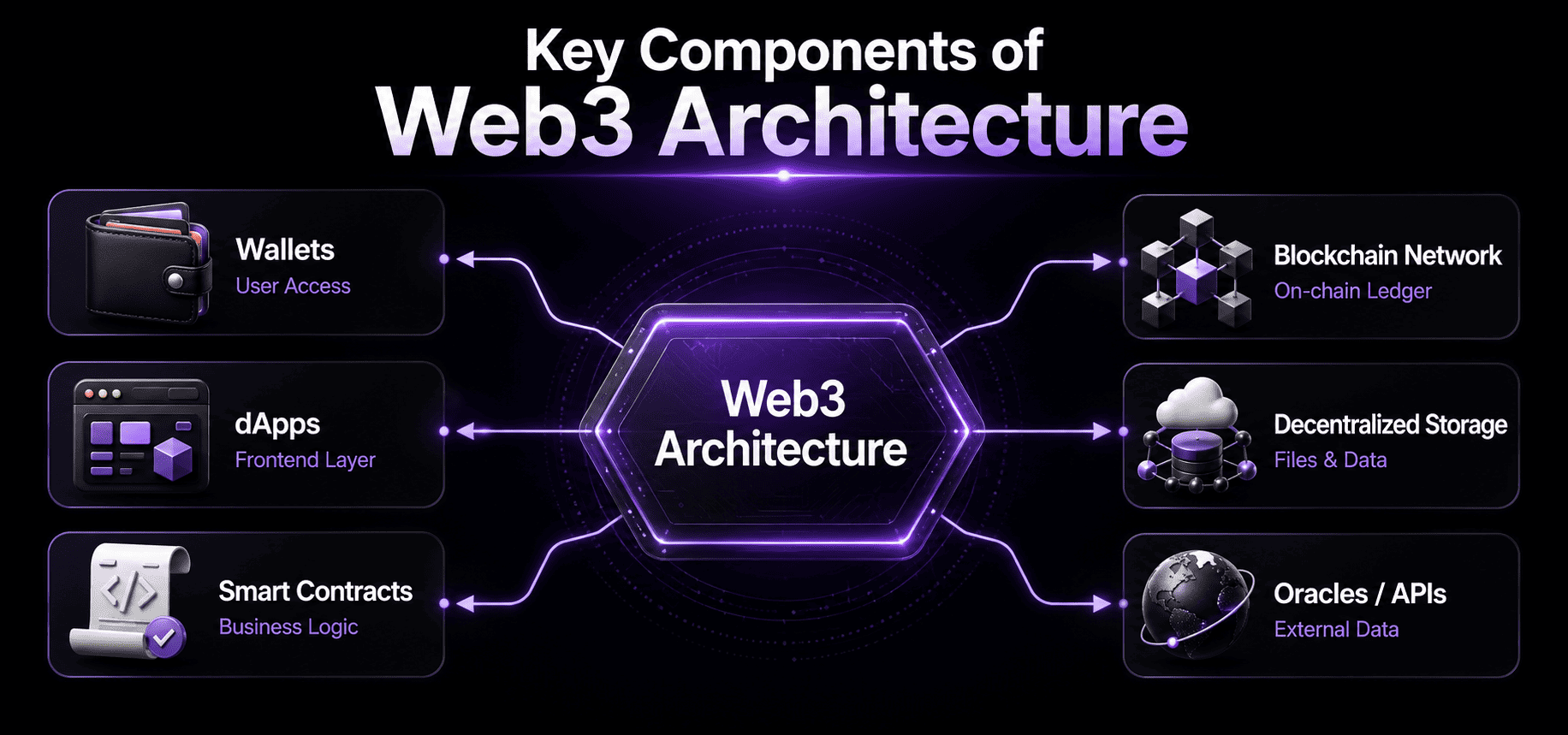
The technologies that make up Web3 design are the building blocks of decentralized systems and tokenized digital economies. The main parts of the Web3 design are:
-
- Layer 1 Blockchains: Ethereum and Solana are two platforms that handle consensus, security, and the processing of smart contracts. They are part of the base settlement layer.
- Layer-2 Scaling Solutions: These are networks like Arbitrum and zkSync that process transactions off the main chain before they are finalized. This increases speed and lowers fees.
- Smart Contracts: These are computer programs written in Solidity or Rust that automate business logic so that it can be run in different places.
- Decentralized Storage: IPFS and Filecoin store data in a way that makes it more resilient and gives users more control over their data than controlled cloud systems.
- Identity Protocols: Decentralized Identifiers (DIDs) and services such as ENS make it possible for individuals to control their own identities and use wallets to prove their identities.
- Oracles: Networks like Chainlink safely add real-world data to smart contracts so that changing logic can run.
- Indexing Protocols: Tools like The Graph make it easy for apps to access blockchain data and power front-end experiences.
5. Enterprise Use Cases of Web3 Development
Big companies are using blockchain to solve real operational problems and create new ways of doing business, and Web3 is no longer just for proof of concepts. Here are some key enterprise Web3 use cases demonstrating how blockchain expansion impacts business:
-
- Interbank Settlements with J.P. Morgan’s Onyx: J.P. Morgan’s Onyx platform uses blockchain technology to settle interbank transfers faster, reduce the need for reconciliations and bring more transparency to financial institutions.
- Walmart’s Supply Chain Tracking: Walmart uses blockchain to trace the source of goods like food, fruit, and other goods. It makes finding things easier and safer and it cuts down on the manual work that is done by hand. Mix Blockchain with IoT and you get more visibility from supplier to shelf.
- Nike’s .SWOOSH Digital Collectibles: Nike has launched digital collectibles called .SWOOSH will develop and sell branded NFTs that show how tokenization and dApps can help create new money and make customers more engaged.
These real-world examples show how blockchain is helping to make markets in banking, retail, manufacturing and data more open, automated and accessible to new business models. The immutable ledger and shared status tracking of blockchain is very useful for building trust, keeping track of things and making operations run more smoothly, says a major study on blockchain in supply chains and business systems.
6. Tools & Frameworks for Web3 Developers
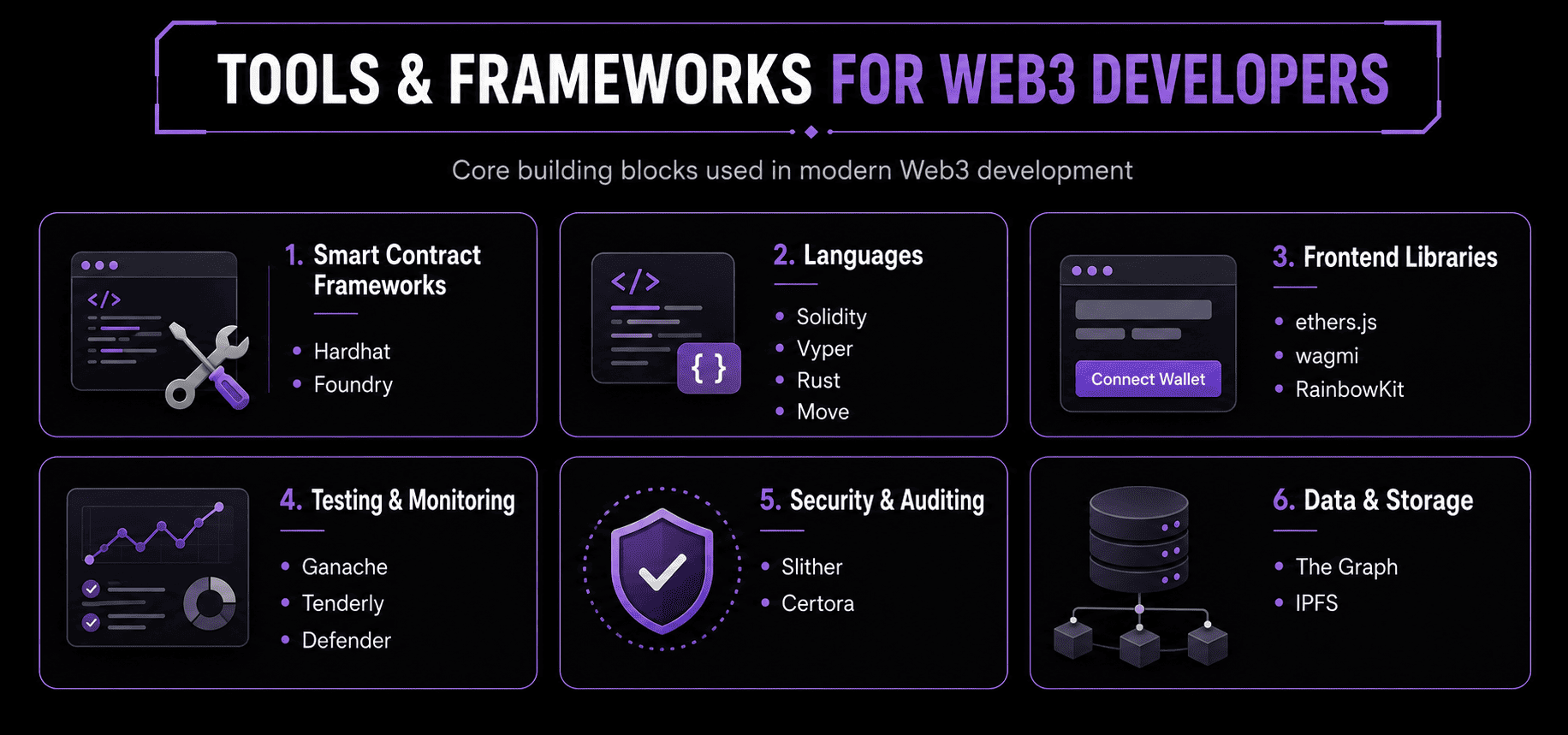
In 2026, web3 developers have a variety of tools at their disposal for building decentralized applications (dApps). These are the most important bits:
-
- Development Frameworks: Smart contracts can be built and tested rapidly using tools such as Hardhat and Foundry.
- Smart Contract Languages: There are different languages you can use to write smart contracts, like Solidity, Vyper and Move. Each of these languages handles security and speed differently.
- Front-End Libraries: ethers.js v6, RainbowKit, and wagmi are some libraries to help users connect to wallets and blockchains.
- Testing and Monitoring: Ganache, Tenderly and OpenZeppelin Defender make it easy to test and monitor Web3 apps.
- AI-Assisted Auditing: Tools such as Certora and Slither provide automatic security auditing of smart contracts.
7. Benefits of Web3 Development for Businesses
The strategic benefits of developing for Web3 include:
-
- Data sovereignty: It means that users own their data, which gives them an advantage over other users.
- Token-based loyalty: Businesses can use tokens for loyalty programs that can keep customers coming back for a long time.
- Programmable Trust: Smart contracts reduce the need for middlemen, thereby reducing costs.
- Transparent Audit Trails: Blockchain ensures that transaction records can be verified, which builds trust.
- DeFi composability: DeFi protocols allow businesses to access liquidity and decentralized financial products.
- Global Inclusion: Web3 allows people without bank accounts to access banking services, thereby increasing the market size.
Businesses can see the blockchain development business impact as they get a tangible return on investment (ROI).
8. Cost of Web3 Development in 2026
There are so many prices to pay when making Web3 apps, from making smart contracts to keeping them running. Here’s a list of the prices that come with developing for Web3:
-
- Smart Contract Development: $30K-$150K, depending on complexity.
- dApp Front-End: UI and wallet interface development for dApp front end: $20,000-$80,000
- Security Audits: $15,000 – $75,000 per audit for smart contract security.
- Infrastructure & Gas Optimization: The perpetual cost of keeping nodes live and decreasing gas fees.
- Maintenance: It costs $5K-$50,000 per year for upgrades & tracking.
Businesses should think about the problems and solutions to adopt Web3. They should employ in-house teams, agencies or a combination of both to help keep costs low.
9. Challenges in Web3 Adoption
Web3 has promise but there are some drawbacks that might make many people hesitant to utilize it:
-
- Regulatory Uncertainty
The regulations for Web3 tools are currently being written. This makes regulation complex, as businesses find it harder to comply across jurisdictions, as evidenced in the EU’s MiCA and the US’s fluctuating posture. - UX Friction
Still a user experience issue, particularly around seed words, gas fees and getting started. So, making Web3 easier to use is about cutting transaction costs and making it easier to manage wallets. - Scalability Trade-Offs
ZK-rollups and optimistic rollups are scalability methods with their own merits and cons. Optimistic rollups are easier to use, but they are less scalable. ZK-rollups are more efficient. It’s still a major difficulty to select the right solution. - Talent Shortage
It is hard to find developers that know Solidity and Rust, as there is a lot of demand for them in the commercial world. It can be good to invest in training or to engage with groups of experts. - Interoperability Gaps
Blockchain network interoperability is not quite there yet. As Web3 interoperability and scale grows, it will be vitally important that different chains get along well with each other. - Perception Issues
But security issues loom over Web3 after negative market cycles. More firms will have to overcome skepticism about Web3 tech and demonstrate they will be valuable in the long run.
- Regulatory Uncertainty
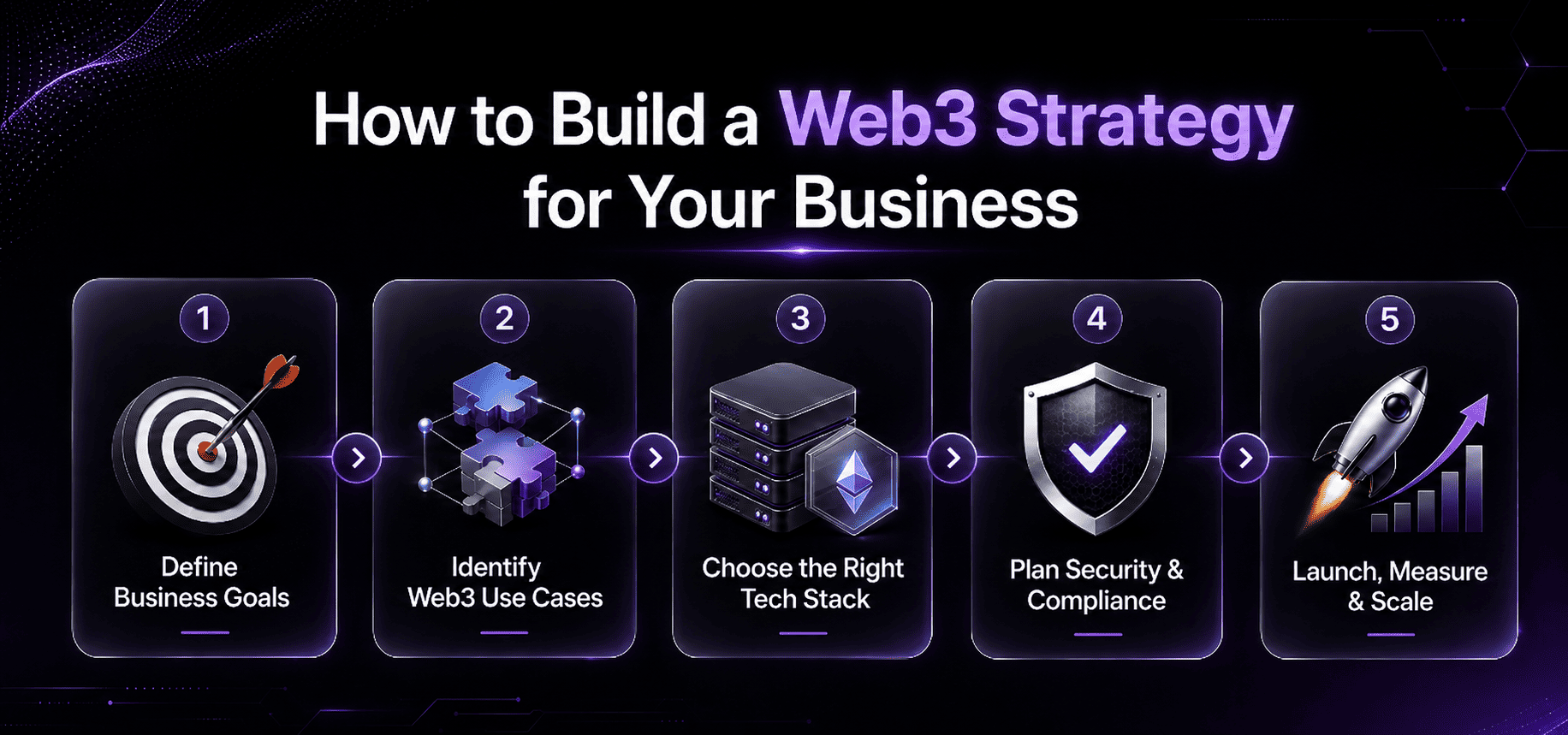
10. How to Build a Web3 Strategy for Your Business
To fully capitalize on the potential of decentralized technologies your organization needs a thoughtful, methodical approach to building a Web3 strategy. That’s the plan.
-
- Identify Value-Add
The first thing we need to do is uncover real problems that decentralisation can remedy. Should your firm be more transparent, operate without trust, tokenize assets? Learn how Web3 can transform your company plan in ways no one can. - Feasibility Assessment
Conduct a thorough market study, regulatory and technical feasibility. Grasp the legislation that applies to Web3 solutions and the limitations regulators place on them and investigate the technologies needs for their viability. Is the market ready for independent services in your geographical area? - PoC Design
Build a Proof of Concept (PoC) or a “minimum viable application” (dApp) to ensure that your Web3 project does what it’s supposed to do. This helps to test assumptions, reduce risks and gain meaningful feedback from early users and stakeholders. - Technology Stack Selection
Select the appropriate technology stack for the project. Will you be working with EVM (Ethereum Virtual Machine) compliant chains or non-EVM compatible chains such as Solana? Select Layer 1 or Layer 2 options based on scalability and cost. - Security and Compliance Integration
Build security and compliance into your Web3 strategy from the ground up. This entails the need to ensure smart contracts are safe, to comply with data protection regulations and to manage any dangers that might emerge from decentralized government. - Pilot Launch and Iteration
Launch a beta version of your Sync to gather feedback from users and see what may be changed. Iteration is the key to improving the user experience and ensuring your solution achieves corporate goals.
- Identify Value-Add
Ethereum roadmap maps the course for Ethereum and other decentralized technologies to develop. It can assist you determine what your approach should be.
Frequently Asked Questions
1. What is Web3 development?
Web3 development is building decentralized applications (dApps) on the blockchain. With blockchain there are no middlemen to talk to, and interaction is transparent and trustless.
2. How does Web3 development differ from Web2?
Web3, unlike Web2 built on centralized systems, replaces centralized systems with decentralized networks, giving people ownership of data, assets and identities.
3. What skills do Web3 developers need?
Skills of a Web3 engineer include in-depth knowledge of smart contract languages (Solidity, Vyper, etc.), blockchain networks, decentralized storage, and front-end frameworks like ethers.js.
4. Which industries benefit most from Web3?
Web3 can help many industries like banking, healthcare, supply chain, gaming and real estate in many ways like tokenization, decentralized financing and safe data management.
5. How much does Web3 development cost?
The cost of Web3 development depends on the complexity of the project. Smart contracts are $30K-$150K, dApp front-ends $20K-$80K, and security audits $15K-$75K each.
6. What tools are essential for Web3 development?
Tools Development frameworks Hardhat, Foundry Smart contract languages Solidity, Vyper Front-end libraries ethers.js, RainbowKit Testing tools Ganache, Tenderly.
7. Is Web3 secure?
Web3 is safe if it is backed by robust smart contract audits, decentralized governance and secure coding practices. Risks of smart contract and governance gaps.
8. What’s the future of Web3 development?
The future of Web3 is more scalable, interoperable and user friendly solutions, wider acceptance in industry and confluence of web3 with AI technologies.
9. What programming languages are used in Web3 development?
Web3 development usually involves programming languages like Solidity (for Ethereum), Vyper, Rust (for Solana), Move (for multiple Blockchain ecosystems).
10. How do smart contracts work?
Smart contracts are self-executing contracts that automatically enforce the terms of an agreement when predefined conditions are met, removing the need for intermediaries.
11. Can Web3 integrate with existing enterprise systems?
Yes, Web3 can be integrated with enterprise systems. Middleware, bridges and API’s are used to connect the blockchain data to legacy databases and services.
12. What are the biggest risks in Web3 adoption?
The biggest dangers include smart contract hazards, regulatory uncertainty, scalability problems and UX friction that hinder user adoption.
Future-Proof Your Business with Web3 Development
Stay ahead of the curve with Techfyte’s in-depth insights into Web3. From transformative Web3 business strategies to real-world enterprise case studies, we provide the resources you need to navigate decentralized technologies. Join our community of forward-thinking executives and builders. Subscribe to our updates and explore Techfyte’s Web3 coverage hub for everything you need to understand the Web3 revolution.
