



Key Takeaways
- Property tokenization allows fractional ownership of Dubai real estate through blockchain-based digital tokens.
- Traditional real estate investment requires full ownership, higher capital, and longer holding periods.
- Tokenized real estate offers greater liquidity with secondary market trading and flexible exit options.
- Dubai regulates tokenized property through VARA, while the Dubai Land Department oversees property ownership and registration.
- Traditional investments provide stronger control over assets, while tokenization automates income distribution through smart contracts.
- Tokenized property lowers entry barriers for global investors, enabling diversified portfolios with smaller investments.
- Both models offer strong return potential in Dubai, but investment choice depends on liquidity needs, risk tolerance, and desired ownership control.
Introduction
In 2026, Dubai’s real estate market is undergoing a rapid transformation, offering high-net-worth individuals and tech-savvy investors prospects that surpass conventional investments in the city. Property tokenization is a disruptive paradigm that is enabling fractional ownership of premium properties through blockchain real estate investing. In contrast, traditional real estate is still anchored in full ownership, standard mortgage processes, and long-term holding. It is imperative to comprehend the subtleties of these two methodologies in order to optimize returns, mitigate risk, and navigate Dubai’s regulatory environment. Learn more about how to tokenize real estate on blockchain to understand the process step by step.
What Is Property Tokenization?
Property tokenization is the process of converting a real estate asset into digital tokens on a blockchain, allowing investors to purchase fractions of a property rather than the whole asset. This approach makes blockchain real estate investing more accessible, offering a lower entry point and enhanced liquidity in tokenized real estate. Each token represents an ownership stake, with smart contracts automating rent distribution, dividends, and compliance. For income automation, Techfyte also explores dividend distribution automation for tokenized assets. In Dubai, property tokenization operates under the oversight of the Virtual Assets Regulatory Authority (VARA), with some models involving the Dubai Land Department (DLD) for registering title deeds to ensure legal ownership. As we explored in our guide to tokenization platforms in Dubai, choosing the right platform is crucial.
What Is Traditional Real Estate Investment?
Traditional real estate investment in Dubai involves purchasing full ownership of a property, either outright or with a mortgage. According to the Dubai Land Department, property registration ensures full legal ownership and protects investor rights in the UAE. Investors have to manage DLD registration, legal due diligence, and the routine administration of rental income or property sales.This model requires a higher initial capital outlay and generally longer holding periods to generate significant returns. Traditional investment in Dubai’s premium property sectors is less technologically driven, but preferred due to established market familiarity, legal clarity and proved asset appreciation patterns.
Dubai’s traditional investments and property tokenization have their own benefits. Traditional investment offers control of physical assets, familiarity and years of confidence in the regulation. Tokenization offers diversified portfolios, faster transactions and automated management. To navigate these options effectively, an understanding of the evolving regulatory environment Dubai real estate operates within, liquidity dynamics, and fractional ownership vs. full ownership is necessary.
According to the Dubai Land Department’s latest report on Dubai real estate market trends, the emirate continues to attract global investors, who are looking at both traditional and innovation-driven property strategies. Tokenization is being pitched as an additional investment to traditional investments.
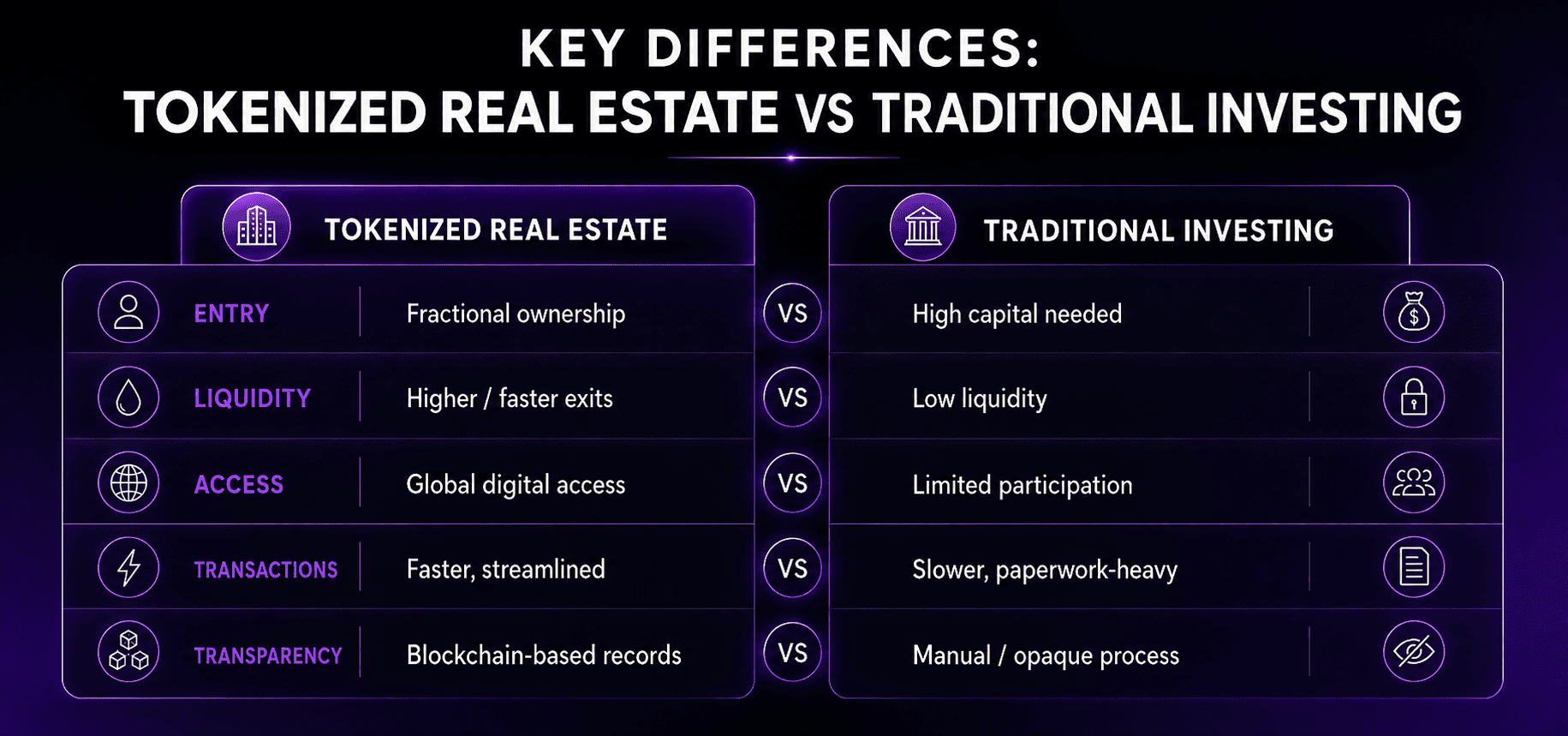
Key Differences: Tokenized Real Estate vs Traditional Investing
The introductory table pointed out the basic contrasts; a deeper look at the five critical dimensions reveals why property tokenization is reshaping Dubai’s investment landscape.
- Capital Requirements
With tokenized real estate, investors can come in with much less capital. Instead of buying a whole luxury apartment, you can buy fractional tokens that represent a share of the property. Meanwhile, traditional investing typically requires a minimum down payment of 20-25%, particularly for expats, and pre-approval of a mortgage from a UAE bank. Learn more about cost structures and tokenization strategies in real-world asset tokenization on blockchain - Investor Access
Tokenized real estate is a game changer for access to investors.” Fractional ownership makes Dubai property markets accessible to international retail investors who cannot afford full units. However, traditional investment is still restricted: only those with substantial liquidity and a UAE bank account can easily participate, which limits cross-border investment opportunities. - Asset Control
Traditional investment provides full ownership and the ability to make decisions about the management, rental agreements and when to sell. Smart contracts and platform governance are what tokenized investors rely on, which automate rent distribution and compliance but reduce direct hands-on control. For blockchain infrastructure details, see cross-chain smart contract solutions. - Income Distribution
Smart contracts in tokenized models automatically distribute rental income and dividends proportionally to token holders. Traditional models require manual management, property maintenance, and direct supervision for timely collection of income. - Exit Strategies
Tokenization provides partial or full exits on secondary markets, giving flexibility to liquidate holdings without the need to wait for a full property sale. In traditional investments, you often have to sell the entire property, which can take months or more, depending on the market demand. Platforms offering RWA tokenization allow fractional investors to trade shares on secondary markets efficiently.
Together, these five dimensions illustrate that traditional ownership is tangible and familiar, but fractional ownership vs full ownership via tokenization opens the door to wider participation, faster returns, and more diversified portfolios.
| Key Differences: Property Tokenization vs Traditional Real Estate | ||
| Feature | Tokenized Real Estate | Traditional Real Estate |
| Ownership Type | Fractional ownership vs full ownership | Full ownership only |
| Minimum Investment | Low, often accessible to smaller investors | High capital required |
| Liquidity | High — tokens can trade on secondary markets | Low — property sales can take months |
| Regulation | VARA oversight, DLD title registration in some cases | Fully regulated under Dubai Land Department |
| Holding Period | Flexible, short-to-medium term | Typically long-term (3–10+ years) |
Liquidity Comparison: Tokenization Wins?
Tokenized property offers liquidity benefits that rank among the most transformative advantages of property tokenization. It means investors can sell fractional shares in secondary markets at any time, allowing partial exits and holding periods of months rather than years. Platforms like Tokenization Platforms Dubai offer a new level of flexibility where investors are allowed to trade shares after the funding process. For detailed secondary market trading insights, explore secondary-marketplace enablements.
By contrast, selling a traditional property is more complicated and takes more time. The sale of a unit is often subject to the completion of DLD registration and transfer formalities, which can take between six to twelve months. Also, the entire property must be sold in one transaction. That lag hampers agility, especially for investors who want to capitalize on short-term moves in the market.
| Liquidity Feature Comparison | ||
| Liquidity Feature | Tokenized | Traditional |
| Market Access | 24/7 secondary trading | Limited to buyers in open market |
| Partial Exit | Allowed via fractional tokens | Not possible — full unit sale only |
| Average Holding Period | Months | 3–10+ years |
| Transaction Speed | Hours to days | Weeks to months |
| Automation | Smart contract payouts | Manual rental/income collection |
The difference is clear: the liquidity of tokenized real estate not only accelerates the realization of gains but also democratizes access for international investors. VARA’s regulations for blockchain real estate investing guarantee that such secondary transactions are 100% compliant and protect local and global participants.
Cost and Fees: Tokenized vs Traditional
As we look to 2026, discerning high-net-worth and tech-savvy investors will need to understand the cost structures of property investment when assessing Dubai real estate. Traditional investment is based on the fixed transactional and management costs, but tokenized real estate brings in a new layer of technology driven fees.
Tokenized Real Estate Fees
Platform fees are generally in the 1–3% range for investors buying tokenized properties. Smart contract gas fees cover the execution of transactions on the blockchain, and annual management fees of around 0.5–2% keep the digital asset and platform running. Depending on the platform, trades on secondary markets may incur minor trading fees. Understand how token standards engineering affects fees, compliance, and automation in blockchain real estate.
Traditional Real Estate Fees
Full-property purchases include DLD registration fees (around 4%), real estate agent commissions (2%) and mortgage arrangement fees for financed purchases. Moreover, the annual costs for investors in Dubai’s prime markets include maintenance, insurance and property management fees which total 8-10% of rental income.
| Cost Comparison Table | ||
| Cost Category | Tokenized Real Estate | Traditional Real Estate |
| Entry/Acquisition | Platform fee 1–3%, gas fee | DLD 4%, agent 2%, mortgage fees |
| Annual Management | 0.5–2% platform maintenance | 8–10% rental income (maintenance, insurance, property management) |
| Exit/Liquidation | Small secondary market trading fee | Agent commissions, DLD transfer fees |
| Hidden Costs | Smart contract updates, platform downtime | Unforeseen repairs, market delays, legal fees |
Overall, the comparison of tokenization fees and traditional fees illustrates that, although tokenized properties have a lower cost of entry, the ongoing platform and tech-related costs can be higher, especially for active traders on secondary markets.
Returns and Profit Potential (Dubai Context)
Dubai’s 2026 real estate market is still churning out strong returns through capital appreciation and rental yields in key areas such as Dubai Marina, Downtown Dubai and Palm Jumeirah. Traditional properties generally offer gross rental returns of 5-8% and capital appreciation of 10-15% in some locations.
Tokenized real estate provides many advantages like access to global liquidity, potential for faster appreciation, staking-like yield mechanisms, and smart contract-generated proportional rental income. This might lead to higher returns compared to traditional ownership, particularly for smaller and more diverse portfolios.
Hypothetical Example
- Traditional Investment: A $500,000 apartment in Dubai Marina rented for $30,000 a year and a gross yield of 5-6%. Assuming 10% appreciation over five years, the total return on investment (ROI) is approximately $575,000–$600,000.
- Tokenized Investment: If you purchase tokenized shares of the same property, you will get proportional rental income and faster potential appreciation based on secondary market demand. Even factoring in platform and transportation fees, the 5-year ROI can be comparable or better than traditional ownership. Investors can also list their securities on a secondary market through platforms such as Tokenization Platforms Dubai.
These trends are indicative of a shift in the Dubai real estate market from full ownership to fractional ownership, allowing local and international investors to buy high-value properties without investing all their capital. Regulatory context for digital asset infrastructure is provided by the World Economic Forum’s overview of principles for investing in real estate with blockchain. For global insights, see the World Economic Forum’s guide on blockchain real estate investments, which highlights principles for transparent, secure tokenized property markets.
Risks Comparison: Blockchain vs Physical Property
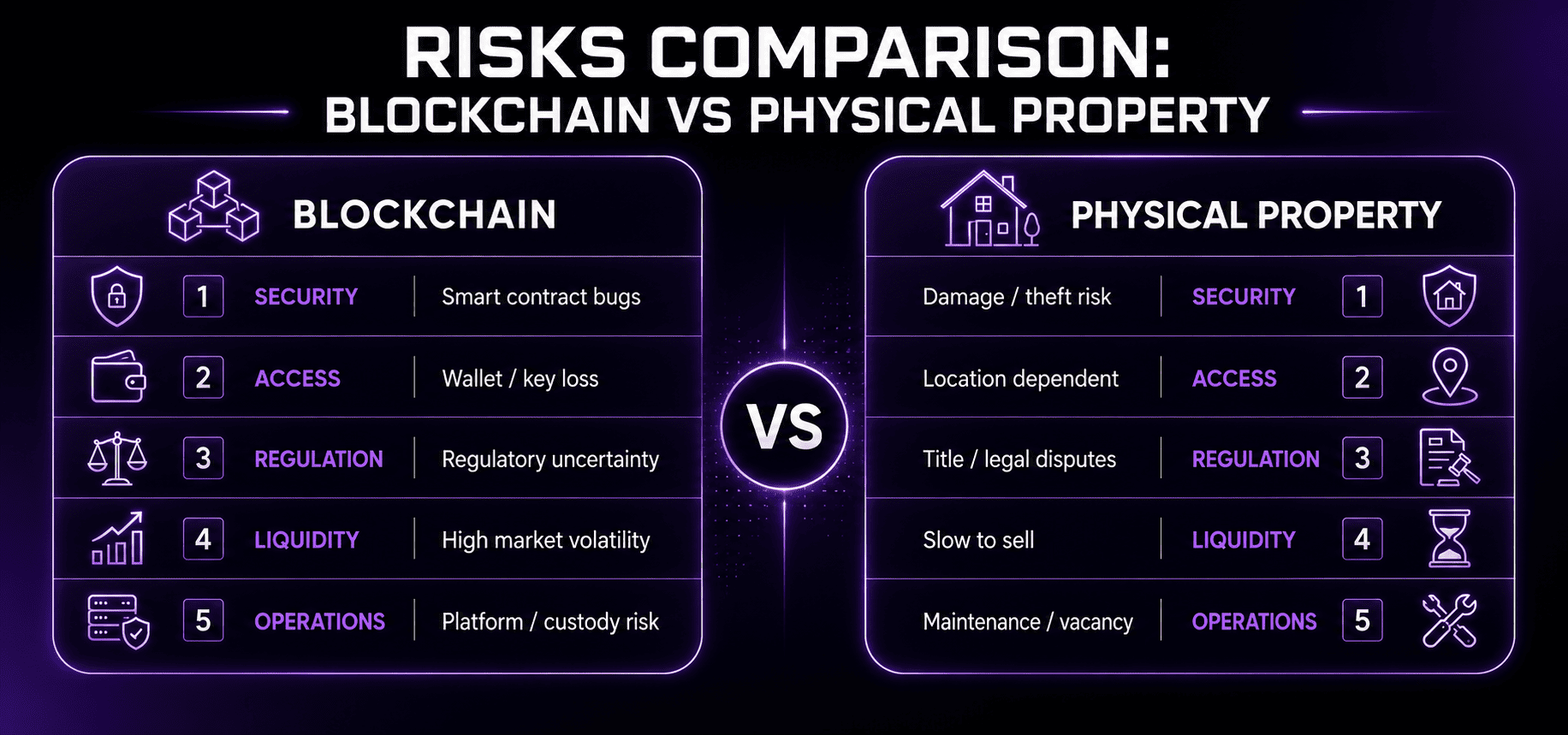
Traditional property is subject to market-cycle and management risks, while tokenized real estate is subject to a set of technology-driven risks. If you are looking to invest in Dubai’s property market in 2026, you should know about these differences.
| Risk Factor | Tokenized Real Estate | Traditional Real Estate | Mitigation Strategy |
| Regulatory Risk | VARA regulations are evolving, licensing required | DLD is well-established, clear legal framework | Choose licensed platforms; refer to Dubai blockchain real estate regulations for compliance guidance |
| Counterparty / Smart Contract Risk | Bugs, hacks, or platform vulnerabilities | Rare — mostly legal or financial intermediaries | Conduct platform audits; diversify holdings; use insured or verified platforms |
| Market Volatility | Token prices can detach from property NAV | Price sensitive to property market cycles | Track property fundamentals; avoid over-leveraging token positions |
| Illiquidity of Underlying Asset | Property may be tokenized but actual asset cannot move | Physical property cannot be sold instantly | Evaluate secondary market activity; consider exit horizons |
| Custodial Risk | Who holds title deeds may vary | Owner directly holds property deed | Ensure custody arrangements are legally clear; use platforms with title escrow |
| Transparency Risk | Smart contract code visibility vs platform reporting | Often manual, relies on agent honesty | Use audited contracts; request clear property management reports |
This risk comparison shows that tokenized real estate shifts exposure to technology, custody and regulatory execution, while traditional real estate is more exposed to property cycles, maintenance and resale timing. To evaluate a platform, consult Techfyte’s guide of tokenization platforms in Dubai.
Use Cases: Who Should Choose What?
The decision to opt for tokenized or traditional real estate depends on capital, liquidity needs, comfort with technology and investment horizon.
| Investor Profile | Recommended Model | Why |
| Tech-savvy global investors, $5,000–$50,000 | Tokenized Real Estate | Fractional ownership allows entry with lower capital; investor access tokenized real estate democratizes property; explore platform options here |
| Crypto-native, younger investors (25–40), seeking quarterly liquidity | Tokenized Real Estate | 24/7 secondary trading and proportional income align with fast-paced portfolios |
| High-net-worth individuals ($250,000+), seeking full control | Traditional Real Estate | Full title deed ownership; predictable long-term returns; mortgage leverage possible |
| Long-term UAE residents, risk-averse | Traditional Real Estate | Stability of tangible asset; established legal framework; minimal tech exposure |
| Investors seeking leveraged property positions | Traditional Real Estate | Access to UAE mortgages and traditional financing options |
| Diversifying across smaller tickets | Tokenized Real Estate | Enables portfolio spread across multiple properties without heavy capital commitment |
In the end, tokenization democratizes Dubai property, allowing doors to open for investors who were previously shut out by high capital requirements. The traditional investment is still the best option for those with higher net worth or risk-averse investors who desire long-term stability, tangible control and full ownership.
Regulatory Environment in Dubai (2026 Update)
Dubai has a transparent regulatory framework governing the property tokenization market. Blockchain title deeds are recognized by the DLD, and underlying properties must be registered. Tokenization platforms are licensed by VARA to ensure compliance with financial and investor-protection regulations. Explore cross-border distribution services to understand global investment facilitation.
Real estate tokens are security tokens that are supported by real assets, which differentiates them from utility tokens. This ensures compliance with the law and ownership. Recent updates from 2025-2026 have shown that DLD could possibly allow direct title registration on the blockchain, which would further facilitate tokenized transactions.
The joint registration of DLDs and VARA-licensed platforms confirms the legality of property tokenization in Dubai, giving investors a transparent and regulated environment.
Which One Fits Your Investment Strategy?
In Dubai, the decision between tokenized and conventional real estate necessitates a comprehensive comprehension of capital size, technology risk tolerance, and liquidity requirements. Investors can be advised by a straightforward framework for making decisions. For deeper Web3 integration and trading automation, check AI trading agents.
| Decision Step | Next Step / Recommendation |
| Start | Evaluate capital available |
| Capital <$100,000? | Yes → Tokenization recommended (fractional ownership, global access) |
| Capital ≥$100,000 | Want full control of property and title deed? |
| Full control desired | Yes → Traditional real estate investment recommended |
| Full control not critical | No → Tokenization mix recommended (blend fractional and traditional holdings) |
Full ownership and fractional ownership are not mutually exclusive. Traditional properties can be employed by investors to ensure stability, while tokenized assets can be employed to provide liquidity, diversification, and global access.
Compare the features, fees, and compliance of the top tokenization platforms in Dubai, which offer automated management tools and support VARA-licensed, DLD-registered assets for 2026 investors.
Explore our complete asset-tokenization services to start investing in Dubai property today.
Frequently Asked Questions
1. What is property tokenization?
Property tokenization is the process of turning real estate into digital tokens on a blockchain so that it can be owned fractionally instead of wholly. Investors can buy fractional interests, sell shares in secondary markets and enjoy proportional rental income.
2. How is tokenized real estate different from traditional investing?
With traditional investing you need to own everything and do everything by hand, with tokenized real estate you can own a piece of a property and get paid automatically. Traditional investing is based on market cycles while tokenization risk comparison is based on technology and platform risks.
3. Can foreigners invest in tokenized real estate in Dubai?
Indeed, foreigners can invest through platforms licensed by VARA, enabling fractional ownership without the hefty capital typically needed for full-property investments.
4. Which investment option has better liquidity?
Tokenized real estate provides partial exits and a 24/7 secondary market. The full unit usually comes in traditional properties and may take several months.
5. Are returns higher with tokenized property?
Competitive returns are achievable. Tokenized property can grow in value and generate proportional rental income. Tokenization fees might slightly cut down on net gains as compared to traditional fees, but they also have the potential to boost liquidity and diversification.
6. How much does property tokenization cost in Dubai?
The costs include also possible secondary trading fees, gas fees, 0.5-2% management annually and platform fees of 1-3%. Entry fees are cheaper than traditional fees, but there are ongoing technology costs.
7. What are the risks of tokenized real estate?
Potential hazards include platform flaws, hacks, and token price volatility. The risk of tokenization comparison shows that licensed tokenization platforms in Dubai reduce technology and regulatory exposure.
8. Is property tokenization legal in Dubai?
Of course, if the underlying property is DLD-registered and the platform is VARA-licensed. Real estate tokens are security tokens according to Dubai law.
9. Do I own the physical property with tokenized real estate?
The property is represented by digital tokens which define ownership. This means investors get legal recognition and proportional benefits, but not the physical deed individually.
10. What is the minimum investment for tokenized property in Dubai?
Fractional ownership usually costs $5,000–$10,000 and gives access to Dubai properties of high value and partial ownership instead of full ownership.
11. How do I sell tokenized property shares?
Smart contracts ensure automatic, transparent transactions and shares are traded on secondary markets using licensed platforms.
12. Which Dubai platforms offer regulated property tokenization?
Services are compliant through VARA-licensed platforms. Techfyte has compiled a list of tokenization platforms licensed under VARA in Dubai.
