



Key Takeaways
- TRC20 wallet apps enable businesses to send, receive, store, and manage USDT on the TRON network with fast transaction processing and low network fees.
- A successful TRC20 wallet requires more than wallet creation, including security architecture, transaction management, compliance controls, and a seamless user experience.
- Common business use cases include crypto payment platforms, remittance services, fintech applications, exchange wallets, merchant payment systems, and Web3 financial products.
- Essential wallet features include wallet address generation, USDT transfers, transaction history, QR code payments, advanced security measures, and an administrative control panel.
- Development costs in 2026 can range from $15,000 for a basic wallet to over $250,000 for enterprise-grade custodial platforms with compliance and multi-chain capabilities.
- Choosing the right wallet model – custodial, non-custodial, or hybrid – plays a critical role in security, user control, scalability, and long-term business success.
Introduction
It is possible to send, receive, keep, and manage Tether USDT on the TRON blockchain by making USDT TRC20 wallets. Many businesses and companies can use TRC20 Wallet App Development to get started with crypto finance. This is because TRC20 transactions are commonly used for stablecoin transfers, payments, exchange withdrawals, money transfers, and business settlements. While making a wallet is important for a real crypto wallet USDT TRC20 option, it is not enough. Before making a cryptocurrency wallet, a business should think about the type of wallet, the security design, the transaction flow, the user experience, the compliance requirements, the admin controls, and the third-party integrations. Businesses can build a strong wallet system that allows stablecoin transactions, blockchain integrations, and scalable user management by working with a professional multi-chain wallet development company.
What Is a USDT TRC20 Wallet?
It is possible to accept, store, and send USDT on the TRON network using the TRC20 token standard with a USDT TRC20 wallet. To put it simply, it works like a cryptocurrency account that lets users see how much USDT they have left, see a log of transactions, and send money to another TRON-compatible wallet address. A good TRC20 USDT wallet app can be used for making payments, settling business debts, exchanging currencies, sending money abroad, trading, and fintech apps that need to make fast stablecoin transactions. Companies that are making a crypto wallet USDT TRC20 solution need to make sure that the wallet has safe key management, accurate amount tracking, transaction signing, and easy TRON network connectivity.
What Is a USDT TRC20 Wallet Address?
The public address that will accept USDT on the TRON network is the USDT TRC20 Wallet Address. It works like an account number that the user can safely give to other people to receive money or payments. When users add USDT TRC20 wallet address feature to an app, the system creates a public address for the user’s wallet that works with TRON.
Why Businesses Build TRC20 USDT Wallet Apps
TRC20 USDT wallet apps are being built by companies as the use of stable coin transactions is becoming practical in the realm of digital money. A crypto wallet USDT TRC20 product allows businesses and companies to make payments faster, send money at a lower cost, and to access Web3 financial services that can scale as needed.
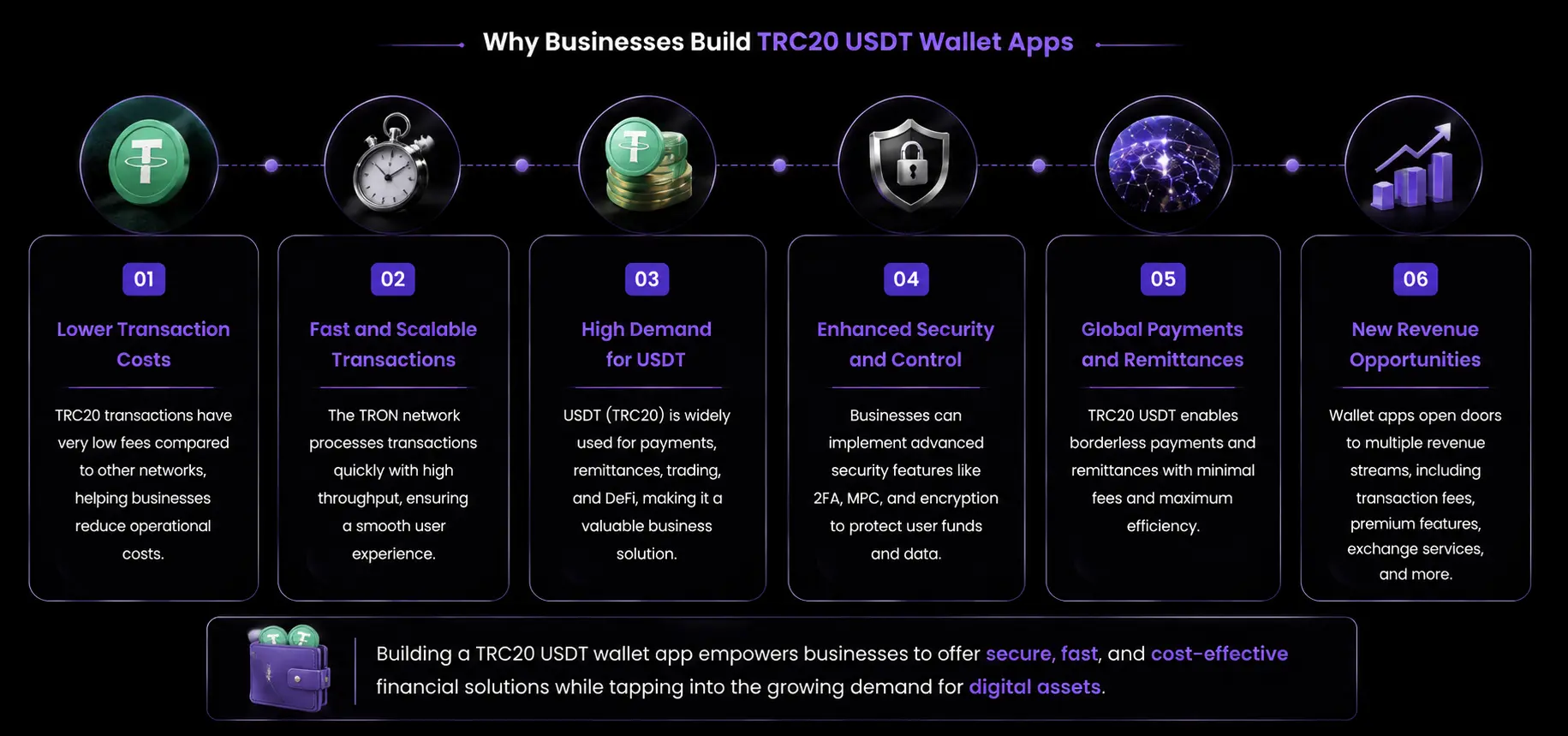
1. Crypto Payment Apps
TRC20 wallets are used by crypto payment apps for users to send, receive and manage USDT from a web or mobile wallet. Expert Web3 development services can help businesses develop payment-focused products if you want to create wallet infrastructure that is scalable and safe.
2. Remittance Platforms
USDT TRC20 wallets on platforms simplify international payments and make it faster to send money to other countries. This enables fintech companies to serve freelancers, foreign businesses and users all over the world.
3. Fintech Apps
TRC20 wallet compatible fintech apps allow users to deposit and withdraw stablecoins, send money to other people and manage digital assets all from a single account.
4. Exchange Wallets
Cryptocurrency exchanges need wallet systems to allow users to deposit and withdraw funds, view their own balances and track transactions. Exchanges can manage USDT transfers through a secure TRC20 wallet module, retaining operational control and audit access.
5. Merchant Payment Systems
Merchant payment systems use USDT TRC20 wallets, so customers can pay with stablecoins. This can help companies manage crypto shopping, bill payments, and digital settlements.
6. Web3 Payment Products
Web3 payment tools use TRC20 wallets to make token payments, run subscription services, transfer funds between treasuries, and enable decentralized financial workflows. Companies making payment goods that work with more than one blockchain may also want to consider making wallets that work with more than one blockchain.
Key Features of a TRC20 USDT Wallet App
A good TRC20 USDT wallet app should be easy to use, secure, and simple. Businesses and start-ups should focus on core features that make it easy to use, keep transactions safe and give them more control over their business.
- Wallet Address Creation
The app should have the ability for users to safely create a USDT TRC20 wallet address and support backups, key management and creation of addresses that work with TRON. - Send and Receive USDT
The wallet should easily be able to send and receive USDT on the TRON network. A good crypto wallet USDT TRC20 solution should show balances, fees, info about the receiver, and confirmation before sending money. - Transaction History
Users should be able to view transaction hash, transaction timestamp, transaction status, payments and withdrawals. You can also check records on TRONSCAN. - QR Code Payments
Scanning a QR code makes USDT payments faster by not having to type in long wallet names manually. - Security Features
Security should include two factor authentication , fingerprint login , seed phrase protection , encryption and device verification. Companies can also adhere to the OWASP Mobile Application Security best practices. - Admin Panel
To control users, monitor wallets, monitor transactions, provide support tools and keep track of any suspicious behavior, businesses need an admin panel.
How to Create a USDT TRC20 Wallet App
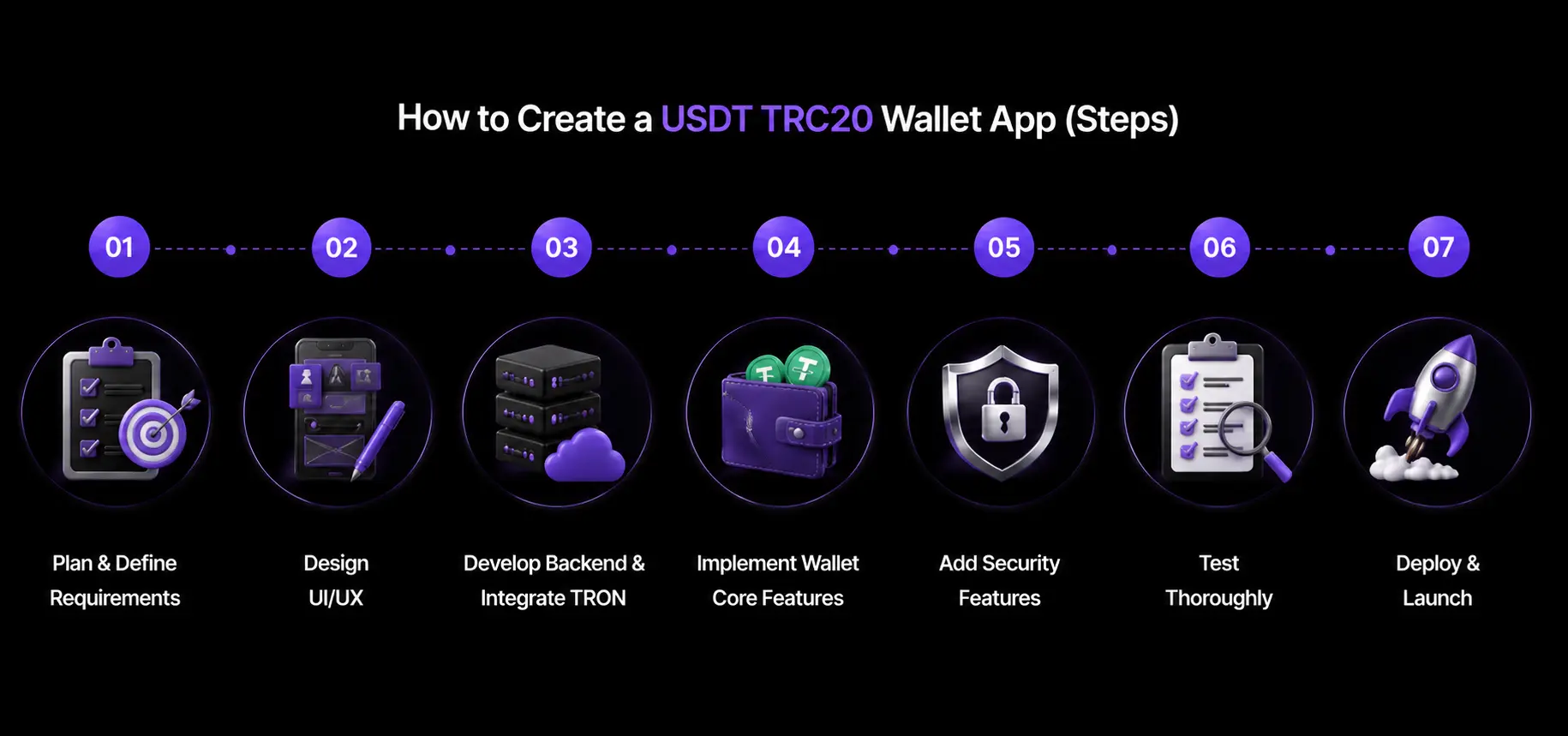
To build a secure TRC20 USDT wallet app, you need the right wallet model, blockchain integration method, security design and testing method. Businesses should not begin with coding but rather should use a structured development method.
Step 1: Choose Wallet Type
The first step is to decide if the bag is going to have money in it, not have money in it, or be a mix. The site stores the user’s private keys in a custodial wallet. People using a non-custodial wallet are responsible for their keys and recovery words. A hybrid model gives users more power, while still being easy to use at a platform level.
Step 2: Finalize Core Features
Before you start coding, outline the key features. In a useful wallet, you should be able to create a wallet, send and receive USDT, see your transaction records, pay with a QR code, and have security features and an admin panel. That helps the first version stay on track and save money.
Step 3: Integrate the TRON Network
The app should connect to the TRON blockchain to generate bank addresses, track USDT balances, sign transactions, and watch transactions. This is where users can safely generate a USDT TRC20 bank address inside the app.
Step 4: Add Security Layers
Security is extremely important when you’re building a TRC20 Wallet App Development. The wallet should have two-factor authentication (2FA), encryption, secret key protection, biometric login, device verification, and fraud monitoring to prevent fraud and unauthorized access.
Step 5: Test and Launch
After the wallet is ready for go-live, it should be subjected to QA testing, blockchain testing, transaction testing, security testing, and speed review. Once installed the wallet is stable, secure and ready for scale with regular updates, monitoring and care.
TRC20 Wallet Development Cost in 2026
The TRC20 Wallet development cost in 2026 depends on the wallet type, app complexity, supported platforms, security requirements, compliance needs, admin panel, and third-party integrations. A simple wallet with basic USDT transfer features costs less, while an enterprise-grade custodial platform with KYC, compliance monitoring, multi-chain support, and advanced admin controls requires a larger development budget.\
| Wallet Type | Estimated Cost |
|---|---|
| Basic TRC20 USDT wallet | $15,000 – $30,000 |
| Mid-level wallet with admin panel | $30,000 – $60,000 |
| Advanced wallet with KYC, swap, and multi-chain support | $60,000 – $120,000+ |
| Enterprise custodial wallet platform | $120,000 – $250,000+ |
Main Factors That Affect TRC20 Wallet App Development Cost
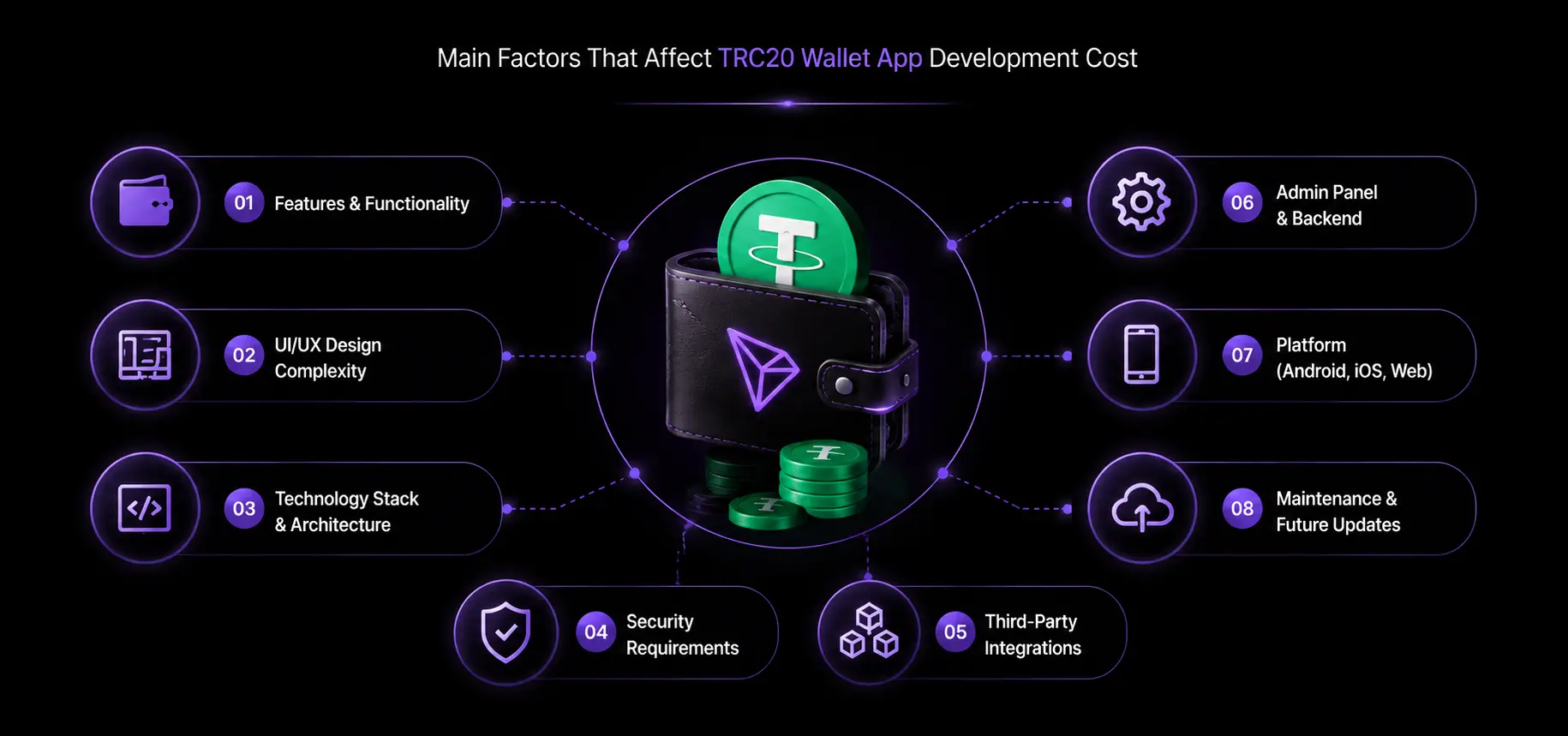
While creating a TRC20 wallet, you need to consider the wallet type, the platform and the security, how to build the blockchain and your legal requirements. A simple crypto wallet USDT TRC20 app is cheaper than a corporate wallet which requires more infrastructure and monitoring.
- Wallet Architecture
Custodial wallets require more control on the backend, private key management, approvals on withdrawals and security monitoring which makes them more work to build. - App Platform
The cost will depend on whether the app is for Android, iOS, web or both. To make something work on more than one platform usually takes more planning, testing and tweaking. - Security Requirements
Private key protection, encryption, 2FA, biometric login, device verification, and fraud detection increase cost but are essential for wallet safety. - Blockchain Integration
How you set up a node, make a wallet, keep track of balances, sign transactions, and watch transactions all directly affect the creation time. - Compliance and KYC
KYC/AML is more expensive because it requires verifying people’s identities, risk assessment, and connecting with third-party services. But it is necessary for regulated fintech and corporate wallet products.
Recommended Tech Stack for TRC20 Wallet App Development
When developing a TRC20 wallet app, the technology stack should be chosen to provide secure wallet operation, fast transactions, scalable backend speed, and a good user experience on all devices. When choosing technologies, businesses should consider the type of wallet, expected number of users, compliance requirements and long-term product strategy.
| Layer | Suggested Technologies |
|---|---|
| Mobile App | Flutter, React Native, Swift, Kotlin |
| Backend | Node.js, NestJS, Golang, Laravel |
| Blockchain | TRON Network, TRONGrid API, Full Node |
| Database | PostgreSQL, MongoDB, Redis |
| Security | 2FA, biometrics, encryption, MPC/HSM |
| Cloud | AWS, Google Cloud, Azure |
Custodial vs Non-Custodial TRC20 Wallet
One of the most important things to consider while developing a TRC20 USDT wallet app is to choose the right kind of wallet. It is good for exchanges, fintech apps and payment platforms because the company holds users’ secret keys and helps them get back into their accounts in a custodial wallet. The non-custodial wallet user owns their own seed words or private keys. That makes them more responsible because they have the keys. For businesses that need flexibility, a hybrid wallet combines both these methods.
| Wallet Type | Best For |
|---|---|
| Custodial Wallet | Exchanges, fintech apps, payment platforms |
| Non-Custodial Wallet | Web3 users and decentralized apps |
| Hybrid Wallet | Businesses needing flexible control |
How Techfyte Helps With TRC20 Wallet App Development
Techfyte uses a business-first approach to help startups and large companies to plan, build, secure and launch TRC20 wallet products. Techfyte provides blockchain development services and crypto wallet development services that assist in planning wallets, integrating the TRON Blockchain, making wallet addresses, developing private and non-custodial wallets, making admin panels and ensuring that transactions are safe.
Techfyte Technology helps companies build Web3 applications. It also helps companies add security features such as KYC/AML integration, testing, deployment, upkeep and long term support. Techfyte’s stablecoin development experience assists companies that are developing stablecoin payment products or USDT-based financial platforms to minimize technical risk, enhance the scalability of their platforms, and get a clearer picture of the costs involved in developing a TRC20 wallet app before they embark on full-fledged TRC20 wallet app development.
Conclusion
Building a USDT TRC20 wallet app in 2026 requires careful planning across wallet type, core features, security, TRON blockchain integration, compliance, admin controls, and development cost. A basic wallet may be enough for early-stage products, while fintech apps, exchanges, and enterprise platforms need stronger infrastructure and monitoring. The success of TRC20 Wallet App Development depends on choosing the right architecture from the beginning. For expert guidance on planning, estimating, and building your wallet project, businesses can connect with Techfyte’s blockchain development team.
Frequently Asked Questions (FAQ)
1. How do I create a USDT TRC20 wallet address?
You need a wallet app that works with TRON to get a USDT TRC20 bank address. These are the public address and private key that the app makes. You can use them to share and receive USDT.
2. What is the average TRC20 Wallet development cost in 2026?
Making a TRC20 wallet costs money, but it relies on the type of wallet, its features, security, admin panel, and the rules that need to be followed. Most of the time, it costs at least $15,000 to $250,000.
3. What features should a TRC20 USDT wallet app include?
A TRC20 USDT wallet app should include address creation, send/receive USDT, transaction history, QR payments, 2FA, biometric login, and an admin panel.
4. Is Trust Wallet a USDT TRC20 wallet?
Yes, Trust Wallet works with the USDT TRC20 wallet. Trust Wallet works with USDT on TRC20. But businesses need custom wallets for senior controls, branding, and following the rules.
5. What is the best crypto wallet for USDT TRC20?
For USDT and TRC20, the best wallet relies on what you plan to do with it. People may want wallets that don’t hold their cash, but businesses need wallets that are safe, compliant, and scalable that are made just for them.
6. Is a TRC20 wallet secure?
Yes, with features like encryption, 2FA, biometric login, and secure key management.
7. Can a TRC20 wallet support multiple cryptocurrencies?
Yes, it can support TRC20 tokens along with assets from other blockchain networks.
8. What is a non-custodial TRC20 wallet?
A non-custodial wallet gives users full control of their private keys and funds.
9. Can I integrate crypto payments into a TRC20 wallet?
Yes, TRC20 wallets can include payment, QR code, and merchant transaction features.
10. How long does TRC20 wallet development take?
A basic wallet can take a few weeks, while advanced solutions may take several months.
