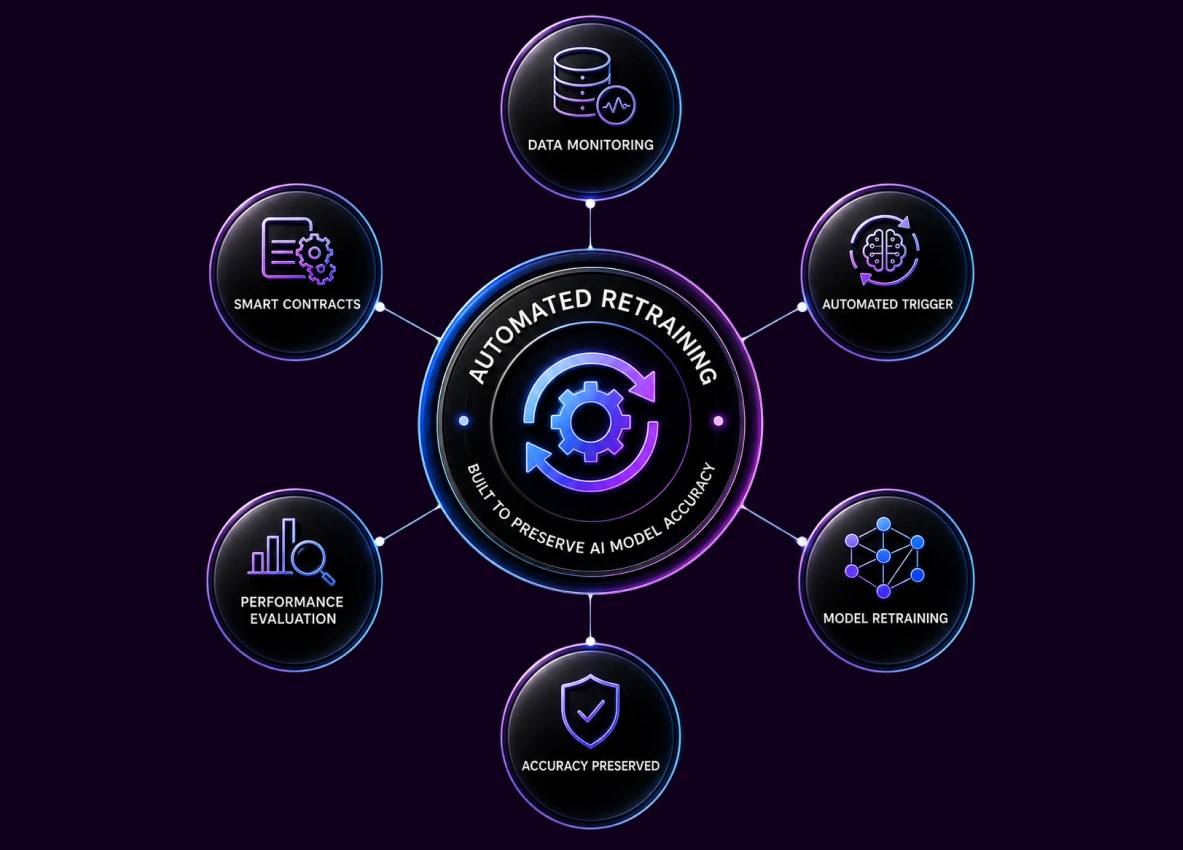
Automated Retraining Built to Preserve AI Model Accuracy
Automated retraining keeps AI models accurate as on-chain data evolves, detecting drift early and refreshing predictions so performance stays reliable, relevant, and production-ready without manual effort or operational friction.
- Early model drift detection
- On-chain data intelligence
- Continuous automated model retraining











What is Automated Retraining?
Automated retraining is how AI systems stay useful after launch. Instead of being treated as static assets, models are designed to evolve as live data changes, allowing them to keep pace with real usage and shifting conditions. In production environments, manual retraining simply doesn’t scale. Data patterns change quietly and often, leading to model drift and gradual model decay long before failures are obvious. Automated retraining brings structure to this problem by making learning a built-in behavior, not a reactive task. As part of modern MLOps and AI lifecycle management, it allows teams to maintain performance without constant monitoring or ad hoc fixes. Rather than chasing accuracy issues after they appear, organizations can design AI systems that adapt by default. This shift lays the groundwork for understanding why automated retraining has become essential for long-term AI reliability.
- Built-In model adaptation
- Drift-aware learning
- Production-scale AI systems
Why Automated Retraining Drives Business Value?
Machine learning models in production don’t stand still; they quietly degrade as customer behavior, markets, and data patterns change over time. Without a system designed to adapt, small inaccuracies compound into unreliable decisions that affect revenue, operations, and confidence in AI-driven outcomes. By the time problems are visible, the cost is already embedded in everyday business processes and harder to reverse quickly at scale later. Automated retraining matters because it shifts AI from a maintenance burden to a performance asset that improves with use. It allows teams to respond to change automatically, preserve decision quality, and protect systems from becoming outdated as the business grows. Instead of reactive fixes, organizations gain consistency, accountability, and long-term reliability across their AI investments even as conditions shift across markets and users globally continuously.

Revenue Protection Impact
More accurate predictions reduce costly mistakes, protect margins, and support better pricing, risk decisions, and forecasting across core business functions.

Operational Efficiency Gains
Automation reduces manual retraining work, freeing engineers to focus on innovation, delivery speed, and higher-value system improvements at enterprise scale.

Competitive Response Speed
Adaptive systems respond faster to market changes, enabling quicker experimentation, smarter decisions, and sustained advantage in dynamic environments over time.

Compliance Confidence Assurance
Consistent model behavior improves audit readiness, traceability, and governance, reducing regulatory risk as AI systems scale across organizations safely globally.
How Automated Retraining Works?
Automated retraining is a structured intelligence process that keeps production models aligned with real-world behavior while evolving quietly in the background.
Performance Signal Tracking
Models are continuously observed using carefully selected indicators that surface early quality shifts before they impact decisions or outcomes.
Behavior Drift Detection
Incoming data and predictions are compared against established baselines to identify meaningful behavioral changes, not routine fluctuations.
Retraining Decision Engine
Defined thresholds and contextual logic determine when retraining delivers real value, preventing unnecessary cycles and preserving system stability.
Pipeline Orchestration Flow
A standardized pipeline refreshes features, retrains models, and maintains full lineage using ML pipeline automation for production-scale systems.
Pre Release Model Validation
Updated models are evaluated across historical data and edge scenarios to confirm performance gains and reliability under real conditions.
Seamless Production Release
Validated models are deployed automatically with controlled rollout mechanisms that protect availability while allowing intelligence to advance.
Essential Features of Automated Retraining
These traits form a disciplined foundation for automated retraining solutions, delivering controlled adaptation, operational trust, and measurable performance gains as models evolve in production environments.

Continuous Performance Visibility
Live performance signals reveal subtle accuracy and latency shifts early, allowing teams to act before business impact accumulates quietly consistently.

Intelligent Drift Awareness
Statistical change detection identifies meaningful behavioral shifts, supported by anomaly detection for real-time monitoring and system reliability.

Value Based Triggers
Retraining activates only when expected gains justify action, balancing freshness with stability while protecting resources and production confidence continuously thoughtfully.

Structured Training Pipelines
A standardized model retraining pipeline refreshes data, rebuilds models, and preserves lineage through repeatable execution aligned with operational standards enterprisewide.

Rigorous Model Validation
Candidate models face controlled evaluations across historical scenarios and edge cases, confirming improvements are real, durable, and safe consistently proven.

Governed Production Release
Approved models move into production through managed rollouts, maintaining availability, traceability, and confidence as intelligence advances responsibly at scale globally.
See How Automated Retraining Works
View the SystemOur Automated Retraining Development Services
Enterprise-grade automated retraining systems designed to connect data intelligence, model behavior, and production deployment into a continuously adaptive AI infrastructure layer.
Pipeline Architecture Design
End-to-end system architecture defining data flow, transformation logic, retraining triggers, and production pathways that ensure controlled and reliable model evolution.

Live Model Monitoring
Continuous observation of model performance across production environments, capturing accuracy shifts, latency changes, and behavioral degradation before operational impact occurs.

Drift Intelligence Detection
Statistical detection layers identifying meaningful data and concept shifts, ensuring retraining is activated based on real distribution changes rather than noise.

Automated Training Orchestration
Coordinated workflows that execute retraining automatically using updated datasets, maintaining consistency, reproducibility, and stability across production machine learning environments.

Validation Framework Engineering
Structured evaluation systems that benchmark retrained models against historical performance and edge cases to ensure measurable improvement and production readiness.

Controlled Deployment Systems
Release pipelines enabling safe promotion of validated models into production with version control, rollback capability, and minimal service disruption.
Version Governance Management
Comprehensive tracking of model iterations with full lineage visibility, enabling auditability, comparison, compliance readiness, and controlled lifecycle progression.

Lifecycle Orchestration Layer
Unified orchestration across monitoring, retraining, validation, and deployment, enabling continuous improvement loops within production AI systems at scale.

Enterprise Integration Engineering
Seamless integration of retraining systems with existing ML infrastructure, data pipelines, and enterprise platforms without disrupting current production environments.
Industry Applications of Automated Retraining
Automated retraining supports industry-specific AI systems operating in dynamic environments where data shifts continuously, ensuring models remain accurate, stable, and aligned with real-world decision contexts at enterprise scale.

Financial Fraud Detection
Fraud systems operate in adversarial environments where behavioral patterns evolve across transaction networks and payment channels. Automated retraining keeps detection models aligned with emerging fraud signatures while preserving accuracy and trust. Explore AI fraud detection solutions for deeper implementation context.
- Adaptive fraud detection logic
- Continuous risk signal updates
- Evolving threat pattern alignment

Ecommerce Personalization Systems
Digital commerce platforms depend on rapidly changing user intent influenced by seasonality, trends, and behavioral shifts. Automated retraining keeps recommendation and forecasting models aligned with live interactions, ensuring relevance, stronger engagement quality, and consistent conversion performance across large-scale retail ecosystems.
- Real time behavior adaptation
- Dynamic recommendation recalibration
- Demand signal continuous learning

Healthcare Predictive Modeling
Healthcare environments evolve through continuous inflow of clinical data, research updates, and patient outcomes. Automated retraining ensures predictive models remain clinically relevant, statistically accurate, and compliant, supporting dependable decision-making across diagnostics, treatment planning, and healthcare intelligence systems.
- Clinical data model alignment
- Regulated update consistency layers
- Outcome driven accuracy refinement

Real Time Trading Systems
Financial markets shift instantly due to volatility, macroeconomic events, and sentiment-driven movements. Automated retraining ensures trading models continuously recalibrate based on live signals, maintaining responsiveness, reducing decision latency, and preserving predictive integrity in high-frequency execution environments.
- Live market adaptation systems
- High velocity strategy updates
- Volatility responsive recalibration logic

Enterprise Risk Intelligence
Enterprise risk exposure evolves with organizational scale, regulatory pressure, and external market conditions. Automated retraining ensures risk models remain aligned with current operational realities, improving governance accuracy, reducing blind spots, and maintaining consistent decision confidence across enterprise systems.
- Dynamic risk recalibration models
- Continuous anomaly detection updates
- Governance aligned intelligence systems
Financial Fraud Detection
Fraud systems operate in adversarial environments where behavioral patterns evolve across transaction networks and payment channels. Automated retraining keeps detection models aligned with emerging fraud signatures while preserving accuracy and trust. Explore AI fraud detection solutions for deeper implementation context.
- Adaptive fraud detection logic
- Continuous risk signal updates
- Evolving threat pattern alignment
Ecommerce Personalization Systems
Digital commerce platforms depend on rapidly changing user intent influenced by seasonality, trends, and behavioral shifts. Automated retraining keeps recommendation and forecasting models aligned with live interactions, ensuring relevance, stronger engagement quality, and consistent conversion performance across large-scale retail ecosystems.
- Real time behavior adaptation
- Dynamic recommendation recalibration
- Demand signal continuous learning
Healthcare Predictive Modeling
Healthcare environments evolve through continuous inflow of clinical data, research updates, and patient outcomes. Automated retraining ensures predictive models remain clinically relevant, statistically accurate, and compliant, supporting dependable decision-making across diagnostics, treatment planning, and healthcare intelligence systems.
- Clinical data model alignment
- Regulated update consistency layers
- Outcome driven accuracy refinement
Real Time Trading Systems
Financial markets shift instantly due to volatility, macroeconomic events, and sentiment-driven movements. Automated retraining ensures trading models continuously recalibrate based on live signals, maintaining responsiveness, reducing decision latency, and preserving predictive integrity in high-frequency execution environments.
- Live market adaptation systems
- High velocity strategy updates
- Volatility responsive recalibration logic
Enterprise Risk Intelligence
Enterprise risk exposure evolves with organizational scale, regulatory pressure, and external market conditions. Automated retraining ensures risk models remain aligned with current operational realities, improving governance accuracy, reducing blind spots, and maintaining consistent decision confidence across enterprise systems.
- Dynamic risk recalibration models
- Continuous anomaly detection updates
- Governance aligned intelligence systems
Discover Where Retraining Creates Value
Explore Use CasesAutomated Retraining System Architecture
A structured engineering framework defining how automated retraining systems are designed, implemented, and optimized for stable, production-grade AI performance across evolving data environments.

Infrastructure Evaluation Phase
Existing ML systems, data pipelines, and deployment setups are analyzed to uncover gaps, performance limits, and retraining readiness before design begins.
System Design Architecture
Scalable architecture defines data flow, feature processing, training logic, validation structure, and deployment paths ensuring controlled, predictable model evolution across environments.


Drift Detection Setup
Continuous observability layers track data shifts, model behavior changes, and performance degradation, enabling early detection before production systems experience instability or drift.
Retraining Logic Configuration
Adaptive rules and thresholds determine when retraining should trigger, ensuring updates occur only on meaningful changes while maintaining operational stability and efficiency.


Model Validation Testing
Retrained models are evaluated against historical benchmarks and edge cases, confirming accuracy gains, stability, and production readiness before deployment into live systems.
Production Deployment Control
Validated models are deployed through controlled pipelines ensuring stability and reliability, aligned with AI deployment and model serving approach.

Why Choose us as Automated Retraining Development Company
Selecting TechFyte means partnering for production-grade automated retraining systems built for reliability, governance, and scalable AI performance across complex, high-scale enterprise environments worldwide.

Production First Engineering
We design production-focused AI systems emphasizing stability, observability, and controlled behavior, ensuring reliable performance across continuously evolving real-world enterprise data environments.

Risk Controlled Automation
Retraining systems include validation gates, monitoring layers, and controlled update logic that reduce operational risk and prevent unstable model deployments in production.

Enterprise Scale Ownership
We manage full system ownership from architecture to deployment, ensuring scalable AI operations, reduced fragmentation, and consistent performance across enterprise infrastructure environments.