Blockchain Based Carbon Credit Platform Development
We build carbon credit platform solutions that make it simple for teams to issue, trade, and manage credits with confidence, while ensuring transparency and scalability across evolving climate ecosystems.
- Easy credit issuance
- Transparent trading flows
- Scalable system design











What is Carbon Credit Platform Development?
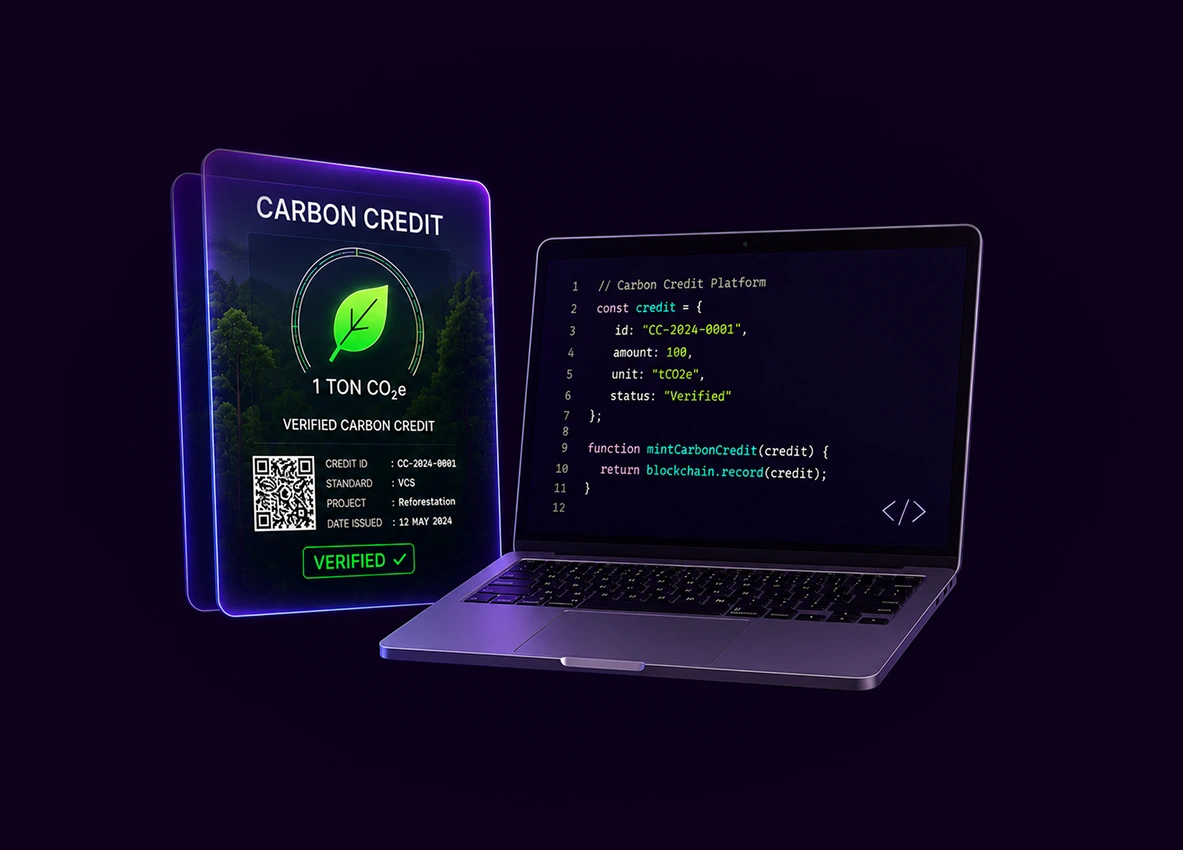
Carbon credit platform development shapes how environmental credits are structured and managed as they move through issuance, transfer, and retirement. It brings order to carbon credit lifecycle management by connecting each stage into a continuous, trackable flow across participants and systems. In traditional carbon credit software development setups, these workflows are often spread across disconnected systems, which leads to delays in reconciliation and inconsistent records. Modern blockchain-based carbon credit platforms replace that with a shared infrastructure where every update is recorded in a synchronized way across the network. This makes it easier to maintain consistency across the system and helps prevent carbon credit double counting without relying on manual verification layers.
- Connected lifecycle flow
- Shared system records
- Reduced duplication risk
Why Carbon Credit Platforms Matter to Businesses?
Businesses are facing increasing pressure to prove the credibility of their climate actions. Regulators, investors, and auditors now expect verifiable data that supports carbon credit compliance, not assumptions or manual reports. Platforms built with blockchain for ESG compliance help improve ESG reporting transparency by providing consistent, auditable records that stand up to scrutiny and reduce regulatory risk. At the same time, participation in the voluntary carbon market is growing as companies commit to net-zero goals. As volumes and counterparties increase, fragmented tools create exposure to errors and fraud. Purpose-built carbon credit platforms reduce these risks by creating a reliable operational backbone that supports confident participation and long-term decision-making.

Regulatory Accountability
Provides auditable records that align with evolving disclosure rules, helping finance teams meet compliance requirements without costly manual reconciliation or reporting delays.

Market Participation Readiness
Enables businesses to engage confidently in the voluntary carbon market as volumes grow, without operational bottlenecks or uncertainty around credit validity.

Fraud Risk Reduction
Minimizes exposure to duplicate or invalid credits by maintaining consistent records that reduce disputes, reversals, and reputational damage.

Financial Decision Clarity
Gives CFOs reliable data to assess credit usage, cost efficiency, and climate investments with clearer visibility and lower reporting risk.
How Carbon Credit Platform Works?
This section explains the operational flow behind a blockchain carbon credit platform, showing how verified climate data becomes tradable assets and ends as permanent, auditable retirements.
Verified Project Intake
Projects enter through standardized intake checks, capturing methodologies, baselines, and evidence early, so downstream processes rely on consistent, review-ready inputs.
Deterministic Credit Issuance
Issuance follows predefined calculation logic, translating verified impact data into precise credit units without interpretation gaps or manual recalculation steps.
On-Chain Credit Representation
Each issued credit is represented digitally with traceable ownership, timestamps, and attributes, enabling reliable tracking across transfers without registry reconciliation.
Rule-Based Market Transactions
Trades execute under encoded rules that automate settlement, enforce eligibility, and reduce counterparty friction while keeping histories transparent and inspectable.
Controlled Credit Retirement
Retirement locks credits permanently once used, updating system state instantly so claims cannot be reused, reversed, or mistakenly reintroduced elsewhere.
Audit-Ready Data Trail
Every action leaves a structured data trail, making reviews faster for auditors, compliance teams, and stakeholders without assembling evidence manually.
Features of Carbon Credit Platform Development
These capabilities define how strong carbon credit platforms operate in production environments, supporting compliance, market operations, and reporting without duplicating lifecycle explanations or trading workflows c

Automated Credit Retirement
Credits close automatically at use, updating system state instantly so retired units cannot reappear, be reversed, or reused later elsewhere.

Secure Trading Execution
Transactions settle within controlled rulesets, reducing counterparty risk while keeping trade history inspectable, consistent, and aligned with approved market participation.

Monitoring And Reporting
Centralized views track balances, usage, and disclosures together, helping teams streamline carbon credit monitoring without assembling data from multiple tools.

Permissioned Network Access
Role-based permissions define who can issue, trade, or retire credits, protecting system integrity while enabling collaboration across verified participants globally.

Transparent Credit Tracking
Every credit remains traceable by origin, status, and ownership, giving stakeholders confidence without relying on external registries or manual reconciliation.

Operational Market Oversight
Activity dashboards surface issuance, trading, and retirement patterns in real time, supporting supervision and issue detection without disrupting participants operations.
Pressure-Test Your Carbon Credit Systems
Run a System ReviewOur Carbon Credit Platform Development Services
These services cover distinct platform models across issuance, trading, governance, compliance, and consumption, allowing organizations to implement carbon credit systems aligned with their operational, regulatory, and market participation needs.

Carbon Credit Marketplace
Builds structured exchanges enabling multi-party trading, standardized transactions, pricing logic, and settlement coordination across verified buyers, sellers, and intermediaries.

Carbon Credit Registry
Establishes an authoritative system for issuing credits, updating ownership, and enforcing permanent retirement without dependence on fragmented external registries.

Enterprise Carbon Platform
Delivers private, permissioned platforms for enterprises managing internal credits, suppliers, or regulated counterparties under defined governance and access controls.

Carbon Offset Platform
Supports customer-facing offset programs that connect purchases to verified credits while preserving structured backend operations and audit-ready traceability.

Issuance Management Systems
Implements controlled processes translating verified project data into carbon credits using predefined methodologies, calculation rules, and validation checkpoints.

Trading Infrastructure Layer
Provides transaction execution frameworks that enforce eligibility, automate settlement logic, and maintain consistent trading records across market participants.

Compliance Reporting Systems
Centralizes carbon credit activity to support regulatory disclosures, audits, and verification workflows without manual data reconciliation across systems.

Permissioned Network Design
Defines participant roles, permissions, and access boundaries to ensure platform integrity while supporting collaboration among approved market actors.

System Integration Services
Connects carbon credit platforms with enterprise tools, registries, and external systems to maintain synchronized data flows across operational environments.
Industry-Driven Carbon Credit Platform Use Cases
Carbon credit platforms are used differently across industries based on how credits are created, exchanged, and applied in real operations. These examples show practical ways organizations structure carbon credit activity within their existing workflows.

Energy & Industrials
Energy and industrial organizations use carbon credit platforms to manage complex credit lifecycles, consolidate monitoring data, and maintain carbon credit compliance across large, distributed operational footprints using blockchain-based tracking.
- Facility-level attribution
- Methodology consistency
- Long-horizon accounting

Aviation & Shipping
Aviation and shipping operators rely on carbon offset platforms to connect emissions activity with verified credits, automate retirement, and maintain carbon credit compliance across routes, fleets, and international counterparties.
- Route-based attribution
- Fuel-linked offsets
- Cross-border claims

Financial Institutions
Banks and trading firms use carbon credit trading platforms to support exchange participation, settlement integrity, and carbon credit compliance while leveraging blockchain for transparent tracking and integration with existing financial systems.
- Portfolio exposure views
- Trade provenance clarity
- Counterparty attribution

Forestry & Agriculture
Project owners and aggregators use registry platforms to support carbon credit issuance, ownership updates, and compliance tracking while using blockchain for carbon credit tracking across long project timelines.
- Multi-year project states
- Land-use attribution
- Baseline change history

Manufacturing & Supply Chains
Manufacturers apply carbon credit platforms to track offset usage across suppliers, manage compliance obligations, and maintain consistent reporting using blockchain-based carbon credit tracking across multi-entity supply chains.
- Supplier-level assignment
- Product-linked offsets
- Inter-entity allocation

Technology & Enterprises
Large enterprises use private, permissioned carbon credit platforms to manage internal credits, offset programs, and compliance reporting while maintaining secure access controls and transparent credit tracking.
- Internal program governance
- Business-unit attribution
- Consumption-based tracking
Energy & Industrials
Energy and industrial organizations use carbon credit platforms to manage complex credit lifecycles, consolidate monitoring data, and maintain carbon credit compliance across large, distributed operational footprints using blockchain-based tracking.
- Facility-level attribution
- Methodology consistency
- Long-horizon accounting
Aviation & Shipping
Aviation and shipping operators rely on carbon offset platforms to connect emissions activity with verified credits, automate retirement, and maintain carbon credit compliance across routes, fleets, and international counterparties.
- Route-based attribution
- Fuel-linked offsets
- Cross-border claims
Financial Institutions
Banks and trading firms use carbon credit trading platforms to support exchange participation, settlement integrity, and carbon credit compliance while leveraging blockchain for transparent tracking and integration with existing financial systems.
- Portfolio exposure views
- Trade provenance clarity
- Counterparty attribution
Forestry & Agriculture
Project owners and aggregators use registry platforms to support carbon credit issuance, ownership updates, and compliance tracking while using blockchain for carbon credit tracking across long project timelines.
- Multi-year project states
- Land-use attribution
- Baseline change history
Manufacturing & Supply Chains
Manufacturers apply carbon credit platforms to track offset usage across suppliers, manage compliance obligations, and maintain consistent reporting using blockchain-based carbon credit tracking across multi-entity supply chains.
- Supplier-level assignment
- Product-linked offsets
- Inter-entity allocation
Technology & Enterprises
Large enterprises use private, permissioned carbon credit platforms to manage internal credits, offset programs, and compliance reporting while maintaining secure access controls and transparent credit tracking.
- Internal program governance
- Business-unit attribution
- Consumption-based tracking
See How This Applies To You
View Industry AlignmentCarbon Credit Platform Development Approach
This process reflects how serious carbon credit platforms are conceived and delivered, anchored in methodology clarity, architectural restraint, and operational fit rather than generic build steps or recycled lifecycle narratives.

Methodology-First Framing
We begin by grounding the platform in approved carbon methodologies, governance boundaries, and usage intent, ensuring every technical decision reflects how credits will be created, transferred, and consumed.
Purpose-Built Architecture
We design the blockchain, contract logic, and data structures to support issuance, trading, and retirement without forcing operational shortcuts or constraining future market participation.


Operational Launch & Alignment
We connect verification bodies, internal systems, and reporting layers, then deploy with controlled access and visibility for teams managing real-world carbon activity.
Why Choose Us as Carbon Credit Platform Development Company?
We focus on building carbon credit platforms that reflect real market rules, verification realities, and operational accountability, helping organizations deploy systems that work in practice, not just on paper.

Double Counting Control
Our platforms enforce state transitions that prevent duplicate issuance, reuse, or reversal of credits across registries, transactions, and retirement events.

Market Rule Fluency
We design systems informed by voluntary and regulated carbon markets, embedding methodology logic, participant roles, and evidence flows into behavior.

Operational Cost Clarity
Our delivery approach emphasizes transparent scope and pricing, so teams understand development effort, tradeoffs, and long-term operating implications before committing.