



Key Takeaways
- Dubai Regulatory Advantage: Dubai has established one of the world’s most advanced regulatory environments for real estate tokenization, with VARA, DFSA, and the Dubai Land Department supporting compliant tokenized property offerings.
- XRPL Fit for Real Estate: The XRP Ledger is well-suited for real estate tokenization because of low transaction costs, fast settlement, built-in compliance controls, native decentralized exchange support, and institutional-grade infrastructure.
- Realistic Platform Cost: Building a production-ready Dubai real estate tokenization platform on XRPL typically costs between $195,000 and $500,000, excluding ongoing licensing, compliance, infrastructure, and maintenance expenses.
- Structured Development Timeline: A compliant tokenized property platform usually follows a 6–9 month process covering legal setup, technical architecture, XRPL tokenization, platform development, audits, and regulatory approvals.
- Partner Expertise Matters: Success depends on combining regulatory knowledge, XRPL-specific technical expertise, strong security practices, and long-term operational support from experienced development and legal partners.
Dubai Real Estate Tokenization on XRP Ledger: Cost, Platform Development & Process
Dubai has emerged as a world center for blockchain innovation, and some of the most impactful testing is taking place at the convergence of real estate and distributed ledger technology. Amid a plethora of blockchains fighting for institutional adoption, the XRP Ledger (XRPL) has emerged as a credible candidate for asset tokenization because of its speed, low transaction costs, and built-in compliance capabilities.
This guide explains Dubai real estate tokenization on XRP Ledger, why XRPL is a strong choice, how much it costs to establish a real estate tokenization platform, and what the development process involves. For businesses comparing asset classes before choosing a product model, this guide on asset tokenization development services gives a broader view of token issuance, compliance, and marketplace infrastructure.
Why Dubai? The Regulatory Landscape
Dubai’s embracing of blockchain has been no accident. The emirate has put in place a purposeful legislative framework to lure tokenization projects.
The Dubai Virtual Assets Regulatory Authority (VARA), founded in 2022, offers a licensing framework for virtual asset activities, including tokenized real estate offerings. In addition, the Dubai Financial Services Authority (DFSA) regulates activities in the Dubai International Financial Centre (DIFC) and has given recommendations on security tokens. In 2024, the DFSA changed its rulebook to legally permit tokenized assets, including tokens backed by real estate.
The Dubai Land Department (DLD) has also been looking into registering property using blockchain technology since 2017. Since then, it has run trial tokenisation programs looking at fractional ownership, where investors can buy digitised shares of tangible property. These three regulatory authorities — VARA, DFSA, and DLD — form the compliance triangle that any firm seeking to tokenize Dubai real estate on the XRP Ledger needs to cross.
Businesses entering this space should also review the ultimate guide to real estate tokenization in the UAE to understand local ownership models, regulatory expectations, and investor-side risks in more detail.
Bottom line: Dubai has one of the most sophisticated and defined legislative settings for real estate tokenization in the world. That clarity lowers legal risk and makes the jurisdiction attractive to platform developers and investors alike.
Why the XRP Ledger for Real Estate Tokenization?
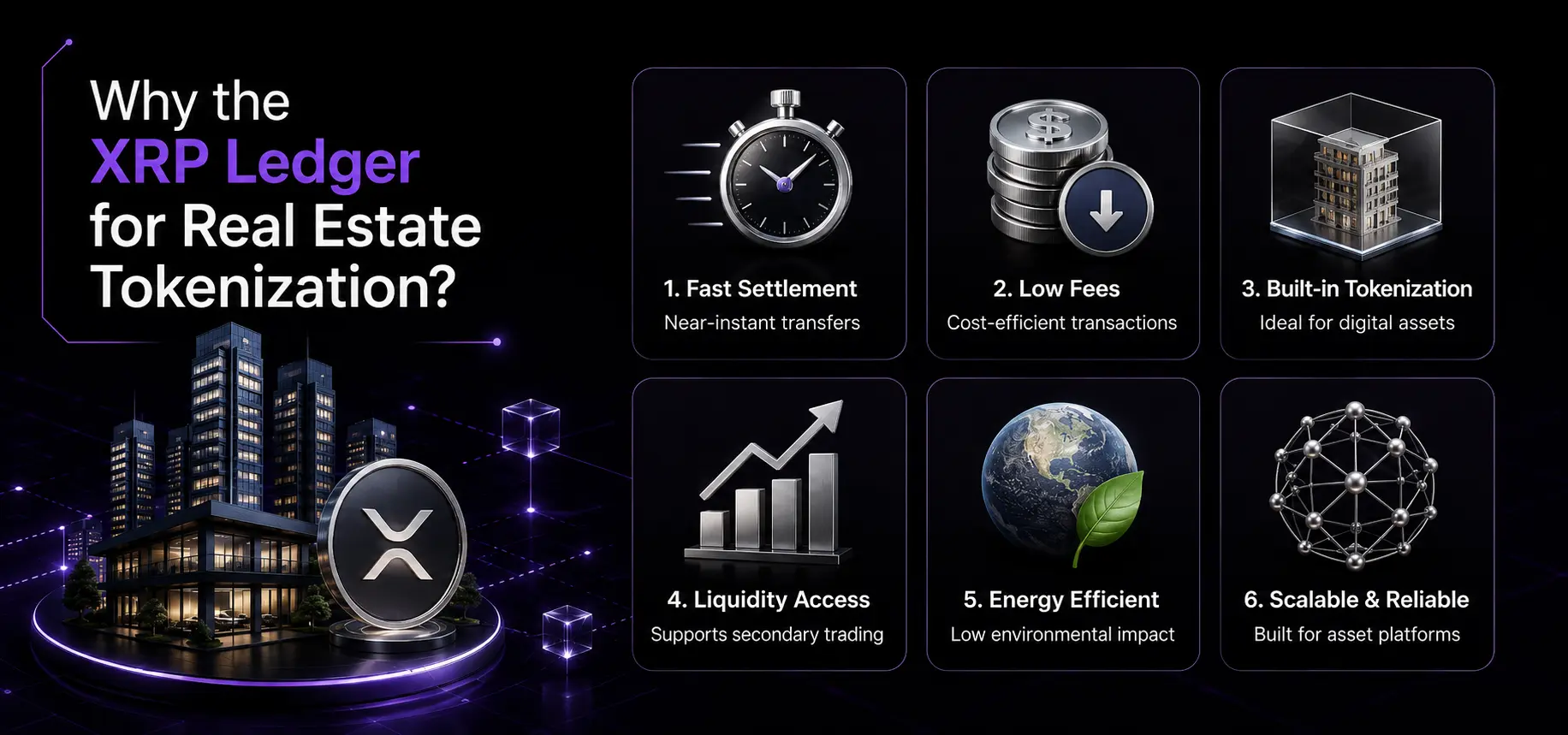 Some blockchains are better suited for tokenizing assets than others. There are many technical features of the XRP Ledger that make it a good fit for the needs of regulated real estate markets.
1. Low Transaction Costs
Transactions on the XRPL cost a fraction of a cent, usually about 0.00001 XRP. High gas networks have a cost profile that is not economically feasible for a tokenization platform that will be processing potentially thousands of micro-transactions, including secondary market trades, dividend distributions, and rental income payouts.
2. Speed & Finality
Transactions settle in 3–5 seconds with deterministic finality. There is no probabilistic settlement time and no possibility of block reorganization. This is a major advantage in real estate transactions, where the finality of ownership transfer can carry legal significance.
3. Built-in Compliance Features
XRPL has Issued Currencies, which enable token issuers to set transfer fees, freeze trust lines, and provide clawback capabilities. The Clawback amendment, enabled on mainnet in 2024, allows token issuers to recover assets from user accounts in certain regulatory or legal situations. This is particularly useful for real estate tokens, where a court judgment may require reversal of a fraudulent transfer.
For security-focused teams, smart contract design should be supported by independent review. Tech teams can compare audit readiness with smart contract formal verification services before moving regulated assets to production.
4. Decentralized Exchange (DEX)
There is a native order book DEX on the XRPL. Real estate assets tokenized on XRPL can be traded directly on-chain without requiring third-party exchange infrastructure. This allows platforms to provide liquidity natively while keeping trading workflows closer to the asset issuance layer.
5. Carbon Efficiency
XRPL uses a federated consensus process instead of proof of work. It uses very little power per transaction, which is increasingly important for ESG-conscious real estate funds and institutional investors.
6. Institutional Adoption
The XRPL already has financial institutions and payment corridors integrated, notably in the Middle East and Asia. This infrastructure makes it easier for a Dubai real estate tokenization platform to connect to banking and payment rails in the XRP ecosystem.
What Does Real Estate Tokenization Actually Mean?
Tokenization of real estate is simply issuing tokens on a blockchain that represent fractional ownership or economic rights to a real-world asset. If you have a Dubai Marina apartment, it could be divided into 100,000 tokens. For example, an investor buys 1,000 tokens and therefore has 1% economic interest, 1% of rental income, and 1% of proceeds from a sale, managed by a combination of smart contracts and legal framework, usually a Special Purpose Vehicle or trust.
Tokenization is not just digitizing a record in a land registry. Tokenization implies:
- Fractionalization of ownership into tradeable units
- Programmable rights such as automatic dividend distribution and voting rights
- Secondary market liquidity through compliant trading venues
- Legal enforceability under the relevant jurisdiction
If your project requires product-level planning beyond blockchain issuance, the real estate tokenization platform development guide explains business models, must-have features, cost planning, and tech stack decisions.
Real Estate Tokenization Platform Cost
This is the first question that generally comes up with any entity looking at tokenization. The price of a real estate tokenization platform depends on the breadth, jurisdiction, and customization needs, and it can vary a lot. Here is a real-world breakdown of a production-grade platform built for the Dubai market on XRPL.
Cost Breakdown by Component
| Component | Estimated Cost Range (USD) | Notes |
| Legal Structuring & Regulatory Advisory | $40,000 – $120,000 | VARA/DFSA licensing, SPV setup, prospectus drafting, investor accreditation framework |
| Platform Architecture & Design | $15,000 – $35,000 | UX/UI for investor portal, admin dashboard, mobile responsiveness |
| XRPL Smart Contract Development | $30,000 – $75,000 | Token issuance, Issued Currencies, clawback implementation, transfer restrictions, compliance rules |
| Frontend Development | $25,000 – $60,000 | Investor onboarding, KYC/AML integration, wallet integration, token purchase flow, portfolio dashboard |
| Backend & API Development | $30,000 – $70,000 | Property data management, income distribution engine, transaction monitoring, reporting |
| KYC/AML Integration | $10,000 – $25,000 | Third-party provider integration such as Sumsub, Jumio, or Onfido, plus ongoing per-verification costs |
| Custody & Wallet Infrastructure | $15,000 – $40,000 | Multi-signature wallets, institutional custody integration, key management |
| Smart Contract Audit | $15,000 – $35,000 | Third-party security audit of all on-chain logic |
| Testing & QA | $10,000 – $25,000 | Functional testing, security testing, user acceptance testing |
| Deployment & Go-Live | $5,000 – $15,000 | XRPL mainnet deployment, server provisioning, monitoring setup |
| Total Estimated Range | $195,000 – $500,000 | Depends on complexity, features, and vendor location |
If you want to reduce build time, a white-label tokenization platform can help validate the business model faster before investing in a fully custom XRPL build.
Ongoing Operational Costs
Beyond the initial build, platform operators should budget for:
- Annual VARA/DFSA license renewal: $20,000 – $50,000
- KYC/AML per-verification fees: $1 – $5 per investor
- Cloud hosting and infrastructure: $800 – $2,500 per month
- Ongoing legal and compliance: $5,000 – $15,000 per month
- XRPL transaction fees: Negligible, usually fractions of a cent per transaction
- Platform maintenance and updates: $3,000 – $10,000 per month
Factors That Influence Cost
- Regulatory scope: A platform serving only accredited investors under a restricted license costs less to build and maintain than a retail-facing platform with full VARA licensing.
- Single property vs. multi-property marketplace: Tokenizing a single building is simpler than building a marketplace that supports multiple issuers.
- Secondary trading functionality: Enabling a built-in exchange or connecting to external liquidity venues adds complexity.
- Integration depth: Direct integration with Dubai Land Department systems and banking partners increases initial cost but reduces long-term operational friction.
For income-generating properties, dividend distribution automation should be planned early because rental payouts, pro-rata calculations, and audit-ready records directly affect investor trust.
Dubai Real Estate Tokenization Platform Development Process
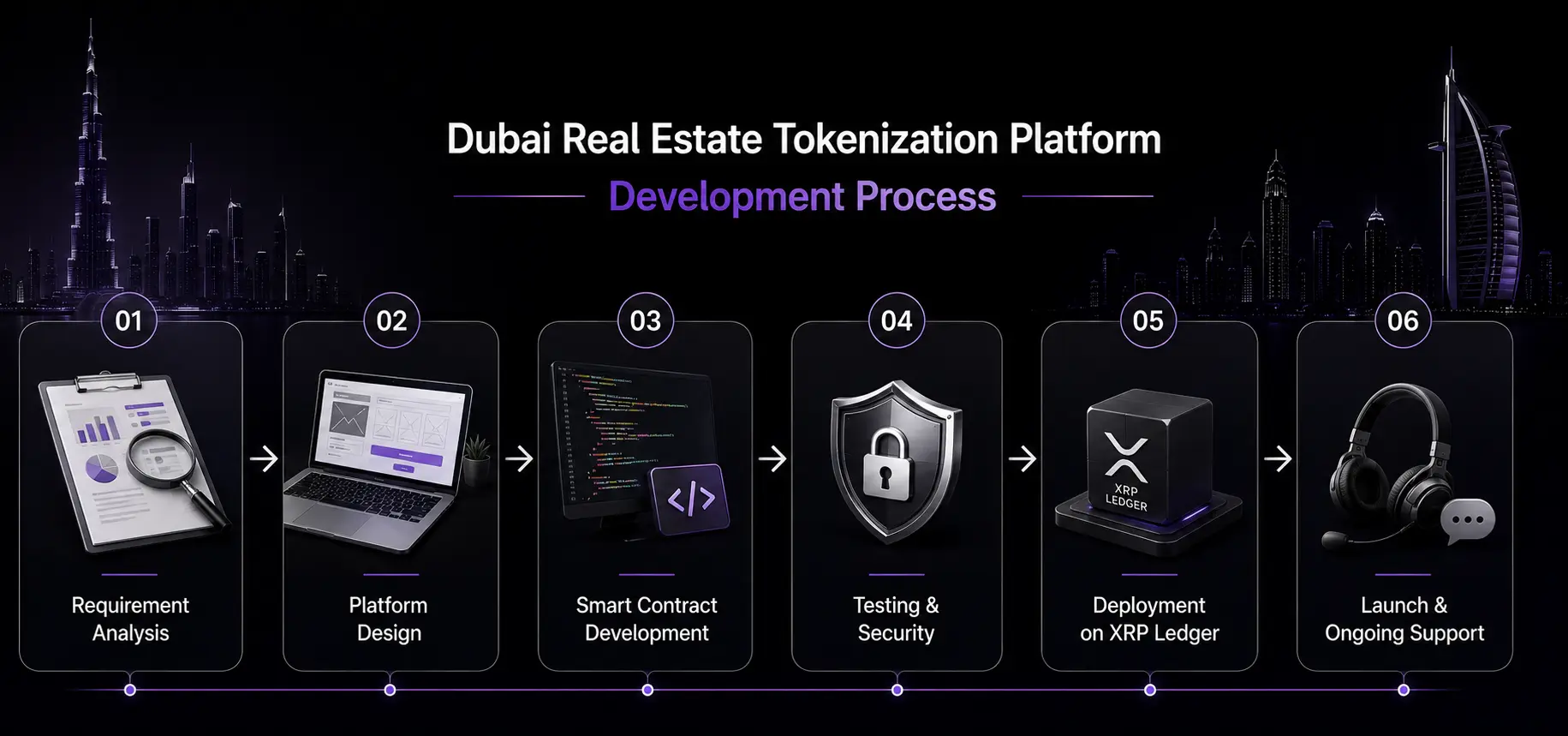
There are a number of consecutive stages to build a compliant Dubai real estate tokenization platform on XRP Ledger. Rushing or skipping steps, especially on the legal side, is an existential risk for the project.
Phase 1: Legal and Regulatory Foundation (4–8 Weeks)
This is the phase where most projects thrive or fail, and it happens before a single line of code is created. Main activities include:
- Seek advice from UAE-based legal counsel with expertise in tokenization
- Identify the regulatory pathway: VARA licensing, DFSA framework within DIFC, or both, depending on the target investor base
- Set up the legal framework, usually an SPV in DIFC or ADGM that owns the real estate and releases tokens indicating beneficial ownership
- Draft the token holder agreement, prospectus if required, and terms of service
- Establish investor eligibility requirements and jurisdictional limits
Phase 2: Technical Architecture Design (3–5 Weeks)
- Define token model on XRPL using Issued Currencies with the right settings
- Design the compliance layer, including transfer limitations, freeze capabilities, and clawback rules
- Build off-chain components such as user database, property data storage, and revenue distribution logic
- Integrate KYC provider, payment gateway, fiat on/off ramp, and XRPL node infrastructure
- Choose the technology stack, usually React or Vue.js for frontend, Node.js or Python for backend, PostgreSQL database, and XRPL JavaScript or Python SDK
At this stage, teams should also compare token design patterns used in tokenized bonds and equities platforms, because regulated asset ownership often requires similar controls for eligibility, transfers, and reporting.
Phase 3: Smart Contract & Backend Development (8–14 Weeks)
- Configure and issue XRPL tokens on Testnet
- Enforce compliance rules such as whitelist, transfer limits, and holding periods
- Develop distribution engine for rental income and dividend payments
- Build investor onboarding flow with integrated KYC/AML
- Build the admin dashboard for property management, investor relations, and reporting
- Establish multi-sig wallet infrastructure for treasury and asset custody
For custom on-chain logic, experienced teams usually follow an audit-ready smart contract development workflow before handling regulated investor assets.
Phase 4: Platform Development & Integration (8–12 Weeks)
- Complete investor portal with property listings, token purchase, portfolio view, and transaction history
- Integrate digital wallets such as Xaman, Ledger, or institutional custody solutions
- Handle fiat deposit and withdrawal payments, often with a regulated payment service provider in the UAE
- Develop secondary market interface if required, using XRPL native DEX or a bespoke order book
- Run integration testing on the XRPL Testnet
Phase 5: Audits, Testing & Compliance Review (4–6 Weeks)
- Get smart contract logic independently audited by a respected company
- Run web platform security penetration testing
- Complete regulatory compliance examination and submission to VARA or DFSA as necessary
- Run user acceptance testing with a pilot investor group
- Complete load testing for anticipated transaction volumes
Phase 6: Launch & Ongoing Operations (2–4 Weeks to Launch)
- Launch on XRPL mainnet and issue tokens
- Launch the first property listing and token offering
- Initiate marketing and investor outreach
- Establish operational workflows for investor servicing, compliance monitoring, and income distributions
- Continuously improve the platform depending on user response
Total development timeline: Approximately 6–9 months from project initiation to platform launch, assuming parallel workstreams on legal and technical development.
Companies benchmarking vendors in the UAE can also review the top real estate tokenization development companies in UAE before shortlisting a development partner.
Key Considerations for Building on XRPL
When setting up a platform for real estate tokenization, developers and project sponsors need to consider many XRPL-specific factors:
- Issued NFTs and Currencies: For fractional ownership, the best token type on the XRPL is Issued Currencies. NFTs on the XRPL, using the XLS-20 standard, are more appropriate for representing whole, unique properties rather than fractional ownership. Most tokenization platforms will use Issued Currencies for the fractional token and may use NFT logic as a title deed representation for the full property.
- Trust Lines: To receive tokens, an investor must establish a trust line to the issuing account. The platform UX needs to handle this smoothly, either by guiding users through it or automating it where possible.
- Clawback Enablement: Clawback must be active at the time of token issuance. It cannot be added after the fact. Also, a Clawback account must be opened for the issuing account.
- Transfer Fees: XRPL allows the issuer to define a transfer fee, such as 0.5% per transfer, which is automatically collected. This could be a platform revenue stream or a way to fund property upkeep reserves.
- DLD Compliance: The Dubai Land Department requires tokenized property transactions to be recorded in the official land registry. The platform architecture should include a bridge between on-chain token transfers and off-chain changes in DLD records. Currently, the process is semi-manual and needs integration with DLD-approved technology.
If the platform later expands beyond real estate, the same compliance-first architecture can support other asset-backed markets such as commodity tokenization and ESG-focused products.
Choosing Real Estate Tokenization Development Services
Few companies have the full stack of capabilities in house: legal, regulatory, blockchain, and real estate. Most successful ventures hire professional real estate tokenization development services to fill in the gaps.
When evaluating development partners, consider:
- XRPL experience: It is not enough to be a blockchain developer. The partner should have demonstrable XRPL experience, including familiarity with Issued Currencies, Clawback, and the XRPL DEX.
- Knowledge of UAE rules: The development team does not need to be a law firm, but it should understand VARA and DFSA requirements well enough to build a compliant system.
- Platform portfolio shipped: Request case studies or references for released tokenization platforms, especially those involving real estate assets.
- Security and audit posture: The partner should be connected with reputable XRPL audit companies and have a clear security development lifecycle.
- Ability to support after launch: Tokenization platforms are living businesses, not one-time software projects. The partner should provide ongoing services for maintenance and compliance updates.
For a broader enterprise comparison, you can also review Techfyte’s blockchain development services to see how tokenization, smart contracts, wallets, and blockchain infrastructure fit into a complete platform roadmap.
Frequently Asked Questions
1. Why use the XRP Ledger for real estate tokenization?
XRPL offers low fees, fast settlement, built-in compliance features, and native trading capabilities, making it practical for real estate platforms that need frequent transfers, income payouts, and regulated ownership controls.
2. How much does a Dubai real estate tokenization platform cost?
Development costs typically range from $195,000 to $500,000, depending on features, compliance requirements, custody setup, integrations, and secondary market functionality.
3. How long does it take to build a tokenized property platform?
Most platforms take approximately 6–9 months to develop and launch, especially when legal structuring, regulatory submissions, audits, and investor onboarding workflows are included.
4. Is real estate tokenization legal in Dubai?
Yes, provided the platform complies with applicable regulations from VARA, DFSA, and the Dubai Land Department. Legal structuring and regulatory review should be completed before token issuance.
5. Can investors trade tokenized real estate assets?
Yes, tokenized assets can be traded on compliant secondary markets or the XRPL’s native DEX, subject to investor eligibility rules, transfer restrictions, and local regulatory approvals.
Concluding Note
Dubai real estate tokenization on XRP Ledger suggests a confluence of regulatory preparedness, technological capacity, and market demand. Dubai provides legal certainty. XRPL has the speed, cost efficiency, and compliance tooling. This makes it compelling for property developers, investment funds, and technology entrepreneurs who want to build tokenized real estate platforms.
The first and most important step for organizations evaluating this opportunity is not technical; it is securing experienced legal counsel in the UAE to define the regulatory pathway. Partner with Techfyte for real estate tokenization development and asset tokenization to build a secure, compliant, and scalable property investment platform.
If your roadmap includes sustainable asset-backed markets in the future, you can also explore carbon credit tokenization as another regulated tokenization use case for ESG-aligned investors.
