



Key Takeaways
- A compliant RWA tokenization MVP can be launched in 30 days, but only by leveraging pre-audited, pre-built infrastructure rather than developing custom components from scratch.
- The first week is dedicated to regulatory, architectural, and token design decisions, as compliance scoping and asset structuring determine the success of the entire platform.
- Pre-built smart contracts, custody integrations, and investor onboarding modules are essential for accelerating development while maintaining institutional-grade security and compliance.
- A white-label or hybrid approach significantly reduces costs and timelines, with single-asset MVPs typically requiring a low-to-mid six-figure investment.
- Choosing an experienced RWA tokenization partner with proven deployments, audited infrastructure, and regulatory expertise is critical to delivering a successful launch within 30 days.
Introduction
Institutional players are moving into real-world asset tokenization faster than most founders expected, and the window to establish a first-mover position is narrowing. Speed matters, but a platform that skips compliance groundwork to hit a launch date usually pays for it later in regulatory friction or investor distrust. A focused RWA tokenization platform development effort can realistically produce a working MVP in 30 days, but only when it’s built on pre-audited, pre-existing infrastructure rather than custom code written from a blank page. Boston Consulting Group’s tokenization research points to trillions in projected asset value moving on-chain over the next decade, which is exactly why the sequencing below matters as much as the timeline itself. This guide walks through the four-week process, where the build-vs-buy decision actually gets made, and what a realistic cost range looks like.
What “30 Days” Realistically Covers – And What It Doesn’t
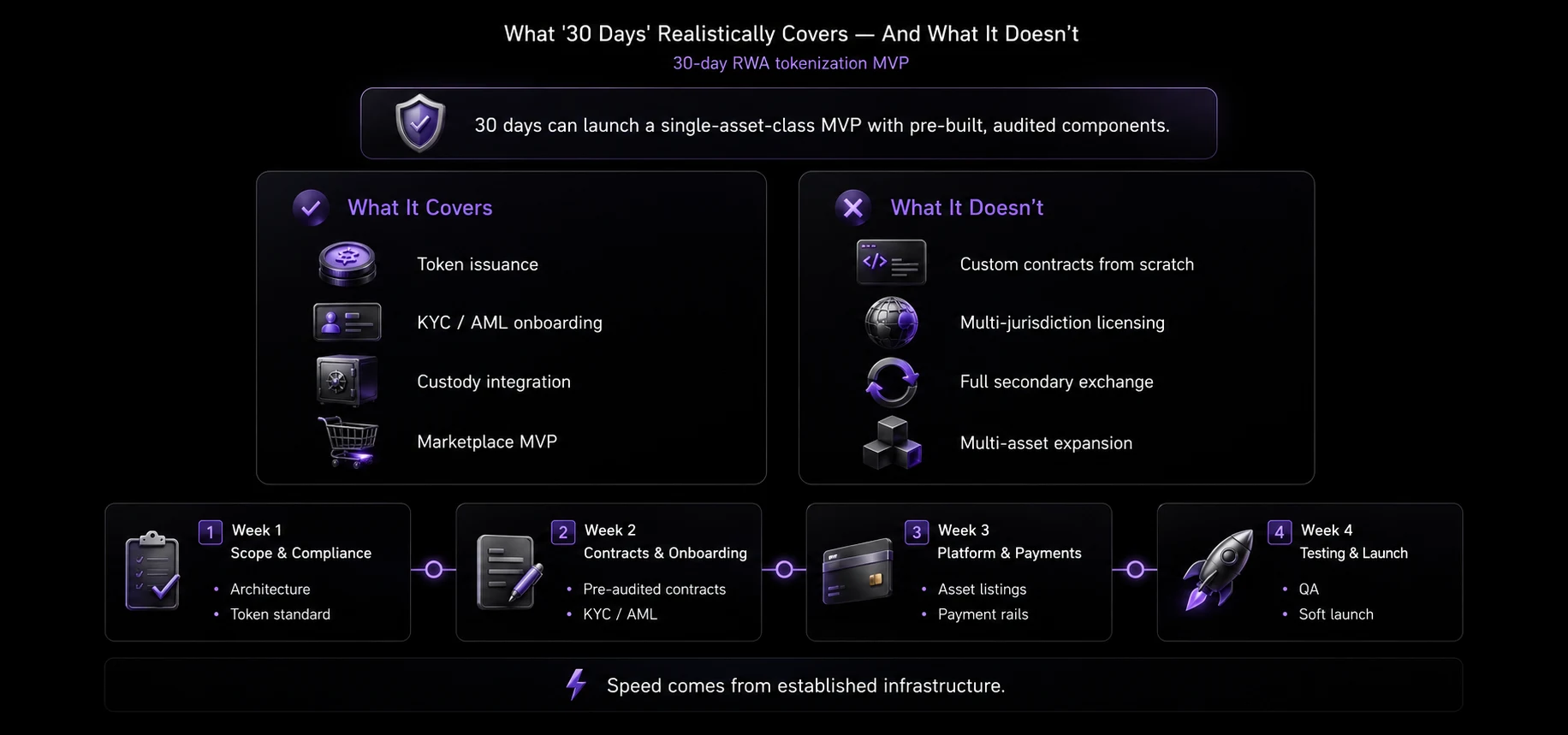
A 30-day build gets you a single-asset-class MVP: compliance-ready token issuance, investor onboarding, basic custody integration, and a functional marketplace interface. What it does not include is custom smart contract development from scratch, multi-jurisdictional licensing, or full secondary-exchange functionality – those extend timelines into months, not weeks. Building an rwa tokenization platform this fast is only possible because pre-built, audited components replace work that would otherwise consume most of the calendar. A useful reference point is BlackRock’s tokenized fund launch, which reached the market through an existing tokenization partner’s infrastructure rather than a ground-up build, illustrating how relying on established rails compresses time-to-market considerably. The role of an experienced RWA tokenization platform provider is exactly this: absorbing the infrastructure work so the issuer’s team can focus on the asset and the offering.
Week 1 – Architecture, Token Standards, and Compliance Scoping
Days 1-3 are for selecting the blockchain, whether a permissioned standard like ERC-3643 for regulated securities, or simpler ERC-20 structures, and establishing the custodial architecture. Days 4-5 examine the regulatory pathway and identify the applicable jurisdiction, licensing category and exemptions. Examples such as the EU’s DLT Pilot Regime show how regulators are creating sandbox pathways for this type of construction. Days 6-7 are spent finalizing the asset class, investor eligibility levels and disclosure criteria, referring to standard documentation such as the official ERC-3643 specification when the offering requires permissioned transfers. A successful RWA tokenization platform starts with scoping work, not code. The regulatory-compliant token design decisions made here will affect everything that comes next.
Week 2 – Smart Contracts, Custody, and Investor Onboarding
Days 8-10: Deploy and configure pre-audited smart contracts to manage transaction-level issuance, distribution and compliance checks. Days 11-12 involve institutional custody for asset backing and fund segregation. Days 13-14 pile up investor onboarding processes including KYC, AML, accreditation checks and sanctions screening – a workstream Techfyte discusses in more detail in its investor onboarding tools. A skilled RWA tokenization platform development company greatly accelerates this phase by re-using proven modules rather than building each one from scratch. That’s why Techfyte builds its own RWA tokenization platform development company engagements around a shared component library. There’s one step that is non-negotiable no matter the time constraints – an independent smart contract audit before any code touches real investor funds.
Week 3 – Platform Interface, Asset Listings, and Payment Rails
Days 15-18 build the investor-facing platform: asset listings with due diligence documentation, an investor dashboard, and a mobile-responsive interface. Days 19-21 integrate fiat and stablecoin on/off ramps alongside payment processing and custody connections. Asset onboarding during this week means formatting legal documentation, valuation reports, and risk disclosures for display. Whether the underlying asset is real estate tokenization, commodities, or structured debt, the listing template, due diligence checklist, and disclosure formatting stay largely the same across asset classes, which is precisely why relying on a white-label tokenization platform for the UI and payment layer is what makes this week’s scope achievable in seven days rather than seven weeks. Analysis from firms like Deloitte’s banking outlook reinforces why early movers who avoid rebuilding this layer from scratch tend to capture better margins once the platform is live.
Week 4 – Testing, Audits, Compliance Reporting, and Soft Launch
Days 22-24, cover end-to-end testing across transaction flows, onboarding, redemption mechanics, and edge cases. Days 25-26, finalize compliance reporting modules, regulatory documentation, and audit trails, while days 27-30 move through a controlled soft launch, monitoring, and go-live. A comprehensive RWA tokenization platform guide would stress that launch day is the beginning of ongoing obligations, not the finish line, especially once a secondary marketplace enters the picture and adds new reporting demands.
Cost Breakdown – What a 30-Day Build Actually Costs
Most of the expenses are allocated to a few categories: pre-audit smart contract license, custody integration, compliance module configuration, UI development, and third-party audit fees. A white-label MVP for a single asset class usually costs in the low-to-mid six figures, a semi-custom construct costs more, and a fully custom platform built without pre-existing components can cost several times as much. The number of asset classes available, the number of jurisdictions covered by the compliance layer, the degree of customisation of the UI and whether cross-border distribution is included from the outset, are the most important drivers of difference. It is well spent, a week to run an honest comparison of RWA tokenisation platforms across build, white-label and hybrid approaches before committing to a budget.
Choosing the Right Partner for a 30-Day Build
What separates a generic blockchain developer from a true RWA tokenization platform supplier is a pre-audited contract library, established regulatory relationships, operational custody connectors, and continuous post-launch compliance support. Before you lock yourself into a 30-day schedule, get potential partners to show you live deployments, not just demos. An experienced RWA tokenization platform development business with production experience can really deliver in a month, a non-experienced one will quietly slide into Q2.
Concluding Note
Thirty days is possible but only with the right infrastructure and compliance-first sequencing. Take shortcuts on either and you’ll turn a quick launch into a costly relaunch. The platform that builds investor trust is one that is auditor-ready and regulator-ready right out of the gate, not one that ships first. When you’re ready to get building, our team can help you understand the timescales and costs of RWA tokenization platform development for your asset type. As institutional capital continues to flow on-chain, the platforms that are built on solid compliance foundations will be the ones that remain as the market develops.
Frequently Asked Questions
1. Can you realistically complete an RWA tokenization platform development in 30 days?
Yes, but only for a single asset MVP built on pre-audited infrastructure, not a fully developed platform. The 30 day time frame includes issuance of tokens, onboarding of investors, custodial integration and a basic marketplace. Custom smart contract development, multi-jurisdictional licensing, and full exchange functionality all add months to project timelines.
2. What does building an RWA tokenization platform cost on a 30-day timeline?
A white-label MVP for one asset class will typically be in the low to mid six figures. Semi-custom builds are more expensive, and fully custom platforms are many times that. The main cost drivers are the asset classes covered, the level of UI customization and whether cross border distribution is included.
3. What should an RWA tokenization platform guide emphasize about the first week?
As any good RWA tokenization platform handbook will tell you, Week 1 is about scope not code. Decisions about blockchain choice, token standards, custodial architecture, regulatory route and investor eligibility tiers are made before code is written. Everything that comes after is impacted by these decisions.
4. How do I choose the right RWA tokenization platform provider for a fast build?
Look for a pre-audited contract library, existing regulatory relationships, working custody integrations, and post-launch compliance support. Ask any RWA tokenization platform provider to show live deployments, not demos. A provider with production history can deliver in a month; one without it will slip into quarter two.
5. How does an RWA tokenization platform comparison help the build-vs-buy decision?
A look at RWA tokenization platforms for built, white-label and hybrid approaches reveals the factors behind variations in cost and timeline. A white-label platform reduces the UI and the payment layer from weeks to days, but fully custom development multiplies both. A week’s worth of possibilities pays for itself.
