



Key Takeaways
- Asset tokenization platforms have evolved into enterprise infrastructure, combining token issuance, investor onboarding, compliance, custody, and secondary trading within a single integrated ecosystem.
- Smart contracts and compliance architecture are the foundation of platform development, with permissioned token standards, independent audits, and embedded regulatory controls minimizing operational and legal risks.
- Development costs range from $80,000–$180,000 for a single-asset MVP to $250,000–$600,000+ for enterprise-grade multi-asset platforms, depending on asset classes, jurisdictions, and custody complexity.
- The choice between custom, white-label, and hybrid development directly impacts cost, timeline, and flexibility, with hybrid approaches offering an effective balance for many organizations.
- Partnering with a development company experienced in production tokenization deployments, ERC-3643, institutional custody, and multi-jurisdiction compliance significantly improves the chances of a successful launch and long-term scalability.
Introduction
Correspondent banking still moves most cross-border remittances, and it still takes days and eats 5-7% in fees along the way. Stablecoins are changing that math with near-instant, low-cost settlement that runs around the clock, and the US GENIUS Act has now given dollar-pegged issuers a federal licensing framework to operate under. But stablecoin remittance platform development USA is not a pure technology exercise – it is a regulated financial services build touching money transmitter licensing, BSA/AML, and OFAC sanctions screening from day one. This guide covers how stablecoin remittance works, core platform features and architecture, US compliance requirements, and development costs in 2026.
How Stablecoin Remittance Works: Speed, Cost, and Settlement
Traditional remittance relies on correspondent banks and SWIFT messaging, settling in two to five business days with fees averaging 5-7% once FX spreads and intermediary charges are included. A stablecoin cross-border payment platform collapses that chain: sender fiat converts to a dollar-pegged stablecoin, transfers on a public blockchain in minutes, and converts back to local fiat on arrival, often for under 1% in total costs. USDC and USDT dominate as settlement rails since both maintain 1:1 dollar backing with regular reserve attestations – Circle, for one, publishes monthly reserve attestations covering the cash and Treasuries backing every USDC in circulation, giving operators a defensible story for banking partners and state examiners. Building a redemption flow that holds up under that kind of audit is the core of what stablecoin development actually involves, since issuance and custody logic has to survive regulatory scrutiny, not just technical load.
Core Features of a Stablecoin Remittance Platform
The success or failure of a remittance platform is the features that make blockchain settlement invisible to users.
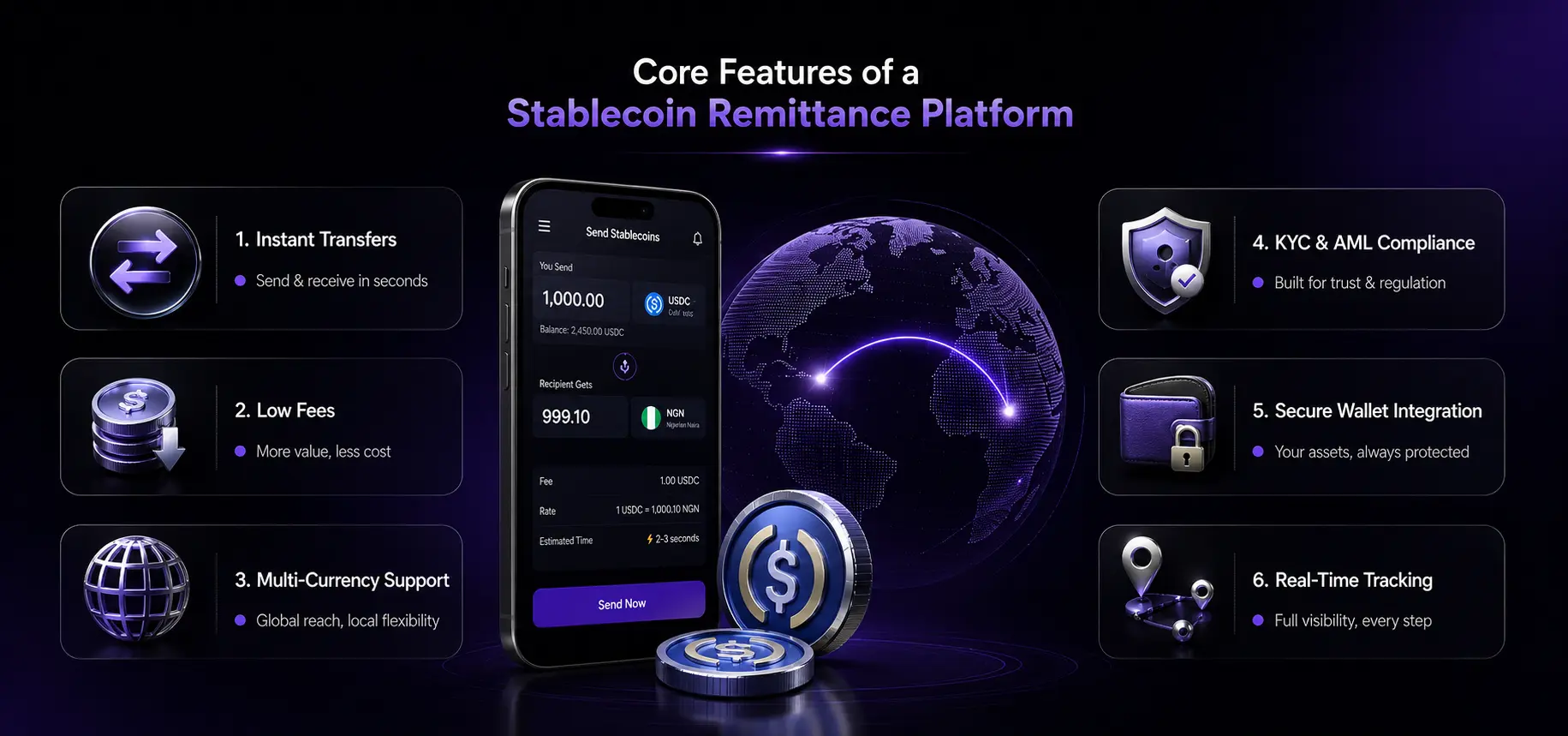
These are the six components that make a production-grade stablecoin remittance app development platform and how they affect user satisfaction:
- Fiat on/off-ramps with bank integrations: The platform must provide fiat-to-stablecoin conversion at the sending and receiving end, and financial partners who understand and accept stablecoin-related flows. This is often the hardest piece to build, not due to technology, but due to the financial relationships that need to be put in place.
- Multi-currency wallet with multi-chain support: A multi-chain wallet gives senders and recipients addresses on Ethereum, Solana, Polygon and other supported networks, so users aren’t tied to the fee structure or congestion patterns of one blockchain.
- Real-time FX conversion with rate locking: Recent research on stablecoin remittance corridors indicates that cross-border remittances still cost around an average of ~6.5% using traditional channels – well above the G20’s 3% target. Rates need to be locked in at the point of transfer to protect both parties from volatility.
- Automated compliance screening: No human review takes place. Every transfer undergoes KYC/AML checks, OFAC sanctions screening and transaction monitoring. So automation is the reason you don’t want compliance costs to scale linearly with transaction volume.
- Multiple recipient payout options: Bank deposit, mobile wallet, and cash pickup; the platform must support the distribution mechanisms used by beneficiaries in each corridor, which vary widely by location.
- Real-time transaction tracking and notifications: Sender and receiver should both be able to see the transfer process, with push alerts at each stage: initiated, converting, on chain, settled, delivered. The biggest difference between this app and your garden variety money transfer app is speed. Settlement is in minutes and the rails are running on nights, weekends and holidays.
Platform Architecture: The Technology Stack
The architecture consists of a mobile-first sender app and a web dashboard for operators to monitor corridors and warnings. Underneath that is the smart contract layer that governs minting, burning, escrow and settlement triggers. This is where the quality of smart contract development matters for reliability in real-world transaction volumes and where a single flaw can freeze customer funds mid-corridor with no warning downstream.
The Infrastructure Layers That Keep Corridors Running
Thus the importance of a comprehensive objective smart contract audit prior to any mainnet deployment. The integration of blockchain is usually with Ethereum, Solana or Polygon which is selected on the basis of cost and speed of finality. Custody needs hot and cold storage with multi-signature controls, often with institutional custody partners for large sums. The compliance middleware checks each transfer against sanctions lists, and fiat integration via banking partners and liquidity providers, often augmented by cross-chain liquidity technology, keeps corridors funded during high-volume times. This is the full stablecoin remittance platform architecture that separates production systems from prototypes that work in a demo but fail under real corridor volume.
Stablecoin Compliance Requirements USA: The Regulatory Layer
The Regulatory Layer Remittance platforms for US stablecoins are subject to a multi-tiered regulatory framework. If any level is skipped, the platform will be shut down. These are the compliance standards US operators need to meet before they can complete a single transfer of stablecoins.
- Federal: FinCEN MSB registration and BSA/AML program: Operators register as a money services business with FinCEN, maintain a written BSA/AML program, file suspicious activity reports, and comply with the Travel Rule, per FinCEN’s MSB registration guidance. The GENIUS Act, signed into law in 2025, adds a federal licensing regime specifically for payment stablecoin issuers, with reserve, redemption, and disclosure rules that platforms integrating third-party stablecoins need to understand even without holding an issuer license themselves.
- SEC clarification on Covered Stablecoins: The SEC clarified in its 2025 statement on Covered Stablecoins that dollar-pegged, fully reserved, redeemable tokens marketed for payments generally sit outside federal securities law – a critical distinction for platforms building on USDC and similar regulated stablecoins.
- State money transmitter licensing – the 49-state patchwork: A stablecoin money transmitter license is generally required in every state a platform serves – a patchwork covering 49 states, since Montana does not license money transmission. Each state has its own application process, capital requirements, and surety bond amounts.
- New York BitLicense: Any platform touching virtual currency business activity involving New York residents needs a BitLicense from the NYDFS, separate from standard MTLs and more demanding in its compliance and capital requirements.
- OFAC sanctions screening and KYC/CIP: OFAC screening against blocked persons lists runs on every transaction, and KYC/CIP procedures – identity checks, due diligence, and enhanced diligence for higher-risk corridors – sit at the front of onboarding. This is where well-designed fintech compliance architecture earns its keep, since regulators expect controls that are demonstrably built into the platform, not just described in a policy document nobody actually reads day to day.
Building Compliance into the Platform, Not Bolting It On
That starts with automated, document-based, government-ID identity verification built directly into onboarding, so risk scoring happens before funds move rather than after a suspicious pattern is already flagged by a case worker reviewing transfers well after the fact. It should be paired end to end with audit-ready compliance reporting built into the core transaction ledger, not bolted on once regulators come asking. Getting this wrong risks civil penalties, criminal liability, and consent orders that can end an operator’s ability to do business in a state entirely.
Stablecoin Remittance Platform Development Cost USA
Development costs include legal & licensing, smart contract development, compliance infrastructure, frontend & mobile builds, custody, and independent security audits; for a US-licensed platform, legal & licensing is sometimes the largest line item. A single-corridor MVP with a single state license typically costs between $150,000 and $350,000, while a multi-corridor stablecoin payment platform development USA platform with licensing in a dozen or more states, institutional custody and full compliance automation can cost between $500,000 and over $1 million once outside counsel and examiner documentation are taken into account.
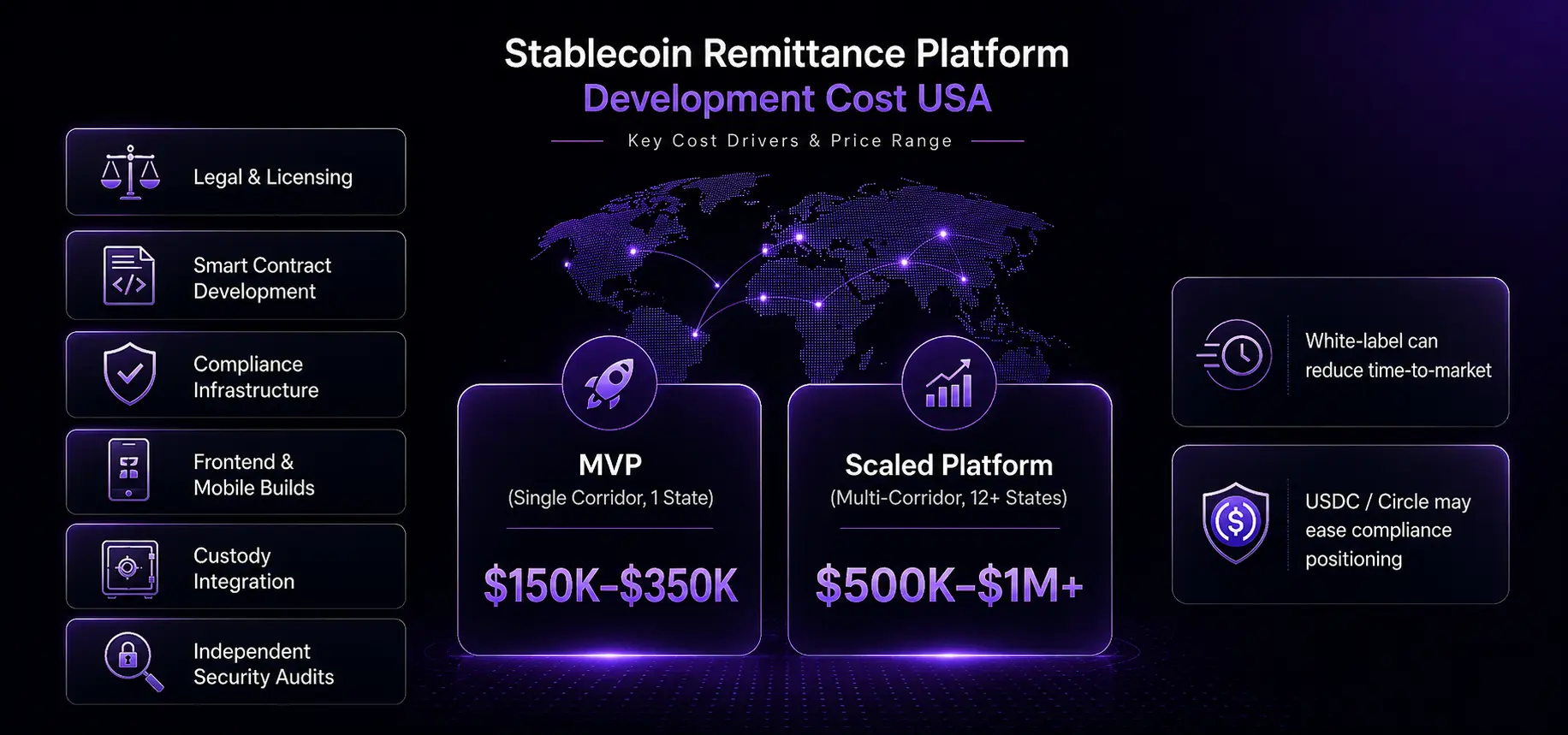
Operators weighing build-versus-buy should compare ground-up development to the foundation of a white-label platform, which can shorten time-to-market by leveraging infrastructure that has already undergone a security review and often a prior state licensing engagement with regulators. It’s also interesting to investigate if current crypto payment gateways can already handle parts of the fiat rail and not build that layer from scratch. Developing a USDC remittance platform will leverage Circle’s existing banking relationships and reserve transparency to potentially make the compliance narrative easier when applying for state MTLs.
Choosing a Development Partner for US Stablecoin Remittance
A track record is more important than a polished pitch deck. Look for partners who have deployed stablecoin platforms into production and run a US money transmitter license themselves, not just prototyped one in a demo. Technical depth should include real multi-chain connectivity, existing custody relationships, operational compliance automation and adjacent capabilities such as crypto exchange development for operators looking for an on/off ramp beyond remittances.
Especially when thousands of transfers are happening every day across multiple active corridors running simultaneously, the efficiency of settlement matters, as gas optimization efforts impact per-transfer margins directly at that scale. Ask about past remittance deployments, current bank partnerships, and whether the partner provides state by state licensing either directly or through legal partners they work with before you sign. Having a partner with regulatory-compliant design experience from the original architecture decision dramatically reduces rework and time-to-market later.
Concluding Note
The fastest growing use case for cross border payments is stablecoin remittances and the technology is simple. US regulatory compliance – FinCEN registration, state money transmitter licensing, NY BitLicense where applicable, OFAC screening and a functional BSA/AML program – distinguishes platforms that are actually moving money from those that are still waiting for a license. If the compliance architecture is established right at the beginning, then stablecoin remittance platform development USA will be a long term business rather than a regulatory burden.
Frequently Asked Questions
1. What is stablecoin remittance platform development USA?
Stablecoin remittance platforms are being built in the United States, creating regulated systems converting currency to stablecoins, sending them on-chain in minutes and converting back to local currencies. US-based platforms are required to be FinCEN registered from the start, have a state money transmitter license in 49 states, have the NY BitLicense if applicable and screen for OFAC sanctions.
2. How does a stablecoin cross-border payment platform reduce remittance costs?
A stablecoin cross border payment platform that combines correspondent banking into one blockchain transfer, reducing costs from 5-7% to below 1% and settlement from days to minutes. The primary settlement rails are USDC and USDT with 1:1 dollar backing and periodic attestations of reserves.
3. What are the stablecoin compliance requirements USA for remittance platforms?
The requirements are divided into five layers: Federal FinCEN MSB registration with BSA/AML program, GENIUS Act for payment stablecoin issuers, State money transmitter license in 49 states, NY BitLicense in New York, OFAC sanctions screening on each transaction. Legal and licensing fees are often more than the cost of technological development.
4. What features does a stablecoin remittance app development project need?
Production-grade platform with six functionalities: fiat on/off ramps with bank integrations, multi-currency wallet with multi-chain support, real-time FX conversion with rate locking, automated compliance screening, multiple recipient payout options, real-time transaction tracking for both sender and recipient.
5. How much does stablecoin remittance platform development cost in the US?
Single corridor MVPs, single state license: $150k-$350k Multi corridor platforms, licensed in a dozen+ states, with institutional custody: $500k-$1 million+ MVP timelines: 6-9 months Fully licensed multi-state platforms: 12-18 months.
