



Key Takeaways
- Most ADAS functions are treated as high-risk AI through the EU AI Act’s product-safety route, connecting compliance with existing vehicle type-approval requirements.
- Tier 1 suppliers need audit-ready technical documentation covering system architecture, model versions, dataset provenance, testing methods, and traceable update records.
- Risk management, data governance, and quality management must operate continuously across design, development, deployment, monitoring, and decommissioning.
- Human oversight must be designed according to the automation level, with clear driver control, interpretable outputs, handback mechanisms, and practical override paths.
- Post-market surveillance must track model drift, edge cases, and safety degradation while connecting field monitoring directly with incident-reporting workflows.
- Conformity assessment requires an integrated evidence package including Annex IV documentation, Article 9 risk controls, Article 10 data records, Article 17 quality processes, and Article 72 monitoring plans.
Introduction
Advanced driver assistance systems are classified as high-risk AI under the EU AI Act. Tier 1 suppliers shipping ADAS into European OEMs are racing against a deadline that was pushed back this year. The AI transition period for regulated products, including vehicles, has now been extended to August 2, 2028, with the AI omnibus simplification package – extra runway, not less scope. EU AI Act compliance ADAS with its own burden of proof for each: risk classification, technical documentation, conformity assessment, and post-market surveillance. This checklist covers how ADAS is classified, the paperwork the Act requires, how to build a governance framework around it and what conformity assessment looks like when the system is ready to ship.
EU AI Act Risk Classification: Where ADAS Falls
Most ADAS functions are classified as high-risk via the product-safety route in Annex I, triggered by Article 6(1) and not the stand-alone use-case list in Annex III. ADAS is a motor vehicle safety feature already covered by third-party type-approval under Regulation (EU) 2019/2144 and therefore derives the high-risk classification from that harmonised law rather than from a use-case definition. The difference in EU AI Act risk classification is operationally important: systems in Annex I are integrated into existing type-approval and CE-marking operations, not a separate registration track. The responsibilities increase with function, with Level 2 ADAS expected to represent around half of new vehicle sales by 2030, so the oversight and validation requirements for Level 2, Level 3 and Level 4 systems are different – and this impacts planning for compliance with automotive AI lifecycle from the earliest design review stages.
ADAS Safety Case Documentation: What the Act Requires
Article 11 and Annex IV define technical documentation that facilitates the reconstruction of the building and the validation of the system: architecture, design specifications, provenance of training data and testing methodologies. The ADAS safety case documentation under the Act overlaps significantly with what ISO 21448 (SOTIF) and ISO 26262 already require for functional safety, but the Act introduces duties that traditional safety cases do not adequately address. Transparency and documentation for artificial intelligence systems is not limited to testing results at the system level, but also model versioning, dataset pedigree, and justification for training choices. The recordkeeping requirements of Article 12 imply that, in addition to the cybersecurity documentation required by UNECE Regulation No. 155, every training run and model update requires an auditable log, since regulators and notified entities will want to be able to trace a decision back to the data and code that generated it.
AI Governance Framework Automotive: Building the Compliance Infrastructure
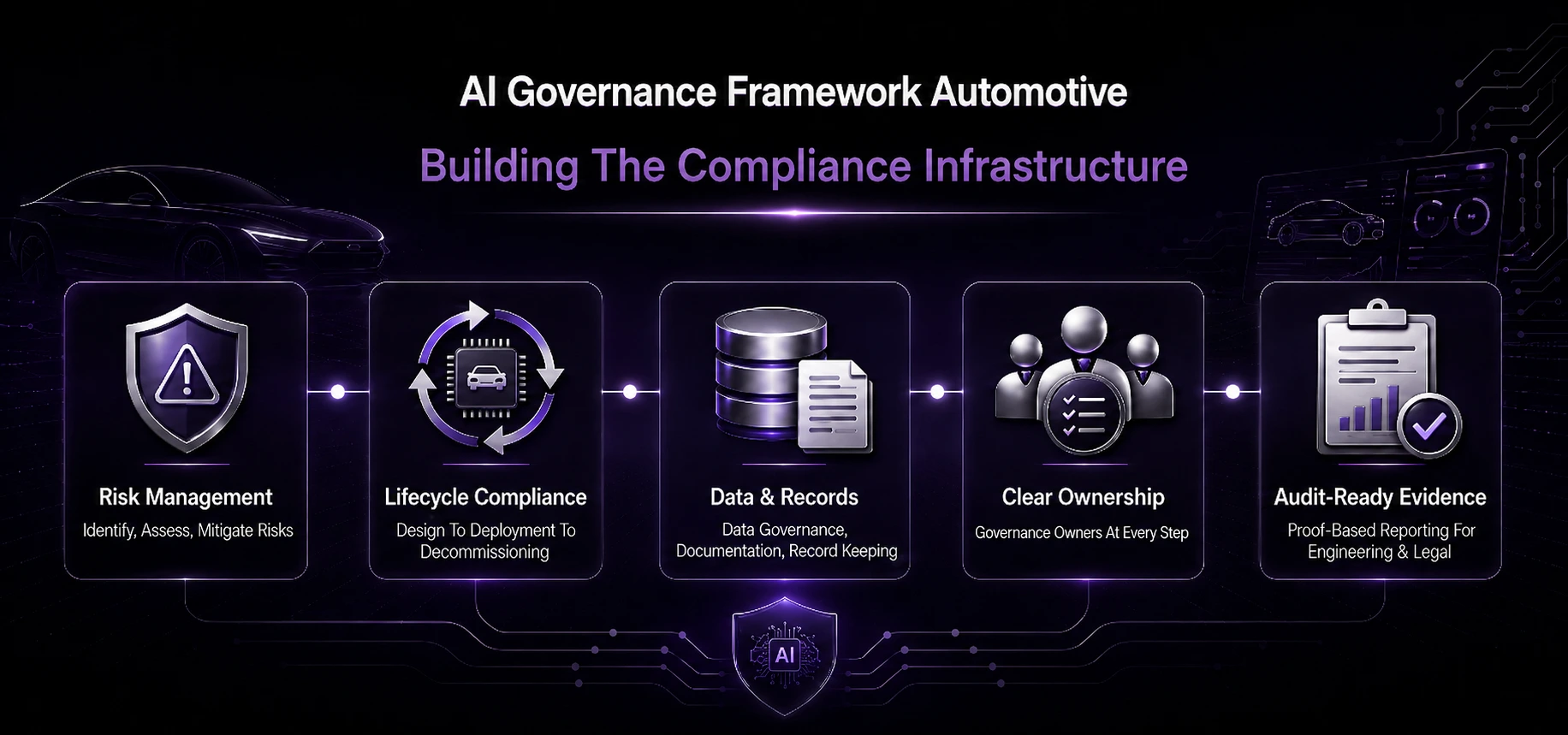
Article 9’s risk management system is the foundation of a daily AI governance framework for automotive teams and involves the ongoing identification, assessment and mitigation of risks throughout the AI lifecycle. This is related to data governance, documentation control and record keeping as ongoing activities, not one off deliverables. Adjacent to Article 17 requirement for quality management system. Automotive AI lifecycle compliance must cover design, development, deployment and eventual decommissioning. You need to have owners of the governance at each step, not just a compliance team spreadsheet.
Audit-Ready Evidence and Documentation Control
Structured compliance reporting that connects risk decisions to supporting data, not a narrative written after the fact, demonstrates audit conformance. On the engineering side, a repeatable technical audit process that both engineering and legal teams can point to on demand benefits from that same proof base.
Data Quality Management EU AI Act: Training, Validation, and Testing
Article 10 sets out data governance obligations for training, validation, and test datasets: relevance, representativeness, and error management appropriate to the intended use. Data quality management EU AI Act obligations for ADAS mean bias detection across driving conditions: rain, low light, degraded lane paint, plus documented data provenance and dataset versioning tied back to a specific model release, not a general training corpus. Disciplined ML pipeline development is what makes that traceability auditable, since every dataset transformation must be reproducible on demand.
Federated Learning, Retraining, and Drift Detection
Federated learning enables vendors to improve shared models across OEM programs without moving each fleet’s raw sensor data from where it was generated and without extracting proprietary sensor data from the vehicle or plant network. But none of that upfront work holds up in production without ongoing checks, where models need to undergo automated retraining so they stay current as road and weather conditions change over the life of a vehicle program, and that retraining loop can only be trusted if a dedicated anomaly detection layer is watching for drift and degradation before either becomes a field issue.
Need an audit-ready AI lifecycle for your ADAS program? Build traceable data pipelines, model governance, monitoring, and compliance evidence into your engineering workflow before conformity assessment begins.
Human Oversight in ADAS AI: Designing for Meaningful Control
Article 14 asks for human control mechanisms, interpretable outputs, a useful human-machine interface, a real override path, not just a checkbox in a design document. The degree of human supervision needed for ADAS AI differs with the degree of automation Level 2 always maintains the driver in the loop, while Levels 3 and 4 depend on conditional handback for supervision, presenting a more difficult interface problem. Therefore, Neuro-symbolic AI systems are gaining popularity here as they enable more explainable decisions for safety-critical operations than pure neural approaches, satisfying both the Act’s interpretability expectations and UNECE’s scrutiny. Suppliers developing broader enterprise AI systems on top of ADAS must ensure they have common oversight design patterns across both, because regulators want a single oversight philosophy, not a product-by-product solution.
Continuous Monitoring of ADAS Systems: Post-Market Obligations
72 Article sets up a defined system for post-market surveillance which gathers real world performance data throughout the operational life of the system and feeds this back into the risk management process of Article 9. We don’t just monitor uptime on ADAS systems, we monitor model drift, edge cases and incremental safety degradation. Predictive analytics of fleet telemetry can detect failure modes as events before they occur. And that’s a lot cheaper than a post-fact response. Article 73 imposes strict limitations for reporting incidents, as short as two days for serious incidents, therefore monitoring and reporting must be linked systems and not separate systems. How quickly a supplier can deliver a remedy after a problem is identified during monitoring is directly impacted by the architecture of the model deployment infrastructure.
EU Regulatory Conformity Assessment: The Final Checklist
Article 43 governs the conformity assessment procedure: internal control checks for systems built to harmonised standards, notified body involvement otherwise, and an EU declaration of conformity before market entry. EU regulatory conformity assessment for ADAS means Tier 1 suppliers need:
- Annex IV technical documentation covering architecture, data, and risk management
- Evidence of an operating Article 9 risk management system
- A quality management system satisfying Article 17
- Data governance records meeting Article 10
- A post-market monitoring plan under Article 72
- CE marking documentation and the EU declaration of conformity
Performance Validation and Formal Assurance
Formal verification can provide mathematical guarantees on safety-critical AI functions in ADAS where testing cannot cover the entire state space. AI model performance validation – accuracy, robustness, cybersecurity and SOTIF alignment together – is what compliance assessors and notified bodies want to see proved, not stated. Suppliers already spending on AI agent development for their own internal engineering processes would probably have a head start here as the underlying evidence discipline appears to be the one demanded by ADAS compliance assessment. MLOps processes just flow into that evidence base, rather than having to install a separate compliance toolchain. That’s the same for teams putting in place larger AI automation systems elsewhere in the business.
Concluding Note
The EU AI Act compliance for ADAS is not a one-time submission, but a multi-layered responsibility, with risk classification, safety case documentation, data governance, oversight by humans, and post-market monitoring, all traceable back to Article 9’s risk management system. Tier 1 suppliers say vendors that build that traceability into the AI lifecycle from the design phase, rather than retrofitting it before a shipment deadline, are best positioned to get ADAS systems into European OEM programs without regulatory delays. EU AI Act compliance ADAS is as much a legal discipline as it is an engineering one, and it rewards teams that get a head-start.
Frequently Asked Questions
1. What is EU AI Act compliance ADAS and when does it apply?
ADAS also ensures compliance with the EU AI Act The requirements for high-risk AI are applicable to sophisticated driver assistance systems. The AI in Automobiles transition date is August 2, 2028. Compliance issues include risk classification, technical documentation, conformity assessment and post-market surveillance.
2. How does EU AI Act risk classification work for ADAS?
Most of the ADAS functions get their high-risk status through the product-safety route in Annex I under article 6(1), i.e. they get status from the type-approval law, not the standalone Annex III list. For level 2, level 3 and level 4 systems, the validation and oversight burden differs.
3. What ADAS safety case documentation does the Act require?
Article 11 and Annex IV require technical documentation on architecture, design specification, training data provenance and testing methodologies. AI system transparency and documentation also covers model versioning, dataset lineage and rationale behind training with each update having traceable logs (Article 12).
4. What does continuous monitoring of ADAS systems involve?
Article 72 requires post-market monitoring to collect real-world performance data over the life of the system to look for model drift, edge cases and safety degradation. Article 73 establishes linked surveillance and reporting mechanisms and requires the reporting of serious incidents within two days.
5. What is required for EU regulatory conformity assessment of ADAS AI?
They will need Annex IV technical documentation, Article 9 risk management system, Article 17 quality management system, Article 10 data governance records, Article 72 post-market surveillance plan and CE marking with EU certificate of conformity. AI model validation will include accuracy, robustness, cybersecurity and SOTIF alignment.
