



Key Takeaways
- Fund tokenization converts regulated fund shares into programmable, blockchain-based assets.
- A tokenized fund platform requires legal structuring, compliant token design, smart contracts, custody, and investor onboarding.
- ERC-3643 helps embed investor eligibility and transfer restrictions directly into token logic.
- A single-fund MVP typically costs $150,000–$350,000, while enterprise platforms can exceed $1.5 million.
- Secondary trading, cross-border distribution, custody integration, and regulatory coverage significantly increase development costs.
- Production-ready platforms need continuous audits, compliance updates, custody management, and post-launch monitoring.
Introduction
By 2026, BlackRock’s BUIDL, Franklin Templeton’s BENJI and JPMorgan’s MONY has tokenized U.S. Treasury and money market products worth about $12 billion on-chain. A fund Tokenization Platform provides on-chain shares representing ownership of a regulated fund, with subscriptions, redemptions and NAV adjustments handled by smart contracts instead of legacy transfer agent paperwork. Two years ago, there were a handful of experimental pilots. Today, it’s a production infrastructure at some of the biggest asset managers in the world. Boston Consulting Group’s 2026 asset management research tokenized funds to be one of the next big distribution wrappers as the market scales. So in this guide we look at what fund tokenization really is, how to build a viable platform and, the question every CFO always wonders, how much does it really cost to build one?
What Is Fund Tokenization: And Why It’s Accelerating in 2026
Fund tokenization is the process of converting fund shares into tokens on a blockchain instead of or in addition to traditional book-entry records. It offers 24/7 settlement, near-real-time NAV updates, and fractional ownership that classic transfer agent systems cannot offer. BlackRock’s BUIDL has amassed over $2.5 billion in assets under management, and Franklin Templeton’s BENJI has surpassed the $2.5 billion threshold after more than doubling this year. JPMorgan’s MONY was introduced as a private placement fund with $100 million in seed capital on the Kinexys platform. But the benefit is not just speed: tokenized shares can be used as programmable collateral in other on-chain workflows, and every holder sees the same transparent verifiable record rather than relying on periodic declarations rather than waiting on a monthly reconciliation cycle. One key structural difference between fund tokenization and real estate tokenization is that a fund generally has an existing regulatory framework and professional manager in place before the creation of any token whereas a single property deal is put together from scratch. It also differs from commodity tokenization, which generally involves a static physical reserve rather than a professionally managed and continuously priced portfolio that requires ongoing NAV calculation.
Get a Custom Cost Estimate for Your Fund Tokenization Platform
The Fund Tokenization Process: From Fund Structure to Live Platform
On average, there are seven steps involved in the tokenization of a fund and if any of those steps are skipped, it will likely mean costly reworking later on. The order is important as each successive stage depends on the fund structure and token design decisions made in the preceding stages which provide the compliance architecture on which all subsequent stages are built.
Stage 1-3: Fund Structuring, Token Design, and Smart Contracts
Fund structuring is where everything begins, from choosing a regulatory domicile and legal wrapper to establishing the rules for investor eligibility. This decision affects all further technical decisions. Next comes token design, where regulatory-compliant token design bakes transfer restrictions and eligibility checks directly into the token itself rather than bolting compliance logic on after the fact. Smart contract development then codes the logic for issuance, redemption, NAV update and yield distribution that the fund will run on a day to day basis. Finally, custody integration is needed to tie together institutional custody of the underlying assets held by the fund with safe, separate token custody for on-chain investor holdings, as they tend to be with different providers.
Stage 4-7: Investor Onboarding, Secondary Trading, and Ongoing Compliance
Then Investor onboarding is completed, including KYC, AML, accreditation checks and jurisdictional eligibility rules before any investor can subscribe for fund shares. The big thing in the rest of the process is distribution reach. After the initial offering is closed and the first lock-up period has expired, a secondary marketplace opens up, where whitelisted holders can trade shares with each other. A separate exercise is cross-border distribution, which takes the fund into additional jurisdictions without contravening local securities restrictions as it enters each new market. The ongoing compliance reporting gives regulators and auditors the transaction level detail that they will be looking for in the end.
Fund Tokenization Platform Development: Core Features and Architecture
A working platform requires a lot of components working together. Not just a token contract sitting on a chain by itself. The logic for issuing and redeeming tokens creates shares against validated deposits and enables intraday NAV updates, when the structure of the fund and the administrator allows. Investor management uses whitelisted wallets and jurisdictional controls at the smart contract level, so if an ineligible transfer occurs, it automatically fails at the chain and does not appear in a reconciliation report days later.
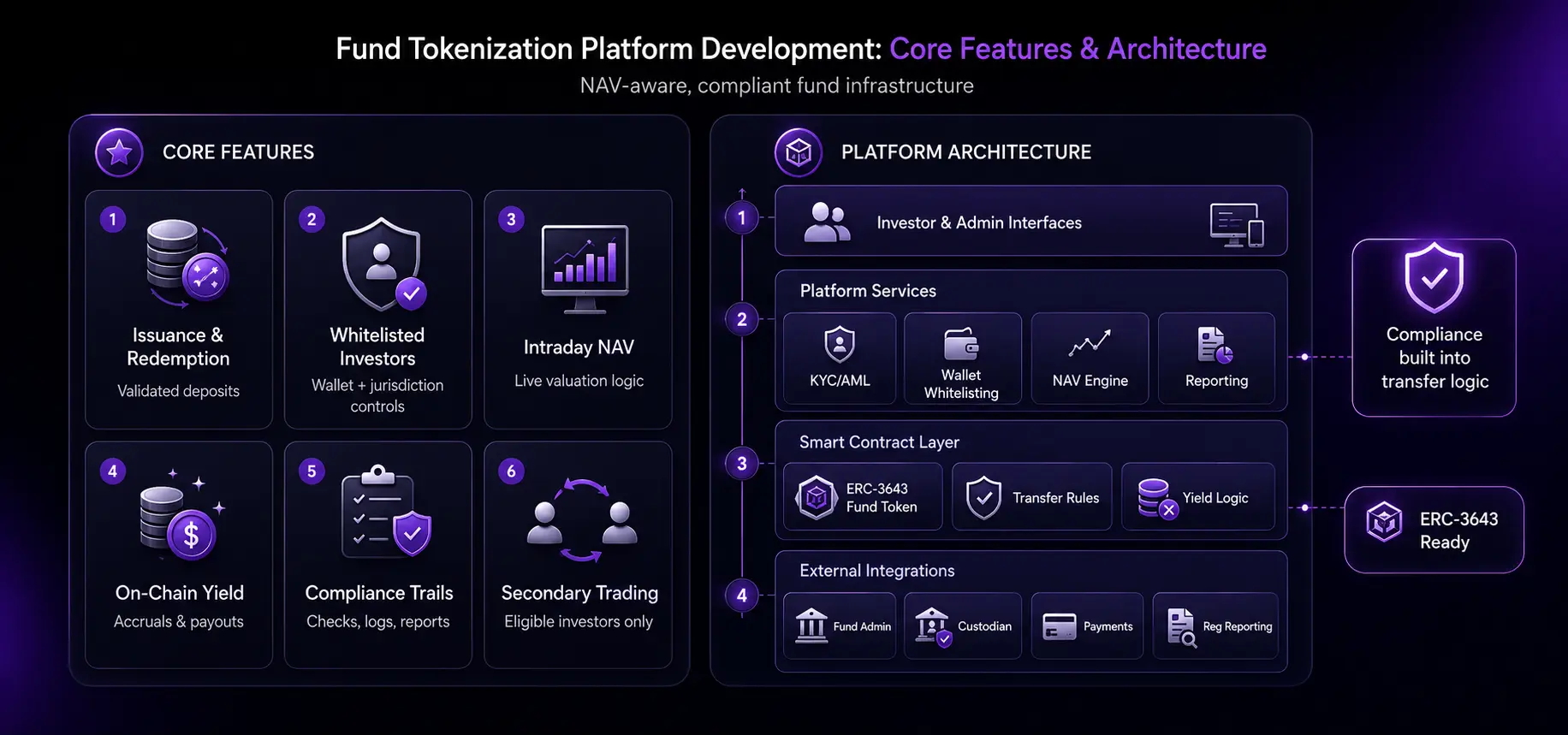
The yield distribution itself needs to be on-chain with accrual monitoring in real-time as well as the compliance layer generating audit trails and regulatory reports without manual intervention from an operations staff. Typical structure is a permissioned secondary trading platform for whitelisted investors with a qualified custodian for the underlying fund assets. Creating a Fund Tokenization Platform is not the same as doing general asset tokenization because funds have ongoing NAV, yield and reporting obligations that you simply don’t have with a one-off real estate or commodity token. Token standards like ERC-3643 are becoming the default choice here for the simple reason that they build in compliance within the transfer logic itself rather than relying on an off-chain checklist.
Fund Tokenization Platform Cost: 2026 Breakdown
Costs consist of legal structuring, smart contract development, compliance infrastructure, custody integration, security audit and implementation. To ballpark some numbers, a single-fund MVP with basic issuance, redemption and compliance checks typically runs between $150,000 and $350,000, while a multi-fund enterprise platform with secondary trading, cross-border distribution and full custody integration can run $600,000-$1.5 million or more. These are estimates – the actual cost of the fund Tokenization Platform will depend on the volume of funds, the countries covered, the complexity of custody, and the depth of audit required prior to launch.
Timeline, Build-vs-Buy, and Ongoing Costs
Timelines are broken down: 4-8 months for a single-fund MVP, 9-14 months for a multi-fund enterprise build, with secondary trading built in from day one. If you go with a white-label tokenization instead of custom built solution you will save a lot of time and money, but you’ll lose some architectural flexibility down the road. And none of this ends at launch either. Ongoing custody fees, compliance staffing, refreshes to smart contract audit, and revisions to regulation all add recurring costs that a fund administrator’s budget needs to account for long beyond year one.
Ready to Tokenize Your Fund Assets?
Choosing an Asset Tokenization Development Partner for Fund Platforms
Track record matters here more than in other tokenization work: ask which fund systems a vendor has actually put into production, what custodial agreements they hold, and whether they have processed real regulatory clearances rather than merely testnet prototypes. The technical depth needs to have hands-on knowledge with ERC-3643, true multi-chain support and compliance automation that does not require manual approval for each and every transfer request.
Ask about historical fund deployment, transfer agent integration and what post-launch support looks like when the platform is holding real investor assets. A fund-specific RWA tokenization platform vendor helps mitigate regulatory risk in ways a generalist cannot. There are fund-specific rules: transfer agent obligations, ‘40 Act compliance for registered funds, that are significantly different than tokenizing a piece of real estate or a warehouse of commodities.
Questions to Ask Before Signing
- See what token standard the vendor defaults to, and why: ERC-3643 and ERC-1400 solve compliance differently.
- Ask for a client reference with a working fund in production, not a testnet demo.
- Define ongoing audit and regulatory updating obligation post platform go live.
Fund use case-specific Asset tokenization development companies will usually outperform Asset tokenization development services targeting broader RWA categories, just because fund operations entail compliance obligations that real estate and commodity tokens don’t.
Concluding Note
As the market matures, fund tokenization costs are falling into clearer tiers. A single-fund MVP, a multi-fund enterprise platform, and everything in between depending on jurisdiction count and custody complexity. The plan for a fund tokenisation platform is for production infrastructure, not a pilot, as the SEC and other authorities are now issuing formal guidelines on tokenised securities. The fund Tokenization Platform space is past the experiment stage, it is operational infrastructure at the world’s leading asset managers. Platforms that are built with compliance, custody and audit as architecture considerations from day one are capturing lasting institutional AUM.
Frequently Asked Questions
1. What is a fund Tokenization Platform?
For example, a Tokenization Platform for Funds replaces the antiquated transfer agent paperwork with on-chain shares, which are used to represent ownership in a regulated fund, and the use of smart contracts to manage subscriptions, redemptions and NAV changes. It offers 24/7 settlement, near real time NAV updates, fractional ownership and programmable collateral usage – all within the existing regulatory wrapper of the fund.
2. How does the fund tokenization process work?
Tokenization of a fund is a 7 step process: Fund structuring (regulatory domicile, legal wrapper), Regulatory compliant token design, Smart contract development for issuance and redemption, Institutional custody integration, Investor onboarding with KYC/AML, Secondary marketplace enablement and Cross border distribution with ongoing compliance reporting.
Need a Compliant Fund Tokenization Solution?
3. How much does fund Tokenization Platform development cost in 2026?
A basic single fund MVP with issuance, redemption and compliance checks will typically cost between $150,000 and $350,000. Multi-fund enterprise platform with secondary trading, cross-border distribution and full custody integration $600,000 – $1.5 million or more. The cost will be a function of the number of funds, the jurisdictions covered and complexity of custody.
4. What is the timeline for building a fund tokenization platform?
Single fund MVP typically 4-8 months. Integrated secondary trading platform from day 1 on multi-fund enterprise platform: 9-14 month White label tokenization can be a money and time saver vs a full custom design.
5. How does fund tokenization differ from real estate or commodity tokenization?
Real estate or commodity tokens don’t have daily NAV, yield distribution and regulatory reporting. Once you have a regulatory wrapper and a professional manager, you can take the fund to tokenisation. Token standards like ERC-3643 build compliance into the transfer logic.
