



Key Takeaways
- A compliant gold tokenization platform must link every token to verified, insured, and auditable physical gold reserves.
- ERC-3643 can enforce KYC, investor eligibility, and transfer restrictions directly at the token layer.
- KYC/AML infrastructure should cover identity checks, sanctions screening, transaction monitoring, and Travel Rule compliance.
- Custody, proof of reserves, oracle integrations, physical redemption, and smart contracts must work as one connected architecture.
- A production platform typically takes 4–8 months for an MVP and 9–14 months for a multi-jurisdiction institutional build.
- Commodity-specific experience matters because gold tokenization adds vaulting, insurance, reserve verification, and physical redemption requirements.
Introduction
Gold has been tokenized for years, but a platform that can meet institutional KYC/AML standards and pass a custody audit is another matter altogether. You can wrap any vault balance in an ERC-20 contract and call it a gold token. Fewer teams can demonstrate reserves, restrict transfers to accredited investors, and create an audit trail that a regulator would genuinely accept.
To build a gold tokenization platform that institutions will trust with real allocations, the architecture must verify physical reserves, enforce investor eligibility at the smart contract level, and maintain records that survive a compliance review – not merely mint tokens against an unverified balance sheet. This guide covers custody architecture, token standards, KYC/AML integration, the development process, and realistic 2026 cost and timeline considerations.
Gold Tokenization Platform Architecture: Custody, Verification, and Token Standards
Every serious gold tokenization platform begins with the physical asset, not the code. Gold bars should meet LBMA Good Delivery standards, be held in audited vaults, and undergo periodic proof-of-reserve attestations that reconcile vaulted ounces with the on-chain token supply. Without this foundation, the token is a liability masquerading as an asset, regardless of how clean the contract code appears.
1. Token Standards, Oracles, and Smart Contracts
The de facto standard for permissioned commodity tokens is ERC-3643. It incorporates KYC checks and transfer restrictions directly into the token contract instead of adding compliance later through an external gatekeeper.
- Oracles provide current gold prices and custody attestations.
- Smart contract development handles minting against validated deposits, token burning, physical redemption, and storage-fee accrual.
- Transfer rules ensure tokens move only between verified and eligible wallets.
A gold platform differs materially from real estate tokenization, where the underlying asset is illiquid, location-specific, and tied to a single structure. It also differs from tokenized bonds because gold may be physically redeemable on demand, introducing vaulting logistics, insurance premiums, delivery options, and storage costs.
2. Custody Architecture: Getting It Right Before Launch
Establishing the institutional custody model at the outset prevents costly redesigns after the platform is live and holding customer assets. The custody structure should clearly define:
- Who legally owns or controls the vaulted gold.
- Who has the right to request physical redemption.
- How disputes, shortfalls, and insolvency scenarios are handled.
- How often vault audits and reserve attestations are produced.
- Whether segregated client accounts and adequate insurance are maintained.
Design a Compliance-Ready Gold Tokenization Platform
KYC and AML Integration: The Compliance Layer
KYC on a gold tokenization platform covers identity verification, accreditation checks, sanctions screening, and jurisdictional eligibility before a wallet is whitelisted to hold tokens. AML compliance continues after onboarding through transaction monitoring, suspicious activity reporting, and Travel Rule controls for cross-border institutional transfers.
Embedding Compliance into the Token Layer
Regulatory-compliant token design makes compliance enforceable rather than aspirational. Eligibility checks are embedded in the transfer function, so tokens cannot move to unverified wallets regardless of how many times they change hands.
Investor onboarding should combine document verification with ongoing monitoring rather than rely on a one-time signup check. In parallel, compliance reporting should automatically generate audit trails, regulatory filings, transaction records, and proof-of-reserve reconciliation. Manual reporting rarely withstands a rigorous institutional due-diligence process.
Regulators continue to assess commodity-backed tokens according to their specific structure and facts. Recent CFTC guidance on tokenized assets reinforces the need to design the legal, custody, and technical model together.
Gold Tokenization Platform Development Process
Gold tokenization platforms are generally developed in six connected stages. Skipping a stage often creates more expense later than following the correct sequence from the start.
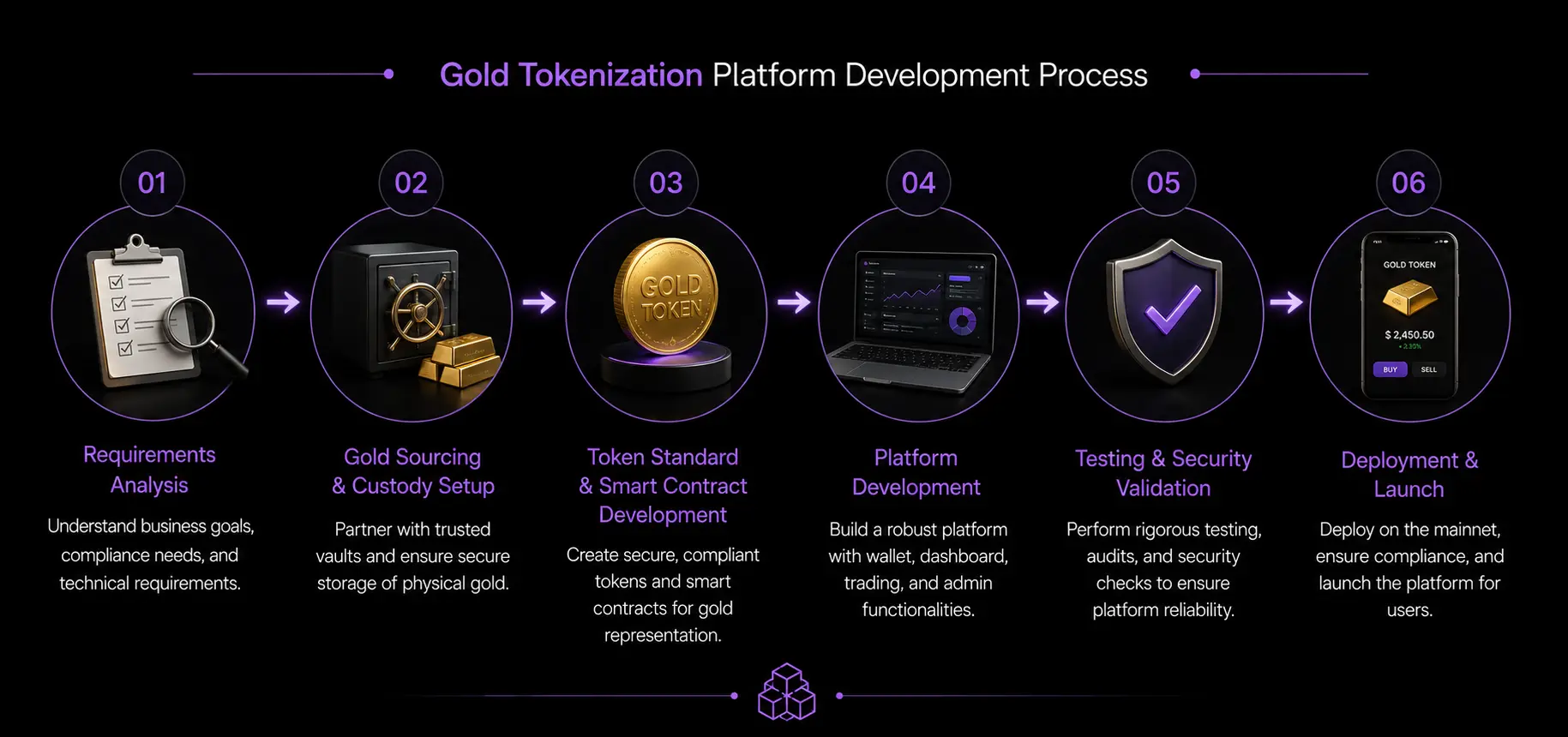
- Custody and vaulting: Select a vaulting partner, define audit rights, arrange insurance, and establish a proof-of-reserve methodology.
- Token design: Define investor eligibility, transfer restrictions, storage-fee logic, redemption rules, and the role of the ERC-3643 permissioned token standard.
- Smart contract engineering: Build minting, burning, reserve validation, fee collection, and physical-delivery triggers.
- KYC/AML integration: Add identity verification, sanctions screening, jurisdiction checks, wallet whitelisting, and ongoing transaction monitoring.
- Compliant trading and distribution: Add a secondary marketplace and support cross-border distribution without allowing tokens to leave the compliance boundary.
- Audit, deployment, and ongoing compliance: Complete an independent smart contract audit, deploy the platform, and maintain a compliance program that continues after launch.
Building a gold platform is not the same as standard asset tokenization. Purely financial assets such as shares do not require physical redemption workflows, vault reconciliation, insured storage, or bullion delivery logistics.
Cost to Build a Gold Tokenization Platform in 2026
Development costs depend on custody integration, smart contract complexity, compliance tooling, third-party audits, deployment support, and the number of jurisdictions covered. A basic single-vault token with limited redemption sits at one end of the spectrum. A multi-vault institutional platform with physical delivery, multi-jurisdiction KYC, and IoT-enabled vault verification sits at the other.
The biggest cost drivers include:
- The number and complexity of custody integrations.
- The jurisdictions and investor categories supported.
- The depth of KYC, AML, monitoring, and reporting automation.
- The frequency and sophistication of reserve verification.
- Whether components are custom-built or integrated from established providers.
- Independent security audits and post-launch support requirements.
Tokenized gold has moved beyond the experimental phase, with significant quarterly trading volume. Products such as PAX Gold demonstrate the institutional expectations for custody, recurring attestations, and redeemability for physical bullion.
A realistic development timeline is typically 4–8 months for an MVP and 9–14 months for a comprehensive multi-jurisdiction institutional platform. Working with an experienced asset tokenization partner with a proven RWA tokenization platform background can shorten the timeline by reusing tested custody, compliance, and reporting integrations.
Choosing a Gold Tokenization Platform Development Partner
Custody mistakes are expensive and difficult to reverse, so track record matters more in gold tokenization than in many other blockchain projects.
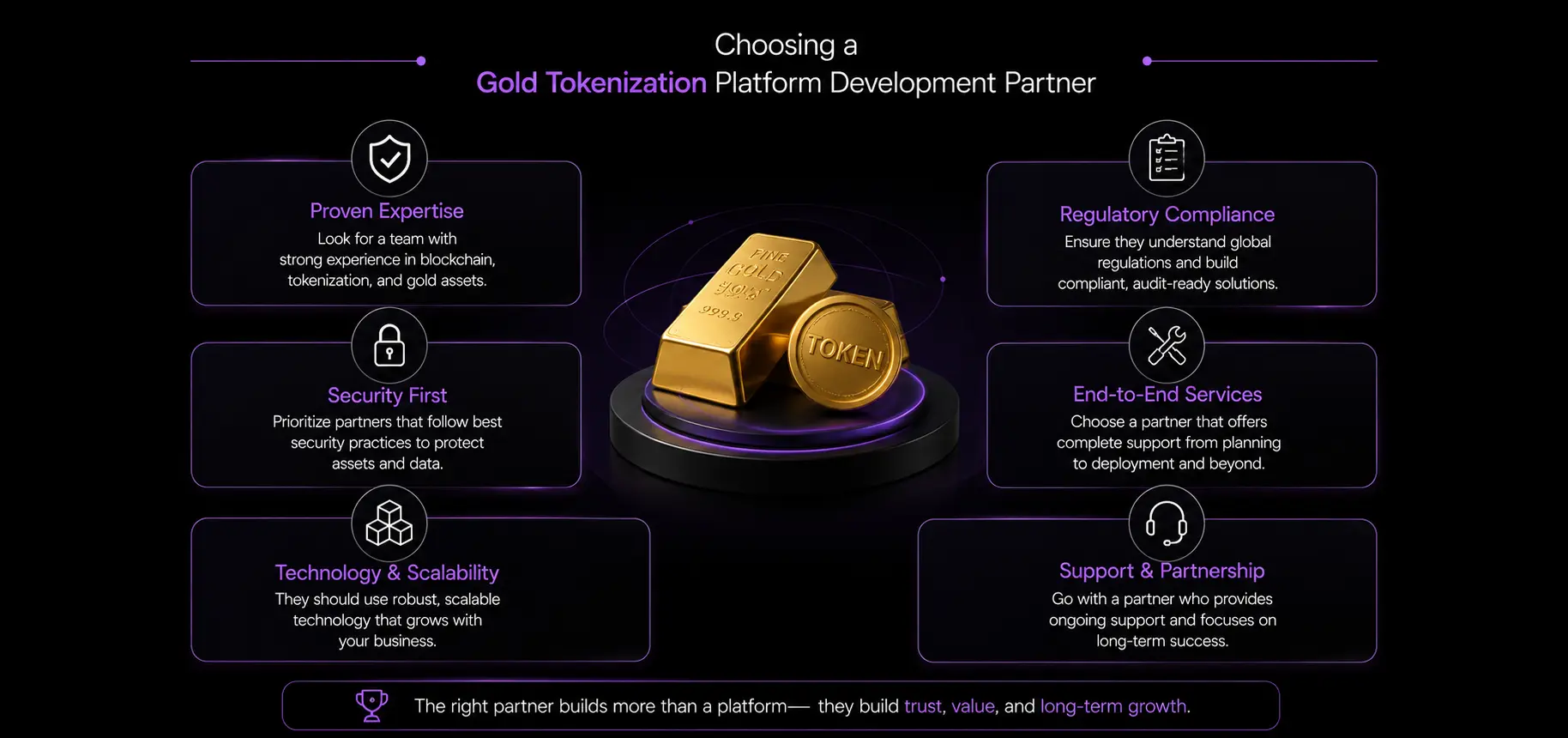
Evaluate potential partners across the following areas:
- Commodity experience: Ask for examples of gold or commodity-backed token deployments.
- Custody relationships: Review vault-audit processes, insurance arrangements, and reserve-verification capabilities.
- Technical depth: Confirm hands-on experience with ERC-3643, oracle integration, physical redemption, and identity-aware smart contracts.
- Compliance capability: Assess KYC/AML integrations, transfer restrictions, transaction monitoring, and regulatory reporting.
- Post-launch support: Determine who will manage upgrades, audits, reporting changes, and compliance operations after deployment.
Gold-Specific vs. Generalist Development Teams
A gold-focused team asks questions that a generalist asset tokenization company may overlook: Which refiner accredits the bars? How frequently is the vault audited? How are reserve shortfalls handled? How does a holder trigger physical redemption on-chain? What minimum quantities and delivery fees apply?
Commodity tokenization requires more sophisticated custody, verification, insurance, and redemption capabilities than tokenization services for purely financial assets such as stocks or corporate bonds.
Build a Secure & Compliant Gold Tokenization Platform
Concluding Note
A compliance-ready gold tokenization platform solves custody verification, KYC/AML, investor eligibility, and regulatory reporting before the first production smart contract is deployed. Compliance should not be retrofitted after launch.
Teams that sequence custody, legal structuring, token design, and compliance correctly are more likely to pass institutional due diligence without expensive redesigns. A platform intended to be audited from day one must be architected for traceability, reserve verification, controlled transfers, and ongoing reporting from the outset.
Frequently Asked Questions
1. What is a gold tokenization platform?
A gold tokenization platform issues blockchain tokens representing ownership of, or a claim on, physical gold. Each token is backed by verified reserves held in audited vaults, while smart contracts manage issuance, transfers, redemption, and compliance controls.
2. How do gold-backed tokens prove they are backed by physical gold?
Gold-backed tokens use independent vault audits, proof-of-reserve attestations, custody records, and oracle integrations to reconcile vaulted gold with the number of tokens in circulation. Verification should be frequent and transparent enough to support institutional and regulatory due diligence.
3. How is KYC/AML implemented in a gold tokenization platform?
KYC/AML implementation generally includes identity verification, sanctions screening, investor eligibility checks, jurisdictional restrictions, transaction monitoring, and suspicious activity reporting. Wallets are whitelisted only after the required checks are completed.
4. Why is ERC-3643 suitable for gold tokenization?
ERC-3643 supports permissioned token transfers by embedding identity verification, investor eligibility, and transfer restrictions into the token architecture. Gold-backed tokens can therefore move only between qualified wallets that satisfy the platform’s compliance rules.
5. Can investors redeem gold-backed tokens for physical gold?
Yes. A platform can support physical redemption when its custody and token architecture are designed for it. The process should define investor restrictions, minimum redemption amounts, fees, delivery options, and the on-chain mechanism used to burn or lock the redeemed tokens.
Launch Your Gold Tokenization Platform with Confidence
