



Key Takeaways
- Stablecoin development combines token engineering, reserve management, compliance, and blockchain infrastructure into one production-ready financial system.
- The stablecoin model determines the architecture, cost, and regulatory requirements, whether fiat-backed, commodity-backed, crypto-collateralized, or algorithmic.
- Security and transparency are non-negotiable, with audited smart contracts, proof-of-reserve systems, access controls, and ongoing attestations required for institutional trust.
- Multi-chain support, KYC/AML, fiat on/off-ramps, cross-chain liquidity, and compliance reporting are essential features for modern enterprise stablecoins.
- Development costs and timelines depend on the number of supported chains, reserve model, compliance depth, custody infrastructure, and audit scope.
- The right stablecoin development company can accelerate market entry by combining blockchain engineering, fintech compliance expertise, reserve infrastructure, and post-launch support.
Introduction
Stablecoins have become the default settlement layer for crypto exchanges, and are now moving into enterprise payments, cross-border remittances and corporate treasury management. Banks, payment processors and fintechs are now arguing not about whether they should issue a stablecoin, but about how to do it without taking on unmanageable regulatory or reserve risk. A stablecoin development company writes the smart contracts, reserve infrastructure, compliance tooling and multi-chain deployment pipeline to turn this idea into a production-grade financial instrument. In this guide you’ll learn about the types of stablecoins, their characteristics, the development process, realistic costs, business advantages, and how to choose a partner.
What Is Stablecoin Development?
Building a stablecoin involves designing the token, writing smart contracts, managing reserves, integrating compliance and deploying on one or more blockchains. It’s not a deliverable, it’s a suite of coordinated stablecoin development services including legal structuring, treasury operations and on-chain infrastructure. Fiat-backed stablecoins like USDC need monthly attestations and custodian integrations. Algorithmic models need monetary policy theory, not reserves. A flaw or mispriced peg can cause a bank-run style event and so smart contract development for stablecoins is heavily focused on formal verification, full test coverage of the minting and burning logic, and access-control checks that restrict who can stop or update the contract. That’s why a thorough smart contract audit prior to mainnet launch is considered non-negotiable, not optional, particularly for issuers who intend to hold billions of dollars in circulating supply. Circle’s USDC transparency reporting provides a helpful baseline of disclosure of reserves that regulators and institutional users expect today.
Types of Stablecoins
Selecting your type of firm is everything downstream: custody structure, banking partners, regulatory reporting, timing, budget.
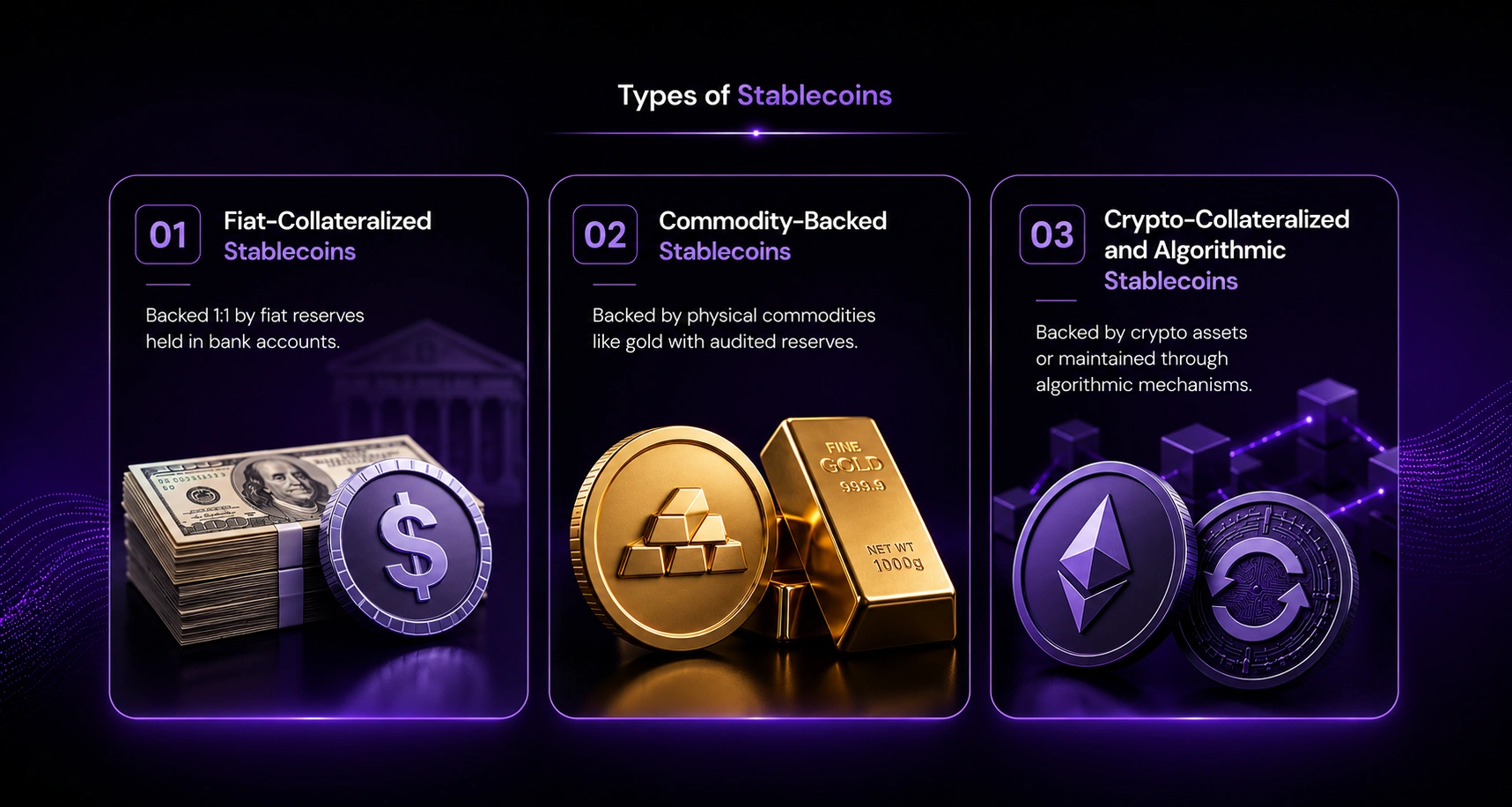
The three market leading models in 2026 are (from simple to more sophisticated and most regulated):
1. Fiat-Collateralized Stablecoins
Fiat-collateralized stablecoins are backed 1:1 by cash and cash-equivalent reserves, are subject to regular third-party attestations, and are generally the easiest to develop, custody, and obtain regulatory approval. A McKinsey’s research found that actual stablecoin payment volumes hit about $390 billion in 2025, with fiat-backed coins making up the bulk of that activity. B2B payments alone made up the lion’s share of that volume, an indication that businesses are seeing stablecoins as functional infrastructure, not a speculative play.
2. Commodity-Backed Stablecoins
Vault audits and proof of reserves tied to a physical custodian, not a bank account, are required for gold-backed stablecoins or those with other commodities. In this framework, physical commodity reserves must be independently audited and reconciled against the on-chain token supply, requiring deeper integration with institutional custody and more frequent verification cycles than fiat-backed solutions.
3. Crypto-Collateralized and Algorithmic Stablecoins
Crypto-backed stablecoins are over-collateralized with on-chain assets and rely on smart contract logic for all management, transferring risk from a custodian to code. Algorithmic or seigniorage style coins lack any direct collateral and are under the most scrutiny from regulators as their peg is based on the design of incentives, and not reserves. The model you select will dictate the level of regulatory compliant token design required pre-launch and directly impacts timelines, budget and ongoing compliance responsibilities.
Ready to Launch Your Own Compliant Stablecoin?
Key Features of a Custom Stablecoin
A production-ready stablecoin needs several features working together rather than a single smart contract. A custom stablecoin development company builds each of these into the token architecture from day one, rather than bolting compliance and liquidity on after launch:
- To manage reserves, attestations of proof-of-reserve, automated & auditable
- Multi-chain on Ethereum, Solana and the major Layer 2s
- KYC/AML integration & in-built compliance reporting for regulated use-cases
- fiat on/off ramps crypto payment gateway & banking partners
- Cross-chain liquidity to make the coin freely move between networks.
- Gas optimization for cost-effective transfers at scale
- Multi-chain wallet support for better token access
Stablecoin Development Process
Typically, a structured build has seven phases. It starts with tokenomics and reserve model design and then jurisdiction selection and regulatory-compliant token design. Then the creation of smart contracts for minting, burning, transfer logic and access controls is done according to the interface conventions lay down in the Ethereum ERC-20 token standard documentation. Let’s forget infrastructure. Custodian integration A pipeline for attestations. Internal audit architecture On top of KYC/AML, transaction monitoring and reporting, compliance integration is layered in, based on fintech compliance requirements specific to the target markets. Next, we will do multi-chain deployment, independent smart contract audit and mainnet launch. Issuers seeking to enter the U.S. market also need to consider the federal framework created by the GENIUS Act, which now governs reserve composition, disclosure, and issuer licensing. Continuous reserve management and attestation reporting throughout the token’s lifecycle.
Stablecoin Development Cost
There are a few line items that make up the cost, and a few variables determine the gulf between an MVP and a full blown compliance multi-chain launch. So that’s how the budget is constituted:
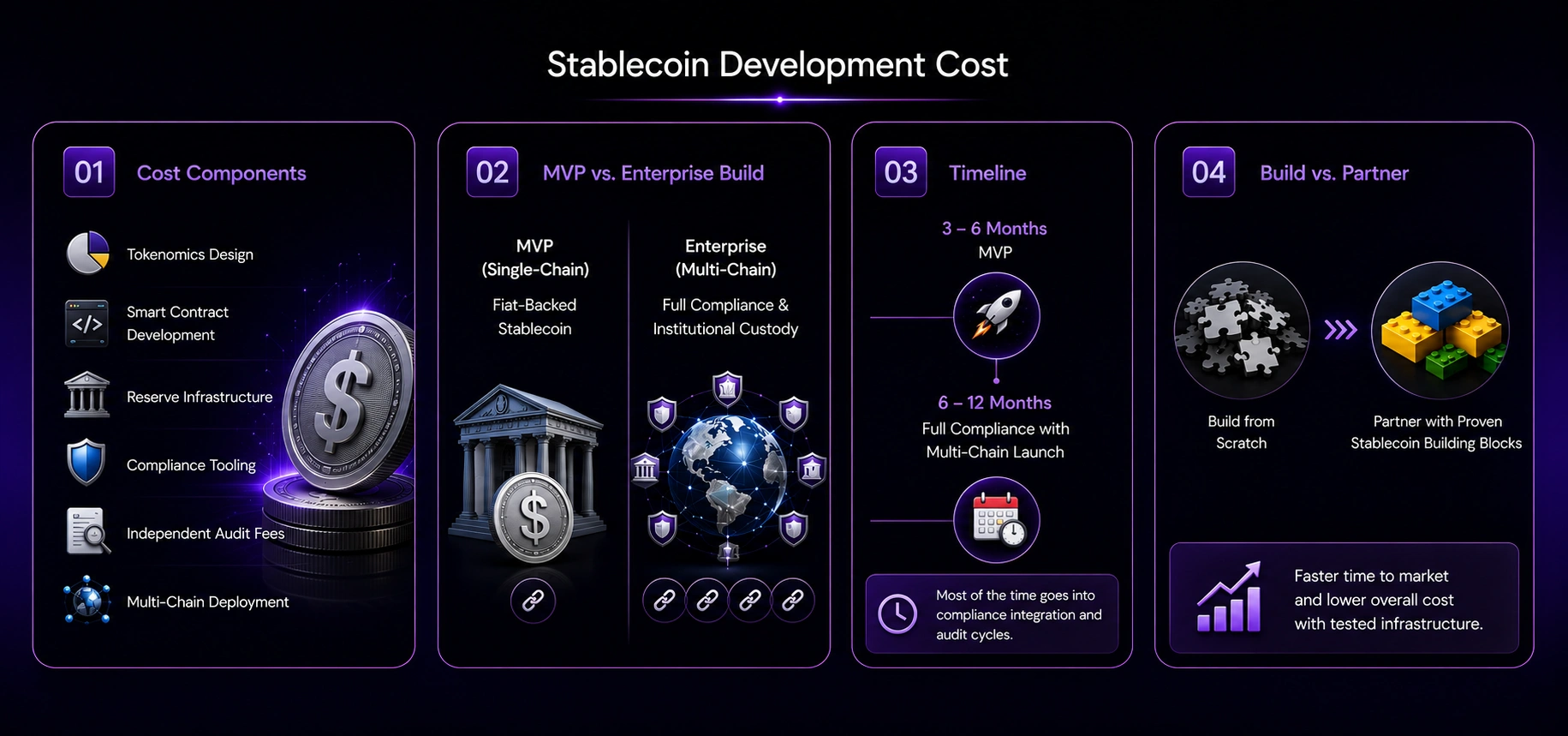
1. Cost components: Tokenomics design, smart contract development, reserve infrastructure, compliance tooling, independent audit fees, multi-chain deployment. Each layer adds scope and if you skip compliance or audit work early it tends to show up later as a much higher cost.
2. MVP vs. enterprise build: At the low end, we have a single-chain fiat-backed stablecoin MVP. Multi-chain stablecoin with full compliance tooling and institutional custody is a lot more expensive, driven by the number of chains supported, compliance depth, audit scope and reserve management complexity.
3. Timeline: 3-6 months for MVP, 6-12 months for full compliance with multi-chain launch. Typically the majority of that time is not spent in the smart contract code itself, but in compliance integration and audit cycles.
4. Build vs. partner: When you partner with a company that already has tried and tested stablecoin building blocks you will dramatically reduce your time to market, instead of building everything from scratch. The same thing applies to related infrastructure, be it stablecoin remittance rails or a white-label exchange built around the token.
Benefits of Launching a Custom Stablecoin
The commercial logic behind a branded stablecoin extends well beyond payment efficiency. So, what are the four advantages driving enterprise adoption in 2026?
1. Payment Efficiency and Cost Reduction
The immediate advantage is reduced transaction costs and almost instant settlement relative to standard banking rails. American Banker’s coverage of PayPal’s PYUSD expansion onto Polygon shows how companies are embracing branded stablecoins for cross-border settlement and payouts. The same goes for stablecoin remittance, payroll and B2B payments where speed and cost are the most important factors for many firms.
2. Treasury Management and Revenue Generation
Programmable money provides corporate treasuries with new tools to manage working capital in real time. It turns a cost center into a potential revenue stream. Issuers can make floats on reserves and transaction fees. Compliance tokens also help to improve relationships with banking partners and regulators, reducing friction in markets where crypto-adjacent businesses still face account closures and compliance scrutiny.
3. Brand, Ecosystem, and Regulatory Positioning
A branded stablecoin increases platform loyalty in a marketplace or ecosystem, keeping consumers in a regulated environment rather than transferring them elsewhere for settlement. In regulated markets, Compliance leadership creates a durable advantage. Once a stablecoin is embedded in banking rails and merchant networks, the bar is much higher for competitors to displace it.
How to Choose a Stablecoin Development Company
Look for experience running stablecoins in production, not just prototypes, and actual experience managing reserves and any regulatory approvals previously obtained. Technical depth is just as important – multi-chain support, smart contract security procedures, oracle integrations and automated attestation pipelines. Your compliance expertise should encompass legislative frameworks applicable to your target markets, KYC/AML tooling and be audit ready from day one. Ask about past deployments and current reserve custodian partnerships, and what post-launch support looks like before you sign. A partner with actual fintech compliance experience minimizes regulatory risk a lot more than one focusing just on smart contract code, and that distinction tends to show immediately when regulators or banking partners start asking thorough questions.
Why Businesses Need Stablecoin Development Solutions
Transaction volumes and adoption are increasing, and early movers are reaping meaningful network effects within their ecosystems before others can catch up. Regulatory certainty provided by frameworks such as the GENIUS Act gives issuers a clear path to compliant issuance rather than a legal murky area. Use cases range from B2B payments and payroll to treasury operations, DeFi integration and tokenized real world assets. End-to-end stablecoin development solutions enable enterprises to bring compliant, audited stablecoins to market more quickly than building each layer in-house, eliminating the trial and error commonly seen by internal teams when reserve architecture and compliance tooling are terra incognita. For companies looking to enter the space, the confluence of legislative certainty and established development infrastructure means the opportunity to capitalize on first-mover opportunities in specific verticals is shortening as more issuers enter the market.
Build the Stablecoin Infrastructure Your Business Needs
Concluding Note
A tailored stablecoin is a strategic asset for payments, treasury management and ecosystem expansion, but compliance, reserve management and security can never be an afterthought. Getting the reserve attestations, audits and regulatory design right from the outset is the difference between a token that is durable and one that attracts regulatory attention. An experienced stablecoin development company provides businesses with the technical and compliance foundation to launch with confidence.
Frequently Asked Questions
1. What does a stablecoin development company do?
Stablecoin development company builds smart contracts, reserve infrastructure, compliance tooling and multi-chain deployment pipeline for production-grade stablecoin launch. Services include tokenomics design, regulatory-compliant token design, smart contract development and audit, custodian integration, KYC/AML compliance and ongoing attestation reporting.
2. What types of stablecoins can a custom stablecoin development company build?
A company that makes custom stablecoins can build fiat-collateralized stablecoins (1:1 backed by cash reserves), commodity-backed stablecoins (pegged to gold or other tangible assets), crypto-collateralized stablecoins (over-collateralized with on-chain assets), and algorithmic stablecoins. The easiest to produce and control coins are fiat-backed. Algorithmic models are the most under the gun.
3. What stablecoin development services are included in a typical engagement?
Services include tokenomics and reserve model design, regulatory compliant token design, smart contract development for minting and burning, reserve infrastructure with custodian integration, compliance tooling for KYC/AML and transaction monitoring, independent smart contract audit, multi-chain deployment, and ongoing attestation reporting.
4. What are the key features of a production-ready stablecoin?
A production-ready stablecoin needs automated proof-of-reserve attestations, multi-chain deployment on Ethereum, Solana and L2s, KYC/AML integration with compliance reporting, fiat on/off-ramps through crypto payment gateways, cross-chain liquidity, gas optimization, and multi-chain wallet support. Both need to be baked into the architecture from day one.
5. How much does stablecoin development cost?
Costs include tokenomics design, smart contract development, reserve infrastructure, compliance tooling, audit fees and multi-chain deployment. At the low end, a fully compliant, institutional custody multi-chain stablecoin is more expensive than a single-chain, MVP fiat-backed stablecoin. MVP timelines are 3-6 months, fully compliant launch timelines are 6-12 months.
Want a Custom Cost Estimate for Your Stablecoin Project?
