



Key Takeaways
- Solana smart contract audits require specialized expertise because Rust, Anchor, account validation, PDAs, and cross-program invocations create risks that differ from EVM-based contracts.
- Audit costs vary by program complexity and architecture, ranging from approximately $15,000–$30,000 for simple programs to $150,000+ for enterprise-grade security reviews.
- DeFi protocols, multi-program systems, lending platforms, and cross-chain applications require deeper financial-logic analysis and CPI tracing, increasing both audit costs and timelines.
- A thorough Solana audit examines account ownership, signer validation, CPI security, SPL token permissions, arithmetic safety, and upgrade authority controls.
- Choose an audit company with proven Solana and Anchor experience, supported by Solana-specific case studies, manual code reviews, automated testing, remediation support, and retesting.
- An audit is the foundation of a broader security program, which should also include on-chain monitoring, bug bounties, multisig upgrade controls, timelocks, and transparent governance.
Introduction
Solana’s ecosystem continues to expand in 2026, with new DeFi protocols, NFT platforms and payment apps launching every week. That expansion brings with it a painful truth: EVM contracts are never abused in the ways Solana programs are. Before you get a quote to price a Solana smart contract audit you need to understand those distinctions. Teams budgeting for Solana audits the same as Solidity audits are typically shocked. Solana’s account model, Rust/Anchor tools, and cross-program invocation (CPI) attack surface push scope, timeline and pricing higher than a comparable Ethereum engagement. Industry security trend data at a broader level shows that on-chain code is actually becoming safer, even as total crypto losses are rising, with more protocols budgeting for audits up front rather than as an afterthought. This guide unpacks what really drives cost, realistic pricing ranges for 2026, and how to select a firm that won’t overlook the bugs that count.
Why Solana Audits Differ from EVM Audits
Solidity auditors look at contract storage layouts and function modifiers. Solana auditors look at Rust programs built on Anchor where state is in separate accounts that the program must explicitly validate. Solidity has its own implicit promise. Each account comes as an untyped byte stream, and the software itself has to verify it for ownership, signing and data type.
The Account Model, CPI Attacks, and the Auditor Supply Gap
Solana’s core accounts guide explains the account concept, which leads to a class of problems that EVM auditors rarely see: missing owner checks, account type confusion, unchecked Program Derived Addresses. Cross program invocation layers, where one program calls another and needs to verify it is calling the intended target and not an attacker supplied look alike. Security research on Solana CPI vulnerabilities has documented exactly how attackers exploit unverified program IDs to hijack account ownership. The review checklist grows substantially. If you talk to companies working on smart contract development in both ecosystems, they will tell you the mental model shift is real, not marketing. There’s also a supply side component to this: the pool of auditors with real Rust and Anchor depth is smaller than the pool of Solidity auditors, and demand for Solana development talent has added even more constraints to that market. There are less qualified reviewers for each open position, and the day rate is higher. This is reflected immediately in the audit invoice.
What a Solana Smart Contract Audit Covers
The real review of Solana is not just a syntactic pass. Auditors verify access control on each instruction. They make sure that account validation logic identifies substituted or fake accounts. They watch every CPI call to make sure that the program that is called is the program you wanted. Solana programs are raw lamport and token math, with none of the safety rails that other languages provide by default. Arithmetic checks for overflow and underflow.
SPL Token Safety, Upgradeability, and Formal Verification
SPL token handling is under special scrutiny, especially around mint authority, freeze authority and the more complicated Token-2022 additions like transfer hooks. Program upgradeability and authority controls are also a risk in themselves if the upgrade key is held by too few signers. This is where smart contract audit services differ most from general Solidity offerings: Solana reviewers need Anchor-specific gear and, for high-value protocols, may advocate formal verification of the most sensitive instructions rather than manual review alone.
Ready to Build a Secure Solana Project?
Solana Smart Contract Audit Cost: 2026 Pricing Tiers
The codebase size (instructions and account structs not lines of code), architecture complexity and protocol type are the biggest cost drivers. A simple SPL token or single pool staking program is audited faster than a multi program loan protocol with cross program dependencies. Each of those is a potential CPI attack surface. The cost of auditing solana smart contracts increases as the number of external connectors the program touches increases.
Pricing by Protocol Category
Protocol category matters as much as raw size. DeFi protocols that do lending, swaps or yield tend to be on the higher end of their tier due to the financial logic auditors have to check against edge cases like flash loans and price manipulation. And that additional financial-logic review takes real hours out of the engagement. NFT platforms that have royalty enforcement, auction dynamics, or on-chain information are typically considered easier than DeFi work, but they still add their own review time.
The prices shown are industry estimates for 2026 and are not firm. Every company scopes differently and final pricing is based on your actual code base.
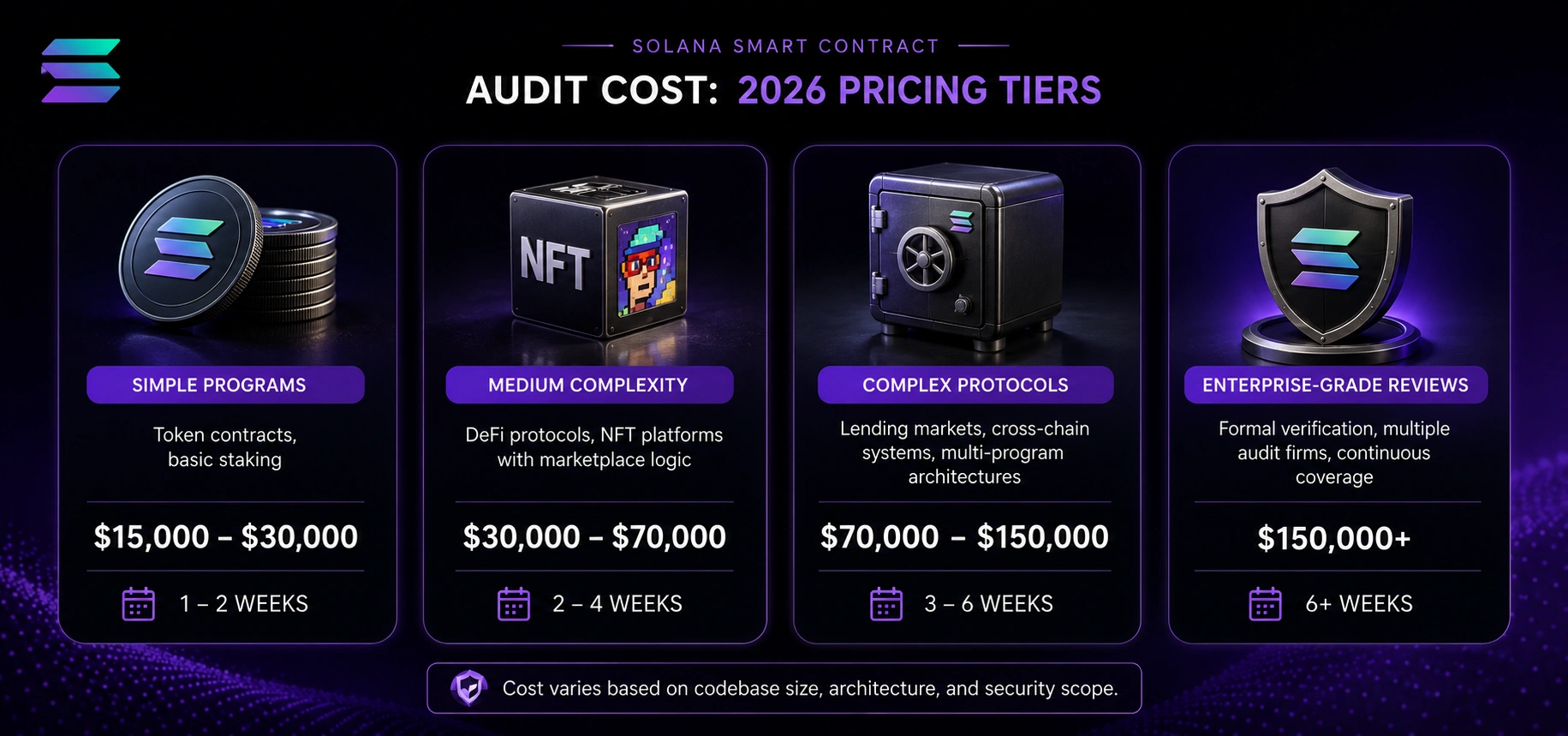
- Simple programs (token contracts, basic staking): roughly $15,000–$30,000, 1–2 weeks
- Medium complexity (DeFi protocols, NFT platforms with marketplace logic): roughly $30,000–$70,000, 2–4 weeks
- Complex protocols (lending markets, cross-chain systems, multi-program architectures): roughly $70,000–$150,000, 3–6 weeks
- Enterprise-grade reviews (formal verification, multiple audit firms, continuous coverage): $150,000 and up
Auditing Solana smart contracts is generally 20-40% more expensive than an equivalent EVM audit of the same complexity, mainly due to a smaller pool of specialized talent and the extra CPI-tracing work mentioned above. Cross-chain smart contracts built as protocols are at the high end of the range, as the auditors have to reason about failure possibilities on both sides of a bridge. Same timing – simple program clears review in one to three weeks, complex cross-chain or loan process can take three to six weeks if remediation review is involved.
DeFi exploit losses dropped to around $680 million in 2025 from $2.62 billion in 2022, according to Immunefi’s research. The firm credits the decline to better auditing techniques, faster bug reward response and the overall maturing of security architecture. When an audit quote seems expensive compared to the much larger cost of a breach, that drop is an important data point: the median loss per incident in 2025 stayed around $1.5 million, according to the same research.
Need an Accurate Solana Smart Contract Audit Cost Estimate?
How to Choose a Solana Smart Contract Audit Company
If you speak to any prospective smart contract audit firm, ask to see Solana-specific case studies, not just a generic blockchain security portfolio. Solidity-only experience doesn’t cleanly map to the Solana runtime. If you’re a firm with a good Ethereum pedigree but little practical experience with Anchor framework, you will probably miss account-model flaws that simply do not exist in Solidity. Ask for sample findings from previous Solana engagements to see if they have actually found CPI or PDA related issues before.
Methodology, Remediation, and Gas Optimization
Reputation is half the battle. The other half is the method. Ask if the review has manual line-by-line analysis, automatic fuzzing built for the Solana runtime, and a retest pass when patches go out. It is also interesting to wonder if the company cares just as much about gas optimization and security, as in Solana programs the efficiency of compute units and the safe handling of accounts are sometimes at odds with each other.
Post-Audit: Security Beyond the Audit Report
An audit report is a snapshot, not a guarantee. Ongoing monitoring that looks for odd instruction calls on-chain activity catches issues that only show up when mainnet traffic begins to flow. Bug bounty schemes go one better, providing independent researchers an incentive to find anything the audit missed.
Governance, Upgrade Authority, and Chain Abstraction
There should be a governance process for the process of upgrading a program. Multisig upgrade keys, timelocks and transparent blockchain governance over who may approve changes all reduce the risk that a single compromised key invalidates months of audit effort, and that process should be documented publicly, not simply by informal trust. This is particularly the case as protocols adopt chain abstraction patterns, as a program that is currently an entrypoint to many chains will have more and more permanent responsibility for the funds flowing through it.
Concluding Note
Solana audits cost more than EVM audits for legitimate technical reasons: the account model, CPI risk, and a smaller talent pool all increase actual review time. The lack of account checks and arbitrary CPI calls have directly resulted in nine-figure losses on Solana. Cutting audit scope to save a few thousand dollars is a poor tradeoff for the funds a program will eventually hold. So budget wisely, choose companies with Solana-specific experience and treat a Solana smart contract audit as the floor of your security program, not the ceiling.
Frequently Asked Questions (FAQ)
1. What is a Solana smart contract audit?
Solana smart contract audit is a security review of Rust/Anchor programs for access control, account validation, CPI safety, arithmetic logic, SPL token processing, and upgrade authority. Solana reviews need to deal with the account model, where state lives in individual accounts and needs to be explicitly checked, unlike EVM audits.
2. How much does a Solana smart contract audit cost in 2026?
Simple programs (token contracts, simple staking) $15K – $30K Medium complexity (DeFi protocols, NFT platforms) $30K-$70 K. Complex protocols (loan, cross chain) – $70K-150K. Enterprise grade, formal verification: $150,000+.
3. Why does the cost of Solana smart contract audit run higher than EVM audits?
Solana audits are 20-40% more expensive because of the smaller pool of qualified Rust/Anchor auditors, extra CPI-tracing work, and the account model has some classes of vulnerabilities that Solidity doesn’t have. The more expensive the daily rate on the audit bills, the less qualified the reviewers.
4. What does a Solana audit cover that EVM audits don’t?
Solana audit finds account model flaws: no ownership verification, unclear account types, unverified PDAs, and CPI attacks permitting unverified program IDs to seize accounts. The Solana runtime has a separate audit review of SPL Token-2022 extensions and Anchor-specific patterns.
5. How do I choose a smart contract audit company for Solana?
Request Solana-specific case studies and sample results from prior work. Hands on experience with Anchor framework, past experience in finding CPI/PDA vulnerabilities. It’s not just about the solidity, a company needs to show they understand Solana’s account model and runtime.
Secure Your Solana Program Before Deployment
