



Key Takeaways
- Integrating an OTC desk enables crypto exchanges to support both retail traders and institutional clients through a unified trading ecosystem.
- OTC functionality provides large-volume traders with negotiated pricing, reduced market impact, and efficient block-trade execution.
- A production-ready OTC desk requires RFQ workflows, liquidity aggregation, institutional custody, multi-currency settlement, and compliance reporting.
- Shared liquidity between the OTC desk and public exchange can improve execution, but it requires strong inventory and risk-management systems.
- Adding an OTC module to an existing exchange can reduce development time, while building a complete exchange with OTC capabilities requires broader investment in trading, custody, security, and compliance infrastructure.
- Choosing an experienced crypto exchange development partner helps reduce implementation risks across RFQ engines, matching systems, custody, liquidity, and regulatory integration.
Introduction
Digital asset demand from institutional investors has moved beyond the prototype stage. Institutions accounted for a record 72% of spot trading activity on Wintermute’s OTC desk in the first half of 2026, up from 61% six months earlier, its latest market report showed, as funds concentrated flow in fewer, deeper markets. That’s why more founders are choosing to build crypto exchange with OTC desk capabilities from scratch rather than bolting them on later. There is no retail order book that can take a seven figure block trade without moving the price. There is no OTC desk that can record continuous retail flow. They build a platform that works for both of them. This guide covers OTC’s features, architecture, development, and cost.
Why Add an OTC Desk to Your Crypto Exchange?
The order book trading is fine with standard size orders but not at the institutional level. If a fund tried to liquidate several hundred BTC in a public book the price would move against itself before it even got filled. OTC desks address this challenge by negotiating a single price for the total size, using the visible book and the terms negotiated with the client.
This is not a niche use case. The average daily OTC volume in crypto is now estimated at $50-60 billion with institutions making up more than half of all trading activity. A crypto exchange with an OTC desk takes that flow in-house instead of losing institutional clients to independent brokers, and the public-facing spot exchange continues to serve retail traffic and order book depth. A recent example of an exchange expanding its institutional lines in this way is Crypto.com’s 2026 institutional OTC options launch.
Core Features of an OTC Trading Desk
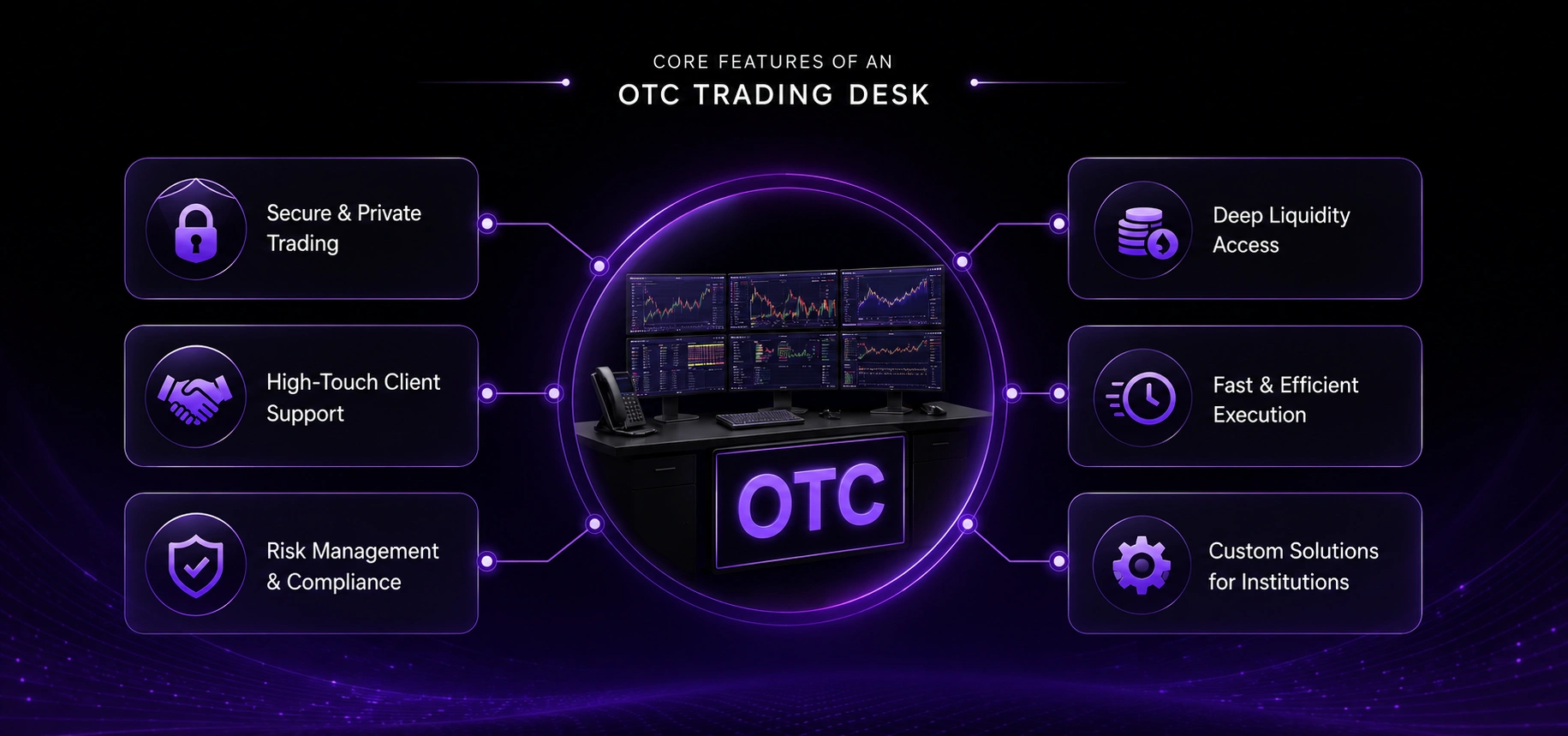
An OTC module requires functionality that differs from normal exchange trading. Getting this correctly differentiates OTC trading platform development for institutions from a thin wrapper around existing order flow.
RFQ, Block Trading, and Settlement
Clients anticipate, at the very least, an RFQ system in which they may request pricing for a given size and obtain an executable quote within a defined window, as well as block trade execution that settles the entire size at a single agreed price rather than walking the order book. Multi-currency settlement with fiat on and off ramps completes the transaction layer, as counterparties frequently need to switch between crypto and traditional currencies during the same trade.
Custody, Matching, and Liquidity
The majority of engineering risk is concentrated in custody. Institutional clients need segregated accounts with multi-signature or MPC controls, built on a multi-chain wallet foundation capable of storing and moving assets over many networks without exposing keys to a single point of failure. Wallet architecture also influences how quickly settlement can occur after a quote is accepted, which institutional counterparties notice right away in practice. None of this works without a dependable matching engine beneath it, because the OTC desk and public order book often rely on shared price feeds and, in many architectures, shared inventory, which both systems compete for during hectic trading sessions and market fluctuations. The pooled inventory must be actively managed across venues and market makers. Weak liquidity management is the single most typical reason institutional quotes spread or lag during volatile times, quietly undermining the desk’s fundamental value proposition.
Compliance and Reporting
Client-facing quality is just as important as backend plumbing, and reporting is no exception: compliance cannot be added late in the development process. It must meet the same fintech compliance criteria that institutional counterparties expect from any regulated venue, including recordkeeping methods in line with FINRA’s OTC transparency and trade reporting norms in traditional markets.
OTC Crypto Exchange Development: Architecture and Integration
The first technical question most founders address is whether the OTC desk should share infrastructure with the exchange or operate independently. In practice, OTC crypto exchange development works best with a layered architecture: a dedicated RFQ engine handles quote requests, an order management system routes accepted trades to settlement, and a shared liquidity layer allows the desk to draw depth from the exchange’s own book when internal inventory is insufficient to meet a request. Custody is listed below both because institutional and retail assets often require different operational controls even on a unified platform.
Ready to Build a Crypto Exchange With an OTC Desk?
Deployment Paths: White-Label, Hybrid, and Derivatives
FIX protocol RFQ specifications, which follow the same message structure used by institutional desks in traditional finance for decades, provide a valuable reference for how quotation requests, responses, and acceptances should be routed between counterparties. A cryptocurrency exchange with an OTC desk does not have to be custom-built from scratch. Some founders begin with a white-label exchange and overlay OTC functionality on top of an already-tested matching engine, custody layer, and compliance stack, which significantly reduces the build time compared to creating each component from scratch and re-proving its security along the way. Others take a different approach and expand an existing hybrid exchange that already combines centralized order books and on-chain settlement, adding OTC as a third execution channel to the two that the platform already supports, keeping liquidity, custody, and compliance under one operational roof rather than spread across three separate systems. If the product roadmap includes a derivatives exchange, the same RFQ infrastructure may frequently be extended to quote options and forwards upon request, which is becoming more prevalent as institutional demand changes from spot to structured products.
Development Process and Timeline
The process of developing an OTC desk is consistent: architecture design, RFQ engine development, matching engine and liquidity integration, custody setup, compliance configuration, front-end and API delivery, security audit, and deployment.
Adding OTC to an established exchange is significantly faster because the matching engine, custody, and compliance layer are already operational; the focus is on the RFQ engine, settlement logic, and onboarding. This normally takes four to seven months. Building a fully functional exchange with OTC capacity from the ground up, including the order book and compliance structure, typically takes eight to fourteen months, depending on regulatory scope and asset coverage. Before managing real institutional funds, every build should undergo an independent smart contract audit, as custody and settlement logic are precisely where an attack can cause the most damage.
Our Portfolio: High-Performance Crypto Exchange Platform
Techfyte has built a high-performance crypto exchange platform that delivers seamless digital asset trading through real-time market data, responsive trading charts and fast order execution. Core infrastructure supporting an efficient trading experience for all user segments with a user friendly interface.
Its architecture demonstrates the basic capabilities that are required when building a crypto exchange with OTC desk capabilities. A scalable trading engine, real-time pricing infrastructure, secure transaction workflows and efficient order management can provide the operational base for expanding into institutional trading. An OTC module can then be added to support RFQ-based execution, negotiated block trades, liquidity management, and settlement for clients with high volumes.
The project is a testament to Techfyte’s expertise in developing exchange infrastructure that can develop beyond traditional spot trading and meet wider institutional needs as demand for the platform increases.
https://techfyte.com/live-demo/?ld_group=group-web3-blockchain&ld_demo=7288&ld_play=1
Cost to Build a Crypto Exchange with OTC Desk
The cost breakdown includes the main exchange platform, the OTC/RFQ module, custody infrastructure, compliance tooling, audits, and deployment. As a general, illustrative guide rather than an estimate, adding an OTC module to an existing exchange often costs between the low and mid six figures, whilst building a full exchange with integrated OTC functionality from scratch typically costs between the high six and low seven figures. These are directional projections; real pricing is significantly influenced by the specific platform and scope, as well as the rate at which the underlying crypto exchange market continues to grow institutional share.
The most significant cost drivers are RFQ complexity, the level of liquidity integration across the desk and order book, regulatory scope, and custody sophistication. Working with an experienced Crypto Exchange development business that already has RFQ engines, matching engine code, and compliance modules in place saves both money and time compared to constructing each layer from scratch.
Choosing a Crypto Exchange Development Partner
Not every exchange vendor has really sent an OTC desk. Look for a partner with a track record across both exchange and OTC builds, since the two require distinct expertise in settlement logic, liquidity aggregation, and custody. Regulatory knowledge is just as important as technical depth; a partner who understands trade reporting obligations saves rework later.
Before committing, ask about past OTC deployments, block trade scale handled, custody integrations, and what post-launch support looks like once clients are live.
Support $10M+ OTC Trades With a Secure Exchange Platform
Concluding Note
Combining an OTC desk and a cryptocurrency exchange provides platform coverage on both ends of the market: continuous retail liquidity on the order book and negotiated, low-slippage execution for institutional investors. As institutional volumes continue growing faster than retail volumes, platforms supporting both are better positioned to retain clients. If you’re ready to build crypto exchange with OTC desk capability, early decisions about design, custody model, and regulatory scope will determine how well the platform scales as institutional demand grows.
Frequently Asked Questions
1. Why should I build a crypto exchange with OTC desk?
Crypto exchange with OTC desk captures retail and institutional flow. Multi-million dollar block trades can’t be absorbed by retail order books without price slippage and standalone OTC desks can’t capture continuous retail volume. They make a complete platform together – institutions accounted for 72% of spot OTC volume in H1 2026 and average daily OTC volume now exceeds $50 billion.
2. What features does an OTC trading desk require?
OTC trading desk needs an RFQ system for negotiated pricing, block trade execution that settles full size at one price without walking the order book, multi-currency settlement with fiat on/off-ramps, institutional custody with multi-signature or MPC controls, shared liquidity management across the desk and order book, and compliance reporting in line with FINRA OTC transparency rules.
3. How does OTC crypto exchange development differ from standard exchange builds?
An OTC crypto exchange development includes a dedicated RFQ engine, order management system for negotiated trades, and a separate settlement logic from order book matching. The architecture layers OTC functionality on top of shared infrastructure: custody, compliance, and liquidity, but the quote-to-settlement flow is fundamentally different from automated order matching.
4. What are the deployment options for adding OTC to an exchange?
There are three options: Build a white-label exchange with OTC on top of tested infrastructure, extend an existing hybrid exchange with OTC as a third execution channel, or build custom from scratch. Adding OTC to an existing exchange takes 4-7 months. Building out a full exchange with OTC from the ground up takes 8-14 months.
5. How much does it cost to build a crypto exchange with OTC desk?
The cost of adding an OTC module to an existing exchange is usually in the low-to-mid six figures. A full exchange build with integrated OTC from the ground up runs into the high six figures to low seven figures. The biggest cost drivers are the RFQ complexity, the depth of integration of liquidity, the regulatory scope and the sophistication of the custody. An experienced Crypto Exchange development company with ready-made modules saves cost and time to market.
Turn Large Crypto Transactions Into Profitable Business
