



Key Takeaways
- Stellar enables enterprise-grade RWA tokenization with built-in compliance controls, fast settlement, and low-cost asset transfers.
- Successful RWA adoption requires scalable infrastructure, regulatory alignment, and real-world institutional usage beyond token creation.
- Soroban smart contracts and Stellar’s asset framework support programmable, secure, and efficient digital asset ecosystems.
- Partnering with an RWA tokenization platform development company helps organizations build secure, scalable solutions designed for issuing, managing, and transferring digital representations of real-world assets.
Introduction
Enterprises are investing in RWA tokenization development services to digitize assets such as securities, real estate, funds, commodities and other financial instruments. Real World Asset (RWA) tokenization is a transition from early blockchain experimentation into core institutional finance strategy. It improves transparency, liquidity and settlement efficiency. \
However, Stellar XLM RWA tokenization adoption requires more than just understanding basic token creation. Organizations need secure infrastructure with regulatory controls, scalable transaction processing, interoperability and reliable asset management capabilities.
In this blog, explore the stellar RWA tokenization platform features 2026 and the architectural considerations that influence successful RWA tokenization platform development for enterprise applications.
Understanding Stellar for RWA Tokenization in 2026
Real World Asset (RWA) tokenization involves converting tangible and intangible assets into blockchain-based digital representations for easy asset ownership and quick settlement. The Stellar Network for RWA Tokenization is a business-oriented platform that enables the issuance and management of different types of assets including real estate, bonds, commodities, private equity, funds, and stablecoins.
Built on the Stellar Consensus Protocol (SCP), the network enables fast and reliable transactions with low costs. It makes the network compatible to support quick and inexpensive transactions. In addition, the issued assets, trust lines, and asset authorization of Stellar are critical features needed for the regulation of assets.
Why Enterprises Are Adopting Stellar for RWA Tokenization
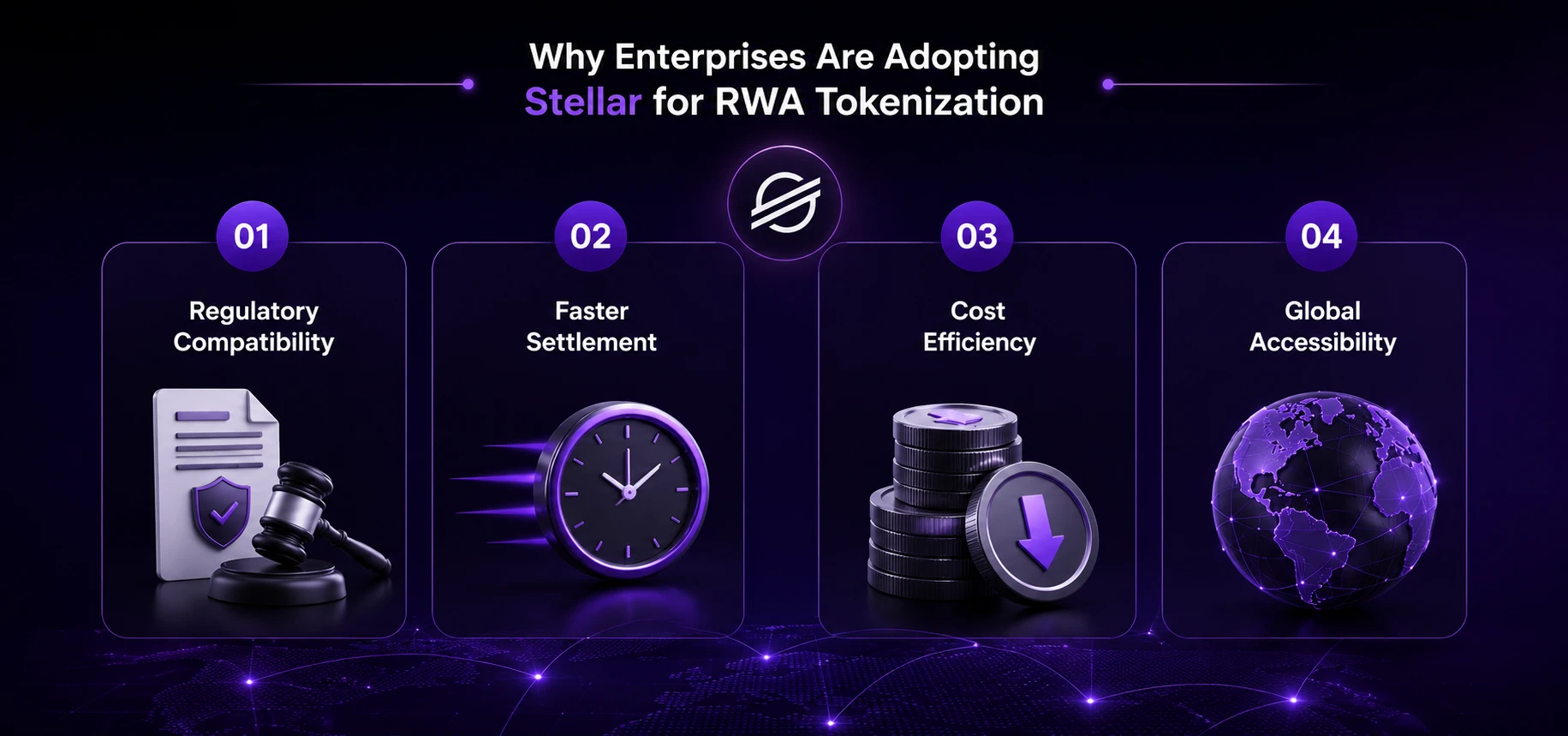
1. Regulatory Compatibility
- Asset level permissions: Stellar allows authorized asset transfer using the concept of trustlines and authorization that is useful for organizations to control the movement of regulated assets.
- Issuer controlled features: Such features as freeze and clawback capabilities allow issuers to design workflows for compliance purposes.
2. Faster Settlement
- Real-time transaction confirmation: Stellar’s high-speed network facilitates the process of transferring digital assets, making it quicker than in conventional financial systems.
- Reduced counterparty risk: Quick confirmation speeds up the whole process of transactions.
3. Cost Efficiency
- Low transaction fees: Stellar offers low transaction fees which make it economically feasible to move large amounts of transactions.
- High-volume financial operations: The blockchain platform allows high-frequency transactions like dividends distribution, asset distribution, and border settlement.
4. Global Accessibility
- Cross-border settlement: Stellar allows global asset movements using its distributed network and ecosystem of financial anchors.
- Digital asset liquidity: Increased use of stellar XLM RWA tokenization is providing global availability for tokenized assets and blockchain financial marketplaces.
Ready to Build a Future-Proof Stellar Tokenization Platform?
Essential Enterprise Stellar RWA Tokenization Platform Features 2026
Understanding these capabilities helps enterprises establish a strong foundation for RWA tokenization platform development while meeting regulatory and operational requirements.
1. Native Asset Issuance and Management
Native asset issuance enables firms to issue tokens based on real-world assets with defined rules for ownership, issuance, and governance. The issued assets feature of the Stellar network can be helpful for enterprises to ensure that they have control over the full asset lifecycle.
Key capabilities:
- Issue regulated digital assets based on the rules of Stellar-issued assets.
- Maintain the metadata of the issued assets for easy identification.
- Control the quantity of tokens by minting and redeeming them.
- Generates issuer accounts for issuing tokens.
- Provide transparent ownership history in the blockchain.
2. Built-In Compliance Controls and Permission Management
Compliance controls assist companies in implementing regulatory requirements by limiting access to asset tokenization solutions. Stellar’s protocol-level authorization mechanisms allow implementing compliance without complex logic. It also enables regulated financial instruments.
Key capabilities:
- Apply authorization flags to authorize eligible asset owners.
- Employ trustlines to make sure that the assets are accepted by authorized accounts only.
- Manage account approval processes for investor onboarding.
- Freeze and claw back assets according to regulatory or legal needs.
- Support security tokens and regulated investment funds.
- Issue institutional stablecoins compliantly.
3. High-Speed Settlement Infrastructure
Quick settlement Infrastructure ensures reduced transaction latency, eliminates counterparty risks, and increases operational efficiency for institutional asset transfers. The low-latency platform of Stellar facilitates timely settlement of high-volume financial transactions.
Key capabilities:
- Confirm transactions within a few seconds.
- Provide low-latency settlement of digital assets transfers.
- Facilitate reconciliation processes across financial systems.
- Supports securities settlement processes.
- Simplify cross-border payment processing.
- Optimize treasury and liquidity management processes.
4. Soroban Smart Contract Integration
Soroban extends Stellar with programmable smart contracts that streamline financial processes without compromising the speed of native asset transactions. It enables businesses to create sophisticated tokenization work flows while maintaining speed.
Key capabilities:
- Develop programmable financial applications using Soroban smart contracts.
- Implement automated asset servicing and workflow execution.
- Build custom business logic with Stellar Asset Contracts (SAC).
- Automate yield distribution and dividend payments.
- Support structured financial products and multi-party agreements.
- Enable flexible asset management for evolving business requirements.
5. Institutional-Grade Security Architecture
Institutional-level security is designed to safeguard tokenized assets from unauthorized access while enabling governance, auditing, and resiliency. Security architecture helps establish trust among enterprises handling regulated financial assets.
Key capabilities:
- Enable secure issuer accounts using best key management processes.
- Implement multi-signature authorization for significant transactions.
- Assign wallet permissions according to the organization’s role structure.
- Detects suspicious or non-conforming transactions.
- Establish audit trails and compliance reporting modules for governance purposes and reporting.
6. Interoperability and Liquidity Connectivity
Interoperability allows tokenized assets to interact with financial institutions, payment systems, and liquidity providers, improving accessibility and market participation. As stellar RWA on-chain value continues to grow, seamless connectivity becomes increasingly important for enterprise-scale adoption.
Key capabilities:
- Utilize Stellar decentralized exchange for asset trading.
- Connect to Stellar Anchor network for fiat integration.
- Fiat on-ramping and off-ramping services.
- Cross-border transfer and settlement of assets.
- Liquidity for tokenized asset markets.
- Increased participation in the digital asset network.
7. Scalable Token Lifecycle Management
A scalable lifecycle management framework enables enterprises to administer tokenized assets from creation to redemption while maintaining compliance throughout the process. This reduces operational complexity and supports long-term asset governance.
Key capabilities:
- Controlled issuance and distribution of assets.
- Transfer of assets between peers and institutions.
- Redemption of the issued assets.
- Generate reporting for operations and regulatory purposes.
- Apply compliance updates throughout the asset lifecycle.
- Maintain consistent governance as tokenized asset portfolios grow.
Tokenize Assets Up to 90% Faster With Stellar
Challenges Enterprises Must Consider Before Building on Stellar
- Regulatory Complexity: Enterprises must ensure tokenized assets comply with securities laws across jurisdictions by adopting a compliance-first token design approach that incorporates transfer restrictions, identity verification, and investor protection mechanisms.
- Liquidity Challenges: Issuing tokenized assets does not automatically create investor demand, making liquidity planning and market participation essential.
- Ecosystem Development: Successful RWA platforms depend on collaboration with custodians, financial institutions, compliance providers, and liquidity partners.
- Security Requirements: Robust infrastructure security, smart contract audits, and secure key management are critical to protecting enterprise-grade digital assets.
Future Outlook of Stellar XLM RWA Tokenization Adoption in 2026
The increased demand for Stellar XLM RWA tokenization adoption is highlighting the requirement of blockchain technology for enterprises in 2026. However, the tokenization depends on the ability of the network to handle compliant issuance, settlement, and interoperability with financial systems.
With native compliance features, fast transaction finality, and Soroban smart contracts, Stellar is well positioned to support enterprise-grade RWA platforms. However, it is long-term adoption that is driven by regulatory requirements, enterprise partnerships and implementation.
Key trends:
- Rising institutional adoption of blockchain-based financial infrastructure
- Expansion of regulated tokenized asset markets
- Growing demand for compliant settlement networks
- Increased enterprise use of Stellar for RWA tokenization
Conclusion
As the interest of enterprises in tokenized assets increases, Stellar is offering solutions that help issue digital assets, manage the assets securely, and settle payments. The native asset management tools, fast transaction speeds, and programmability make Stellar a great platform for developing RWA applications.
However, the success of RWA tokenization depends on more than just blockchain technology. Enterprises evaluating RWA tokenization development services should prioritize regulatory compliance, security, interoperability, and long-term scalability when designing enterprise-grade platforms.
Techfyte is one of the top compliance focused RWA tokenization platform development companies. Our approach combines AI-driven compliance workflows with multi-chain smart contract infrastructure to support secure asset lifecycle management, regulatory reporting, and scalable digital asset operations.
FAQs
1. What makes Stellar suitable for RWA tokenization?
Stellar for RWA Tokenization provides native asset issuance, protocol-level compliance controls, trustlines, and issuer permissions for regulated assets. Combined with fast transaction settlement, low fees, and Soroban smart contracts, these stellar RWA tokenization platform features 2026 enable enterprises to build secure, scalable, and compliant digital asset ecosystems.
2. How does Stellar handle regulated tokenized assets?
Stellar supports regulation of assets through trustlines, authorization flags, issuer permissions, and the possibility to have freeze and clawback features. The native controls of Stellar allow companies to control who can own these assets and implement regulations, such as KYC/AML.
3. What assets can be tokenized on Stellar?
Stellar has several tokenized tangible assets, which include real estate tokenization, stocks, corporate and sovereign bonds, commodities, private equity, investment funds, and stablecoins.
4. What features should enterprises look for in an RWA tokenization platform?
An enterprise RWA tokenization platform should provide compliance controls, robust security, scalable infrastructure, efficient asset lifecycle management, interoperability with financial systems, and programmable smart contract capabilities.
6. How does Stellar RWA on-chain value reflect ecosystem growth?
Growing stellar RWA on-chain value indicates increasing adoption of tokenized assets, stablecoins, and enterprise applications on the network. However, organizations should also evaluate transaction activity, institutional participation, liquidity, and regulatory adoption to assess the long-term maturity of the Stellar ecosystem.
7. Why choose professional RWA tokenization development services?
Building an enterprise-grade platform requires expertise in blockchain architecture, compliance integration, security, and asset lifecycle management. Experienced RWA tokenization development services providers build a platform that aligns with regulatory requirements and enterprise scalability goals.
Launch Your Stellar RWA Platform in 7 Days
