



Key Takeaways
- ETF tokenization enhances settlement, ownership, and distribution without changing the underlying fund structure.
- Tokenized ETFs enable fractional ownership, faster settlement, and programmable corporate actions.
- Compliance-ready architecture is essential for institutional ETF tokenization platforms.
- Major asset managers are already launching regulated tokenized fund products.
- Clearer regulations are accelerating institutional confidence in tokenized ETFs.
- Early investment in compliant infrastructure creates long-term competitive advantages.
- Choosing the right tokenization partner reduces compliance risks and speeds deployment.
Introduction
Global ETF assets are in the tens of trillions of dollars and the next chapter of the industry is already being written on blockchain. ETF Tokenization has moved beyond a theoretical exercise to the practical question of infrastructure, as major issuers, custodians and exchanges experiment with how fund shares could exist as programmable digital investments while preserving the regulatory protections investors rely on.
The move is significant as ETFs are already the most liquid and transparent asset management wrapper, and are therefore an ideal testing ground for blockchain-based ownership records.
This article examines why ETFs are such a good fit for tokenization, the operational benefits involved, how a tokenization platform is typically constructed, the current stance of regulators, and what the next few years could bring for issuers and institutional allocators.
What Is ETF Tokenization?
For an ETF, tokenization refers to the digital representation of an ownership interest in a regulated exchange-traded fund in the form of a token recorded on a blockchain rather than using traditional book-entry procedures at a transfer agent or depository. The token is still a claim on the same underlying fund, it’s the recording, transfer and settlement of ownership that changes.
Here’s how tokenized ETFs differ from traditional ETF shares and other tokenized asset classes:
- Operational upgrades over traditional ETFs: Tokenized ETFs can offer operational benefits over traditional ETFs, such as near-instant settlement instead of T+2, fractional ownership in smaller denominations than whole shares, and programmable distribution logic that automates dividends or corporate actions instead of routing them through manual back-office processes.
- Different from real estate tokenization: Real estate tokenization is different from the tokenization of real estate in that it digitizes an illiquid, physically-anchored asset, enabling fractional access and secondary trading where none previously existed. As the underlying property does not hold the market price of a listed security, any token needs to be independently evaluated and verified for the title before distribution.
- Different from commodity tokenization: Commodity tokenization is unique as it represents a claim on a physical stockpile, such as gold or oil, and requires independent auditing and reconciliation against vault records. ETFs, in contrast, start out in the opposite position: already liquid, regulated and diversified.
- Incremental infrastructure, not wholesale replacement: Near-term efforts to tokenize ETFs are incremental additions to existing infrastructure rather than wholesale replacements of trading, clearing and settlement systems, TD Securities has described it in its market structure research. Tokenization is an enhancement to the settlement and distribution layer for an asset class that already works well.
Why ETFs Are the Ideal Asset Class for Tokenization
ETFs have three characteristics that make them particularly well suited to blockchain rails: established legal certainty under securities law, extensive secondary market liquidity and diversified, rules-based portfolio composition that is easy to audit. There is already trust in the underlying asset, so tokenization does not have to deal with this. It can focus on operational efficiency, collateral mobility and the mechanics of programmable distribution. Tokenized fund shares can be integrated into existing fund administration flows without requiring issuers to rebuild their entire operating model from scratch. An on-chain ownership layer is all that is needed.
The market context reinforces the timing. TD Securities’ 2026 ETF outlook predicts continued growth in active management, options-based strategies and asset allocation products, with tokenization being one of the vectors of innovation that will change the space, alongside autocallable ETFs and private-market access. Institutional allocators are asking for on-chain exposure on top of their existing custody and prime brokerage relationships, and those issuers who understand asset tokenization infrastructure will be in a better position to answer, without having to rebuild their compliance stack for each new product.
Benefits of ETF Tokenization
There are a few specific advantages over traditional fund operations that tokenized ETFs are operationally built on.
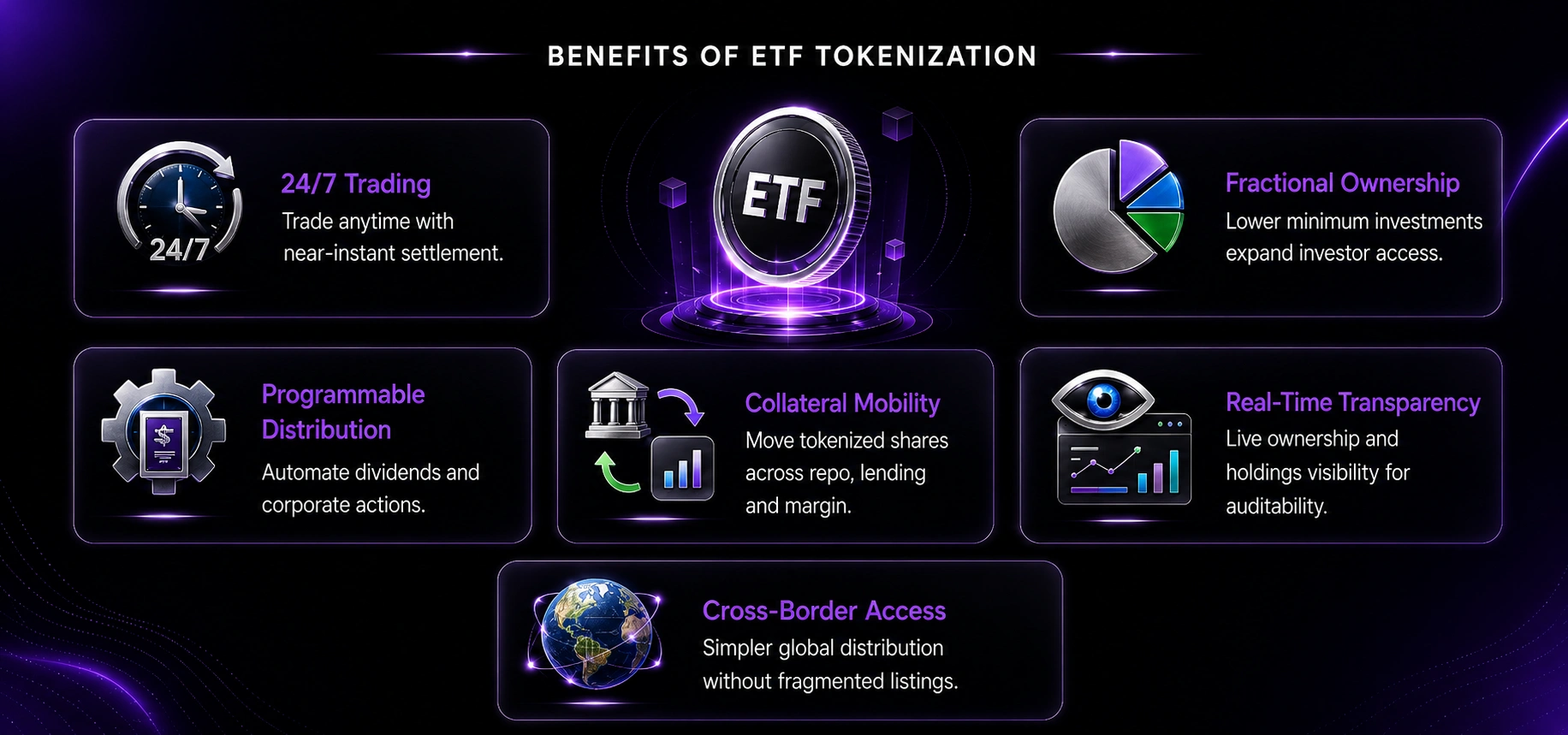
Here are six of the most important ETF tokenization benefits for institutional issuers:
- 24/7 trading and near-instant settlement rather than T+1 or T+2 cycles tied to market hours.
- Fractional ownership and lower minimum investments lead to greater diversity of investor base
- Programmable Distribution Automated dividend payments and corporate action processing.
- Collateral mobility allows tokenized shares to move more easily between repo, lending and margin arrangements.
- Real-time transparency into ownership records and holdings for auditability
- Simple cross-border distribution without fragmented jurisdiction-specific listing infrastructure.
Each of these advantages depends on the same underlying shift: moving ownership records and settlement logic onto shared infrastructure that every counterparty can verify independently, rather than reconciling separate ledgers after the fact. These benefits compound when a secondary marketplace for tokenized shares exists alongside robust reporting and audit trails, since institutions get both the liquidity guarantees they expect from traditional ETFs and the operational speed of on-chain settlement. That reporting layer is not optional window dressing. A serious compliance reporting system has to reconcile on-chain transfer data against fund administrator records continuously, not just at quarter-end, so regulators and auditors can trust the numbers in real time.
TD Securities’ analysis of tokenized money market funds shows that regulated fund structures can already accommodate blockchain-based ownership and peer-to-peer transfers within existing regulatory frameworks, which is a useful proof point for ETF issuers weighing whether the same model can extend to equity and fixed income exposures. Industry data compiled by rwa.xyz shows the broader tokenized real-world asset market has grown more than 200% year over year, underscoring how quickly institutional appetite for on-chain fund structures is scaling beyond early pilots.
Ready to Bring ETF Ownership On-Chain?
ETF Tokenization Platform Architecture
A typical production grade ETF tokenization platform will have a four tier structure. Each layer plays a role in the stack as follows:
1. Token Layer
The token layer is a permissioned standard (e.g. ERC-3643) that embeds identity verification and transfer limits into the token itself, such that only eligible, KYC-verified holders can transact. This is the basis for all subsequent layers of compliance enforcement at the transfer level.
2. Smart Contract Layer
The smart contract layer is responsible for minting and redeeming against the underlying fund, distributing dividends and providing NAV-linked oracle feeds to ensure on-chain pricing is in line with the fund’s official valuation. The long-lasting institutional platform is distinguished from a proof-of-concept that cannot grow beyond the pilot phase by consistent application of Smart contract development in all layers.
3. Custody Layer
Institutional custody arrangements will need to protect the underlying ETF assets but also the private keys or the wallet infrastructure that govern the tokens themselves, often in the form of a regulated custodian or transfer agent acting as the system of record.
4. Compliance Layer
The compliance layer handles investor onboarding, KYC/AML screening and jurisdiction-specific transfer limitations, and these are enforced at the smart contract level, not after the fact. It is this combination, coupled with a regulatory-compliant token design from the very beginning of architecture decisions, that distinguishes a long-term institutional platform from a proof-of-concept.
None of these layers function well in isolation, which is why issuers increasingly evaluate the stack end to end before committing to a single vendor or blockchain network. Firms building this kind of stack typically pair a purpose-built RWA tokenization platform with dedicated smart contract engineering and careful token design, since retrofitting compliance onto an existing token after launch is far harder than building it in from day one.
Franklin Templeton’s tokenized share structure, which represents fund exposure through a BENJI token issued on public blockchains including Stellar and Polygon, illustrates how these layers combine in a live, regulated product used across multiple wallet environments.
Build a Compliance-Ready ETF Tokenization Platform
Regulatory Landscape for Tokenized ETFs
On January 28, 2026, the SEC‘s Divisions of Corporation Finance, Investment Management and Trading and Markets issued a joint staff statement on tokenized securities, reaffirming that a tokenized security is still a security for purposes of federal securities laws, whether ownership records are maintained on-chain or off-chain.
Here are the main regulatory changes that are shaping tokenized ETFs:
- SEC taxonomy for tokenization models: They separate tokens that are intended to represent a direct ownership interest from tokens that offer synthetic exposure to a stream of returns. This classification has direct consequences for ETFs as it determines which regulatory regime applies to tokenized shares.
- Exchange infrastructure adapting: Nasdaq’s amended rule filing and DTC’s tokenization pilot program both aim to allow market participants to identify orders for tokenized settlement without disrupting existing clearing systems.
- Global regulatory patchwork: MiCA rules in the EU and emerging UCITS advice determine how tokenised fund shares can reach European investors. Hong Kong sanctions tokenized money market funds via designated fintech sandboxes Compliance must be engineered into institutional asset tokenisation schemes from the outset, not appended as an afterthought, especially as blockchain ETFs are traded across multiple regulatory regimes simultaneously.
The Institutional Opportunity: What’s Happening Now
The most clear sign of institutional intent is the level of activity from the big issuers. What the biggest asset managers are building:
- BlackRock: BlackRock is said to be eyeing tokenized structures linked to exposure in equities ETFs, pending regulatory approval, on top of early pilots with money market funds.
- Franklin Templeton: Franklin Templeton has tokenised five funds across US stock, gold and high-yield bond strategies. Shares can be traded directly (via cryptocurrency wallets) 24/7 and are available through distribution partner Ondo Finance.
- Collateral and lending convergence: The ability to use tokenized fund shares as collateral for repo or margin financing offers tangible benefits over the convenience of trading alone. ETFs on the blockchain shares are increasingly perceived as a bridge between traditional custody and decentralized financial infrastructure.
- Competitive signal: The fact that two of the world’s leading asset managers are actively building this market is a clear signal that ETF tokenization has moved beyond the experimental stage for a competitive product strategy.
What’s Next for ETF Tokenization
Near-term adoption is expected to focus on liquid, benchmark-tracking ETFs and Treasury or money market products, where operational benefits are easiest to demonstrate and regulatory risk is lowest. Over the coming few years, expect greater integration between tokenization platforms and existing fund administrator procedures, such that on-chain settlement becomes an extra distribution channel rather than a separate operational track needing separate reconciliation.
Tokenized ETFs are expected to become a normal building piece inside multi-asset portfolios rather than a standalone experiment, particularly for institutions already comfortable holding digital assets as collateral. Issuers and platform providers that invest early in compliant token design and secondary market infrastructure stand to gain a significant cross-border distribution advantage as more allocators view on-chain access to conventional fund exposures as a standard feature rather than a novelty.
Concluding Note
ETF Tokenization is not a gamble on replacing the ETF wrapper; rather, it is a bet on improving the settlement, custody, and distribution rails beneath an asset class already trusted by institutions throughout the world. With regulators providing clearer guidance, major issuers shipping live products, and exchange infrastructure adapting to support on-chain settlement, the next wave of adoption will most likely reward firms that build compliant, well-architected platforms now rather than waiting for the market to fully mature around them.
The window for issuers exploring ETF Tokenization to create infrastructure ahead of demand is open, but it will close as more of the world’s major asset managers transition from pilot projects to production.
Frequently Asked Questions
1. What is ETF Tokenization?
ETF Tokenization is the conversion of an ownership interest in a regulated exchange-traded fund into a digital token on the blockchain versus traditional book-entry procedures. The token represents a claim on the same underlying fund, but ownership is recorded, transferred and settled separately. Tokenized ETFs provide quick settlement, fractional ownership and programmable distribution.
2. How do tokenized ETFs differ from other tokenized assets?
Tokenized ETFs depend on existing liquidity, regulation and diversity. Real estate tokenization is the process of turning illiquid physical assets that need independent appraisals into the digital form. Commodity tokenisation is a claim over physical stock and needs vault audits. ETFs are already regulated and liquid so tokenization is an extra layer of settlement not one of access where none existed before.
3. What are the benefits of ETF tokenization?
Six benefits drive institutional adoption: 24/7 trading and near-instant settlement vs. T+2; fractional ownership with lower minimums; programmable distribution that automates dividends and corporate actions; collateral mobility for repo and margin financing; real-time transparency into ownership and holdings; and simplified cross-border distribution without fragmented listing infrastructure.
4. What does an ETF tokenization platform architecture look like?
The architecture is comprised of four layers: a token layer that validates identities with permissioned standards like ERC-3643; a smart contract layer for minting, redemption, dividends, and NAV oracles; a custody layer that secures the underlying ETF assets and token keys through regulated custodians; and a compliance layer for investor onboarding, KYC/AML, and jurisdiction-specific transfer restrictions.
5. What is the regulatory status of tokenized ETFs?
On January 28, 2026, the SEC issued a joint staff statement clarifying that tokenized securities are subject to the federal securities laws. It distinguishes between tokens that represent direct ownership and those that represent synthetic exposure. Nasdaq and DTC are trying to upgrade their exchange infra. MiCA, UCITS and Hong Kong sandboxes are reshaping the world’s cross-border distribution systems.
6. Which institutions are actively building tokenized ETFs?
BlackRock is exploring tokenized structures linked to equity ETF holdings. Franklin Templeton has tokenized five funds that mirror US stock, gold and high-yield bond strategies with shares traded directly in cryptocurrency wallets via Ondo Finance. Tokenized fund shares are increasingly being used as collateral for repo and margin lending, bridging the gap between traditional custody and decentralized finance infrastructure.
Launch Your ETF Tokenization Infrastructure with Confidence
