



Key Takeaways
- The global blockchain supply chain market size is projected to reach USD 34,991.8 Million by 2034.
- The integration of Internet of Things (IoT) and Artificial intelligence (AI) in the Blockchain industry improves data analytics and favors the supply chain market.
- A widespread adoption of smart devices like IoT sensors and radio-frequency identification tags are becoming common in the supply chain sector.
- The region segregation for blockchain supply chain market is classified into North America, Asia-Pacific, Europe, Latin America and Middle East and Africa.
- Major players in global enterprise blockchain solutions include Kaleido, Techfyte, Oracle Corporation and other industry leaders.
Introduction
The growing inclination of consumers towards online retail platforms for purchase of products and services has resulted in widespread adoption of blockchain supply chain technology. However with the expansion of enterprise supply chains across the global supplier and logistics networks it also increases the complexity of the system.
Blockchain supply chain solutions help enterprises to build a secure and transparent ecosystem by creating a shared and tamper-proof record of transactions. As a result it helps organizations with improved collaboration, reduced operational risks and strengthen compliance across the supply chain.
In this blog, explore the modern blockchain solutions for supply chain, its development cost, benefits and use cases across industries.
What Are Enterprise Blockchain Supply Chain Solutions?
Enterprise blockchain supply chain solutions are blockchain networks that enable manufacturers, suppliers, logistics providers, distributors and retailers to securely share verified data in real time. Unlike public blockchains, only authorized participants get access and validate information, improving privacy and governance.
These blockchain supply chain management solutions integrate with the enterprise systems like ERP, IoT and warehouse management platforms to improve collaboration, traceability and streamline operations across a secure multi-party ecosystem.
| Traditional Supply Chain | Blockchain Supply Chain |
|---|---|
| Data stored in separate systems | Shared, immutable ledger |
| Limited visibility | End-to-end transparency |
| Manual reconciliation | Automated smart contracts |
| Higher fraud risk | Tamper-resistant records |
| Slower collaboration | Real-time data sharing |
Why Are Enterprises Adopting Blockchain Solutions for Supply Chain?
1. Suppliers Networks Across The World
Supplying products across the world may result in fragmented data and build communication gaps. Supply chain solutions using blockchain technology helps establish a unified network of all stakeholders who can easily access the information securely.
2. Traceability
Businesses require transparency in their supply chain, from raw material procurement to delivering the finished products to customers. Using blockchain solutions for managing supply chains allows for easy transactions tracking and product recalls.
3. Counterfeiting Prevention
Counterfeit products harm the business reputation and may result in higher losses for the company. A blockchain solution verifies every transaction of the product in the blockchain, thus helping businesses prevent counterfeit products.
4. Regulation
Some industries have strict compliance regulations set for the business to follow. The automated nature of blockchain transactions makes smart contract audits easy and quick.
5. ESG Reporting
Organizations demand for ethical sourcing and sustainability. Blockchain solutions improve transparency in the supply chain. It also offers reliable records of sourcing, manufacturing, and environmental considerations compatible for ESG reporting.
6. Real-Time Visibility
Inconsistencies and delays in data can affect supply chain activities. The use of blockchain technology allows for authorized parties to have access to real-time data. This improves inventory management and shipping.
7. Data Integrity
Databases are prone to unauthorized changes and inconsistencies in data. Business data is protected using blockchain technology, which ensures that each transaction is always accurate and secure.
Build a Future-Ready Blockchain Supply Chain Platform
How Does a Blockchain-Based Supply Chain Platform Work?
A blockchain-based supply chain platform records every transaction in a secure, shared ledger, allowing authorized participants to track products in real time from sourcing to final delivery.
Step 1: Supplier
Raw materials are registered on the blockchain using RFID tags, QR codes, or IoT sensors to establish their origin.
Step 2: Manufacturer
The manufacturer verifies incoming materials, updates production records, and stores each event on the shared ledger.
Step 3: Logistics Provider
Shipment details, location updates, and transportation conditions are automatically recorded through IoT-enabled tracking devices.
Step 4: Warehouse
Inventory movements, storage conditions, and stock transfers are synchronized with the blockchain and integrated ERP system.
Step 5: Retailer
Retailers verify product authenticity and delivery records before making products available to customers.
Step 6: Customer
Customers can scan a QR code to verify the product’s origin, manufacturing history, and delivery journey.
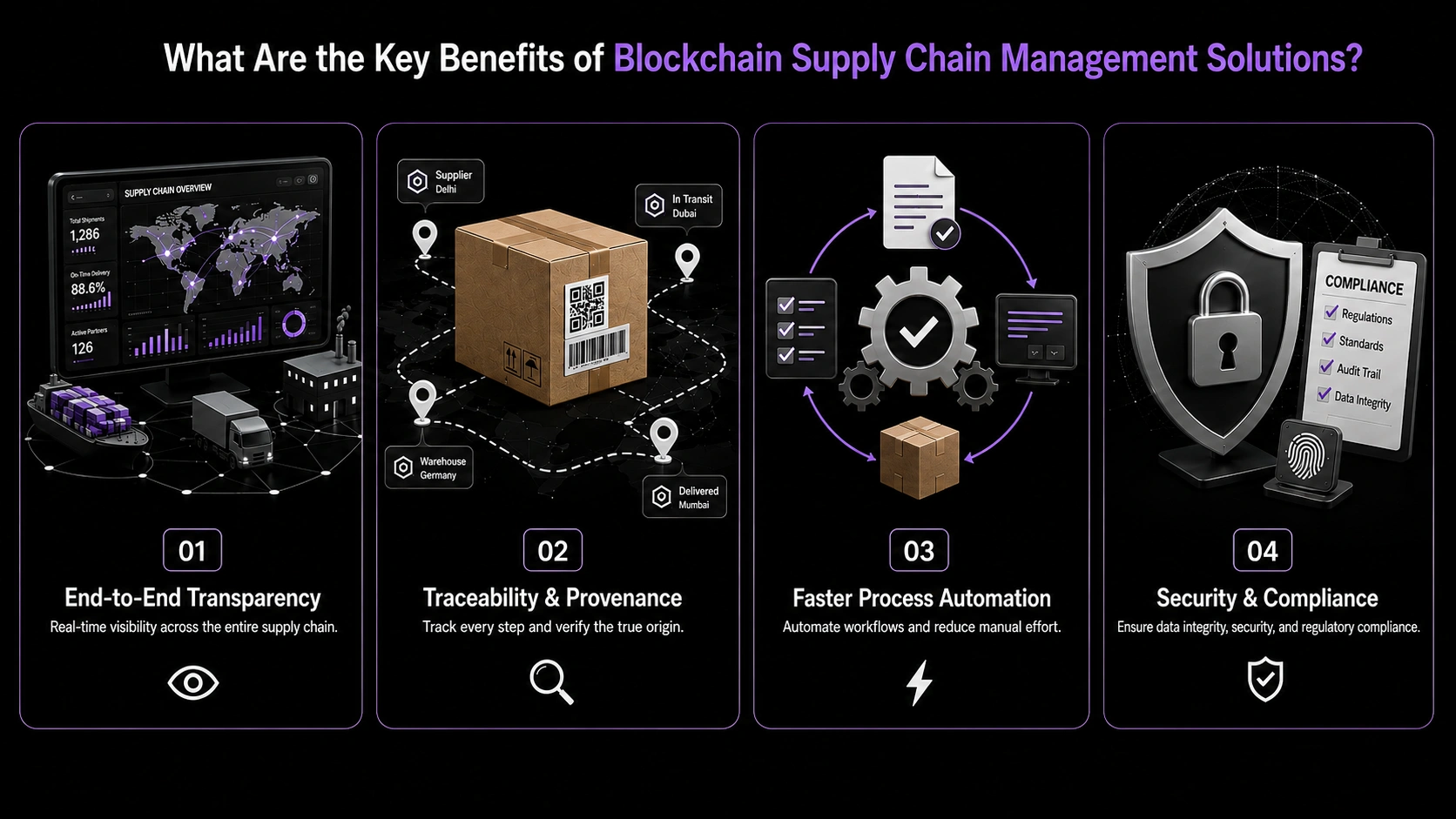
What Are the Key Benefits of Blockchain Supply Chain Management Solutions?
1. End-to-End Traceability
- Tracks every product movement from raw material sourcing to final delivery.
- Enables faster product recalls and simplifies root-cause analysis.
2. Supply Chain Transparency
- Blockchain supply chain transparency solutions provide a shared, real-time view of transactions for authorized participants.
- Improves trust and accountability across suppliers, manufacturers, logistics providers, and retailers.
3. Faster Regulatory Compliance
- Maintains immutable records to simplify audits and regulatory reporting.
- Supports compliance with industry standards through verifiable transaction histories.
4. Reduced Counterfeiting
- Verifies product authenticity at every stage of the supply chain.
- Prevents unauthorized modifications and reduces the circulation of counterfeit goods.
5. Automated Smart Contracts
- Automates approvals, payments, and business workflows based on predefined conditions.
- Minimizes manual intervention, delays, and processing errors.
6. Improved Partner Collaboration
- Provides a single source of truth for all authorized supply chain partners.
- Enhances data sharing and reduces disputes caused by inconsistent records.
7. Immutable Audit Trail
- Creates a permanent, tamper-resistant history of every transaction.
- Strengthens data integrity and supports secure forensic investigations when issues arise.
What Are the Most Common Enterprise Use Cases?
1. Manufacturing
Blockchain technology is used by manufacturers for tracking raw materials, monitoring manufacturing processes, authenticating components, and improving cooperation between suppliers.
2. Food & Beverage
Blockchain is used by food companies to trace products from the field to the store, ensuring food safety, managing recalls, and verifying source data.
3. Pharmaceuticals
Blockchain technology is utilized by pharmaceutical firms to prevent counterfeit drugs, trace medicine distribution, and ensure compliance with regulations.
4. Retail
Blockchain is used by retailers to validate product authenticity, improve inventory management, coordinate with suppliers, and build consumer trust.
5. Logistics
Logistics companies use blockchain to trace shipments, manage documents automatically, track the delivery process, and coordinate transportation partners.
6. Automotive
Automotive companies use blockchain technology to trace vehicle components, assess the quality of suppliers, manage recalls, and keep record of all parts.
7. Luxury Goods
Luxury goods brands use blockchain to authenticate high-value items, protect themselves from counterfeits, and prove ownership and origin to their clients.
8. Agriculture
Agricultural businesses use blockchain technology to trace the origins of crops, track produce along the supply chain, verify sustainability practices, and increase traceability.
How Much Does Enterprise Blockchain Supply Chain Development Cost?
The cost of developing an enterprise blockchain supply chain solution depends on factors such as network size, required features, blockchain platform, ERP integration, smart contracts, security, compliance, and infrastructure. Projects with more participants, complex integrations, and advanced blockchain governance require high investment.
| Project Type | Estimated Cost | Key Aspects |
|---|---|---|
| MVP | $30,000–$70,000 | Basic blockchain network, core smart contracts, product traceability, limited integrations, and pilot deployment. |
| Mid-size Enterprise Solution | $70,000–$150,000 | Multi-party network, ERP integration, IoT/RFID support, role-based access, compliance features, and analytics dashboard. |
| Large Enterprise Platform | $150,000–$500,000+ | Enterprise-grade architecture, multiple business partners, advanced security, governance, API integrations, cloud infrastructure, scalability, and custom smart contracts. |
Ready to Improve Supply Chain Transparency with Blockchain?
What Features Should a Blockchain Supply Chain Platform Include
A robust blockchain-based supply chain platform should provide the tools needed to securely manage data, automate business processes, and enable seamless collaboration across the supply chain. The following features are essential for enterprise deployments:
- Permissioned Access: Restricts network participation to authorized users with role-based permissions.
- Smart Contracts: Smart contract development automates approvals, payments, and business workflows based on predefined rules.
- Digital Identity: Verifies the identity of organizations, suppliers, and network participants.
- Product Traceability: Tracks products from sourcing to final delivery with complete lifecycle visibility.
- ERP Integration: Connects with enterprise systems such as SAP, Oracle, and Microsoft Dynamics for synchronized operations.
- IoT Connectivity: Collects real-time data from sensors, RFID devices, and connected equipment.
- Analytics Dashboard: Provides actionable insights through real-time reporting and performance monitoring.
- Compliance Reporting: Maintains immutable records to simplify audits and regulatory compliance.
- Multi-Party Collaboration: Enables secure data sharing among suppliers, manufacturers, logistics providers, and retailers.
- API Integration: Supports seamless connectivity with third-party applications, cloud platforms, and existing business systems.
Why Techfyte is the Right Blockchain Supply Chain Development Company
Techfyte delivers enterprise-grade blockchain supply chain development services designed to improve transparency, automation, and operational efficiency across global supply networks.
As an experienced blockchain supply chain development company, Techfyte builds secure and scalable solutions using leading blockchain frameworks while ensuring seamless enterprise integration.
- Blockchain Expertise
- Enterprise Integration
- Security & Scalability
- Smart Contract Development
- End-to-End Support
Future Trends in Enterprise Blockchain Supply Chains
Enterprise blockchain supply chains are evolving with advanced technologies that improve automation, transparency, and decision-making. Future Blockchain Supply Chain Solutions will combine blockchain with emerging technologies to create more intelligent, connected, and sustainable supply networks.
1. AI + Blockchain
Artificial Intelligence in the blockchain industry results in improved supply chain prediction capabilities, automation of decision making, and safe data analytics while preserving the network data integrity.
2. IoT Integration
The use of IoT devices and sensors provides timely and accurate information regarding product location, temperatures, quality, and conditions. The information is recorded on blockchain networks.
3. Digital Product Passport
Digital Product Passports delivers complete information about product lifecycle, from manufacturing, ownership and sustainability details.
4. ESG Compliance
Sustainability compliance for enterprises is facilitated by blockchain. It assists to verify environmental activities like sustainable sourcing, carbon tracking and ethical supply chain processes.
5. Tokenization
Tokenization of assets, inventories and ownership records improve asset management and financing.
6. Real-Time Analytics
Analytics platforms integrated into blockchain technology to provide real-time insights into inventory levels, supplier activities, logistics activities, and supply chain disruption potentials.
7. Interoperability
Interoperability is the future of blockchain technology. It serves different blockchain platforms and enterprise systems to exchange data across various complex global supply ecosystems.
Conclusion
Enterprise blockchain supply chain solutions transforming the operations of businesses. It provides transparency, collaboration and operational efficiency. It also enables secure data sharing, real-time tracking, smart contract automation and trusted records. Blockchain helps enterprises to overcome complex supply chain challenges.
Partnering with enterprise blockchain supply chain development companies help organizations improve traceability, compliance and partner coordination. Blockchain technology continues to evolve with AI, IoT and analytics, investing in scalable blockchain solutions help enterprises to build more resilient and future-ready supply networks.
Frequently Asked Questions
1) What is the enterprise blockchain in the supply chain?
Enterprise blockchain in supply chain is a permissioned ledger system that enables secure data sharing among suppliers, manufacturers, logistics providers, and retailers. It improves traceability, automates workflows through smart contracts, and creates a trusted ecosystem for managing supply chain operations.
2) How does blockchain improve supply chain transparency?
Blockchain improves transparency by recording every transaction on an immutable ledger. Blockchain supply chain transparency solutions allow authorized participants to track products in real time, reduce data errors, and improve trust across the supply network.
3) Is blockchain solutions for supply chains suitable for my large enterprise?
Yes, blockchain is suitable for large enterprises with complex supply networks. It provides secure data sharing, scalability, controlled access, and seamless integration with ERP, IoT, and cloud systems to improve supply chain efficiency.
4) Which industries benefit the most with blockchain supply chain development services?
Industries such as manufacturing, pharmaceuticals, food, retail, automotive, logistics, agriculture, and luxury goods benefit from blockchain through improved traceability, counterfeit prevention, compliance management, and supply chain visibility.
5) What is the cost of blockchain supply chain development?
Blockchain supply chain development costs depend on features, platform, integrations, security, and scalability requirements. MVP projects may cost $30,000–$70,000, while enterprise platforms can range from $150,000 to $500,000+.
6) Which blockchain platform is best for enterprise supply chains?
Popular blockchain supply chain management solutions platforms include Hyperledger Fabric, Ethereum Enterprise, Quorum, and Corda. The right choice depends on business requirements, security needs, scalability, and integration capabilities.
7) How long does Blockchain-based supply chain platform development take?
The development timeline of blockchain supply chain solutions varies and depends on project complexity and customization. A basic MVP may take a few weeks, while a full enterprise blockchain supply chain platform takes several months for development, integration, testing and deployment.
Turn Supply Chain Complexity into a Competitive Advantage
