



Key Takeaways
- Saudi Arabia is rapidly emerging as a regulated hub for RWA tokenization, supported by Vision 2030 and CMA-led fintech initiatives.
- Tether’s Hadron Tokenization platform provides a strong institutional reference for building compliant real estate tokenization infrastructure in the Kingdom.
- Real estate presents significant tokenization potential through fractional ownership, improved liquidity, transparent records, and broader investor participation.
- Saudi RWA platforms must integrate compliant token design, smart contracts, investor onboarding, custody, reporting, and secondary-market infrastructure.
- The CMA sandbox approach requires platforms to address regulatory, operational, and asset-specific requirements before progressing toward broader market deployment.
- ERC-3643 and identity-gated token standards can help enforce investor eligibility and transfer restrictions directly within the token infrastructure.
- Early platform builders can gain a competitive advantage as Saudi Arabia expands tokenized real estate, commodities, bonds, and other institutional assets.
Introduction
On August 6, 2026, Tether announced Hadron Tokenization would facilitate institutional real estate issuance in Saudi Arabia, in collaboration with First Advanced Data for Artificial Intelligence and fintech startup BKN301. The move by the world’s largest stablecoin issuer signals something asset managers and fintech innovators can no longer afford to write off as speculative: The Kingdom is building real infrastructure for real-world asset tokenization, not just doing pilots. Years of legislative and digital groundwork behind Vision 2030, including a Capital Market Authority sandbox, a modernized property sector and an attempt to move beyond oil, as well as the arrival of Hadron, suggest institutional capital believes Saudi Arabia is ready. In this article, we discuss what Hadron does, why the Kingdom is becoming the next RWA hub, the opportunity in real estate, and how a platform is built and approved for a regulator that means business.
What Is Tether’s Hadron Tokenization Platform?
For the past decade, the business has managed the world’s largest stablecoin, and the technology and compliance knowledge it has gained is the foundation of Tether’s Hadron tokenization infrastructure launched in November 2024. Hadron is a full-stack Tether Hadron Tokenization Platform, not a single product. Here’s what it gives you:
-
- Full-stack tokenization infrastructure: One-stop system for asset issuance and burning, investor KYC, blockchain-based reporting and capital market management. Issuers can shift stocks, bonds, commodities, funds, loyalty points or tangible assets such as real estate over a shared train with compliance controls built in rather than bolted on later.
- Saudi deployment via strategic partners: Tether uses Hadron as the main platform for the issuance and management of institutional-grade tokenized real estate in the Kingdom, through its strategic partner First Data and BKN301. BKN301 handles banking connectivity and compliance integration. First Data is the commercial lead and major issuer. Tether has said its operating model may eventually expand beyond real estate to include energy and infrastructure finance.
-
- Credible Reference Architecture for the eco system: The willingness of a stablecoin issuer with Tether’s balance sheet to back a national RWA tokenization platform is a big deal, because it signals to enterprises that are considering building something similar that a significant part of the infrastructure risk has already been validated at the protocol level. With Hadron’s launch, the whole ecosystem of custodians, exchanges and development partners now has a real reference architecture to build on, not a speculative one.
Why Saudi Arabia Is the Next RWA Tokenization Hub
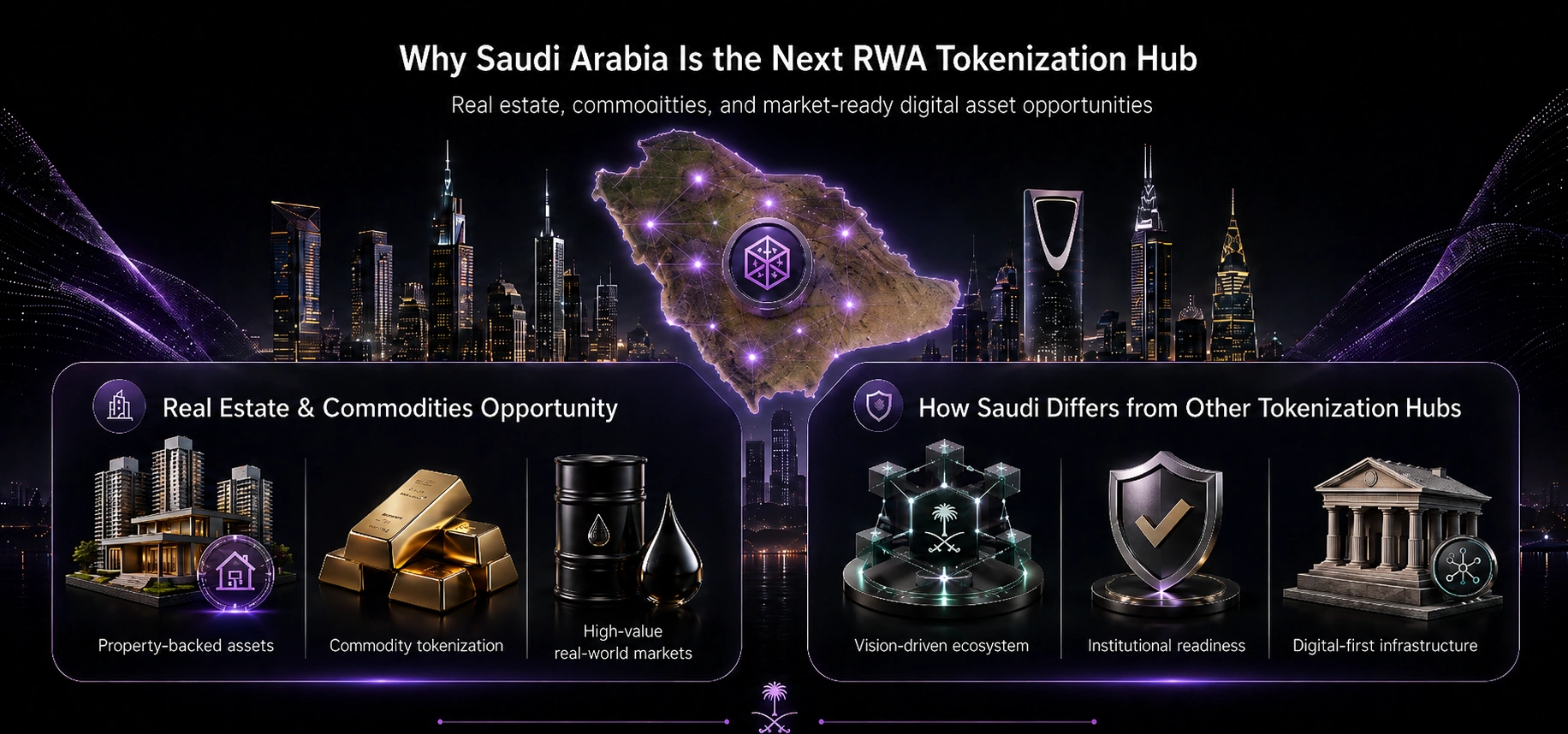
Vision 2030 aimed to reduce Saudi Arabia’s dependency on oil revenue and to boost non-oil GDP. Fintech was identified in the development program for the financial sector as one of the key levers to deliver that change. The Capital Market Authority’s FinTech Lab has been in operation since 2018 and offers a formal channel for firms to pilot tokenized securities models under direct supervision before full licensing. As of the second quarter of 2025, the CMA had sanctioned 68 experimental fintech licenses, with 36 firms already live.
1. The Real Estate and Commodities Opportunity
The regulatory patience is now matching the institutional demand. Saudi Arabia’s real estate tokenization opportunity sits atop a sector worth tens of billions of dollars and expected to grow over the next decade, driven by megaprojects, a maturing mortgage system and significant Public Investment Fund financing. Commodity tokenization is on a similar track with energy and infrastructure assets being looked at for the same rails that Hadron is bringing to property now.
2. How Saudi Differs from Other Tokenization Hubs
Saudi Arabia diverges from Dubai’s VARA framework and Singapore’s project-based sandboxes in sequencing. Rather than starting with a liberal general framework, the CMA has developed asset-specific pilots; property tokenization linked to national real estate registers, fintech experimental permits linked to certain business models, before opening access. It’s slower, but it’s regulated issuance, not pilots that never become production volume, and that’s the signal institutional allocators have been waiting for.
Build a CMA-Compliant RWA Tokenization Platform for the Saudi Arabian Market
The Saudi Real Estate Tokenization Opportunity
The Saudi Arabian real estate market was valued at around $74-$77 billion in 2025 and is forecast to exceed $100 billion in the early 2030s, with residential, commercial and logistical segments all growing at healthy compound rates. That scale, and a market that historically has required a large amount of capital to participate in, is exactly what tokenization is made for. Here’s why the opportunity is attracting institutional interest:
- Fractional ownership unlocks both retail and institutional demand: Tokenized property can reduce the entry point from a multi-million riyal purchase to a five-figure share, allowing retail investors to invest in mega project-adjacent developments. Institutional allocators get a liquid, auditable way to own slices of big portfolios, not whole buildings. First movers such as Hadron’s Tether push are targeting assets close to key Vision 2030 developments where demand and price appreciation are easiest to underwrite.
- Dual-audience design is the core engineering challenge: A real estate tokenization development company entering this market must design for both sides at the same time. That includes retail-friendly minimums and onboarding, as well as the custody, reporting and identity verification institutional investors and the CMA require. This is a significantly different build than a general purpose tokenization product.
- Asset class specialization replaces one-size-fits-all platforms: Saudi Arabia’s real estate tokenization development services are getting more specialized by asset class and not just a general platform. Tokenized property has different compliance, custody and investor onboarding needs than commodities, bonds or funds and the CMA’s sandbox approach looks at each asset class separately.
Building an RWA Tokenization Platform for Saudi Arabia
If we are to be a production-grade platform for the Saudi market, there are five layers that need to work together: issuance, investor onboarding, compliance, custody and a marketplace for trading once the assets are online. It is often speeding through any of them where projects stall during the CMA sandbox evaluation as the regulator wants to see the whole lifespan, not just the token-minting part.
1. Token Design, Smart Contracts, and Investor Onboarding
The entire process begins with a regulatory-compliant token design. In a capital market environment where capital market instruments are directly regulated by the CMA, the choice for a permissioned standard requiring identity checks at the smart contract level rather than off-chain side agreements determines whether a token can be a security or real estate interest at all. Most teams developing this layer point to standards like ERC-3643, the formal specification of which is updated through the Ethereum Improvement Proposal process.
That design work is built on top of solid smart contract development because defects or unchecked logic at the transfer-restriction layer are quickest to fail a sandbox review, or worse, be abused after launch. Once the token is stable, the platform needs investor onboarding to verify their identification and accreditation status against CMA guidelines before any wallet can hold or trade the token. That verification stage determines who is legally entitled to receive a transfer once the token is launched. It has to work smoothly enough that legitimate investors are not put off by inconvenience right away.
2. Custody, Compliance, and Secondary Market Infrastructure
After onboarding, the platform needs to be matched with institutional custody that meets the same asset-protection criteria demanded by Saudi counterparties’ banks and funds, as allocators will not commit large sums of capital to a platform whose key management has not been independently verified. Compliance reporting then begins to run in the background constantly, creating the audit trail that regulators and investors will want for each issue and transfer. The commercial layer is equally important. secondary marketplace transform a tokenized asset from a static certificate into something liquid, enabling early investors to cash out and new investors to get in without a new primary issuance Dubai’s Prypco Mint platform launched secondary trading on tokenized property positions less than a year after it opened, with demand clearing within minutes on early offerings.
3. Cross-Border Distribution and Multi-Asset Expansion
For platforms that want to serve investors across the GCC, or internationally rather than only domestically, cross-border distribution must be designed in; jurisdictional constraints are far easier to design in the beginning rather than retrofit onto a live platform. Once a platform has proven its value in real-estate, the same architecture naturally extends to tokenized bonds and other fixed-income instruments.
Regulatory Landscape: CMA, Vision 2030, and Tokenized Assets
Tokenized securities are regulated by the Capital Markets Authority under existing capital markets regulation, with the FinTech Lab providing an onramp for enterprises to test a particular token model before applying for a full permission. This sandbox-first approach is a deliberate extension of Vision 2030’s financial sector agenda, which sought to modernize capital market regulation as part of a broader effort to attract foreign investment and diversify the economy.
1. What the CMA Sandbox Requires in Practice
The actual requirements for a platform team are a registered business presence in the Kingdom, a testing term of two years under the experimental permission, and close communication with the CMA throughout the sandbox phase, not a single application. Real estate tokenization also adds another layer of complexity, given Saudi Arabia’s real estate authority has been working on developing national standards linking tokens with official property registrations, a step few other markets have taken.
2. How Saudi Arabia’s Approach Compares to the UAE
This is quite different to the UAE where VARA, the DIFC and ADGM offer more general purpose virtual asset licensing regimes that are not attached to a specific asset class and where the Dubai Land Department has been running its own parallel title tokenization sandbox since March 2025. Overall, Saudi Arabia’s approach is more limited and slower to launch, but it is offering regulated, government-supervised issuance, rather than open-ended pilots, which institutional investors are increasingly preferring as the world of asset tokenization evolves globally.
Launch a Secure Real Estate Tokenization Platform with ERC-3643 and Automated Compliance
How to Choose an RWA Tokenization Development Partner for Saudi
Here track record is more important than in less controlled areas. Here’s a step-by-step checklist to evaluate candidates:
- GCC Production experience: A partner should be able to showGCC or Middle East tokenization initiatives that have gone from proof of concept demos to production from sandbox.
- CMA regulatory expertise: Knowing permit schedules, documentation expectations and how the real estate system interacts with capital market rules saves months over learning the regulator from scratch.
- ERC-3643 and multi-chain: Ask if the team has implemented identity gated token standards such as ERC-3643 in production and if the design supports multiple chains rather than locking a client into one.
- Compliance automation: Learn how compliance rules are updated post-launch. “As the CMA framework grows, a partner that handles regulatory changes manually will create bottlenecks.
- Reference deployments over sales claims: A real estate tokenization development business that can give tangible answers to inquiries through reference deployments is a better bet than one that offers a generic white-label wrapper. The right Real Estate Tokenization Development Services partner treats the CMA relationship as part of the product, not an afterthought just before launch.
Concluding Note
Tether’s decision to bring Hadron Tokenization to Saudi Arabia’s real estate market is not one headline, but a culmination of years of work on a Vision 2030 fintech strategy, a CMA sandbox that has quietly matured since 2018 and a property market big enough to reward the institutions that move first. Asset managers, developers and fintech innovators considering whether to build now have the regulatory framework, technical standards and first credible reference deployment all available at the same time. Test your Hadron Tokenization strategy for Saudi Arabia while the window for early adopter and fast follower is still wide open, the platforms that are launched during this window will set the standards that everyone else will have to catch up to in the end.
Frequently Asked Questions
1. What is Hadron Tokenization?
In November 2024, Tether launched its full-stack tokenization technology Hadron Tokenization. It is responsible for asset issuance, investor KYC, capital market management and reporting on the blockchain. In August 2026, Tether announced that Hadron will be used to enable institutional real estate issuance in Saudi Arabia through deals with First Advanced Data and BKN301.
2. What does the Tether Hadron Tokenization platform enable in Saudi Arabia?
Tether Hadron Tokenization platform delivers institutional-grade tokenized real estate issuance in Saudi Arabia. First Data is the commercial lead and BKN301 manages banking connectivity and regulatory compliance. The idea could also be extended to energy and infrastructure financing and provide the ecosystem with a solid reference architecture for RWA tokenization in the Kingdom.
3. Why is Saudi Arabia emerging as an RWA tokenization hub?
The CMA FinTech Lab, a part of Vision 2030’s fintech strategy, has 68 experimental licenses and 36 live companies, all coming together with a real estate market forecast to top $100 billion by early 2030s, and asset-specific regulatory pilots tied to national property registers. Saudi Arabia is trying a more limited route, with issuance being regulated and overseen by the government not open-ended pilots.
4. What is the Saudi real estate tokenization opportunity?
Saudi Arabia’s real estate industry is set to cross $100 billion in the early 2030s. Tokenized property can reduce entry costs from multi-million riyal purchases to five-figure holdings, making giga-project developments accessible to ordinary investors and providing institutions with liquid portfolio exposure. Early movers are seeking assets close to flagship developments for Vision 2030.
5. What regulatory requirements apply to tokenization platforms in Saudi Arabia?
Platforms must be registered businesses with a business presence and operate under the CMA FinTech Lab with a two-year sandbox period and close interaction with the CMA. But real estate tokenization adds a layer of complexity, linking tokens to formal land registers through national standards. Compliance reporting should be ongoing, not just at launch time.
Develop a Scalable Saudi RWA Platform for Institutional Asset Issuance and Trading
