



Key Takeaways
- Institutional adoption is shifting from simply putting assets onchain to making them useful through lending, collateral, liquidity, and other DeFi applications.
- The gap between tokenized asset value and DeFi utilization creates a strong need for infrastructure that connects compliant RWAs with onchain financial markets.
- The next generation of RWA platforms must combine KYC, transfer controls, custody, and settlement with DeFi interoperability, liquidity, and smart-contract functionality.
- Techfyte is the reliable RWA platform development company that supports the full RWA lifecycle, from tokenization and smart contracts to compliance, oracle, DeFi, custody, and settlement infrastructure.
Introduction
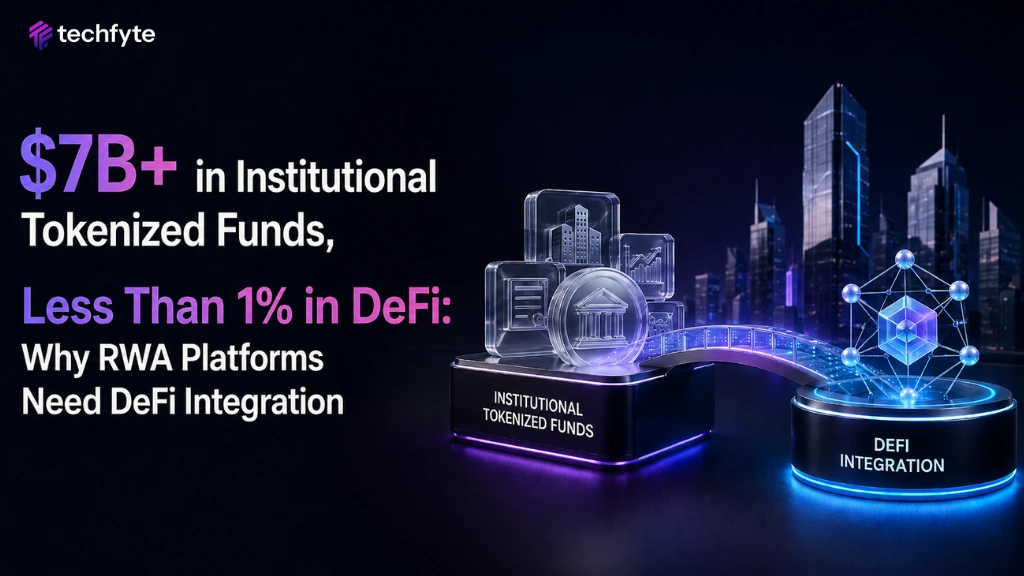
More than $7 billion has flowed into institutional tokenized funds. The numbers indicate that traditional finance is increasingly moving assets onchain. However, real-world asset tokenization alone does not make an asset useful in decentralized finance.
A token represents a Treasury fund or private credit product while remaining largely inactive beyond holding and transferring. The real opportunity lies in RWA DeFi Integration connecting tokenized assets with lending, liquidity, collateral and other DeFi primitives. This integration for Tokenized real-world assets tune passive onchain representations into productive financial instruments.
In this blog post, analyse the next phase of RWA growth will depend not just on issuing tokens, but on building infrastructure around them.
Why Institutional Tokenized Funds Are Still Disconnected from DeFi
Institutional tokenized funds are gaining traction, but most are relatively disconnected from DeFi because tokenization and DeFi usability are two different things.
Issuing a token representing a fund adds the asset to the blockchain, but it does not automatically allow that token to engage with lending protocols, DEXs, vaults, derivatives or collateral markets.
Institutional products frequently have strict compliance, custody, and investor-access restrictions that contrast with the open nature of permissionless DeFi. As a result, billions of tokenized assets may reside on blockchain without becoming productive financial assets.
1. Tokenized Does Not Mean DeFi-Ready
For an institutional asset to participate in DeFi, the underlying RWA tokenization platform needs infrastructure that can preserve regulatory controls while enabling controlled protocol interaction. Key requirements include:
- KYC/AML requirements: Investors and counterparties may need to be verified before accessing the asset.
- Whitelisted addresses: Transfers may be restricted to approved wallets or entities.
- Transfer restrictions: Smart contracts may enforce rules around who can buy, sell, or receive tokens.
- Permissioned settlement: Institutional transactions may require controlled settlement rather than unrestricted peer-to-peer transfers.
- Investor eligibility: Certain funds may only be available to accredited or qualified investors.
- Custody requirements: Tokenized assets may need to remain connected to regulated custodians.
- Compliance-controlled smart contracts: Compliance rules can be embedded directly into token and transfer logic.
2. The Utilization Gap Is an Infrastructure Problem
Tokenized fund has significant AUM, but limited DeFi activity. It does not necessarily mean institutional demand is weak. The bigger issue is the missing bridge between regulated assets and DeFi protocols.
The gap is visible in major institutional products: the report found that BUIDL had about $2.7B in active market cap but only $18.2M in DeFi, while USYC had more than $3B in market cap with roughly $31.5M deployed in DeFi.
Institutional RWA tokenization therefore needs to evolve beyond simply creating and distributing tokens. The infrastructure must make those assets usable across lending, collateral, liquidity, and other financial applications while preserving their compliance requirements.
The Concept Behind RWA DeFi Integration
RWA DeFi integration focuses on tokenized real-world assets that are usable within decentralized financial systems. It does not involve simply putting an asset on the blockchain. The architecture involved connects the traditional asset to a tokenization layer, compliance layer, smart contract, DeFi integration layer and financial applications.
Each layer handles specific functions from asset insurance and ownership records to investor permissions, transfer restrictions, NAV updates and redemption. DeFi integration for RWA platforms enables tokenized assets to connect with lending, liquidity, and collateral systems. This model can support RWA lending and borrowing while maintaining eligibility and compliance controls.
The platform needs reliable oracle infrastructure for asset valuation, identity and permission management for regulated investors and smart contracts that enforce compliance rules. A tokenized Treasury fund is used as collateral to stablecoins through a lending market while maintaining exposure to the underlying asset. This creates a use case for tokenized asset collateral, allowing eligible holders to access liquidity without selling the underlying asset.
Build a DeFi-Ready RWA Platform for Lending, Liquidity & Collateral
The Architecture of a DeFi-Ready RWA Platform
A DeFi-ready RWA platform needs more than a token issuance engine. A well-designed RWA platform architecture must connect the underlying asset, compliance requirements, smart contracts, real-time data, DeFi protocols, and offchain settlement into one coordinated system.
Enterprise-grade RWA platforms also need features such as permission management, asset lifecycle controls, interoperability, liquidity connectivity, and institutional security.
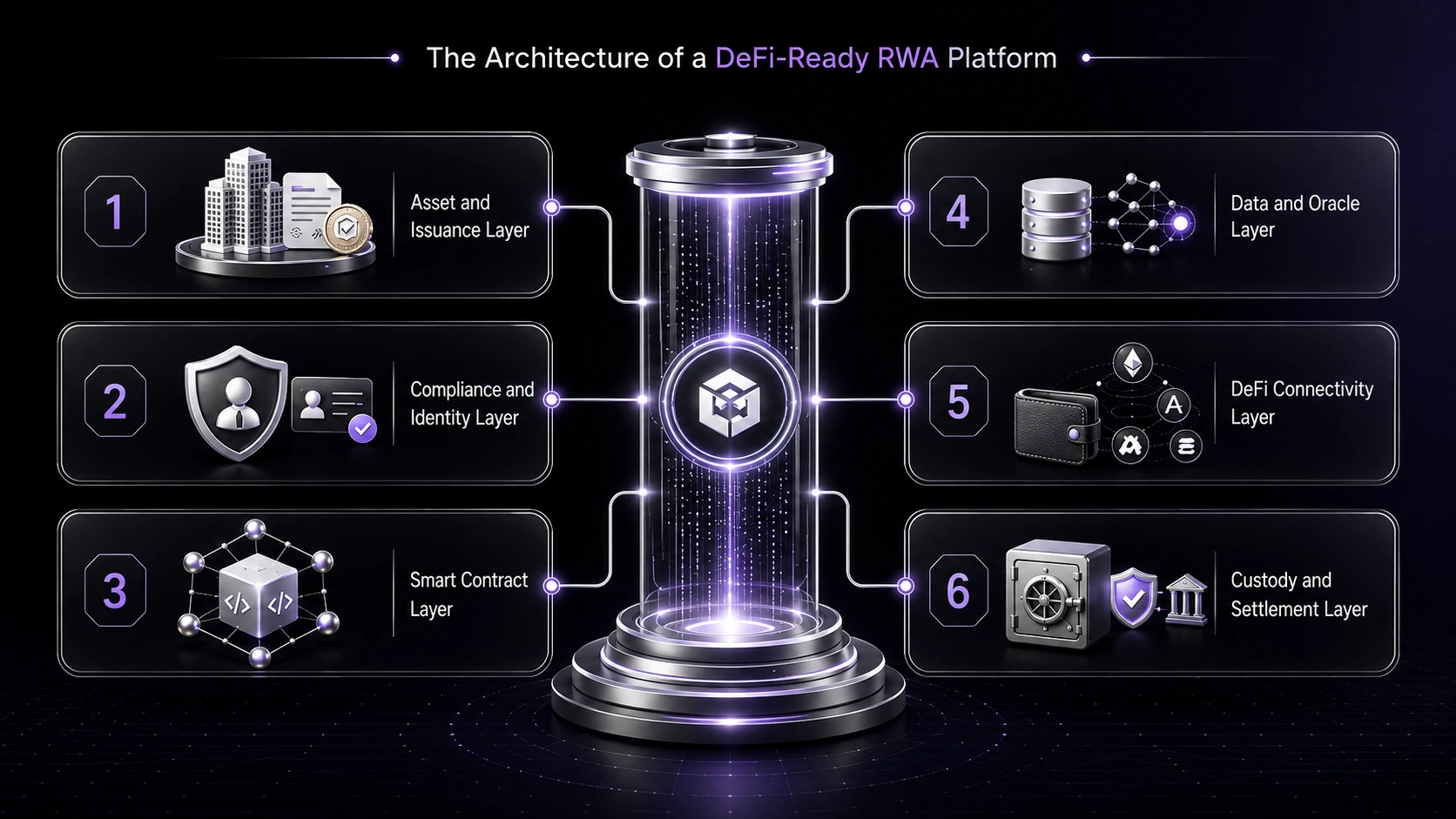
1. Asset and Issuance Layer
This is the foundation where the real-world asset is registered, structured, and represented as an onchain asset.
- Token issuance
- Fund/asset registry
- Investor onboarding
- Subscription and redemption
2. Compliance and Identity Layer
This layer ensures that only eligible participants can access, hold, transfer, or redeem regulated tokenized assets. Building a compliant RWA tokenization platform requires compliance and architecture decisions to be defined early in the development process.
- KYC/KYB verification
- Wallet whitelisting
- Jurisdiction controls
- Transfer restrictions
- Permissioned wallets
3. Smart Contract Layer
Smart contracts automate ownership, compliance, transfers, redemptions, and other financial rules governing the asset.
- Token contracts
- Access-control contracts
- Compliance modules
- Redemption logic
- Corporate-action handling
This is where RWA smart contract development becomes critical because contract logic must balance programmability with regulatory controls.
4. Data and Oracle Layer
This layer connects blockchain applications with reliable offchain information required to value and manage RWAs.
- NAV updates
- Asset valuation
- Interest rates
- Reserve data
- Offchain asset events
Incorrect or stale data can result in inaccurate collateral values, improper borrowing limits, or even unnecessary liquidations.
5. DeFi Connectivity Layer
DeFi-integrated wallet development can therefore complement the underlying RWA infrastructure by connecting tokenized assets with actual user interactions.
- Lending protocols
- DEXs
- Vaults
- Automated market makers
- Stablecoins
- Yield strategies
6. Custody and Settlement Layer
The final layer connects onchain activity with institutional custody, fiat movement, and the redemption of underlying assets.
- Qualified custodians
- Wallet infrastructure
- Fiat rails
- Redemption workflows
- Settlement systems
The Difference Between Traditional and DeFi-Integrated RWA Tokenization Platforms
The distinction primarily depends on what the platform allows when an asset is tokenized. Traditional platforms often focus on issuance, ownership, compliance, and custody.
The distinction is significant because RWA tokenization platform development is progressively shifting away from token issuance and toward establishing infrastructure that enables compliant assets to engage in larger onchain financial activity. A DeFi-integrated platform provides the necessary infrastructure to make those assets usable in lending, collateral, liquidity, and other onchain applications.
| Particular | Traditional RWA Tokenization Platform | DeFi-Integrated RWA Platform |
|---|---|---|
| Primary purpose | Digitize and manage asset ownership | Make tokenized assets financially usable |
| Asset flow | Asset → Token → Investor wallet → Hold | Asset → Token → Compliance → Oracle → Collateral → Lending → Liquidity → Settlement |
| Token utility | Mainly ownership and transfer | Ownership, collateral, lending, liquidity, and yield |
| Liquidity | Limited or issuer-controlled | Connected to liquidity pools, DEXs, or institutional markets |
| Protocol integration | Minimal | Lending protocols, vaults, DEXs, and stablecoins |
| Oracle infrastructure | May be limited to basic asset data | Required for NAV, valuation, rates, and collateral pricing |
| Collateralization | Usually not a core feature | Designed to support eligible tokenized assets as collateral |
| Risk management | Focuses on asset and compliance risks | Adds collateral, oracle, liquidation, and smart-contract risks |
| Compliance | KYC, KYB, whitelisting, transfer restrictions | Same controls, adapted for DeFi interactions |
| Smart contracts | Token issuance and ownership logic | Token, access control, compliance, collateral, lending, and redemption logic |
| Settlement | Primarily issuance/redemption | Onchain activity connected with custody, fiat rails, and redemption |
| End result | Tokenized asset | Programmable financial asset |
The Technical Challenges Behind RWA DeFi Platform Development
Building RWA infrastructure that connects regulated assets with DeFi introduces several technical and operational challenges. An RWA lending platform can allow eligible tokenized assets to be used within controlled lending markets. The main difficulty is balancing compliance, interoperability, liquidity, and risk management without compromising the underlying asset’s regulatory requirements.
1. Compliance vs. Composability
Permissioned RWA tokens are not naturally suited to permissionless DeFi setups. Transfer restrictions, whitelisted contracts, permissioned pools, and identity-aware transactions may be required to ensure that only eligible users have access to the asset. This complicates protocol integration beyond connecting a regular crypto coin to a DeFi application.
2. Valuation and Oracle Risk
Many RWAs do not have regularly updated market prices. NAV can be estimated on a regular basis, but private credit, real estate, and other assets may only trade seldom. DeFi programs rely on this data for collateral valuation or liquidation, therefore delayed or inaccurate oracle information might result in wrong pricing and wasteful liquidations.
3. Liquidity Fragmentation
Developing effective RWA liquidity solutions requires addressing fragmentation across chains, custodians, and compliance environments. This fragmentation makes it difficult to create deep and unified markets. Even when an asset is tokenized, sufficient liquidity may not exist where or when DeFi users need it.
4. Redemption and Settlement
Traditional assets frequently adhere to market hours, T+ settlement cycles, fund redemption periods, and banking schedules, but DeFi markets are open around the clock. Smart contracts must therefore account for these time discrepancies so that onchain transactions do not result in settlement or redemption obligations that cannot be met instantly.
5. Smart-Contract and Counterparty Risk
RWA platforms include both blockchain and traditional financial risks. Smart-contract exploits, upgradeability, and excessive admin capabilities can all have an impact on blockchain security, while custodians and issuers pose offchain counterparty risk. Oracle dependencies add another layer, as incorrect external data might have a direct impact on lending, collateral, and liquidation methods.
What a DeFi-Ready RWA Platform Needs to Support
A DeFi-ready RWA platform should consider both regulatory requirements and on-chain financial utility. The checklist below covers the key infrastructure required to link tokenized assets to DeFi while ensuring control, transparency, and operational reliability.
RWA tokenization development services are being used for more than just token issuing. A capable RWA platform development company must address how tokenized assets will interact with lending, liquidity, collateral, and other institutional DeFi solutions from the outset.
Technical Checklist
- Permissioned token standards: Support transfer restrictions and investor eligibility rules.
- Onchain identity and access controls: Verify wallets and control protocol access.
- Oracle/NAV integrations: Provide reliable valuation, NAV, and market data.
- Collateral management: Define eligibility, LTV ratios, and liquidation rules.
- Lending market connectivity: Enable eligible RWAs to participate in lending and borrowing.
- DEX/liquidity integrations: Provide controlled secondary-market liquidity.
- Custody integrations: Connect tokenized assets with appropriate custodial infrastructure.
- Stablecoin settlement: Support efficient onchain settlement and liquidity movement.
- Cross-chain infrastructure: Enable controlled movement or representation across supported networks.
- Audit and monitoring systems: Continuously monitor contracts, smart contract audits, transactions, and risk parameters.
- Compliance reporting: Maintain records required for regulatory and institutional oversight.
- Redemption workflows: Connect token redemption with underlying asset settlement.
The Future of Institutional RWA Tokenization Is Programmable Finance
The $7B+ growth in institutional tokenized funds shows that the first phase of RWA adoption is already underway: bringing traditional assets onchain. These applications extend beyond institutional funds, with real-world asset tokenization being explored across multiple industries and asset classes.
The next stage will focus on DeFi composability for RWAs, enabling institutions and DeFi applications to use these assets across broader financial workflows. The evolution is moving from tokenized assets toward automated financial strategies, where RWA DeFi Integration becomes increasingly important. Success will therefore depend not only on the amount of assets tokenized, but also on interoperability, liquidity, compliance, and financial utility.
Effective RWA DeFi platform development will focus on connecting existing tokenized assets with lending, collateral, liquidity, and other financial applications, turning them from passive onchain representations into productive financial instruments.
Move Beyond Tokenization with Programmable RWA Infrastructure
Conclusion
Putting a Treasury fund, private credit instrument, or real estate exposure on a blockchain does not automatically create a new financial market. The real opportunity begins when these assets can interact with lending, collateral, liquidity, and other financial primitives while still respecting their regulatory requirements.
The $7B+ in institutional tokenized funds therefore represents more than adoption; it highlights the gap between putting assets onchain and making them financially useful. The next generation of RWA infrastructure will need to bridge institutional compliance with DeFi composability, turning tokenized assets into accessible, programmable, and productive financial instruments.
Frequently Asked Questions
1. What is DeFi integration for RWA platforms?
DeFi integration for RWA platforms connects tokenized real-world assets with financial applications such as lending markets, liquidity pools, collateral systems, and other DeFi protocols.
2. What is tokenized asset collateral?
Tokenized asset collateral refers to using a blockchain-based representation of a real-world asset to secure a loan or other financial obligation. The platform needs mechanisms for asset valuation, eligibility checks, loan-to-value ratios, liquidation rules, and reliable oracle data.
3. Why are RWA lending and borrowing important for institutional assets?
RWA lending and borrowing can give institutional investors additional ways to access liquidity while maintaining exposure to the underlying asset. However, these systems require careful management of compliance, valuation, custody, liquidation, and redemption requirements.
4. What role does DeFi composability for RWAs play?
DeFi composability for RWAs allows a compliant tokenized asset to interact with multiple financial applications rather than functioning as an isolated token. For example, an eligible tokenized fund could potentially move from custody to collateralization, lending, liquidity, and settlement workflows through connected infrastructure.
5. What should an RWA platform architecture include?
A robust RWA platform architecture should typically include asset issuance, compliance and identity management, smart contracts, oracle infrastructure, DeFi connectivity, custody, settlement, and redemption workflows.
6. How is tokenized fund development changing?
Tokenized fund development is moving beyond simply representing fund ownership onchain. Modern platforms increasingly need to consider investor eligibility, transfer restrictions, NAV data, custody, liquidity, collateralization, lending integrations, and redemption from the initial architecture.
7. Why choose Techfyte for RWA platform development?
Techfyte is the reliable RWA platform development company that supports RWA infrastructure across tokenization, smart contracts, compliance controls, oracle integrations, DeFi connectivity, custody, and settlement. The focus is on designing the complete asset lifecycle so that tokenized assets can be built with future liquidity and DeFi utility in mind.
8. What are the primary benefits of connecting real estate assets to decentralized finance platforms?
Connecting tokenized real estate assets to DeFi platforms can increase liquidity, enable collateral-based borrowing, improve investor access, support fractional ownership, automate transactions through smart contracts, and create new opportunities for yield generation. It can also make traditionally illiquid real estate assets more flexible and usable across onchain financial applications.
Build an Institutional-Grade RWA Platform with DeFi Connectivity
