



Key Takeaways
- Carbon credit marketplace platform development requires more than trading functionality; it should connect credit discovery, registry data, transactions, transfers, retirement, and reporting.
- Registry integration and credit provenance are essential for maintaining accurate lifecycle records and reducing double-counting risks.
- Blockchain is optional, but it can support tokenization, smart contracts, transparent ownership, and programmable transactions when there is a clear business need.
- A scalable platform should include KYC/KYB, AML controls, secure payments, RBAC, encryption, audit trails, and fraud monitoring.
Introduction
Companies are moving beyond fragmented and broker-led transactions in carbon markets. The incline is towards digital platforms that make carbon credits easier to discover, purchase, transfer and retire. Building a reliable marketplace involves far more than adding credit listings, payment gateways and a blockchain wallet.
Businesses that want to represent carbon assets digitally can also explore carbon credit tokenization as an additional layer for ownership tracking, transfers, and automated retirement. Carbon credit marketplace platform development involves an infrastructure that connects the entire credit lifecycle, from project data and validation or verification to registry records, credit inventory, carbon credit trading, transfer, retirement, and ESG reporting.
For businesses entering the market, the real challenge is creating a trusted digital environment where buyers evaluate credits confidently and sellers manage inventory efficiently.
What Is a Carbon Credit Marketplace Platform?
A carbon credit marketplace platform is a digital infrastructure that connects eligible buyers and sellers to discover, evaluate, purchase, transfer, and retire carbon credits through a secure, traceable workflow. From a technical perspective, it combines project and credit data, user management, compliance, transaction processing, registry connectivity, and reporting within a single system. However, a marketplace is different from related carbon-market technologies.
A carbon credit marketplace primarily facilitates discovery and transactions between participants. The platform focuses more heavily on trading workflows, pricing, order management, and potentially market matching. Moreover, a carbon registry records the issuance, ownership, transfer, and retirement status of carbon units, while a carbon accounting platform helps organizations measure emissions and manage sustainability data. This marketplace can integrate with both registries and accounting systems without replacing them.
How Does a Carbon Credit Marketplace Platform Work?
A carbon credit marketplace platform manages the credit lifecycle through a sequence of connected technical and operational steps:
-
Carbon Project: Project developers register eligible emission-reduction or removal projects and provide project, methodology, location, and documentation data.
-
Validation & Verification: The project and reported emissions reductions undergo the applicable validation and verification process by qualified third parties.
-
Registry Issuance: Once approved, carbon credits are issued through the relevant registry with unique identifiers and associated project information.
-
Credit Inventory: The marketplace synchronizes available credit data, including quantity, vintage, project type, status, and ownership.
-
Marketplace Listing: Sellers list eligible credits with pricing, availability, and supporting project information.
-
Buyer KYC/KYB: Buyers complete identity or business verification before accessing applicable purchasing and trading functions.
-
Purchase / Trade: Buyers select credits or submit an order/RFQ, followed by payment and transaction processing.
-
Transfer: Ownership or allocation records are updated and reconciled with the relevant registry.
-
Retirement: Purchased credits can be permanently retired when the buyer intends to use them for an eligible environmental claim.
-
Certificate & ESG Reporting: The platform records the retirement and generates supporting documentation, portfolio data, and ESG reports.
Planning to Build a Secure Carbon Credit Marketplace?
Key Features of a Carbon Credit Marketplace Platform
A successful carbon credit marketplace platform needs more than basic buying and selling functionality. Its core features should create a transparent, secure, and traceable experience across the entire carbon-credit lifecycle.
1. Project and Credit Listing
Each listing should display project details, location, methodology, registry, vintage, available quantity, price, verification information, sustainability benefits, and current credit status. This gives buyers enough information to evaluate a credit before initiating a transaction.
2. Registry Integration
API or data integrations can synchronize registry identifiers, serial numbers, issuance records, available units, transfers, and retirement status with the marketplace.
The integration should maintain accurate lifecycle data without treating the marketplace itself as the authority for project verification.
3. Search and Credit Discovery
Advanced filters can help buyers find credits by project type, location, vintage, registry, price, methodology, reduction or removal type, volume, and other quality attributes.
A structured discovery layer makes it easier for enterprises to compare credits and identify assets matching their procurement requirements.
4. Trading and Order Management
A carbon credit trading platform can support fixed-price purchases, RFQs, bulk orders, and buy-and-retire workflows, while advanced platforms may introduce order-book trading.
For an MVP, fixed-price and RFQ workflows are generally more practical than building a complex exchange with matching and liquidity management.
5. KYC, KYB and Compliance
KYC/KYB workflows can verify individual and business participants, while sanctions screening and transaction monitoring add additional compliance controls.
Role-based permissions and detailed audit logs help restrict sensitive operations and create a traceable record of marketplace activity.
6. Retirement and Certificate Generation
Purchase or transfer gives a participant control of a credit, whereas retirement permanently removes the unit from further use or resale.
The platform can connect retirement records with certificates or supporting documentation that buyers can use for their applicable reporting requirements.
7. ESG and Portfolio Reporting
Buyers should be able to track purchased and retired credits, project-level allocations, emissions impact, certificates, and portfolio performance.
Downloadable reports and APIs can also connect marketplace data with enterprise carbon accounting, sustainability, and ESG reporting systems.
Blockchain Based Carbon Credit Platform Development: Use Cases
Blockchain based carbon credit platform development can add transparency and automation to a carbon marketplace, but blockchain should be treated as an optional technology layer rather than a mandatory foundation.
Depending on the business model, blockchain can support several use cases:
-
Tokenized representations: Carbon units can be represented digitally on-chain to enable programmable ownership and transfer. Businesses can explore token standards engineering when designing customized tokenized carbon assets.
-
Immutable transaction records: Blockchain can create a tamper-resistant history of transactions and ownership changes.
-
Smart-contract transfers:
Smart contracts can automate predefined transfer and settlement rules. -
Programmable settlement: Payment and asset-transfer workflows can potentially be coordinated through smart contracts.
-
Transparent ownership: Participants can independently track on-chain ownership records where the asset structure supports it.
-
Interoperability: Standardized blockchain assets may support integration with other digital platforms and ecosystems.
Development Process for a Carbon Credit Marketplace Platform
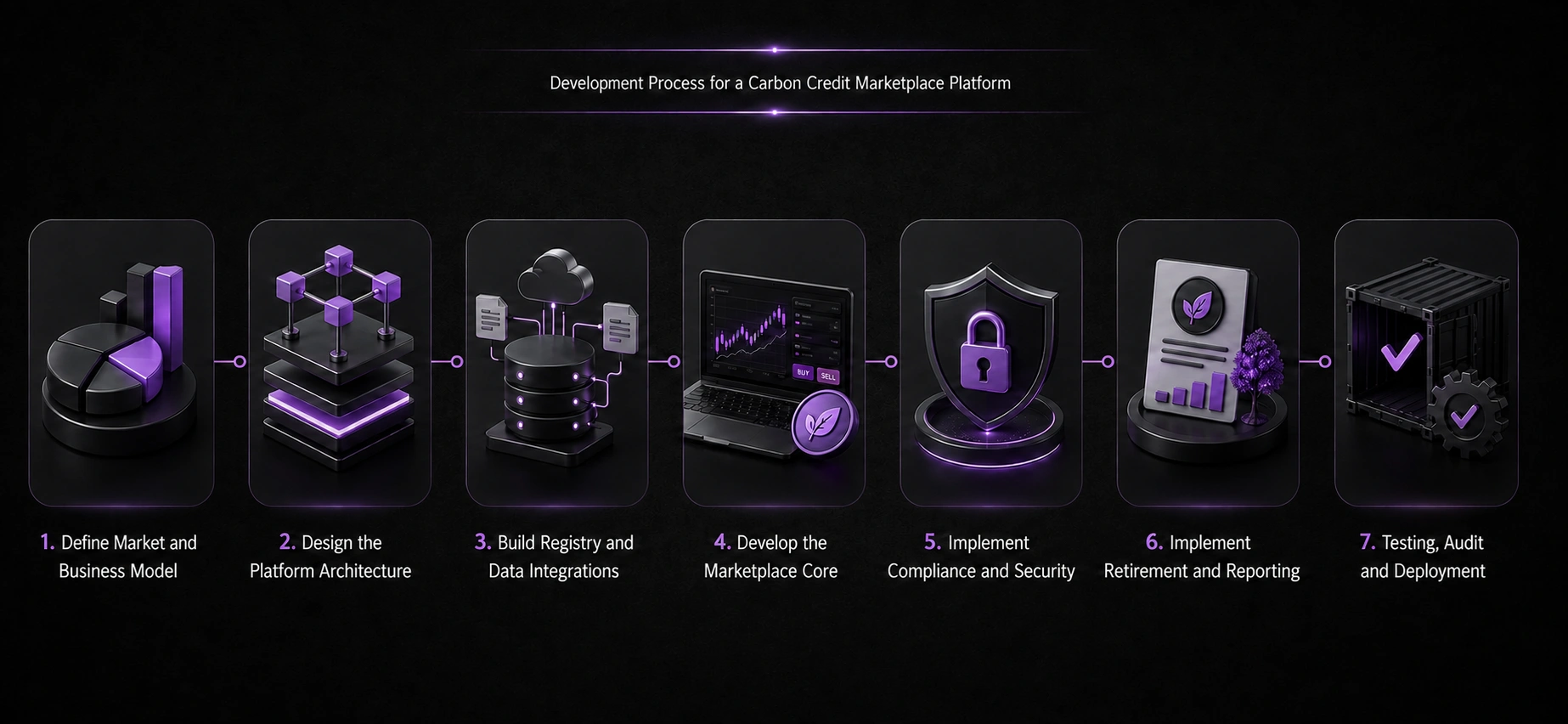
Developing a reliable carbon marketplace requires a structured approach that connects business requirements with secure technology and carbon-credit lifecycle management.
1. Define Market and Business Model
First, determine whether the platform will serve voluntary or compliance markets, which geographies it will support, and whether it targets businesses, project developers, brokers, or institutional buyers. It should also define whether the product will operate as a marketplace, brokerage, or exchange, along with its custody and retirement models.
2. Design the Platform Architecture
Plan the frontend, backend, database, transaction ledger, registry connectors, compliance services, and payment infrastructure. If required, an optional blockchain layer can be added for tokenization, smart contracts, or transparent transaction records.
3. Build Registry and Data Integrations
Develop secure connectors to synchronize project records, credit identifiers, issuance data, transfers, and retirement status from relevant registries. The integration layer should also include scheduled synchronization, validation rules, error handling, and reconciliation mechanisms.
4. Develop the Marketplace Core
Build user accounts, project and credit listings, search and filtering, pricing, RFQs, order management, checkout, and transaction history. For an MVP, fixed-price purchases and RFQs can provide a simpler foundation before introducing advanced order-book functionality.
5. Implement Compliance and Security
Integrate KYC/KYB, applicable AML controls, role-based access control (RBAC), encryption, secure API authentication, fraud detection, and audit logging. These controls help protect user information, transactions, and sensitive carbon-credit lifecycle data.
6. Implement Retirement and Reporting
Connect completed transactions with retirement workflows so eligible credits can be permanently retired and removed from available inventory. Generate retirement evidence, certificates, portfolio records, and reporting data that customers can use within their applicable ESG workflows.
7. Testing, Audit and Deployment
Conduct penetration testing, API testing, load testing, registry-reconciliation testing, and disaster-recovery testing before launch. For blockchain-enabled platforms, smart-contract audits should also be performed, followed by a phased deployment to monitor performance, security, and transaction reliability.
Tech Stack for Carbon Credit Marketplace Platform Development
| Layer | Recommended Technologies | Purpose |
|---|---|---|
| Frontend | React.js / Next.js | Marketplace, dashboards, portfolios |
| Backend | Node.js / NestJS or Python / Django | Business logic and APIs |
| Database | PostgreSQL | Users, projects, orders, transactions |
| Cache | Redis | Sessions, caching, high-speed operations |
| Search | Elasticsearch / OpenSearch | Credit/project discovery |
| Cloud | AWS / Azure / Google Cloud | Scalable infrastructure |
| APIs | REST / GraphQL | Registry and enterprise integrations |
| Payments | Stripe / Adyen / regional gateway | Transaction processing |
| Identity | OAuth 2.0 / OpenID Connect | Authentication |
| Blockchain | Ethereum-compatible L2 / Polygon, if required | Optional tokenization |
| Smart Contracts | Solidity | Optional tokenized assets |
| Security | KMS, Vault, WAF, SIEM | Key and infrastructure security |
| Monitoring | Prometheus / Grafana | Performance and infrastructure monitoring |
Monetization Models for a Carbon Credit Marketplace
A carbon credit marketplace can generate revenue through multiple streams rather than relying only on trading commissions. A diversified model can combine transaction income with recurring subscriptions and premium services.
1. Transaction Fees
The platform can charge a fixed fee or percentage on every successful credit purchase, sale, or trade. Revenue increases as transaction volume and marketplace activity grow.
2. Listing and Onboarding Fees
Project developers or suppliers can pay a one-time or recurring fee to onboard projects, upload credit inventories, or access enhanced listing capabilities.
3. Retirement Fees
A fixed processing fee or percentage can be charged whenever a buyer retires carbon credits through the platform. Higher retirement volumes can therefore create an additional recurring revenue stream.
4. Enterprise Subscription
Businesses can pay monthly or annual subscription fees for advanced portfolio management, ESG reporting, procurement workflows, user management, analytics, and API access.
5. Data and API Services
Enterprises can pay for access to structured carbon-market data, credit information, pricing data, or APIs that integrate marketplace intelligence into their internal systems.
6. Advisory and Due-Diligence Services
The platform can generate service revenue by offering paid project assessments, credit-selection assistance, procurement support, and carbon-market advisory services.
Carbon Credit Platform Development Cost
Below are the factors that decide the carbon credit platform development cost and affect the overall development budget. The major cost drivers:
-
number of registries
-
trading complexity
-
blockchain requirements
-
KYC/AML integrations
-
payment gateways
-
enterprise APIs
-
security requirements
-
mobile apps
-
reporting
-
admin/compliance infrastructure
| Platform Type | Estimated Development Cost* | Typical Timeline |
|---|---|---|
| Basic Marketplace MVP | $30,000–$60,000 | 3–5 months |
| Advanced Marketplace | $60,000–$120,000 | 5–8 months |
| Enterprise Carbon Trading Platform | $120,000–$250,000+ | 8–12+ months |
| Blockchain-Enabled Platform | $150,000–$300,000+ | 9–15+ months |
Want to Know the Cost of Building Your Carbon Credit Marketplace?
Security and Compliance Considerations for Carbon Credit Marketplace Platform Development
-
KYC/KYB and AML: Verify users and businesses, with sanctions screening and transaction monitoring where applicable.
-
Data & Access Security: Use encryption, Multi-factor authentication (MFA), RBAC, secure API gateways, and transaction authorization.
-
Audit & Fraud Controls: Maintain immutable audit trails, fraud monitoring, and registry reconciliation.
-
Infrastructure Security: Implement secure backups, disaster recovery, penetration testing, and vulnerability assessments.
-
Blockchain Security: Conduct smart-contract audits, secure transaction signing, and regulatory-compliant token design where blockchain-based carbon assets are used.
Common Challenges in Carbon Credit Marketplace Development
Building a carbon marketplace involves challenges that go beyond standard e-commerce or trading platforms.
Some of the key challenges include:
-
Registry interoperability: Connecting and synchronizing data across different registry systems.
-
Credit provenance: Maintaining a clear, traceable history for every credit.
-
Double-counting controls: Preventing the same credit from being claimed or traded more than once.
-
Liquidity: Attracting enough buyers and sellers to support active trading.
-
Credit-quality differentiation: Helping buyers distinguish between credits based on relevant quality attributes.
-
Pricing transparency: Providing reliable and understandable pricing information.
-
Regulatory uncertainty: Adapting to changing requirements across jurisdictions.
-
Fraud Detection & Secure settlement:
AI fraud detection solutions can add real-time risk scoring and behavioral analysis to these workflows. -
Retirement reconciliation: Ensuring retired credits are accurately reflected across systems.
-
Enterprise reporting: Providing reliable data for ESG and carbon-accounting workflows.
Turn Your Carbon-Market Concept into a Scalable Technical Architecture
How to Choose a Carbon Credit Platform Development Company
Choosing the right blockchain based carbon credit platform development company can significantly impact the platform’s security, scalability, and long-term performance. Look for a development partner with expertise in:
-
Marketplace architecture and enterprise SaaS
-
Blockchain development where genuinely required
-
Registry and third-party API integrations
-
Payment and transaction workflows
-
KYC/KYB and compliance implementation
-
Cybersecurity and cloud infrastructure
-
Audit-ready systems and data management
Before starting development, check whether the company provides architecture documentation, source-code ownership, a clear testing strategy, DevOps support, post-launch maintenance, and scalability planning. Techfyte can help businesses design and develop scalable blockchain based carbon credit marketplace solutions tailored to their specific business and technical requirements.
Frequently Asked Questions
1. How much does carbon credit platform development cost?
A basic marketplace MVP can cost around $30,000–$60,000, while advanced platforms may range from $60,000–$120,000. Enterprise or blockchain-enabled solutions can exceed $120,000–$300,000+, depending on features, integrations, security, compliance, and development complexity.
2. How long does carbon credit marketplace platform development take?
An MVP typically takes 3 to 5 months, an advanced marketplace around 5 to 8 months, and an enterprise-grade platform can take 8 to 12+ months. Blockchain, multiple registry integrations, complex trading, and compliance requirements can further increase the timeline.
3. Is blockchain required for a carbon credit marketplace?
No. A conventional cloud-based architecture can handle marketplace, registry integration, payments, compliance, and reporting requirements. Blockchain carbon credit marketplace is useful when the business requires tokenization, smart contracts, programmable transfers, or transparent on-chain ownership.
4. How does a carbon marketplace integrate with registries?
The platform uses APIs or dedicated data connectors to retrieve and synchronize project information, credit identifiers, serial numbers, issuance records, ownership, transfers, and retirement status. Proper synchronization and reconciliation help keep marketplace records aligned with the relevant registry.
5. How does a carbon credit marketplace prevent double-counting?
The platform uses unique credit identifiers, registry reconciliation, controlled transaction states, ownership tracking, and retirement controls. Once a credit is retired, its status should be updated so it cannot be offered for another transaction or claim.
6. What features should a carbon credit trading platform include?
Core features should include project and credit listings, search and filtering, registry integration, KYC/KYB, trading and order management, secure payments, transaction tracking, retirement workflows, certificates, ESG reporting, portfolio management, and an administrative compliance dashboard.
Ready to Build a Trusted Carbon Credit Marketplace?
