



Key Takeaways
- A Remitano clone script can typically start from around $6,000 to $12,000 for a standard P2P exchange solution in 2026.
- Advanced Remitano clone software development with custom features, mobile apps, payment integrations, and enhanced security can exceed $20,000.
- Core functionality generally includes P2P trading, escrow, multi-currency wallets, KYC/AML integration, payment methods, dispute management, and an admin dashboard.
- The cost of a Remitano clone website script depends on customization, blockchain integrations, payment gateways, security requirements, and deployment infrastructure.
Introduction
Launching a peer-to-peer cryptocurrency exchange in 2026 is no longer necessarily a year-long software project. A ready-made Remitano clone script can provide the core infrastructure for P2P trading, escrow, wallets, user verification, payment integration, dispute management, and administration. However, the price of the software is only one part of the launch budget.
For a business-ready platform, entrepreneurs should think beyond the purchase price and evaluate customization, security, compliance integrations, liquidity, infrastructure, mobile applications, payment gateways, testing, and ongoing maintenance.
Based on publicly advertised clone-script offerings, a standard implementation can fall around $6,000 to $12,000 USD, while heavily customized implementations can move beyond $20,000. The final figure depends on what is included in the package and how much development is required after the initial installation.
Remitano Clone Script Cost in 2026
A useful way to estimate the budget is to divide development into three levels.
| Development Level | Indicative Budget | Typical Scope |
|---|---|---|
| Basic | $6,000–$9,000 | Core P2P exchange and escrow |
| Business | $9,000–$15,000 | Custom branding, integrations and advanced administration |
| Enterprise | $15,000–$20,000+ | Mobile apps, advanced security, APIs, liquidity and custom modules |
These figures should be treated as planning estimates rather than fixed industry prices. Vendors generally calculate the final quotation according to features, integrations, customization and infrastructure requirements.
A ready-made solution can reduce development time because core functionality is already available. For example, current Remitano-style offerings describe escrow wallets, multi-currency wallets, KYC/AML functionality, payment integrations, real-time trading, dispute management and administrative dashboards.
Need a Clear Budget for Your Remitano Clone?
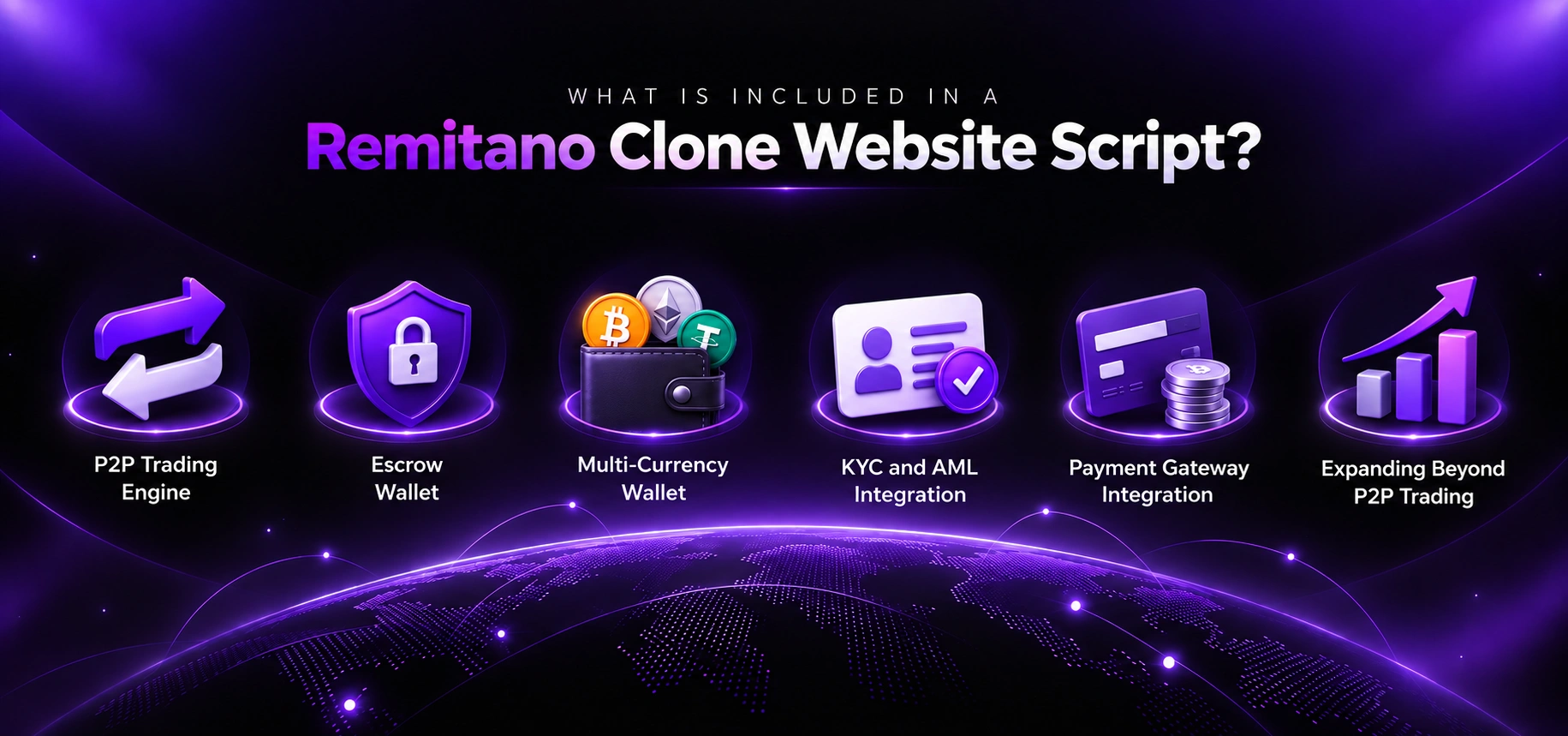
What Is Included in a Remitano Clone Website Script?
A Remitano clone website script is essentially a pre-built P2P crypto-exchange foundation that can be branded and customized for a particular business.
The core architecture normally contains several important layers.
1. P2P Trading Engine
The trading layer allows users to create buy and sell advertisements, define prices, select payment methods and connect with counterparties. A sophisticated implementation can add automatic matching based on price, currency, payment method, geography, trading limits and user reputation. This is important because P2P trading is not simply a conventional order book. The system needs business logic around advertisements, trade status, payment confirmation, timeouts, cancellations and disputes.
2. Escrow Wallet
Escrow is one of the defining components of a P2P exchange. When a trade begins, the seller’s cryptocurrency is placed into escrow. The buyer then completes the agreed fiat payment. Once the seller confirms the payment, the cryptocurrency is released to the buyer. This workflow reduces counterparty risk and provides the exchange with a controlled mechanism for handling disputes. Current clone-script offerings specifically describe escrow as the mechanism that protects funds during the transaction.
3. Multi-Currency Wallet
A business-ready platform may support multiple cryptocurrencies and fiat currencies.
The wallet layer needs to handle deposits, withdrawals, balances, transaction histories, confirmations and internal transfers. For a production exchange, wallet security is more important than simply displaying balances on a dashboard. Depending on the architecture, businesses may also require hot-wallet controls, cold storage, multi-signature authorization, cross-chain liquidity aggregation, withdrawal limits and transaction monitoring.
4. KYC and AML Integration
KYC and AML should not be treated as a checkbox. A serious platform needs identity verification, sanctions screening, transaction monitoring and appropriate risk controls based on its operating jurisdiction. Clone software can provide integration points for these services, but the software itself does not automatically make an exchange legally compliant. Compliance depends on the business model, jurisdiction, licensing requirements, policies and external providers.
5. Payment Gateway Integration
P2P exchanges depend heavily on payment methods. Depending on the target market, integrations may include bank transfers, cards, digital wallets and local payment systems. A business should confirm whether payment integrations are included in the quoted development price or charged separately.
6. Expanding Beyond P2P Trading
Businesses looking to evolve their exchange beyond conventional P2P crypto trading can consider adding advanced trading products such as perpetual contracts, futures, and other derivatives. A dedicated derivatives exchange can introduce additional trading functionality and revenue opportunities, although it also requires more sophisticated risk management, margin systems, liquidation mechanisms, pricing infrastructure, and regulatory considerations.
See How a Business-Ready P2P Exchange Can Work
Remitano Clone Software Development: Where Does the Money Go?
The purchase of the base script is only one component of Remitano clone software development.
1. UI/UX Customization
Changing the logo and colors is basic customization. A business-ready platform may require redesigned user flows, trading screens, wallet pages, advertisements, dashboards and mobile interfaces.
2. Backend Customization
Backend development can include custom trading rules, user limits, fee structures, wallet logic, payment workflows, referral systems, dispute processes and administrative controls.
3. API Development
APIs become increasingly important when an exchange connects to external KYC providers, blockchain infrastructure, payment gateways, liquidity providers and analytics systems. A current vendor offering, for example, lists site API and liquidity API integration as possible additions to a Remitano-style platform. Integrating AI trading agents can help automate specific trading workflows while connecting the exchange with market-data feeds, execution APIs, and risk-management systems.
4. Security Engineering
Security should have its own budget. Two-factor authentication, encryption, access controls, anti-DDoS protection and secure wallet architecture are important, but businesses should also consider penetration testing, dependency scanning, infrastructure hardening, logging, monitoring and incident-response procedures. A vendor may advertise security features, but buyers should request technical documentation and independent testing evidence before handling real customer funds.
Remitano Clone Development: Web, Android and iOS
A web platform may be enough for an initial MVP, but many P2P exchanges eventually require mobile applications. Android and iOS development increases the budget because applications need their own interfaces, authentication flows, notifications, wallet functionality, API integration, testing and store deployment.
Some current Remitano clone offerings explicitly include web, Android and iOS versions. For cost control, a sensible approach is to launch the web platform first and add native applications once the business validates its market.
Infrastructure and Technology Costs
A Remitano clone development budget should also account for infrastructure.
Typical requirements can include:
- Cloud servers
- Database infrastructure
- Redis or equivalent caching
- Blockchain nodes or RPC services
- Object storage
- CDN and DDoS protection
- Monitoring and logging
- Backup and disaster recovery
- Email and SMS services
Modern clone solutions may use technologies such as React or Vue on the frontend, Node.js, Python or Django on the backend, relational or NoSQL databases, WebSockets for real-time communication, and cloud infrastructure such as AWS, Google Cloud or Azure.
How Long Does Remitano Clone Development Take?
One of the biggest advantages of using ready-made software is time-to-market.
A pre-built platform can potentially be configured and deployed much faster than developing a P2P exchange completely from scratch. However, “deployment” should not be confused with “business launch.” A basic technical deployment might involve server configuration, branding, database setup and existing integrations.
A genuine production launch can require additional time for:
- Custom development
- Payment-provider onboarding
- KYC/AML integration
- Security testing
- Liquidity configuration
- Legal and compliance preparation
- Mobile-app approval
- User acceptance testing
Therefore, businesses should be cautious about promises of launching an entire exchange in only a few days.
Is a $6,000 Remitano Clone Enough for a Real Business?
It can be enough for a technical starting point, but it should not automatically be considered the total investment. The lower end of the budget may cover the software foundation. Additional expenses can arise from security audits, payment providers, KYC services, cloud infrastructure, liquidity, legal work, support and custom integrations.
For example, an entrepreneur might spend $8,000 on the initial script but another substantial amount preparing the platform for a specific country and customer base. The right question is therefore not “How cheap is the clone?” It is: “What exactly is included, what must be customized, and what will it cost to operate securely after launch?”
How to Choose a Remitano Clone Script Provider
Before signing a contract, request a live demonstration and technical documentation.
Ask the provider:
- Do we receive the complete source code?
- Who owns the intellectual property?
- Are there recurring license fees?
- Which blockchain networks are supported?
- How are private keys protected?
- Is the escrow logic configurable?
- Which KYC/AML providers can be integrated?
- Which payment gateways are supported?
- Is liquidity integration included?
- Are Android and iOS applications included?
- What APIs are available?
- Is a security audit included?
- What are the hosting requirements?
- What support is provided after deployment?
- What happens when the platform needs major upgrades?
These questions reveal the difference between a simple clone script and a platform designed for serious commercial use.
Final Verdict
For planning purposes, $6,000 to $12,000 USD is a reasonable starting range for a standard Remitano-style P2P exchange script, while a more customized platform can move into the $15,000 to $20,000+ range. But the software quotation should not be mistaken for the total launch budget.
A business-ready guide for P2P crypto exchange requires a combination of software, infrastructure, security, compliance, liquidity, payment integrations and ongoing technical support. The most cost-effective strategy at Techfyte usually starts with a modular Remitano clone script, validates the P2P business model in a defined market, and then invests in advanced features as transaction volume and user demand grow. That approach reduces initial development risk without locking the business into a basic platform forever.
Frequently Asked Questions
1. What is a Remitano clone script?
A Remitano clone script is pre-built software designed to provide the core functionality of a P2P cryptocurrency exchange, including trading, escrow, wallets, user management and administration.
2. How much does a Remitano clone script cost in 2026?
A standard solution may cost around $6,000–$12,000, while extensive customization and enterprise requirements can push the investment above $20,000.
3. Is the Remitano clone website script customizable?
Yes. Businesses can generally customize branding, UI/UX, payment methods, currencies, fees, trading rules and additional modules. The exact scope depends on the provider.
4. Does a clone script include KYC and AML?
Many solutions provide KYC/AML functionality or integration capabilities. However, regulatory compliance depends on the jurisdiction and the services integrated into the exchange.
5. How long does Remitano clone development take?
A ready-made platform can be deployed faster than a completely custom exchange, but the actual production timeline depends on customization, integrations, security testing, compliance and infrastructure.
6. Is a clone script cheaper than building an exchange from scratch?
Usually, yes. A pre-built codebase can reduce initial development time and cost because fundamental exchange functionality already exists. However, customization and operational costs still need to be considered.
7. What features should a business-ready P2P exchange have?
At minimum, consider P2P trading, escrow, wallets, KYC/AML integration, payment methods, dispute management, admin controls, security monitoring, transaction history and reliable customer support.
Planning to Launch a P2P Crypto Exchange?
