



Key Takeaways
- A KuCoin clone script provides a pre-built foundation for creating a customizable cryptocurrency exchange.
- Development cost depends on trading features, blockchain integrations, liquidity, security, compliance and infrastructure.
- A production-ready exchange requires architecture, security, liquidity and operational planning beyond the software package.
- KYC, AML and transaction monitoring requirements should be implemented according to target jurisdictions.
Introduction
Launching a cryptocurrency exchange is no longer limited to building every component from the ground up. A KuCoin clone script can provide businesses with a pre-built foundation for creating a trading platform with features similar to those offered by established exchanges. However, moving from a software package to a live, operational exchange involves far more than customizing a logo or changing the color scheme.
This is where KuCoin clone development becomes a business and engineering exercise rather than a simple software deployment project. For startups and established businesses, the real advantage of a clone-based approach is acceleration.
What Is a KuCoin Clone Script?
A KuCoin clone script is pre-built cryptocurrency exchange software designed around the core functionality commonly found on large centralized exchanges. Instead of developing every exchange component from zero, a business can start with an existing software foundation and customize it according to its brand, target users, trading products, and operational requirements.
The underlying architecture is also important. A reliable exchange needs more than an attractive trading dashboard. Orders must be processed consistently, balances must remain accurate, deposits and withdrawals must be reconciled with blockchain transactions, and sensitive operations must be protected through multiple layers of security.
For this reason, businesses evaluating a KuCoin clone script should assess the quality of its backend architecture, scalability, source-code access, API capabilities, security controls, customization options, and ongoing maintenance support rather than judging the solution only by its visible features.
Planning to Launch Your Own Crypto Exchange?
Core Architecture Behind a KuCoin-Like Exchange
The technical architecture determines whether an exchange can handle growing trading activity without compromising performance or reliability. A well-designed KuCoin clone development project should therefore separate major exchange functions into logical services rather than building the entire platform as one tightly coupled application.
- Frontend Layer: Web and mobile trading interfaces for account management, portfolio tracking, order placement, charts, and real-time market data.
- API Gateway: REST and WebSocket APIs for authentication, trading requests, market feeds, rate limiting, and secure communication between clients and backend services.
- User & KYC Layer: User registration, authentication, 2FA, KYC/KYB, AML checks, device management, and role-based access controls.
- Order Management System: Validates orders, checks balances and trading permissions, manages order status, and routes eligible orders to the matching engine.
- Matching Engine: Processes buy and sell orders, maintains order books, executes trades, and delivers low-latency matching with predictable performance.
- Market Data Engine: Generates real-time prices, trade feeds, order-book depth, ticker information, and candlestick data through WebSocket connections.
- Ledger & Balance Engine: Maintains user balances and records trades, fees, deposits, and withdrawals using a reliable internal accounting system.
- Wallet & Blockchain Layer: Manages deposit addresses, withdrawals, blockchain confirmations, hot/cold wallets, custody controls, and transaction reconciliation.
- Risk & Liquidity Layer: Handles trading limits, margin and liquidation logic, liquidity-provider integrations, market makers, spread management, and slippage monitoring.
- Security & Admin Layer: Provides encryption, DDoS protection, withdrawal controls, audit logs, compliance monitoring, user management, and platform configuration.
- Infrastructure Layer: Uses databases, caching, message queues, load balancers, monitoring, backups, and disaster-recovery mechanisms to support scalability and availability.
Essential Features of a KuCoin Clone Script
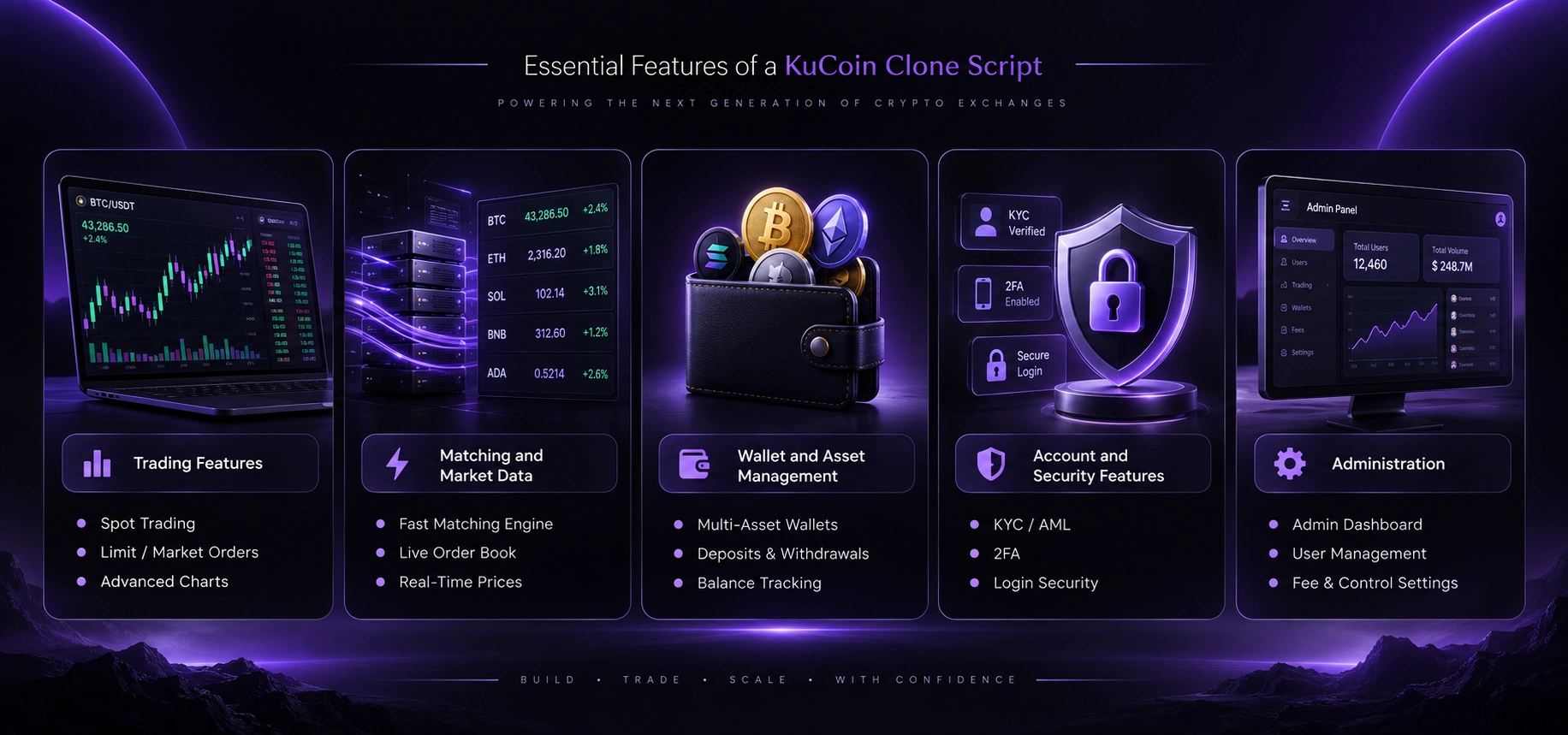
The feature set of a KuCoin clone script should be evaluated from both the trader’s perspective and the exchange operator’s perspective. A platform may offer dozens of visible features, but its underlying systems need to work together reliably.
1. Trading Features
Spot trading is generally the foundation of a centralized exchange, allowing users to buy and sell supported digital assets. Businesses can also introduce margin trading and futures if their regulatory framework, risk infrastructure, and target market support these products. Common order types include market, limit, stop, and other conditional orders.
2. Matching and Market Data
The matching engine processes incoming orders according to the platform’s matching rules and updates the relevant order books. Real-time market-data services distribute price, trade, and order-book information through WebSocket connections. Performance should be measured using actual latency and throughput benchmarks rather than vague claims about instant execution.
3. Wallet and Asset Management
Users need dedicated deposit addresses, withdrawal functionality, transaction histories, and balance information for supported assets. The wallet system should include blockchain confirmation rules, withdrawal controls, transaction monitoring, and reconciliation mechanisms.
4. Account and Security Features
Registration, login, two-factor authentication, identity verification, device management, API-key controls, withdrawal restrictions, and suspicious-login alerts form the foundation of account security.
5. Administration
The administrative console gives operators control over users, assets, trading pairs, fees, withdrawals, deposits, support cases, compliance processes, and platform configuration. Strong role-based access controls are essential so that sensitive administrative actions are restricted and auditable.
Additional modules such as staking, trading bots, referral programs, launchpad functionality, or institutional tools can be introduced as the exchange’s business model develops.
Security and Compliance Requirements
For a production-ready KuCoin clone script, security and compliance need to be built into the architecture from the beginning. Key areas include:
- Account Security: 2FA, strong password policies, biometric authentication, device management, and suspicious-login detection.
- Data Encryption: Encrypt sensitive data both in transit and at rest using industry-standard encryption protocols.
- Wallet Security: Use controlled hot-wallet limits, cold storage, multisignature or MPC-based custody, and secure private-key management.
- Withdrawal Protection: Implement withdrawal limits, address whitelisting, multi-level approvals, transaction screening, and additional verification for high-risk withdrawals.
- API Security: Secure API keys, authentication tokens, rate limiting, request validation, permission controls, and IP restrictions for sensitive APIs.
- Infrastructure Protection: Deploy firewalls, WAF, DDoS protection, network segmentation, secure cloud configurations, and continuous infrastructure monitoring.
- Application Security: Conduct code reviews, vulnerability assessments, penetration testing, dependency scanning, and regular security updates.
- Transaction Monitoring: Monitor deposits, withdrawals, and trading activity for unusual patterns, potentially fraudulent behavior, or suspicious transactions.
- KYC/KYB: Integrate identity and business verification services according to the requirements of the target market.
- AML/CFT Controls: Implement transaction monitoring, sanctions screening, risk scoring, case management, and appropriate reporting procedures.
- Audit & Logging: Maintain tamper-resistant logs for account activity, withdrawals, administrative actions, configuration changes, and compliance events.
- Backup & Disaster Recovery: Maintain encrypted backups, redundancy, recovery procedures, and tested failover mechanisms to minimize operational downtime.
- Regulatory Compliance: Assess licensing, custody, consumer-protection, data-protection, Travel Rule, and reporting requirements based on the jurisdictions in which the exchange operates.
Step-by-Step KuCoin Clone Development Process
Developing a cryptocurrency exchange with a KuCoin-like feature set requires a structured process that connects business objectives with technical implementation. A typical KuCoin clone development process can be divided into the following stages:
1. Define the Business Model
Determine the target users, supported assets, trading products, revenue model, operating jurisdiction, and regulatory requirements. Decide whether the platform will initially focus on spot trading or also support products such as margin, futures, staking, or trading bots.
2. Select the Technology Approach
Choose between a white label KuCoin clone script, a heavily customized solution, or a fully custom exchange. Evaluate source-code ownership, scalability, API availability, security architecture, customization capabilities, and long-term maintenance before selecting a technology provider.
3. Design the Exchange Architecture
Define the architecture for the matching engine, order management system, internal ledger, wallets, blockchain integrations, APIs, market-data services, risk engine, databases, and infrastructure. The architecture should be designed around expected transaction volumes and future expansion.
4. Customize the Platform
Apply the business’s branding, user interface, trading fees, supported assets, trading pairs, account tiers, permissions, and regional settings. Additional modules can be introduced based on the target market rather than replicating every available exchange feature.
5. Integrate Blockchain and Liquidity
Connect supported blockchain networks and configure deposit and withdrawal workflows. Integrate liquidity providers and market makers to establish sufficient market depth and competitive spreads before opening trading to users.
6. Implement Security and Compliance
Integrate KYC/KYB, AML, transaction monitoring, sanctions screening, Two-factor authentication, withdrawal controls, and security monitoring. Conduct security reviews and establish operational policies before moving toward production.
7. Test the Platform
Perform functional, integration, load, stress, security, and failover testing. Test order execution, wallet transactions, blockchain confirmations, balance calculations, fee processing, and ledger reconciliation under normal and high-load conditions.
8. Deploy and Monitor
Deploy the exchange on scalable infrastructure with monitoring, logging, backups, alerting, and disaster-recovery mechanisms. A staged launch can help the operations team identify performance or operational issues before exposing the platform to a larger user base.
How Much Does KuCoin Clone Development Cost?
The cost of KuCoin clone development depends on the scope of the exchange rather than simply the price of the underlying script. A basic spot-trading platform requires significantly fewer components than an exchange supporting derivatives, advanced custody, multiple blockchain networks, institutional APIs, and mobile applications.
Key cost factors include:
- Software approach: White label, customized, or fully custom development.
- Trading functionality: Spot trading requires less infrastructure than margin and derivatives.
- Matching engine: Performance requirements increase with expected order volume and user activity.
- Wallet infrastructure: Multi-chain support, custody controls, and withdrawal workflows add development and operational complexity.
- Liquidity: Liquidity-provider integrations, market makers, and aggregation systems affect both implementation and operating costs.
- Mobile applications: Building and maintaining dedicated iOS and Android applications adds to the overall scope.
- Compliance: KYC, AML, transaction monitoring, legal reviews, licensing, and regulatory requirements vary by jurisdiction.
- Security: Audits, penetration testing, monitoring, custody controls, and infrastructure hardening require additional investment.
- Infrastructure: Cloud resources, blockchain nodes, databases, monitoring, backups, and disaster recovery contribute to ongoing expenses.
Know the Investment Required for Your Crypto Exchange
From Launch to Long-Term Exchange Operations
Going live is not the final stage of cryptocurrency exchange development. Once users begin depositing assets and placing trades, the platform becomes an operational financial technology system that requires continuous monitoring and maintenance.
The business should continuously monitor:
- Trading infrastructure: Matching-engine performance, API latency, order processing, and WebSocket connections.
- Wallet operations: Deposits, withdrawals, blockchain confirmations, wallet balances, and transaction reconciliation.
- Liquidity: Trading volume, spreads, market depth, slippage, and market-maker performance.
- Security: Login activity, withdrawal patterns, API usage, vulnerabilities, and infrastructure alerts.
- Compliance: KYC status, transaction-monitoring alerts, sanctions screening, investigations, and regulatory reporting.
- Infrastructure: Server health, database performance, storage capacity, backups, and disaster-recovery readiness.
- Customer support: Account issues, failed transactions, withdrawal requests, disputes, and security-related incidents.
- Product development: New trading pairs, blockchain networks, APIs, mobile features, trading tools, and other platform improvements.
This ongoing operational layer is what turns a KuCoin clone app from a software product into a functioning exchange business. Regular upgrades and security reviews are also necessary because blockchain networks, regulations, user expectations, and attack techniques continue to evolve.
Conclusion
A KuCoin clone script can give businesses a practical starting point for building a cryptocurrency exchange without developing every component from scratch. However, the script itself is only one part of the equation.
A successful exchange requires a reliable matching engine, accurate internal ledger, secure wallet infrastructure, sufficient liquidity, compliant user-verification processes, strong cybersecurity, scalable infrastructure, and dedicated post-launch operations.
Businesses considering KuCoin clone development should invest in services at Techfyte. We evaluate underlying architecture, source-code access, scalability, security controls, integration capabilities, customization options, and provide long-term technical support that can have a much greater impact on the platform’s success.
Frequently Asked Questions
1. What is a KuCoin clone script?
A KuCoin clone script is pre-built or white label cryptocurrency exchange software designed around functionality similar to a major centralized exchange. It can provide components such as trading, wallets, user management, administration, APIs, and blockchain integrations that businesses can customize for their own exchange.
2. Is a KuCoin clone script a complete cryptocurrency exchange?
Not necessarily. A script provides the software foundation, but launching a live exchange also requires liquidity, blockchain connectivity, custody infrastructure, KYC/AML processes, security controls, regulatory compliance, payment integrations, and operational support.
3. How does KuCoin clone development work?
The process typically involves business and regulatory planning, technology selection, architecture design, platform customization, blockchain and liquidity integration, security implementation, testing, deployment, and ongoing maintenance.
4. What features should a KuCoin clone include?
Core functionality can include spot trading, order management, a matching engine, real-time market data, wallets, deposits and withdrawals, user authentication, KYC integration, administration tools, APIs, and security controls. Additional modules such as margin, futures, staking, or trading bots can be added according to business requirements.
5. What is involved in KuCoin clone app development?
KuCoin clone app development involves creating mobile applications that securely connect to the exchange’s backend. Common features include market data, charts, order placement, portfolio management, deposits, withdrawals, transaction history, notifications, and account-security controls.
6. How is liquidity added to a new crypto exchange?
Liquidity management systems can be established through external liquidity providers, market makers, liquidity aggregators, or integrations with other trading venues. The exchange should monitor order-book depth, spreads, trading volume, and slippage to maintain an effective trading environment.
7. How much does KuCoin clone development cost?
There is no fixed cost because the scope varies significantly between projects. The overall investment depends on the trading products, number of blockchain networks, wallet architecture, liquidity integrations, mobile applications, security requirements, compliance scope, infrastructure, and customization.
8. Is a KuCoin clone legally compliant by default?
No. Software cannot automatically make an exchange legally compliant. Businesses must evaluate licensing, KYC/AML, sanctions screening, transaction monitoring, data protection, custody, reporting, and other requirements applicable to their target jurisdictions and products.
9. How long does it take to launch a KuCoin-like exchange?
The timeline depends on the amount of customization and the business’s regulatory, liquidity, banking, security, and infrastructure requirements. A pre-built foundation can accelerate software development, but the complete path to a production launch involves considerably more than deploying the software.
10. What should businesses check before choosing a KuCoin clone provider?
Businesses should evaluate the source code, architecture, scalability, security practices, audit history, API capabilities, customization options, blockchain integrations, liquidity support, documentation, deployment process, ownership terms, and post-launch maintenance.
Discuss Your KuCoin-Like Exchange Requirements With Our Experts
