



Key Takeaways
- RWA Tokenization Compliance should be built into the platform architecture, including KYC/AML, investor eligibility, wallet controls, transfer restrictions, custody, and transaction monitoring.
- RWA tokenization is regulated based on the asset, token structure, and activity, not simply because blockchain technology is being used.
- 2026 is increasingly focused on integrating tokenization with regulated financial infrastructure, including custody, issuance, compliance, and secondary trading.
- Businesses planning to build RWA tokenization platform infrastructure should partner with Techfyte for asset class, investor profile, platform activities, and advanced technology stack.
Introduction
Real-world asset tokenization is moving beyond experimental blockchain projects and into regulated financial infrastructure. Real estate, investment funds, debt instruments, securities, and other assets can now be represented through blockchain-based tokens, creating new models for ownership, distribution, settlement, and trading.
But tokenizing an asset does not automatically make it a cryptocurrency or remove it from existing financial laws. The regulatory treatment can depend on what the token represents, who can purchase it, where the issuer operates, how the token is transferred, and what services the platform provides. This makes RWA Tokenization Regulations one of the most important considerations for businesses planning to enter the tokenized-asset market in 2026.
Dubai, Saudi Arabia, the USA, and Hong Kong have each developed different approaches to digital assets, securities, financial technology, and tokenization. Understanding these differences is essential before launching an RWA product or investing in RWA tokenization platform development.
What Are RWA Tokenization Regulations?
Real world asset tokenization regulations are the rules that determine how physical or financial assets can be represented, issued, transferred, marketed, traded, and managed through blockchain infrastructure. Understanding these real-world asset tokenization use cases across industries helps businesses identify where tokenization can create practical value before evaluating the applicable regulatory framework.
An RWA token may represent an interest in:
- Real estate: Fractional interests or economic rights connected to property.
- Securities: Shares, bonds, debt instruments, or other regulated investments.
- Funds: Tokenized interests in investment products or funds.
- Commodities: Digital representations linked to physical commodities.
- Private assets: Certain private-market ownership or contractual rights.
The technology is only one part of the structure. The legal rights attached to the token and the activities performed by the platform are equally important.
Ready to Build an RWA Tokenization Platform?
Why Real World Asset Tokenization Platform Compliance Matters
A compliant RWA platform should address multiple regulatory and technical layers:
- Token classification: Determines which legal framework may apply.
- Licensing: Certain issuance, dealing, brokerage, custody, or trading activities may require authorization.
- KYC/AML: Helps establish who can participate and supports financial-crime controls.
- Custody: Defines how tokens and underlying assets are safeguarded.
- Investor eligibility: Determines which investors can access particular products.
- Transfer restrictions: Can prevent tokens from being transferred to unauthorized participants.
- Disclosure: Gives investors information about the asset, structure, risks, and associated rights.
This is why a strong RWA Tokenization Legal Framework needs to be considered before the smart-contract architecture is finalized.
RWA Tokenization Regulations Dubai
Dubai has established a dedicated virtual-asset regulatory environment through the Virtual Assets Regulatory Authority (VARA). VARA is the competent authority for virtual-asset activities in Dubai outside the Dubai International Financial Centre (DIFC).
For RWA projects, the important point is that the regulatory analysis depends on the token and the activity being performed rather than simply on the use of blockchain.
1. Dubai’s Regulatory Structure
Several authorities can become relevant depending on the business model:
- VARA: Relevant to virtual-asset activities in Dubai outside DIFC.
- DFSA: Relevant to regulated activities conducted within DIFC.
- Other UAE authorities: May become relevant depending on the underlying financial activity and legal structure.
Dubai has also moved beyond general digital-asset regulation into practical RWA experimentation. In February 2026, VARA confirmed that the first phase of Dubai’s real estate tokenisation pilot had been completed and that the initiative had entered a controlled second phase focused, among other things, on evaluating secondary-market mechanisms. VARA also emphasized that entities offering, marketing, or facilitating tokenized real estate products require the appropriate approvals.
2. What Does This Mean for RWA Platforms?
A company planning to Build RWA Tokenization Platform in Dubai should consider:
- Token classification: Identify exactly what rights the token provides.
- Activity mapping: Determine whether the business is issuing, dealing, arranging, exchanging, or providing custody.
- Licensing: Match the planned activities with the relevant regulatory authorization.
- KYC/AML: Build investor verification and monitoring into onboarding.
- Marketing controls: Ensure tokenized products are promoted only in accordance with applicable requirements.
- Transfer controls: Restrict transactions where investor or jurisdictional requirements apply.
Dubai’s real-estate tokenization pilot also demonstrates an important principle: technical feasibility does not automatically equal permission to commercially offer a tokenized asset.
Saudi Arabia RWA Tokenization Regulations
Saudi Arabia takes a securities-focused approach when tokenization involves regulated investment products or capital-market activities. The Capital Market Authority (CMA) operates a FinTech regulatory framework that allows qualifying innovative products and business models connected with securities activities to be tested within defined parameters. The CMA’s FinTech framework specifically defines a FinTech ExPermit as a permit allowing applicants to participate in the FinTech Lab and experiment with innovative financial technology products related to the capital market.
1. Saudi Arabia’s Tokenization Landscape
The CMA’s FinTech ecosystem has already included models involving distributed ledger technology.
Its published FinTech ExPermit categories include:
- DLT for securities: Using distributed ledger technology to arrange and offer securities and provide custody services.
- Debt instruments: Platforms for offering and investing in debt instruments.
- Investment funds: Platforms distributing investment and real-estate fund units.
- Stock ownership transfer: Technology supporting ownership-transfer processes.
The CMA’s current ExPermit directory also lists companies under categories including DLT-based securities and custody services, investment and real-estate fund distribution, debt instruments, and stock ownership transfer.
2. Saudi Arabia RWA Tokenization Compliance
For a Saudi RWA project, businesses should assess:
- Underlying asset: What exactly is being tokenized?
- Investor rights: Does the token provide ownership, income, repayment, or another economic interest?
- Securities classification: Could the structure fall within capital-market regulation?
- Authorization: Does the business require a CMA authorization or another regulatory approval?
- Custody: Who holds the underlying asset and the digital representation?
- Investor onboarding: How will identity and eligibility be verified?
This makes Saudi Arabia particularly relevant for businesses exploring tokenized securities, investment products, debt, and real-estate-related financial models.
USA RWA Tokenization Regulations
The USA RWA Tokenization Regulations landscape is more fragmented than a single-regulator model because jurisdiction can depend on the underlying asset and the activity being performed. The Securities and Exchange Commission (SEC) is particularly important when an RWA token represents a security.
In January 2026, SEC staff issued a statement specifically addressing tokenized securities. The statement describes a tokenized security as a security represented as a crypto asset where ownership records are maintained, at least in part, through crypto networks.
1. When Can an RWA Token Be a Security?
The critical question is not simply whether the product uses blockchain.
A platform should examine:
- Underlying rights: What does the investor actually receive?
- Economic characteristics: Does the token represent equity, debt, fund interests, or another financial instrument?
- Issuance model: Who creates and distributes the token?
- Trading model: Will investors be able to trade it?
- Custody model: Who controls the underlying asset and token?
- Investor relationship: What contractual rights exist between the investor and issuer?
The SEC’s 2026 statement also distinguishes between securities tokenized by or on behalf of issuers and securities tokenized by unaffiliated third parties.
2. USA RWA Tokenization Compliance
Depending on the structure, a U.S. platform may need to evaluate:
- Securities registration or an applicable exemption.
- Broker-dealer requirements.
- Trading-platform or ATS considerations.
- Custody arrangements.
- Investor eligibility.
- AML and financial-crime controls.
- State-level securities and financial regulations.
The key takeaway is simple: putting a traditional financial asset on-chain does not automatically change its regulatory character.
Hong Kong RWA Tokenization Regulations
Hong Kong has developed a structured regulatory approach toward tokenized securities, virtual assets, and tokenized investment products. The Securities and Futures Commission (SFC) has been particularly active in establishing frameworks for tokenization.
In April 2026, the SFC issued a circular setting out requirements under which it would consider allowing tokenization of SFC-authorized investment products for public offering in Hong Kong.
1. Hong Kong’s Tokenization Framework
The framework covers areas including:
- Tokenized investment products
- Tokenized securities
- Licensed intermediaries
- Digital-asset custody
- Primary dealing
- Secondary trading
The SFC follows a “see-through” approach for tokenized investment products, meaning the underlying product’s regulatory requirements remain important even when blockchain technology is introduced.
2. Secondary Trading in Hong Kong
Hong Kong’s 2026 framework also introduced a pilot for secondary trading of tokenized SFC-authorized investment products. The SFC stated that the framework primarily facilitates secondary trading of tokenized open-ended funds on SFC-licensed virtual-asset trading platforms, subject to safeguards around fair pricing, orderly trading, liquidity, disclosure, and other requirements.
For RWA businesses, this demonstrates how tokenization is increasingly being connected to regulated issuance and trading infrastructure, rather than existing as an isolated blockchain product.
RWA Tokenization Regulations: Dubai vs Saudi Arabia vs USA vs Hong Kong
| Regulatory Area | Dubai | Saudi Arabia | USA | Hong Kong |
| Main regulatory focus | Virtual assets and regulated activities | Capital markets and FinTech | Securities, commodities and financial activities | Securities and virtual assets |
| Key regulator(s) | VARA, DFSA where applicable | CMA, SAMA where applicable | SEC, CFTC, FinCEN and state regulators | SFC, HKMA where applicable |
| Token classification | Depends on token and activity | Depends on underlying rights and activity | Securities classification can be critical | Tokenized securities remain subject to securities regulation |
| KYC/AML | Applicable requirements | Applicable requirements | Applicable requirements | Applicable requirements |
| Custody | Activity-dependent | Activity-dependent | Activity-dependent | Regulated custody considerations |
| Secondary trading | Depends on authorization and structure | Depends on authorization and product | Significant regulatory considerations | Specific frameworks developing for tokenized products |
| Platform licensing | Depends on activities | Depends on activities | Depends on activities | Depends on activities |
How to Build an RWA Tokenization Platform in 2026
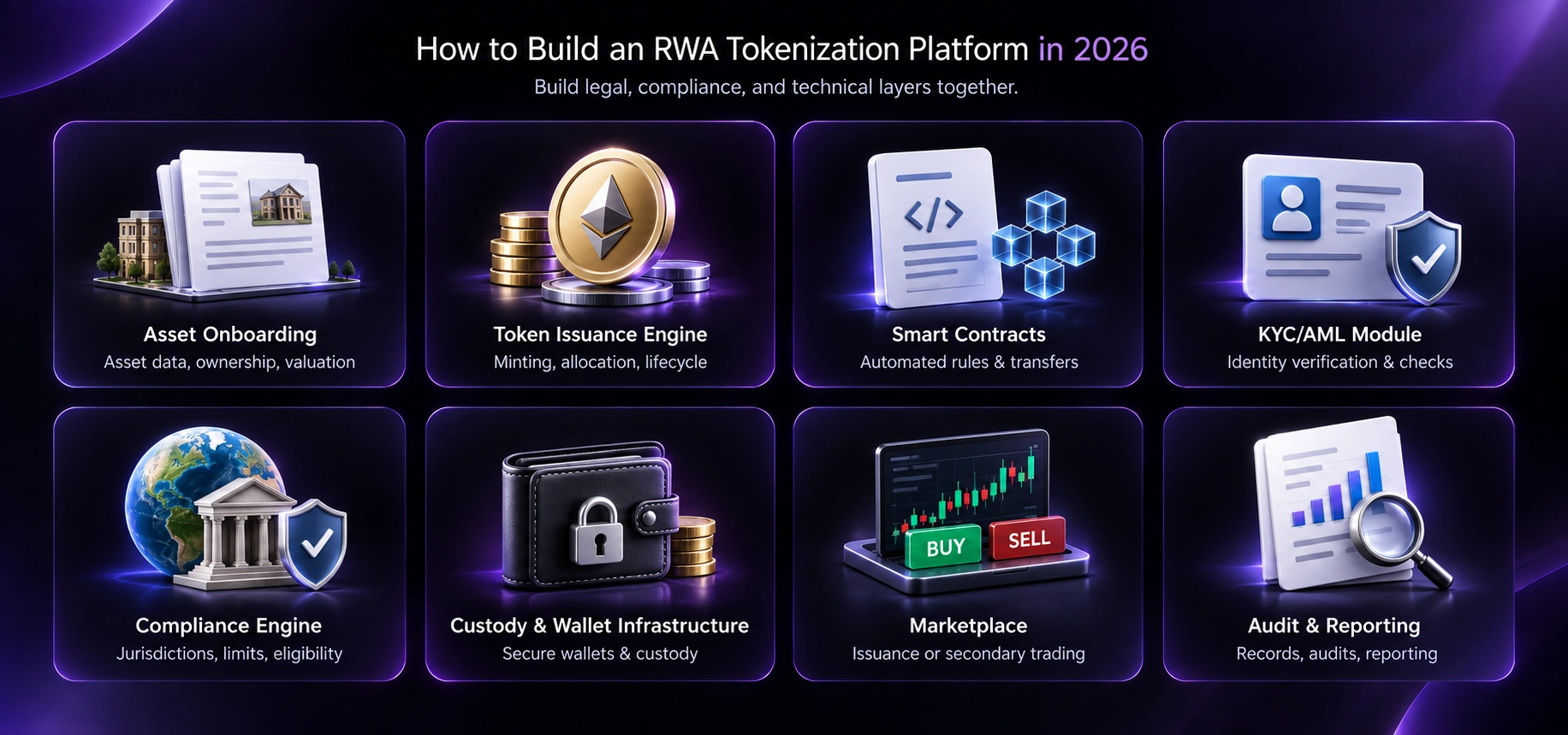
Regulatory compliance should influence the platform architecture from the beginning. A business planning to Build RWA Tokenization Platform infrastructure should design the legal, compliance, and technical layers together.
Core Components of an RWA Tokenization Platform
1. Asset Onboarding
The platform should capture information about the underlying asset, ownership structure, valuation, documentation, and eligibility.
2. Token Issuance Engine
This component manages minting, allocation, supply controls, and token lifecycle management.
3. Smart Contracts
Smart contracts can automate transfers, distributions, redemption mechanisms, permissions, and other predefined rules.
4. KYC/AML Module
Investor identity verification and compliance checks can be connected directly to wallet and transaction permissions.
5. Compliance Engine
The compliance layer can enforce rules relating to jurisdictions, investor categories, token limits, and transfer eligibility.
6. Custody and Wallet Infrastructure
The platform needs secure management of wallets and clear segregation between token custody and the underlying asset.
7. Marketplace
Where legally permitted, the platform can provide primary issuance or secondary trading functionality.
8. Audit and Reporting
Every material action should produce reliable records for internal compliance, audits, and regulatory reporting.
Need Expert Support for RWA Platform Architecture?
RWA Tokenization Compliance: Build Compliance Into the Technology
One of the biggest mistakes in tokenization projects is treating compliance as a document that is added after development. A better approach is compliance-by-design.
For example:
- A user who has not completed KYC should not receive restricted tokens.
- A wallet from a restricted jurisdiction can be blocked.
- Investor eligibility can be checked before transactions.
- AI Smart contracts can enforce transfer restrictions.
- Transaction monitoring can flag suspicious activity.
- Administrative actions can be recorded in immutable audit logs.
This approach connects RWA Tokenization Compliance directly with the technical architecture. For companies providing RWA Tokenization Development Services, this also changes the development process: legal requirements become functional requirements that must be reflected in the platform.
RWA Tokenization Platform Compliance Checklist
Before launching an RWA platform, businesses should work through the following:
- Identify the asset: Determine precisely what is being tokenized.
- Define token rights: Document ownership, income, redemption, voting, or other rights.
- Classify the token: Determine its potential regulatory treatment.
- Map jurisdictions: Identify where the issuer, asset, platform, and investors are located.
- Identify regulators: Determine which authorities have jurisdiction.
- Confirm licensing: Establish whether authorization is required.
- Design KYC/AML: Integrate identity and financial-crime controls.
- Implement transfer restrictions: Prevent unauthorized transactions.
- Secure custody: Protect digital tokens and underlying assets.
- Prepare disclosures: Clearly communicate structure, risks, and investor rights.
- Monitor transactions: Detect suspicious or prohibited activity.
- Maintain records: Preserve reliable audit and compliance information.
What Will Shape Tokenized Asset Regulations in 2026?
The direction of Tokenized Asset Regulations 2026 is increasingly focused on integrating blockchain into existing financial-market structures.
Several areas deserve close attention.
- Tokenized Securities
Regulators are increasingly addressing securities that use blockchain as part of their ownership or transaction infrastructure.
- Regulated Secondary Markets
The ability to trade tokenized assets after issuance is becoming an important regulatory question, as demonstrated by Hong Kong’s 2026 framework.
- Institutional Custody
As more financial institutions explore tokenization, secure and regulated custody becomes an essential part of the infrastructure.
- Automated Compliance
KYC, investor eligibility, transfer restrictions, and transaction monitoring can increasingly become integrated with blockchain systems.
- Cross-Border Compliance
A platform serving investors in multiple countries may need to apply different rules simultaneously.
Build an RWA Tokenization Platform With Compliance at the Core
Launching an RWA platform requires more than creating a token and deploying a smart contract. The platform must connect asset ownership, legal rights, investor onboarding, KYC/AML, custody, token issuance, transfer controls, trading, and reporting into one operational framework.
Whether the target market is Dubai, Saudi Arabia, the USA, or Hong Kong, regulatory classification should be addressed before the platform architecture and token economics are finalized.
If your business is planning to enter the tokenized-asset market, an experienced RWA tokenization platform development company like Techfyte can help translate regulatory and business requirements into the technical architecture required for the platform.
Frequently Asked Questions
1. What are RWA Tokenization Regulations?
RWA Tokenization Regulations are legal requirements governing the creation, issuance, transfer, custody, and trading of tokens representing real-world assets.
2. Is RWA tokenization legal?
The legality depends on jurisdiction, asset type, token structure, licensing requirements, and platform activities.
3. What does RWA Tokenization Platform Compliance involve?
It includes token classification, licensing, KYC/AML, custody, investor eligibility, transfer restrictions, disclosures, monitoring, and audit trails.
4. Are RWA tokens securities in the USA?
Some RWA tokens can represent securities. The legal classification depends on the characteristics and rights of the instrument. The SEC published a dedicated statement on tokenized securities in January 2026.
5. Does Hong Kong allow tokenized investment products?
Hong Kong permits tokenization of certain SFC-authorized investment products subject to applicable requirements. In April 2026, the SFC also introduced a framework for secondary trading of certain tokenized SFC-authorized investment products.
6. What does RWA Tokenization Platform Compliance involve?
It can include token classification, licensing, KYC/AML, investor eligibility, custody, asset verification, transfer restrictions, disclosures, transaction monitoring, and audit trails.
7. Can I build an RWA platform without a financial license?
Developing software is different from operating a regulated financial service. Whether the business requires authorization depends on the jurisdiction, asset, token structure, and activities performed by the platform.
8. What does RWA Tokenization Platform Compliance involve?
The cost depends on the asset class, blockchain network, smart-contract requirements, compliance architecture, custody model, marketplace functionality, integrations, and target jurisdictions.
Build Your Compliance-Ready RWA Platform With Techfyte
