



Key Takeaways
- A two-week tokenized stock platform launch is feasible for a customizable shell, not a fully licensed brokerage with live custody and trading.
- ERC-3643, investor verification, transfer restrictions, custody integrations, and settlement logic form the core architecture for compliant tokenized securities.
- Licensing, custody agreements, market access, and regulatory approvals operate outside engineering timelines and can extend full platform launches into months.
- A two-week platform shell typically costs $15K-$40K, while full custom builds can reach $80K-$200K+.
- Independent audits, redundant price oracles, continuous reconciliation, and secure custody integrations are essential before deploying tokenized stock infrastructure with real investor funds.
Introduction
Tokenized securities have moved from experimental pilots to production systems. Dinari now handles trades of over 700 U.S. stocks with self-custody wallets, while Citi estimates the broader tokenized securities industry will be worth $5.5 trillion by 2030. For founders looking at tokenized stocks platform development, there is a real question: Can you actually go live in two weeks?
The honest answer is true, but only for a narrow scope: a pre-built, flexible, compliant and licensing-ready platform shell. This is a separate project, a fully licensed, live brokerage with market maker relationships and custody agreements. This guide makes the difference very clear, what can be built in two weeks, what takes three to six months, what the architecture looks like, what compliance actually requires and how much it costs.
What “Two Weeks” Actually Means for Tokenized Stock Platforms
A two-week tokenized stock trading platform launch is a good deliverable and has a purpose. It includes a customized platform shell using a permissioned token standard, a compliance engine that can be customized for each jurisdiction, wallet and custody interfaces that connect to a testnet or a licensed custody partner sandbox, and a trading interface ready for pilot users. It does not include a broker-dealer license, a live NAV feed to a regulated exchange, or contractual custody of real securities, all of which are out of the development timeline as they depend on regulators and counterparties, not code.
1. Why Vendors Overstate the Scope
The difference is important because vendors who tout an unqualified “2-week brokerage” are either over-estimating the breadth or under-estimating the depth of licensing work. The registration of a broker-dealer alone can take months of regulatory examination, regardless of whether any code is created. Founders who are realistic about breaking out the engineering and licensing timelines, and don’t just see a gap in the middle of the process.
2. Where the Market Is Heading
The current tokenized securities market is valued at $17 billion, with potential to grow to $5.5 trillion by 2030, according to Citi’s Tokenization 2030 research. It shows the category is still in its infancy and the platforms built today will define future growth. Stock market tokenization is done in phases, first shell, then licensing, then live trading. Founders who understand the sequence get off the ground faster than those chasing a single “done” milestone.
Ready to Build a Tokenized Stock Trading Platform?
Core Architecture of a Tokenized Stock Trading Platform
Every legitimate platform has a legal wrapper, a corporate structure that lays out who owns the underlying shares and what rights the token grants. The token standard sits on top. Tokenized securities compliance is largely being addressed by teams using ERC-3643, a permissioned standard that checks the identity and eligibility of the investor every time a transfer happens, rather than outsourcing compliance to an off-chain process. It’s that one design decision that distinguishes a security token from a speculative crypto asset.
1. Custody Models: Custodial vs. Synthetic
Then think about your custody model. Will you hold the shares through a certified custodian and mint tokens 1:1 or will you use synthetic exposure? Custodial arrangements are more appropriate for custody of tokenized stock since the token holder has a direct right to a real, segregated asset.
2. Trading and Settlement Layers
Above custody is the trading layer, with an order book for price-time priority execution or an AMM for continuous liquidity, and finally the settlement layer, which uses stock token smart contract technology for delivery-versus-payment, ensuring that the share and payment move together or not at all. Most founders ignore the blockchain stock settlement layer which needs to reconcile cleanly with whatever offchain custody data the legal wrapper is based on.
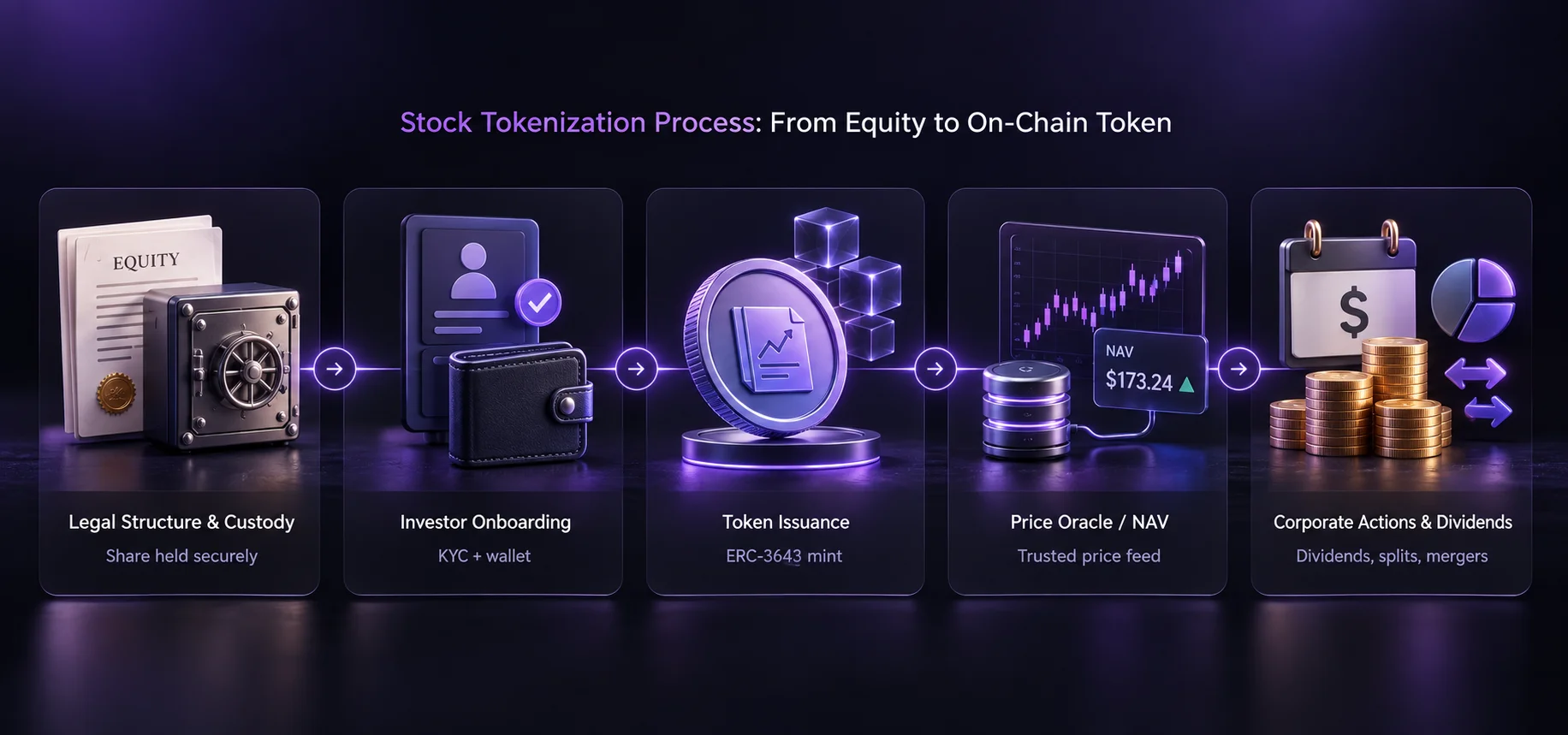
Stock Tokenization Process: From Equity to On-Chain Token
No matter the scope, the stock tokenization process follows a set sequence. First, the legal structure, seeing which organization issues the token and under what exemption or registration. The custody arrangement then proceeds to establish the account in which the underlying share is actually held.
1. Token Issuance and Price Oracle
Token issuance is the technological process of minting the ERC-3643 token using the validated identity of holders. Then, a NAV or price oracle impacts the token’s market value, because a tokenized stock needs a trustable, tamper-proof price source to trade against.
2. Corporate Actions and Dividends
Many platforms cut corners when dealing with corporate activity, which should not happen. Tokenized stock dividends need a defined mechanism. For example, Dinari pays dividends in USDC instead of normal banking routes, bridging a big operational gap. Other tokenized stock business operations like splits and mergers also require similar on-chain reasoning.
3. Investor Onboarding
The onboarding of tokenized stock investors closes the loop by including identity verification, accreditation checks if necessary and wallet provisioning, all prior to a single trade being executed. The sequence does not alter the underlying securities laws as evidenced by the SEC’s January 2026 statement on tokenized securities. A tokenized share is still a share.
Compliance and Regulation: The Non-Negotiable Layer
Tokenized securities regulation is not a loophole in securities law; it is simply a different recordkeeping format. The SEC’s guidelines explicitly states that a tokenized asset is subject to the same registration and disclosure obligations as its traditional counterpart, regardless of whether it is issued directly by the corporation or wrapped by a third party using a custodial or synthetic model. The teams starting in the EU will have similar obligations under MiCA and existing prospectus requirements, which are parallel in structure.
1. KYC/AML and Transfer Restrictions
KYC AML checks for tokenized stock should be done before onboarding, not after, and accreditation status, transfer limits and jurisdictional rules should all be enforced at the smart contract level, not in a compliance officer’s spreadsheet.
2. The Licensing Ceiling: Dinari’s Example
Dinari’s structure as an SEC-registered transfer agent and FINRA member broker-dealer is a case in point. That’s the ceiling. That’s the license depth to service US residents directly. And that’s the stuff that takes months, not sprints.
Building the Trading Experience in 2 Weeks
The frontend is where a 2-week build genuinely delivers a finished product. A wallet-connected trading interface, portfolio view, and order flow can be configured against the platform shell in days once the underlying architecture is in place. What makes 24/7 stock trading blockchain infrastructure different from a traditional brokerage app is that the trading window never closes – the UI has to communicate clearly when it’s showing live exchange-hours pricing versus after-hours on-chain price discovery.
Fractional Ownership and Liquidity Caveats
Fractional stock ownership blockchain mechanics are also a frontend and smart contract collaboration: token divisibility lets users buy a fraction of a share, which needs to be reflected accurately in balances, statements, and corporate action payouts. Tokenized stock liquidity is the honest caveat here – early-stage platforms often have thin order books, and atomic settlement mechanics mean delivery-versus-payment executes instantly once a counterparty is found, but finding that counterparty at a fair price is still a market-depth problem, not a code problem.
What You Actually Pay For in a 2-Week Build
A 2-week shell deployment (platform, adjustable compliance, licensing-ready architecture, testnet trading) usually costs $15K-$40K depending on the level of templating vs custom for the compliance and custody integration. A full custom platform with specialized brokerage linkages, live licensing work and production custody agreements runs $80K to $200K or more and takes months, not weeks. The difference between these numbers is mostly legal and licensing work, not engineering time.
1. How to Compare Vendor Quotes
Pricing also varies by vendor type: a generalist agency would quote differently from a RWA tokenization development business that has already established the compliance modules required for a security token. When assessing RWA tokenization development services, founders should consider what is templated versus custom-built, because two vendors quoting the same price point could be selling very different scopes. The best RWA tokenization development solutions reuse audited, production-tested contracts across clients, which is precisely what allows for the 2-week timetable starting with – no one is building permissioned-token logic from scratch.
2. Team Composition and Audit Requirements
The 2-week timeline is reduced when working with a well-established smart contract development team, as the ERC-3643 contracts, identity registries and compliance modules are already in place, and need to be configured, rather than created from scratch. The shell phase keeps the team lean: a blockchain engineer, a product lead with a compliance bent, and a frontend developer, with legal and custody specialists working in concert.
A smart contract audit is not an optional luxury at any budget level, a security token backed by real investor funds needs to be independently evaluated prior to mainnet deployment and the most common mistake entrepreneurs make in this space is to ignore this and save a week. Audit costs increase with contract complexity, but they should always be seen as part of the core budget, not an optional add-on negotiated away under time pressure.
Launch Your Tokenized Stock Trading Platform with Confidence
Technical Considerations and Security
The transfer-restriction logic is the code path that enforces all compliance requirements the business depends on and is the source of smart-contract risk. The scope of the audit should specifically cover the identity registry, the compliance module, and the upgrade/pause mechanism, and not only the token contract in isolation. Tokenized Stock Development Without a formal audit scope doc is more likely to find production gaps the worst place to find production gaps.
1. Oracle Design and Redundancy
The Oracle design is just as important: a manipulated or stale price feed can cause improper settlement, so token development in this category should emphasize redundant, tamper-resistant price sources over a single feed. A single oracle is a single point of failure, which is expensive enough for an instrument related to real-world securities prices to build against from the start.
2. Custody Integration and Reconciliation
The other main risk surface is custody integration that benefits from the same rigor as tokenomics consulting work, i.e. modeling how token supply, redemption and custody balances reconcile under stress, not just at launch. The reconciliation logic needs to run continuously to catch drift between on-chain token supply and shares held by the custodian before it compounds. Teams with DeFi development experience typically adapt more quickly here, as AMM and Oracle patterns from DeFi immediately translate into security token architecture, with compliance logic on top.
What to Have Ready Before Week 1
The fastest two-week builds begin with five decisions already made. The legal structure must be determined, including which company issues or custody of the tokenized security, as well as which exemption or registration applies. A custody partner must be under contract or in active negotiation, as custody is the dependency most likely to disrupt the timeline.
1. Compliance Vendor and Jurisdiction Decisions
A compliance provider for KYC/AML and accreditation checks should be chosen that adheres to the same fintech infrastructure norms as other regulated finance institutions. Jurisdiction decisions occur next – U.S., EU, or a mix – since they define which compliance modules are constructed first and which disclosures the platform must make to investors prior to their first trade.
2. Transferable Experience From Adjacent Builds
Teams that have previously worked on stablecoin development for settlement rails have a significant advantage, as the wallet infrastructure, on-ramp relationships, and reserve-reporting habits developed for a stablecoin project are closely related to tokenized equities. The same is true for previous P2P crypto exchange development work for order matching, where the matching engine, order-book logic, and dispute-resolution routines require just minimal changes to accommodate security token trading regulations rather than a complete rebuild.
Experience with NFT marketplace development for token-gated access is also transferable, as gating a marketplace by verified identity is fundamentally equivalent to gating a security token transfer by investor eligibility. Brand assets and a confirmed launch jurisdiction round out the list of minor decisions that would otherwise delay week one.
3. Setting the Custody Standard From Day One
Institutional-grade custody merits another mention: platforms such as qualified custodians and prime brokers now segregate client assets with regulatory-bound bankruptcy remoteness, which is the standard that a tokenized stock platform should strive to meet. A 2-week shell can reasonably integrate with merely a sandbox version of that relationship, but the production target should be established from the beginning so that the architecture does not require reworking later.
Concluding Note
A two-week launch is possible, but it is a shell: customisable compliance, a licensing-ready ERC-3643 architecture, testnet trade, and a completed frontend. A fully licensed, active brokerage with custody agreements and market maker connections takes 3-6 months, and no vendor who claims differently is telling you the truth. Budget $15K-$40K for the shell and $80K-$200K+ for the entire build, and use the two weeks to validate the architecture as the legal and custody work is done concurrently. Done in that order, tokenized stocks platform development provides entrepreneurs with a working, testing platform quickly; without pretending that the licensing timeline does not exist.
Frequently Asked Questions
1. Can I really launch a tokenized stock trading platform in 2 weeks?
Yes, but a specific scope; platform shell with configurable compliance, licensing-ready ERC-3643 architecture, testnet trading and a finished frontend. A full-featured live brokerage with custody agreements and market maker relationships takes 3-6 months, as licensing is up to regulators, not code.
2. How much does a tokenized stock trading platform cost?
Typical 2-week shell deployment is $15K-$40K. Full custom platform with bespoke brokerage integrations, live licensing work, and production custody agreements runs $80K-$200K or more, spread across months. The difference between those numbers is mostly legal and licensing labor, not engineering time.
3. What is ERC-3643 and why does it matter?
Instead of off-chain compliance, ERC-3643 is a permissioned token standard that checks the identity and eligibility of investors each time a transfer occurs. That’s the one design decision that separates a security token from a speculative crypto asset, and it’s the standard that most tokenized stock platforms are built on.
4. Do tokenized stocks need to comply with securities law?
Yes. The SEC January 2026 statement clarifies the law hasn’t changed because of a tokenized security, a tokenized share is still a share. It still has to meet the same registration and disclosure requirements as its traditional counterpart. Europe’s MiCA regime imposes comparable obligations.
5. What is the difference between custodial and synthetic tokenized stocks?
A custodial model stores real shares with a qualified custodian and mints tokens 1:1, providing token holders with a direct claim on a segregated asset. A synthetic model provides exposure without direct ownership. For regulated platforms, the legal claim is cleaner, so custodial is more defendable.
6. How are dividends handled on tokenized stocks?
Mechanism is defined by platforms. Dinari, for instance, pays dividends in USDC instead of traditional banking rails, filling an operational gap. Corporate actions like splits and mergers require similar on-chain logic, and many platforms are cheaping out.
7. What compliance work is required before launch?
KYC/AML checks, accreditation verification and sanctions screening are performed prior to onboarding not post. Transfer restrictions, jurisdiction rules and holding periods have to be enforced at the smart contract level. Choose a compliance vendor for identity and accreditation before week 1.
8. Do I need a broker-dealer license?
Yes, if you are directly servicing US persons. Dinari is a registered transfer agent with the SEC and a broker-dealer member of FINRA – that’s the highest license for direct U.S. service, and it’s months of regulatory review to get there. 2-week shell not licensed, licensing-ready.
9. Why is blockchain stock settlement harder than it looks?
Settlement must reconcile cleanly with off-chain custody records that the legal wrapper relies on. Delivery-versus-payment must be done so that the share and payment move together or not at all. Most founders discount this layer, because the code is easy; the reconciliation is not.
10. What should I have ready before week one?
Five decisions: legal structure, which entity issues or custodies the token a custody partner that is either under contract or in active negotiation a compliance vendor selected a jurisdiction decision (U.S., EU, or both) brand assets Week one missing any of these stalls.
Turn Your Tokenized Stock Trading Platform Idea into Reality
