



Key Takeaways:
- Core Value: AI agents are no longer experimental technology. They’re practical tools businesses now rely on to work faster, smarter, and with fewer manual efforts.
- Comprehensive Services: Leading AI agent development companies don’t just build software, they help design, integrate, and support AI agents that fit into real business workflows.
- Business Benefits: By handling repetitive tasks and decision-making, AI agents save time, cut costs, and allow teams to focus on higher-value work.
- Industry Use Cases: From healthcare and finance to gaming and real estate, AI agents are already making day-to-day operations more efficient and responsive.
- Future Trends: AI agents are becoming more autonomous, secure, and collaborative, working alongside humans rather than replacing them.
decision-making, and scale operations using intelligent systems. In this guide, we’ve listed the top AI agent development companies in 2026, along with their specialties, costs, and use cases. These agents have transitioned from being simply futuristic technology to an everyday requirement of many businesses to make their operations faster and more efficient. If your company wants to use AI to automate tasks, enhance your productivity or improve your customer service, businesses today are increasingly investing in AI development services to streamline operations and stay competitive. It is essential for you to learn about the top AI agent development companies in 2026. These firms supply an array of goods, services and assistance to their clients, including customized AI assistants, AI-based assistants and collaborative agent networks which perform complex workflows without the assistance of humans. Locating the type of AI delegate that best meets your business or industry’s (healthcare, real estate or gaming) needs will greatly enhance both efficiency and results.
What is an AI Agent?
An AI agent is a software entity that is created to perform actions as an agent for the end user or the enterprise as a user of the agent. Typical automation software is an automation tool that does not have intelligence or the ability to interact with other systems. An AI agent can make decisions based on data and interact with other systems. This is possible by accomplishing complex tasks through algorithmically driven workflows as well as autonomous and intelligent interactions. According to Forbes advisor, AI is expected to contribute more than $15.7 trillion to the global economy by 2030, reflecting its rapid uptake across business functions including automation, decision-making, and workflow optimization.
Examples of AI agents include generative AI agents which generate content or insight and conversational AI agents which are the backbone of the customer support and virtual assistant industry. More advanced systems involve multi-agent frameworks, autonomous AI agents powering NPC development in gaming.
Use Cases Across Industries:
- Real estate: Analyze trends in residential or commercial property and provide leads.
- Healthcare: Facilitate patient follow-up, provide predictive diagnosis and ultimately reduce the cost of providing health care to the public.
- Gaming: Provides a richer experience to players as NPCs use advanced AI and are increasingly integrated with Web3 development to enable decentralized economies and in-game asset ownership.
How AI Agents Work?
AI agents use data collection, machine learning, and execution of actions as their basis. An AI agent has the ability to research structured and unstructured data as well as determine its actions through an AI decision-makeing system. Then it will execute its action (such as sending a notification or producing a report) using the data from its most recent feedback in order to learn, improve upon and perform its task in a more effective manner.
AI agents often work closely together through an AI orchestration platform by performing various workflows and/or systems, allowing organizations to grow quickly and productively while maintaining low operating costs. The technologies that an AI agent utilizes include natural language processing (NLP), generative AI models and reinforcement learning. Building such systems often requires specialized custom AI solutions to ensure accuracy, scalability, and seamless integration.
With the assistance of AI-powered assistants, organizations are able to lower errors, save time and increase productivity with very little human interaction. According to Gartner, 91% of customer service leaders feel pressure to adopt AI by 2026, highlighting how conversational AI agents are quickly becoming a core part of enterprise operations.
Benefits of AI Agents for Businesses
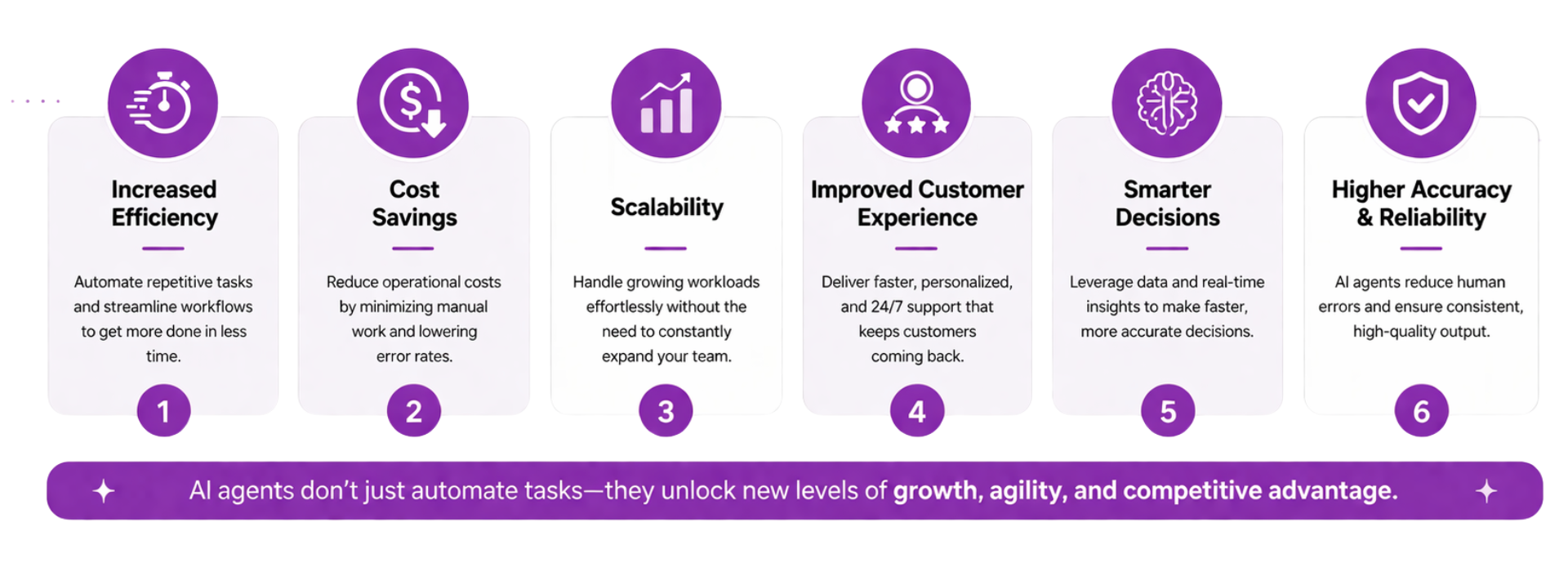
AI agents are essentially changing the way businesses function. Market research estimates that the AI customer service market will reach nearly $48 billion by 2030, showing how rapidly businesses are adopting intelligent automation to scale operations and improve efficiency. Unlike simple chatbots or scripted automation, these AI agents are able to reason, plan and take decisions on your behalf. Instead of being solely rule-based, they can actually make choices on their own. Here’s what that actually looks like in practice.
24/7 Availability Without Burnout
Your employees require time to rest. Your AI agents do not. Customer inquiries, order changes and support requests will be handled at 3 am as easily as they will be handled at 3 pm.
Lower Operational Costs
It takes approximately four employees to match the productivity of one AI Agent. There are no payroll taxes or overtime associated with an AI Agent, and they deliver an unparalleled amount of output for only a fraction of the cost.
Faster Decision Making
An AI Agent will process data and make decisions in seconds, not days, thus allowing for automatic inventory replenishment and prompt processing of customer refunds. No more waiting on approvals.
Personalization at Scale
Treat every customer like your only customer. AI agents remember past interactions, preferences, and behavior to deliver tailored responses across thousands of conversations simultaneously. Gartner predicts that 70% of customers will begin their service journey using conversational AI interfaces by 2028, showing how vital AI-driven agents are to modern customer interactions.
Reduced Human Error
Exhausted humans can sometimes fail to perform correctly. Because AI Agents behave in a consistent manner throughout all their actions, data entries, invoice processing and compliance checks will be correct every time.
Handles Repetitive Work
Utilize your best resources for unexpected issues. AI Agents will handle repetitive processes such as sorting email, scheduling appointments, extracting data and generating reports consistently, without complaint or feeling burned out.
Scales Instantly
Need to process 10 times the number of items than normal tomorrow? Your AI Agent will immediately process these items without the need to hire personnel, train staff or hold meetings regarding staffing.
Top AI Agent Development Companies in 2026
Here is a curated list of leading companies providing AI agent development services:
| Company | Specialization | Key Industries |
|---|---|---|
| OpenAI | Generative AI agents, conversational AI agents | Healthcare, finance, education, gaming |
| Techfyte | Specializes in Enterprise AI automation, intelligent virtual agents | Real estate, logistics, e-commerce |
| Webisoft | Custom AI agent development, autonomous AI agents, generative AI solutions, and workflow automation | Healthcare, fintech, logistics, e-commerce, blockchain |
| IBM Watson | AI decision-making systems, AI business automation tools | Healthcare, banking, retail |
| Microsoft Azure AI | Scalable AI agents, workflow automation | Finance, manufacturing, gaming |
| Cognizant AI Labs | Multi-agent systems, AI orchestration platforms | Healthcare, telecom, insurance |
| Infosys Nia | Conversational AI agents, AI workflow automation | Retail, finance, logistics |
| UiPath AI Center | Enterprise AI automation, robotic process integration | Banking, insurance, supply chain |
| H2O.ai | Custom AI agent solutions, agent-based AI architecture | Healthcare, finance, gaming |
How to Choose the Right Company?
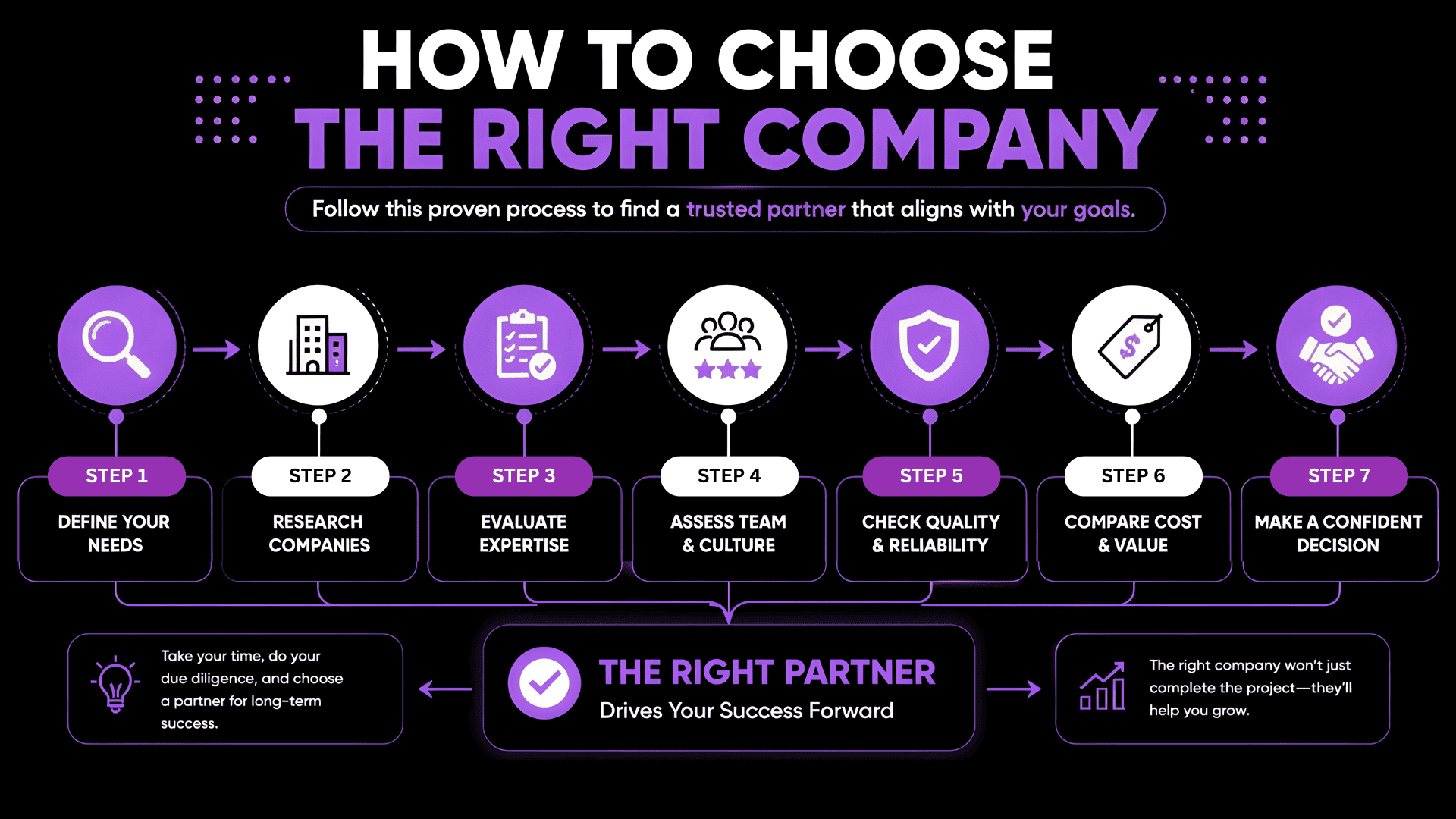
Selecting an AI agent partner is a major decision and should be made with thoughtful consideration. Start by checking their past work and/or reviews of their industry knowledge. If they design, develop, and implement custom AI agent solutions for clients, provide integration with existing workflows, and have good security protocols in place, this is a sound company to work with.
If you’re looking to implement AI agents tailored to your business needs, it’s best to get in touch with experts who can guide you through the process.
When selecting a company as your AI Agent Partner, you should also consider whether they can provide scalability based on your project’s future growth. If they will continue to provide you support during ongoing maintenance and provide you with an AI orchestration platform that meets your requirements. As a business, you should work with a partner that aligns with your company’s key strategic goals (firms that do this will provide ROI) while implementing enterprise AI automation.
Cost of AI Agent Development
Development costs for AI agents will depend on the agent’s complexity, its technological capabilities, and the specific requirements of the industry that employs it. However, both basic conversational agents and highly tailored enterprise multi-agent systems can be built in 2026 at a cost of $15,000 and more than $500,000 respectively.
| AI Agent Type | Estimated Cost (USD) |
|---|---|
| Basic Conversational AI Agent | $15,000 – $30,000 |
| Generative AI Agent | $50,000 – $100,000 |
| Multi-Agent Enterprise Systems | $150,000 – $500,000 |
| Fully Customized Solutions | $500,000+ |
Factors influencing costs include integration needs, number of agents, and ongoing maintenance for AI business automation tools.
Future Trends in AI Agent Development
The growth of AI agent development is happening rapidly. Private sector enterprises that embrace these new innovations will have a competitive advantage. Here are the primary trends influencing the future of AI agents and how they will develop:
- Autonomous AI Agents
The next generation of AI agents will be fully autonomous and able to make complex decisions without any assistance from humans. They will monitor processes, predict results, and optimize processes in real-time adding value across several industries. This is because organizations can eliminate the need for manual supervision of operations and maximize productivity within the organization. - Integration of Generative AI
Generative AI agents are no longer limited to creating content, businesses are using it to generate reports and create marketing plans as well as assist with software development projects. Furthermore, the combination of generative AI and multi-agent systems will allow enterprises to have a higher level of automation and creativity in their processes. - Cross-Platform AI Orchestration
Future AI agents will work together across an organization’s ecosystems (IoT, Cloud, and AI orchestration platforms). By providing organizations with the ability to manage complicated workflows across multiple ecosystems and share real-time visibility and control over their processes, organizations can develop enterprise-level AI automation that is scalable and resilient, supported by cross-chain ecosystems and scalable blockchain frameworks. - Industry-Specific AI Solutions
AI agents will become closely aligned with industry-specific capabilities in multiple domains. In the healthcare industry, for example, AI will assist with both patient diagnosis as well as monitoring patients. In the real estate market, builders will utilize AI to evaluate trends within the market and handle marketing leads. In gaming, AI will also provide consumers with superior user experiences through autonomous agents providing smarter non-player character collaborations. Companies will be able to utilize AI-based agents as tools specifically created around their individual organizational requirements. - Enhanced Security and Compliance
AI is providing access to sensitive information, due to which cybersecurity will become one of the primary focuses of future AI deployments. Future deployments of AI agents will be designed with secure architectures, data encryption to protect both consumer and organizational confidential information, and globally compliant with all laws and regulations. As such, companies will be able to deploy intelligent virtual agents with complete confidence in data security. - Human-AI Collaboration
Rather than replacing humans, AI agents will increasingly collaborate with human users by assisting employees in making decisions, researching, and solving complex problems. By blending both the human ability to anticipate and the ability of the machine to be efficient, a collaborative approach between AI agents and humans will increase overall productivity and innovation within an organization. - Smarter AI Decision-Making Systems
Along with improved decision-making, AI systems will enable agents to recommend and execute actions. Managers can then make quicker and more accurate decisions by relying on AI agents for predictive analytics, workflow evaluation, and other methods to improve performance.
Real-World Impact:
- Healthcare: AI agents will predict patients’ risk and provide improvement opportunities for the best delivery of care.
- Finance: Autonomous AI agents will help detect fraudulent behavior and assist with investment management.
- Logistics: AI will provide real-time optimization of route planning and warehouse functions.
Beyond 2026, these developments will demonstrate that, in addition to automating routine activities, AI will be a valued partner working to develop new products and services.
Wrapping Up
In 2026, AI agents will completely alter how business processes function, due to enterprise-AI automation and intelligent business decision-making using real-time data. Companies can also partner with major organizations such as OpenAI, Techfyte, Webisoft. IBM Watson, and Microsoft Azure AI to create scalable and consistent intelligent strategy solutions that will support increased employee productivity and workplace efficiency while enhancing the overall experience of customers.
Frequently Asked Questions
1. What is an AI agent in business?
An AI agent is an independent digital assistant that collaborates with a company to assist that company in completing repetitive tasks and accessing information. The advantages of utilizing an AI agent include lowering the amount of time a business takes to complete repetitive tasks while allowing the business to focus on more strategic activities that have a longer-term goal.
2. What do AI agent development companies do?
AI agent development companies design the AI solutions used by businesses to automate repetitive tasks and/or provide new ways for employees or customers to interact with their companies. There are many different types of AI solutions designed by an AI agent development company, including chatbots and multi-agent systems.
3. How do I choose the best AI agent development company?
When looking for a company to partner with in the development of your AI agents, it is very important to research potential partner companies to identify reputable companies who have already been successful in providing high-quality AI agent solutions. Consider the qualifications of the company, the range of solutions they have available to meet your needs and wants, and whether they have existing integration capabilities that allow for seamless communication between your organization and theirs, while ensuring the protection of your company’s confidential data.
4. What industries benefit from AI agents?
There are many industry sectors making use of AI agents today. The sectors with the most significant experience thus far are finance, healthcare, retail, gaming, and real estate. Companies can automate many of their processes with an AI agent, providing their customers with an excellent customer service experience, while providing their teams with better insights and ability to get their jobs done quickly and efficiently.
5. How much does AI agent development cost in 2026?
Depending on the complexity of the solution, costs will vary. A basic conversational AI may run $15,000, while an enterprise level AI with multiple agents costs $500,000.
6. What is the difference between an AI agent and a chatbot?
Typically a chatbot assists with messaging and responding to inquiries such as a virtual receptionist. An AI agent is significantly more advanced than that. An AI agent has the ability to make autonomous decisions, perform numerous tasks and work between different systems without continuous human input.
7. Can AI agents be customized for specific business needs?
Certainly! AI agents can be custom built to fit your business’s specific goals and workflows. This provides a way for you and your AI agent to have an ideal working relationship since they are purposely built with the necessary tools to perform optimally within your organization and to operate without requiring any change or adjustment to how you do business.
8. What technologies are used to build AI agents?
The primary technologies that AI agents use are NLP (natural language processing), generative AI and reinforcement learning. They also run on orchestration platforms or software that will help automate many tasks as well as enable the agent to make intelligent decisions on its own without human intervention.
9. How long does it take to develop an AI agent?
It depends on the project. A basic conversational AI can be up and running in a few months, but more complex multi-agent systems for enterprises can take anywhere from six months to a year, including testing and integration.
10. Are AI agents secure for enterprise use?
Yes, as long as they have been built with sufficient security protections such as data encryption to protect against theft or data loss. Enterprise AI agents are also designed to avoid disclosing their data to unauthorized users by enforcing strict policies controlling access rights to service providers.
