



Key Takeaways:
- Polkadot parachains are sovereign, application-specific blockchains that inherit shared security from the relay chain and achieve native interoperability through XCM.
- Unlike smart contracts, parachains offer full customization of runtime logic, governance, tokenomics, and storage — ideal for enterprise-grade applications.
- Agile Coretime (Polkadot 2.0) replaces fixed slot auctions with flexible bulk and on-demand purchases, lowering barriers to entry.
- Parachains suit mission-critical, high-throughput applications; parathreads work for variable-demand use cases; smart contracts are best for MVPs and simple dApps.
- Partnering with an experienced Polkadot development company can reduce time-to-market from 12–18 months to 6–9 months while mitigating technical and operational risks.
Introduction
The difficulty for organizations is to develop scalable interoperable blockchain solutions that can work seamlessly across networks. Traditional blockchains have a tendency to produce bottlenecks and expensive operating costs. The parachain paradigm of Polkadot provides a solution to the problems of scalability, interoperability, and security in a decentralized environment.
Techfyte is a prominent Polkadot parachain development company that assists enterprises to build custom production-ready solutions by relying on Polkadot’s multi-chain architecture. We are experts in AI-native infrastructure and in Web3 apps with seamless cross-chain communication.
What Is a Polkadot Parachain?
A Polkadot parachain is an application-specific, sovereign blockchain that runs parallel to other parachains and is connected to and secured by the Polkadot relay chain. Parachains are specially constructed on Substrate, unlike isolated blockchains they inherit common security, accomplish cross-chain interoperability using XCM (Cross-Consensus Messaging).
What Is Involved in Polkadot Parachain Development
Developing Polkadot parachains includes designing, constructing and deploying application specific blockchains on the Polkadot network. Substrate allows developers to define their own unique runtime logic, develop specialized pallets, and establish parachain-specific governance. Parachains also provide complete control over logic, governance and tokenomics, unlike smart contracts and are therefore excellent for enterprise applications requiring scalability and security. Our custom blockchain development services let you construct your own modular blockchain on Polkadot.
How Polkadot Parachains Work
Polkadot’s architecture is composed of the relay chain (Layer 0) that provides common security, consensus and cross-chain interoperability, and parachains (Layer 1) that function as specialized, parallel blockchains. XCM (Cross-Consensus Messaging) allows parachains to communicate with each other, enabling safe data and value transmission without the need for external bridges. Validators secure the network, collators collate transactions and produce blocks , and fisherman watch for malicious behavior. This means that the blockchain can scale with simultaneous execution over several chains.
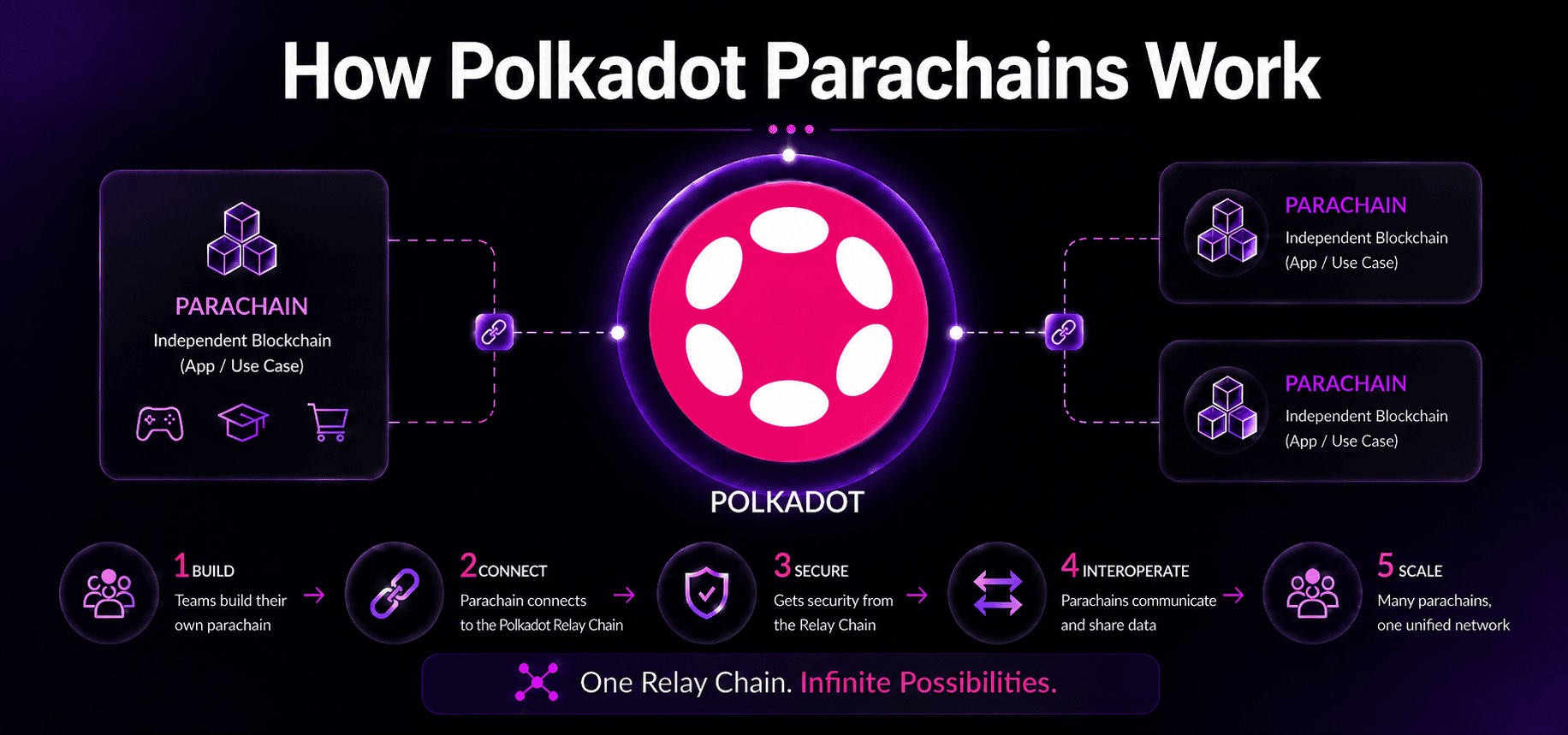
The Scalability Trilemma: Parallel Execution, Shared Security, and Data Availability Availability
Polkadot solves the scalability trilemma by enabling execution in parallel on several parachains. The relay chain guarantees shared security and data availability. Off-chain infrastructure such as indexers and RPC nodes deliver scalable, responsive user experiences without overwhelming the network.
Polkadot Architecture Explained
Polkadot’s design is made up of the Layer 0 Relay Chain, Layer 1 Parachains and Bridges to other networks. Validators run on the relay chain, which uses XCM for Nominated Proof-of-Stake consensus and for cross-chain messaging. The parachains are responsible for the runtime logic, administration, tokenomics, and storage, but rely on the relay chain for final decision making.
Polkadot is a layered system – at the bottom is the Relay Chain, then the Parachains, then there are Bridges to the outside world. The relay chain coordinates validators, employs Nominated Proof-of-Stake to help people achieve consensus, and employs XCM to send messages between chains.
Parachains are independent blockchains that have their own runtime logic, tokenomics, governance, and storage. They only rely on the relay chain for finality. This means that parachains can be built specifically for DeFi, NFTs, gaming, or business purposes. Polkadot’s ecosystem development tools, especially Substrate, enable fully custom chains that remain compatible with each other.
Polkadot can connect to other networks like Ethereum and Kusama through bridges. This means more than just the native ecosystem can work together. Substrate’s WASM execution environment allows for forkless runtime updates, meaning the network can evolve without hard forks. To learn more about cross-network linking, see the Polkadot Bridges documentation.
Key Features of Polkadot Parachain Development
Polkadot parachains provide advantages that general-purpose blockchains cannot provide; complete customization, shared security and native interoperability. Parachain, parathread, or smart contract: It all depends on the use case, budget, and level of control you want. Thanks to the shared security of Polkadot, parachains don’t require their own individual set of validators. You can explore more about Polkadot’s key features on our page.
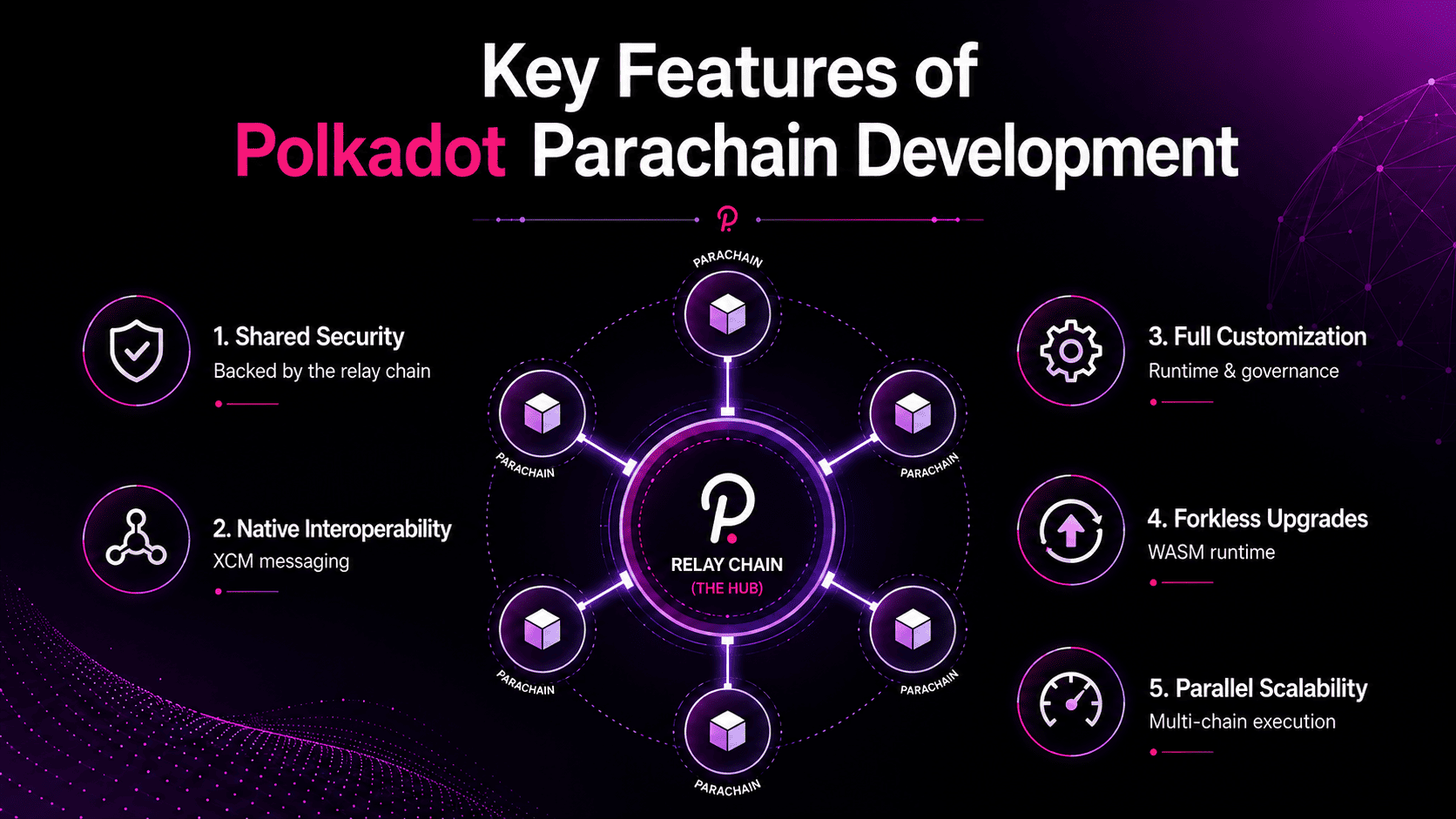
- Shared Security Without Building a Validator Network
Thanks to the shared security of Polkadot, parachains don’t require their own individual set of validators. Parachains are connected directly to the relay chain’s validator pool, which cuts down both costs and the complexity of bootstrapping security, unlike isolated blockchains. Unlike traditional blockchains, Polkadot parachains offer scalable and cost-effective transactions. To learn more about optimizing transaction costs, explore our Gas Optimized Contracts services. - True Interoperability Through Native Cross-Chain Communication
XCM on Polkadot allows parachains to communicate with each other trustlessly, enabling secure data transfer and value exchanges without the need for external bridges. This makes Polkadot a powerful option to the Polkadot smart contract alternatives in terms of cross-chain interoperability. - Forkless Upgrades with Substrate’s WASM Runtime
And with Polkadot’s WASM-based runtime, parachains can implement forkless upgrades with governance-approved changes, removing the danger and downtime of hard forks.
Choosing Your Path: Parachains, Parathreads, and Smart Contracts
| Feature | Parachain | Parathread | Smart Contracts (ink!/EVM) |
| Block space | Dedicated, continuous | Pay-as-you-go, intermittent | Shared with other dApps |
| Cost | Coretime auction/purchase (substantial DOT bond) | Per-block payment (flexible, lower cost) | Gas fees per execution |
| Throughput | Highest, predictable | Variable, based on usage | Limited by chain capacity |
| Control | Full customization (runtime, governance, storage) | Full customization | Limited to contract logic and storage |
| Security | Relay chain inherited | Relay chain inherited | Chain-dependent |
| Best for | Large-scale dApps, enterprise use cases, dedicated chains | Variable-demand apps, testing, bootstrapping | MVPs, community dApps, simple token logic |
When to choose: Parachains are ideal for high-throughput, sovereign governance applications. Parathreads work for variable-demand or bootstrapping without upfront capital. Smart contracts like ink! smart contracts are best for rapid prototyping and simple dApps.
How to Build a Parachain on Polkadot
The process of building a Polkadot parachain is simplified as follows:
Step-by-Step Development Workflow
- Design and Feasibility: Specify the runtime logic, tokenomics, and governance model of your parachain.
- Substrate Development Setup: Set up a Rust environment and get the Substrate node template for your parachain.
- Collator Node Configuration: Configure collators to produce blocks, including P2P networking and key management.
- Local and Rococo Testing: Test on the Rococo testnet for integration testing and verify interactions with Zombienet.
- Security Audit and Benchmarking: Conduct runtime benchmarks and security checks of bespoke pallets.
- Coretime Acquisition and Launch: Acquire coretime through slot auctions or Agile Coretime and start governance.
Securing a Slot: From Auctions to Agile Coretime
DOT bonding through candle auctions and crowdloans in parachain slot auctions. Agile Coretime offers flexibility for projects with varied use needs through bulk coretime purchases and on-demand coretime. This progression reduces cost structure and produces predictable coretime for scalable projects.
Benefits of Hiring a Polkadot Parachain Development Company
Partnering with a professional Polkadot development business will accelerate the time-to-market and lessen the dangers of the steep learning curve of Rust and Substrate.
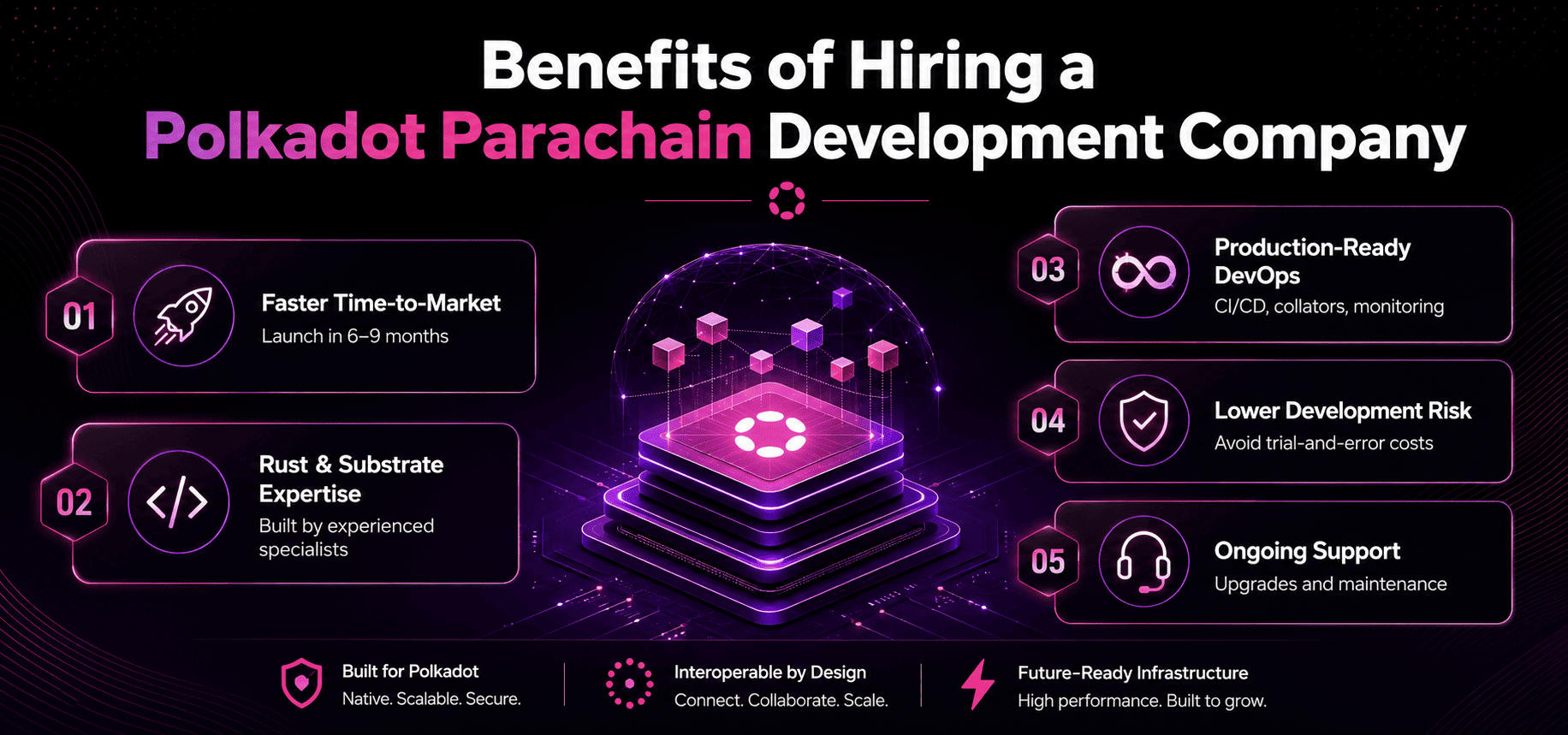
- Accelerated Time-to-Market
Pre-built pallet libraries, CI/CD pipelines and testnet automation can help an experienced team take development time down from 12-18 months to 6-9 months, so you can focus on the core application functionality. - Deep Substrate and Rust Expertise
Learning Rust is no easy task. The substrate further complicates the process. Techfyte’s staff does this with battle-tested experience for speedier, more efficient development. - Production-Grade DevOps and Infrastructure
From launch to continuous maintenance, from the deployment of collator nodes to key management and DDoS protection, we ensure seamless operation.
The Strategic Choice: Build In-House vs Partner with an Expert Team
| Factor | In-House Team | Specialized Parachain Dev Company |
| Time-to-Market | 12–18 months | 6–9 months |
| Rust/Substrate Expertise | Requires hiring and upskilling | Existing team with proven deployments |
| Infrastructure & DevOps | Build from scratch; trial-and-error | Production-tested CI/CD, collator setup |
| Cost Predictability | Variable | Fixed-scope engagements |
| Ongoing Maintenance | Internal team burden | Managed services, runtime upgrade support |
| Risk | High (knowledge silos) | Mitigated (distributed expertise) |
When to choose: In-house teams work for long-term projects with Rust talent. For most enterprises, partnering with experts accelerates launch and reduces risks.
Polkadot vs Other Blockchain Platforms
The right platform depends on application requirements, team capabilities, and long-term architecture goals.
Polkadot vs Ethereum and EVM Rollups
| Feature | Polkadot Parachains | Ethereum L1 | EVM Rollups |
| Architecture | Heterogeneous multi-chain (sovereign L1s) | Monolithic L1 | L2 scaling on Ethereum |
| Security | Shared relay chain security | PoS validator set | Inherits Ethereum security + additional assumptions |
| Interoperability | Native XCM | External bridges | Emerging bridge standards |
| Customization | Full runtime, governance, tokenomics | EVM smart contracts only | EVM-compatible; limited customization |
| Upgrades | Forkless WASM upgrades | Hard forks | Varies by implementation |
| Cost | Coretime + DOT bond | Variable gas fees | Lower than L1; rollup-specific costs |
While Polkadot parachains offer full customization and interoperability via XCM, solutions like stablecoins focus on providing price stability in decentralized finance.
When Polkadot Parachains Are Not the Right Choice
Polkadot may not be the best choice for simple MVPs or single-domain applications without interoperability. Teams lacking Rust expertise or early-stage dApps may benefit more from EVM-compatible rollups or existing parachains.
Real-World Use Cases of Polkadot Parachains
Polkadot’s sovereignty and interoperability is ideal for certain blockchain use cases across many industries. Polkadot parachains can be used in the creation of decentralized NFT marketplaces, enabling secure and efficient transactions for digital assets. Learn more about NFT Marketplace Development.
1. Enterprise-Grade DeFi and Asset Tokenization
Polkadot parachains enable regulated and KYC compliant financial products such as lending platforms and real-world asset tokenization with sovereign governance and compliance. Polkadot parachains enable regulated and KYC-compliant financial products such as lending platforms and real-world asset tokenization with sovereign governance and compliance. Polkadot parachains also provide an ideal solution for real-world asset tokenization, including enterprise-grade use cases such as AI-powered DeFi platforms. Discover our AI Development expertise.
2. Supply Chain and Cross-Border Logistics
Cross-chain interoperability using dedicated parachains allows supply chain consortiums to share data securely with privacy and across jurisdictions.
3. AI-Native and DePIN-Native Parachains
Polkadot’s common security and interoperability also makes it a natural fit for AI and DePIN (Decentralized Physical Infrastructure Networks) use cases. Examples include:
- Decentralized GPU Compute Markets: Resource Allocation, Job Verification, and Incentive Distribution for AI Training Workloads.
- Federated Learning Governance Chains: On-chain model updates and privacy-preserving verification across edge devices.
- IoT Sensor Data Markets: Verifiable sensor data trading with bespoke validation and collective security.
Thanks to Polkadot’s interoperability, DePIN networks can connect to payment, identification, and data storage chains. These solutions are built to meet the demands of a changing world With Techfyte’s experience creating AI and DePIN infrastructure. Polkadot parachains offer robust solutions for industries like supply chain, where real-time data and decentralized tracking are critical. Learn more about Blockchain Supply Chain and Logistics Solutions
Identity and Credential Networks
Polkadot is the perfect environment to construct sovereign identification solutions, like KILT Protocol, which shows decentralized identity management with cross-chain attestations.
Challenges in Parachain Development
- Rust and Substrate Learning Curve: The intricacy of Rust and the abstractions of FRAME and runtime storage in Substrate contribute to a 3-6 month ramp-up. Teams should plan for this learning curve as such.
- Documentation and Ecosystem Maturity: Polkadot’s documentation is less complete than Ethereum’s. Advanced features generally require reading source code or being part of the community. The tooling environment is maturing but still less advanced than Ethereum’s.
- Operational Complexity: Parachain success depends on collator uptime, DevOps and governance. Downtime impacts core time economics and user experience.
- Economic Considerations: Coretime and DOT bonding are large financial commitments and DOT pricing volatility complicates planning. Crowdfunding and crowdloans are also important for funding.
Future of Polkadot Parachains
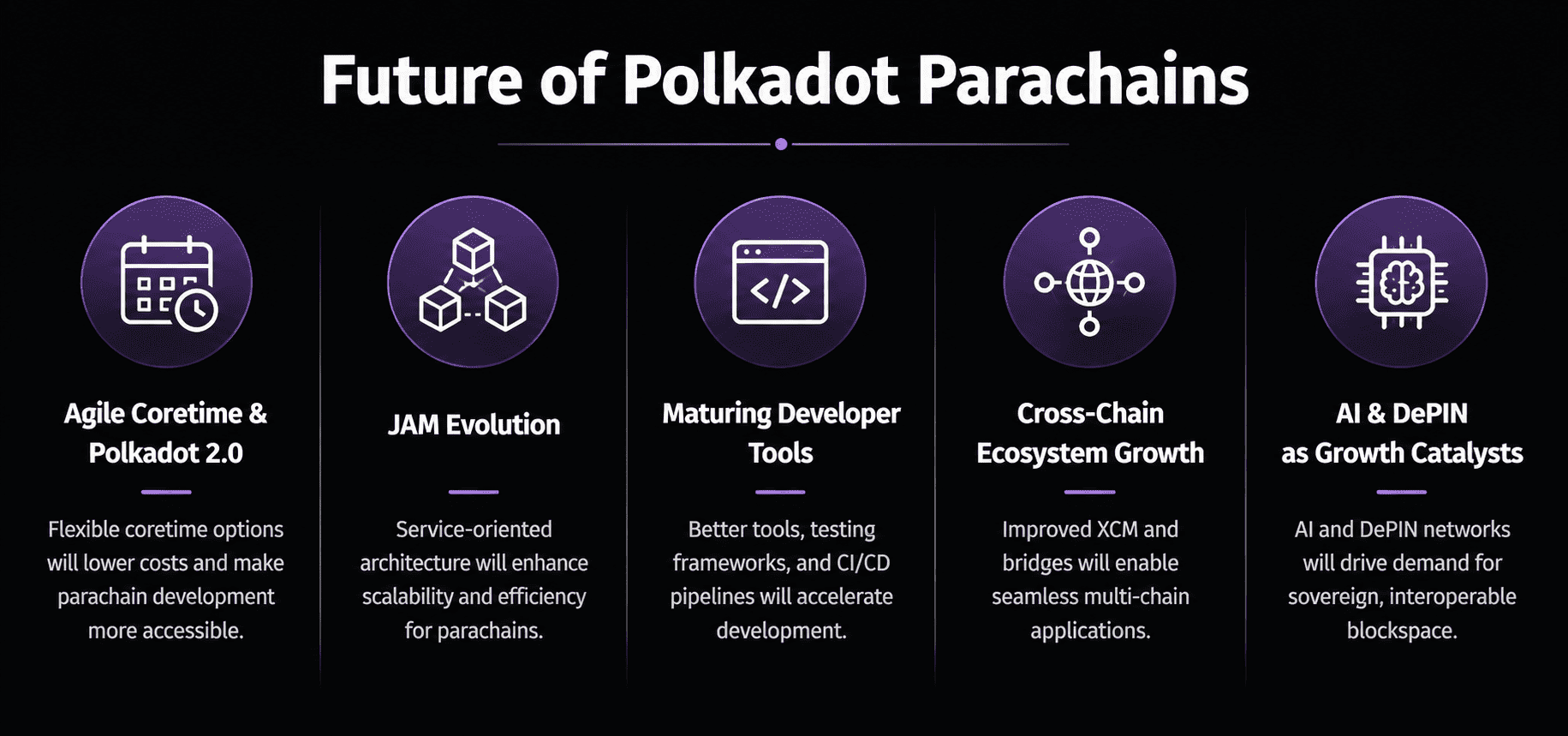
- Agile Coretime and Polkadot 2.0: he ability to purchase coretime and on-demand parathreads reduces the capital needs, making Polkadot more accessible to entrepreneurs and corporations exploring parachain ideas.
- JAM Evolution: More service-oriented architectures for parachains with Polkadot’s future JAM (Join-Accumulate Machine) chain concept.
- Maturing Developer Tools: Better IDEs, testing frameworks and CI/CD integration are making it easier to get started with parachain application development.
- Cross-Chain Ecosystem Growth: Improved XCM patterns and bridges to other networks will allow for sophisticated multi-chain applications, hence boosting Polkadot’s addressable market.
- AI and DePIN as Growth Catalysts: AI and DePIN networks will create demand for sovereign, interconnected block space. Polkadot’s shared security and interoperability make it a great choice for the next generation of decentralized infrastructure.
Frequently Asked Questions
1. What is a Polkadot parachain?
Polkadot-secured, sovereign, application-specific blockchain running concurrently to others. Parachains use Substrate’s modular framework, share security, and have native XCM interoperability.
2. How do parachains work in Polkadot?
Parachains share security and consensus with relay chains. Each runs its own runtime, produces blocks via collators, and communicates trustlessly with other parachains through XCM without bridges.
3. Why choose Polkadot for blockchain development?
For organizations who need sovereign block space and cross-chain capability without establishing an isolated L1, Polkadot offers shared security, native interoperability, forkless upgrades, and full customisation via Substrate.
4. What is Substrate in Polkadot?
A modular framework for parachains and bespoke blockchains. Users can customize runtime logic using Rust and FRAME on pre-built consensus, governance, and staking pallets. Visit Substrate.io.
5. How much does parachain development cost?
Development and coretime expenditures average $150,000–$500,000+. Complexity, bespoke pallets, and audits determine total. Costs are more predictable with an experienced dev business than in-house developments.
6. What industries use Polkadot parachains?
Supply chain, identity management, gambling, IoT/DePIN, AI infrastructure, and DeFi/asset tokenization. Polkadot is ideal for multi-party, cross-border, and regulated enterprise applications because of its compatibility.
7. What’s the difference between a parachain and a parathread?
Coretime purchases give parachains continuous block space. Only when producing blocks, parathreads pay for block space. Parachains are for high-throughput programs, parathreads for variable-demand or bootstrapping.
8. How long does it take to build a Polkadot parachain?
6–9 months for experienced teams, 12–18 months for new in-house Substrate teams. Custom pallet complexity and audit scope affect timelines.
9. Can I migrate an existing Ethereum dApp to a Polkadot parachain?
Rebuilding logic as Rust Substrate pallets, rewriting governance, and perhaps keeping EVM compatibility via Frontier are required. Scalability, native interoperability, and cheaper costs are benefits.
10. What is Agile Coretime in Polkadot?
A flexible alternative to fixed slot auctions that provides bulk coretime for known workloads and on-demand coretime for unpredictable use. Lowers obstacles, removes protracted lock-ups, and streamlines blockspace markets.
