



Key Takeaways
- AI is transforming fashion across design, manufacturing, supply chains, and ecommerce, helping brands shorten decision cycles and reduce manual workloads.
- Generative design, trend forecasting, and virtual prototyping enable creative teams to explore more concepts while reducing sampling time and costs.
- AI-powered quality control, demand forecasting, and inventory optimization help minimize defects, reduce overstock, and improve production planning.
- Personalized recommendations, virtual shopping assistants, and AI-powered size prediction create more relevant shopping experiences and can improve conversion while reducing returns.
- Virtual try-on and digital wardrobe platforms such as Virtufy help shoppers visualize outfits, discover styling options, and make more confident purchase decisions.
- Fashion brands should begin with the use case linked to their biggest operational or customer-experience gap, then scale AI adoption based on measurable business impact.
Introduction
Fashion has always been about balancing creativity and business but now AI is rewriting each half of that equation at once. Machine learning is squeezing processes that once took entire seasons into mere days, from sketchpads to shipping docks to checkouts. Executives evaluating AI in fashion industry adoption are no longer asking whether to invest, but where they’ll get the most bang for their buck and which use case to focus on. According to McKinsey and the Business of Fashion’s State of Fashion 2026 report, AI is now the biggest single potential in the business. In this video you’ll walk through 12 real use-case examples in design, manufacturing and ecommerce, each of which is thorough enough to make a real-world budget choice.
AI in Fashion Design – From Sketch to Collection
1. Generative AI Fashion Design
Generative AI fashion design tools allow designers to describe a silhouette in plain language and receive dozens of graphic options in minutes rather than days. Veteran designer Norma Kamali has trained a proprietary AI model on her own collection of 57 years, yielding new drawing concepts infused with her own taste, rather than generic ones. The technology reduces the brainstorming process from weeks to hours, giving creative teams a chance to experiment with a larger number of alternatives before homing in on examples. A lot of this methodology is built on AI agent development, where creative steps (sketch, palette, fabric) are incorporated into a single pipeline, rather than being isolated tools that require manual handoffs between specialists.
2. AI Trend Forecasting
AI trend forecasting draws on clues gleaned from social media, runway footage and street style to predict emerging designs months before they hit mainstream retail. Inditex, the company behind Zara, uses artificial intelligence to monitor sales in real-time and social sentiment at its 7,000+ sites, changing production orders in weeks, not seasons. According to McKinsey, brands who are leveraging AI for trend forecasting are reducing overstock by 15-20% and increasing full-price sell-through by 8-12%. Instead of one seasonal forecast prepared months in advance, the models continuously reprocess sales, weather and event data.
3. Virtual Prototyping and 3D Garment Visualization
Virtual prototype lets teams study drape, fit and movement on a computer model before cutting a physical sample, reducing sampling costs and schedules. A procedure often based on custom LLM development tailored to fashion-specific vocabulary, construction words and fabric behaviour that a generic language model fails to capture when a designer defines a draped hemline or bias-cut seam. As OpenAI describes in its literature on picture generation, models can now generate and modify visual elements from a written prompt or reference photo with a single API call – a feat that previously took an entire photography setup, a hired model, and an entire studio day to duplicate.
4. Fashion Design Automation
Trend indications are used to inform collection development, helping teams decide which categories require more design hours this season. AI-generated mood boards and lookbooks automatically pull together reference photos, eliminating the need for creative teams to manually curate. Each created asset goes to the right reviewer automatically, working with AI automation systems – a sketch, a pattern remark, and a fabric swatch all arrive at the same design lead without any manual coordination.
Ready to Build an AI-Powered Virtual Fashion Platform in 4 Weeks?
AI in Fashion Manufacturing: From Factory Floor to Warehouse
5. AI Quality Control
AI quality control fashion systems employ computer vision on the manufacturing line to detect stitching faults, fabric irregularities and color incompatibilities at a rate that no human inspector can match for an entire shift. Smart textile production, using IoT sensors and AI, can monitor loom tension and dye uniformity in real time, flagging any variations before a fabric roll is wasted. The ROI is simple. A few percent reduction in defect rates adds up over millions of units per season.
6. Demand Forecasting
Demand forecasting fashion models use weather, local events and historical sell-through to predict which trends go where. Inditex built their fast-replenishment business on this principle: constant store feedback, no singular seasonal plan. It fits naturally with predictive analytics that continuously reprocess signals, not static predictions. We need anomaly detection to spot supplier delays or demand spikes before they impact next week’s results to keep the model trustworthy.
7. AI Supply Chain Optimization
McKinsey’s retail research has recently been reported by Just Style to show that AI supply chain optimization has reached an inflection point, with the most value concentrated in sourcing, pricing and assortment decisions for apparel and footwear. Real-time production scheduling adjustments enable manufacturers to shift capacity to fast-selling styles mid-season, requiring model deployment that updates forecasts on a continuous basis rather than a weekly batch job that is already out of date by the time anyone reads it.
8. Automated Inventory Management
Automated inventory management ensures consistent stock levels across stores, warehouses and online, reducing markdowns from overstock and lost sales from stockouts. AI agent infrastructure really comes into its own when it comes to coordinating planning, procurement and logistics around live numbers, enabling systems to communicate updates automatically rather than through laborious email chains that cause delays and inaccuracies.
AI in Fashion Ecommerce – From Browse to Buy
9. AI Fashion Recommendation Engine
An AI fashion suggestion engine examines browser history, buying trends, and style preferences expressed through returns to determine which things a customer is likely to purchase next. According to industry personalization data provided by Adobe Analytics and McKinsey research, leaders are witnessing revenue increases of up to 40%, with recommendations accounting for a quarter or more of ecommerce revenue. The finest systems go beyond single-item suggestions to whole outfit coordination, recommending parts that complement one another rather than isolated products on a generic grid.
10. AI Virtual Shopping Assistant
An AI virtual shopping assistant converses with customers to guide them through product discovery, answering fit and material inquiries that would previously need a store associate. A fashion chatbot conducts typical customer support activities such as order status, refunds, and sizing, allowing human agents to focus on more difficult instances. These systems are frequently driven by enterprise AI assistants designed to handle high support load during peak seasons while maintaining accuracy throughout thousands of daily chats. Ecommerce personalization for email, offers, and retargeting increasingly relies on multi-agent orchestration to coordinate communications, ensuring that a client does not receive a full-price email on the same day that they see a discount on-site.
11. AI-Powered Size and Fit Prediction
AI-powered size and fit prediction lowers returns by comparing a shopper’s previous purchases and measurements to a brand’s sizing tendencies – an issue that static size charts have never tackled effectively. With visual search and similar-item recommendations, customers may upload a photo and instantly identify related items across a catalog. Virtual try-on with augmented reality allows buyers to see how a garment looks on their own body before making a purchase, directly addressing the fit uncertainty that drives many internet apparel returns.
12. Automated Product Tagging and Catalog Management
Automated product tagging employs picture recognition to provide color, pattern, and category metadata at scale, a task that would otherwise necessitate a huge manual merchandising crew. When combined with AI-powered recommendations and virtual try-ons, a thoroughly tagged catalog serves as the foundation upon which all other ecommerce AI features rely for accuracy.
Limited Offer: Validate Your AI Fashion MVP Before You Spend Big
Virtufy: AI-Powered Fashion Technology in Practice
The use cases listed above are not theoretical, they are already implemented in production platforms. Techfyte’s AI-powered fashion technology platform, Virtufy, brings together virtual try-ons, digital wardrobe management, personalized styling and social commerce in a seamless ecosystem that tackles the root causes of low online fashion confidence and conversion.
Solving the Fashion Experience Gap
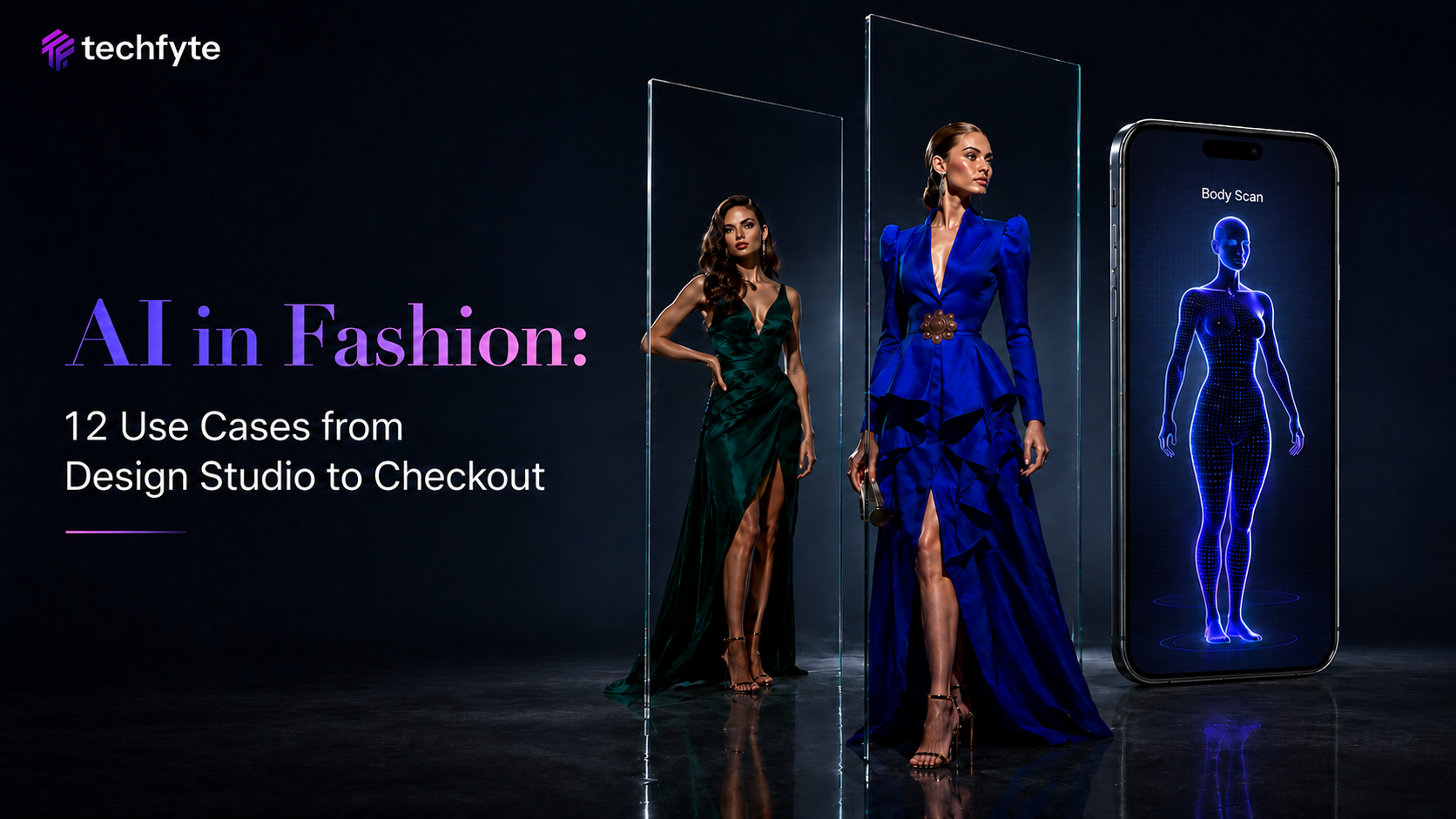
We have chronic structural problems in fashion commerce: a visualization gap that static photos can’t fill to show true fit, inconsistent sizes across brands that lead to returns and a dizzying amount of choice with little in the way of individualized counsel. Virtufy handles each through an integrated AI stack, including body scanning for precise digital profiles, AI-driven virtual try-ons that showcase clothing on a user’s own body live, and customized outfit recommendations based on wardrobe, weather, occasion and personal tastes.
From Fragmented Tools to a Unified Ecosystem
Before Virtufy, wardrobe management, styling tools, shopping and social engagement were on separate sites. Virtufy combines all of those things into one experience – a digital closet that gives AI insights on usage, a marketplace for sellers to showcase products via virtual try-ons and live sessions, and community features for sharing looks and connecting with others. Smart analytics on the platform help users better understand their use of the wardrobe by finding items and ways to style that they may not otherwise see.
Measurable Impact Across the Fashion Journey
Techfyte measured Virtufy’s performance by analyzing user actions before and after the deployment of AI-powered features. The results are the full journey where outfit visualization has gone from static photographs to realistic virtual try-ons, increasing buying confidence. Sizing accuracy changed from irregular and vague to body profile based fitting which resulted in less aggravation in sizing. Styling decisions went from manual and time consuming to AI powered recommendations allowing faster outfit choosing. Vendors were able to showcase their items with real-world preview experiences instead of static photos, which increased confidence in the marketplace. Wardrobe management has evolved from ad hoc and manual to AI-based smart closets with enhanced utilization insights. It’s a change from commerce to social, live interaction. It’s about keeping users on the platform for the long term.
Concluding Note
It’s the same story across design studios, production floors and checkout pages: AI is shortening decision cycles that used to take weeks into hours, and revealing patterns that human teams might otherwise overlook. Brands looking to implement AI in fashion industry don’t need to take on all 12 use cases at once; often the starting point with the highest value is where forecasting errors or manual bottlenecks are quietly costing the most today. Whether it’s generative design, demand forecasting or virtual try-on, the technology is ready for production and those companies implementing it today are gaining a competitive advantage that will only grow as the industry catches up.
Frequently Asked Questions (FAQ)
1. How is AI used in the fashion industry?
AI applications can be design (concept generation, trend forecasting), manufacturing (computer vision quality control, demand forecasting) and retail (personalized recommendations, virtual try-ons, size prediction). Brands like Zara and Norma Kamali are already incorporating technology into their manufacturing processes. McKinsey predicts that in 2026 the biggest opportunity for the fashion industry will be AI.
2. What are the highest-ROI AI use cases in fashion design?
Generative AI fashion design reduces brainstorming time from weeks to hours. AI Trend Forecasting reduces overstock by 15-20% and increases full-price sell-through by 8-12%. The physical samples are replaced by digital models, and therefore the sampling costs are reduced in virtual prototyping. AI-driven mood boards and automated review workflows accelerate collection planning in fashion design.
3. How does AI improve fashion manufacturing?
In AI quality control machine vision is used for detecting stitching faults and fabric defects at speed that humans can’t match. Demand forecasting takes into account weather, events, and sales data to anticipate style change. Mid-season supply chain optimization shifts manufacturing to fast-selling items, and automated inventory management cuts down on overstock markdowns and stockout losses.
4. What AI features improve fashion ecommerce conversion?
AI fashion recommendation systems can earn 40 percent more with personalized suggestions. Virtual shopping assistants powered by AI answer questions about fit and material in spoken form. Decreases returns by matching consumer measurements to brand sizing. Predicting size and fit. Virtual try-on gives shoppers the ability to try items on their own bodies before buying.
5. What is Virtufy and how does it apply AI to fashion?
Techfyte’s AI-powered fashion platform Virtufy offers virtual try-ons, digital wardrobe management, personalized styling and social commerce. It combines body scans to create precise digital profiles, AI-powered try-ons to let you view products in real time and personalized recommendations based on your wardrobe, weather and tastes, all in one place.
Launch Smarter: Get Your 4-Week AI Fashion MVP Roadmap at $0
