



Key Takeaways
- Asset tokenization platforms have evolved into enterprise infrastructure, combining token issuance, investor onboarding, compliance, custody, and secondary trading within a single integrated ecosystem.
- Smart contracts and compliance architecture are the foundation of platform development, with permissioned token standards, independent audits, and embedded regulatory controls minimizing operational and legal risks.
- Development costs range from $80,000–$180,000 for a single-asset MVP to $250,000–$600,000+ for enterprise-grade multi-asset platforms, depending on asset classes, jurisdictions, and custody complexity.
- The choice between custom, white-label, and hybrid development directly impacts cost, timeline, and flexibility, with hybrid approaches offering an effective balance for many organizations.
- Partnering with a development company experienced in production tokenization deployments, ERC-3643, institutional custody, and multi-jurisdiction compliance significantly improves the chances of a successful launch and long-term scalability.
Introduction
Tokenization is moving from pilot to production with real estate, commodities, bonds and private credit moving from proof-of-concept to real infrastructure. An asset tokenization platform issues tokens for the underlying assets, manages investor data, ensures compliance, and coordinates custody. To understand asset tokenization platform development cost, you need to know what needs to be built at each layer, from features and architecture to a realistic cost range and schedule.
Core Features of an Asset Tokenization Platform
Every meaningful platform needs a token issuance engine for minting, burning and lifecycle management. They also need additional layers that assist with onboarding, compliance, custody and dashboards. DTCC has already started to validate this set of features at scale in production deployments: DTCC launched limited production trading of tokenized assets in mid-2026, with plans for a broader rollout later.
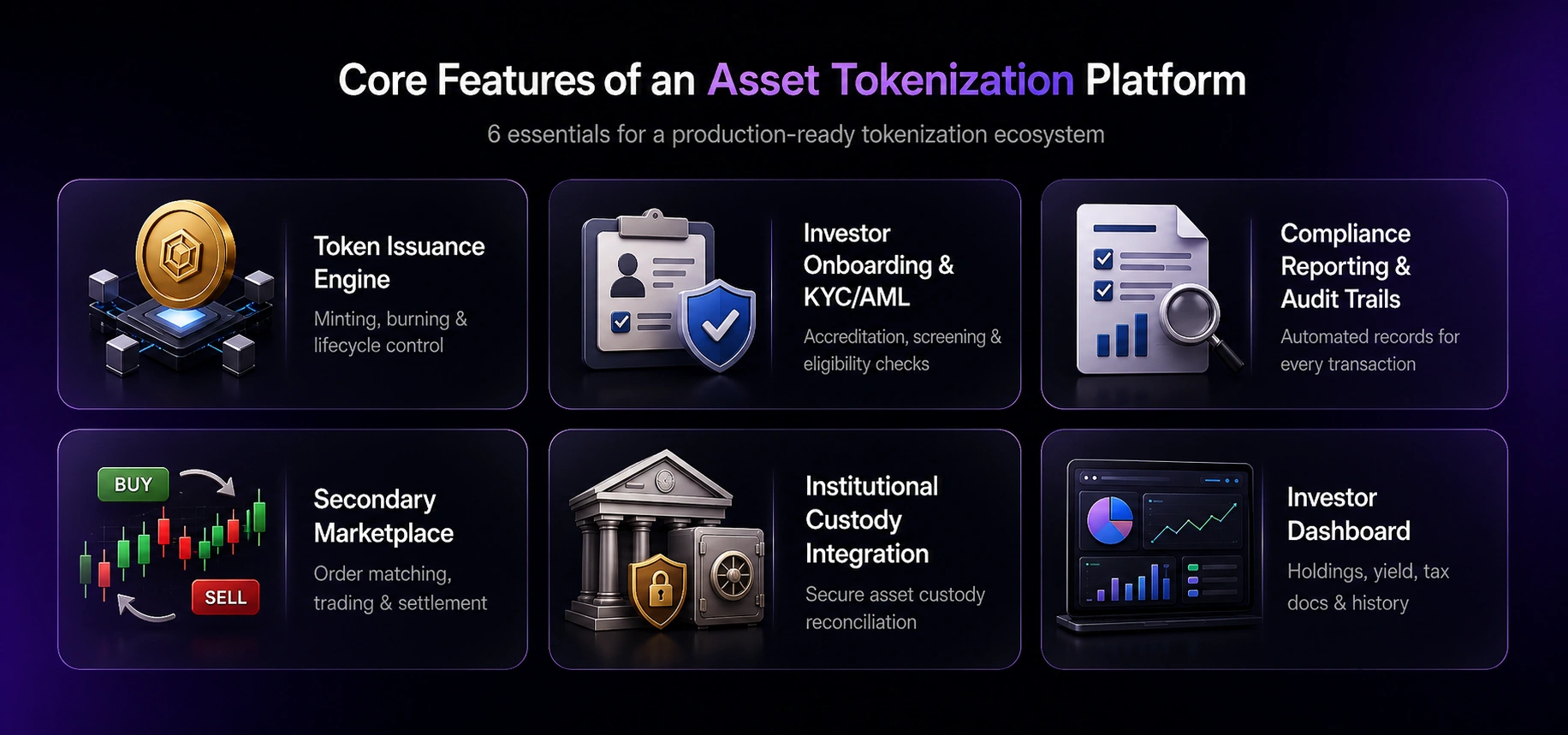
Here are six characteristics that make a production-grade tokenization platform, and how they vary in complexity depending on the underlying asset class:
- Token issuance engine: Layer responsible for minting, burning and lifecycle management of tokens backed by verified assets. Real estate tokenization needs rent distribution logic, escrow processing and title-linked verification that ties each token to a specific property record and its entire legal chain of ownership over time. Commodity tokenization requires tracking of delivery-and-redemption tied to physical inventories, warehouse receipts and periodic proof-of-reserve attestations. Tokenized bonds and stocks follow a very different approach with coupon schedules, corporate action processing, and dividend or interest distribution logic that needs to be compatible with legacy settlement systems.
- Investor onboarding and accreditation: Rigorous investor onboarding can take weeks of integration effort to get accreditation checks, sanctions screening and multi-jurisdiction eligibility requirements properly wired together and validated against edge circumstances. Each country adds another layer of verification logic, and getting it wrong exposes the platform to regulatory action in every market it serves.
- Compliance reporting and audit trails: Once investors are on board, the platform has to keep proving to authorities, on an ongoing and defensible basis, that every single transaction was in compliance with the rules at the point it was done. Automated compliance reporting does this without manual intervention each cycle even as transaction volume grows and the number of jurisdictions covered increases over time, requiring additional reconciliation work every fiscal quarter without fail.
- Secondary marketplace: Once compliance is handled, the next hurdle is liquidity. A functional secondary marketplace for order matching and settlement extends the engineering scope beyond pure issuance and it is rarely optional once a platform moves from a single-issuer pilot to something investors will want to trade on.
- Institutional custody integration: In addition, the core feature set is complete with the integration of institutional custody, which is often overlooked in initial cost estimates as few businesses would deploy a platform before a qualified custodian is already linked and thoroughly vetted end-to-end. This layer reconciles on-chain token positions with off-chain assets held by a licensed custodian.
- Investor dashboard and portfolio management: Beyond the backend infrastructure, investors need a clean interface for tracking holdings, yield distributions, tax documentation, and transaction history. A dashboard that surfaces this data clearly is what separates a platform investors trust from one they tolerate. Even incumbent infrastructure providers are converging on this same feature set rather than something narrower.
Platform Architecture: How the Components Fit Together
- Mobile-responsive frontend
- Smart contract layer
- Compliance middleware (KYC/AML)
- Custody and settlement with fiat on/off ramps
- Data layer for records, portfolio data, and NAV tracking
A typical stack includes five layers: mobile responsive front end, smart contract layer, compliance middleware (KYC/AML), custody and settlement (fiat on/off ramps) and data layer to track records and NAV.
The costs and risks are most concentrated in the smart contract layer, so smart contract development work is the anchor of an architecture, not an afterthought. Every token that is issued through this layer will inherit the rules that were coded in at the time of deployment, so mistakes here are more expensive to fix than errors higher up the stack later on. Permissioned-token standards like ERC-3643 include identification and compliance verification in the transfer function itself, so a failed check just reverts the transaction instead of requiring additional off-chain enforcement, like a patch. That puts real risk onto the contract code itself, which is exactly why an independent smart contract audit is regarded as absolutely necessary before any mainnet deployment for real capital. Companies that skip this step will only find out the true cost when a transfer restriction fails silently in live production. For platforms with cross-country distribution, the same layer must include cross-border distribution logic from the start. Adapting jurisdictional rules later is costly and generally requires a complete redeployment.
Asset Tokenization Platform Development Cost: 2026 Breakdown
Costs are split into discovery, smart contract creation, compliance, frontend, custody, audit and deployment. Costs for a single-asset-class MVP are estimated at $80,000 to $180,000, and a multi-asset platform with secondary trading and institutional custody will cost $250,000 to $600,000 or more, depending on team location and scope. It is contingent upon the number of asset classes, jurisdictions, custody complexity and if the build is bespoke or white-label tokenization.
Timelines are comparable: 3-5 months for an MVP, 7-12 months for a complete enterprise platform, with a number of jurisdictions to choose from at launch. You have to factor in recurring costs like custody fees, compliance staffing and smart contract maintenance into the post-launch equation. In general, RWA tokenization platform development falls toward the higher end of this spectrum than simpler, single-purpose tokenization initiatives that only need to accommodate one instrument type from the start. This gap is largely a matter of scope and jurisdiction: real-world asset platforms that span multiple instrument types and markets have to do a lot more upfront regulatory-compliant token design work because each individual asset class can trigger an entirely different regulatory treatment, and cross-border transactions make it even more complicated. Institutional estimates vary greatly on where the broader market will ultimately settle, but a joint BCG and Ripple analysis predicts that tokenized assets will surpass $18 trillion in the next few years, answering the question of why businesses are budgeting for this now rather than later.
Build vs. White-Label: Choosing the Right Development Approach
A custom build gives you complete control over features and branding, but takes longer and costs more, so appropriate for platforms that require significant difference. White labeling is the fastest and cheapest way to get to market, whereas a hybrid approach uses a white label core and adds custom integrations for one asset class or jurisdiction, keeping costs and timelines low. Custom builds make sense where the compliance model or the investor experience has to be very different. One such reason why white-label options have grown into a legitimate starting point is down to recent industry data tracking tokenization platforms showing a number of active platforms has exceeded 199. For teams debating this option, the trade-off really just comes down to whether speed or distinction is ultimately more important for the particular market being targeted.
Regulatory Compliance: The Layer That Shapes Cost and Timeline
In this context, jurisdiction is really everything. Tokenized securities are regulated by different licensing regimes in the European Union (MiCA), the United Arab Emirates (VARA), Singapore (MAS), and the United States (SEC framework). KYC/AML and sanctions screening is done on an ongoing basis during onboarding and ongoing monitoring, and regulatory-compliant token design means embedding transfer restrictions and compliance checks in the smart contract layer rather than enforcing rules manually after the fact. The SEC own statement on tokenized securities said the format of an asset doesn’t matter for its legal status; a tokenized security is still a security, and it still needs to be audited and licensed. Skipping that step is not a shortcut worth taking. Platforms that excel here view compliance as a continuous architectural requirement, not a pre-launch, never-to-be-revisited checkbox item.
How to Choose an Asset Tokenization Platform Development Partner
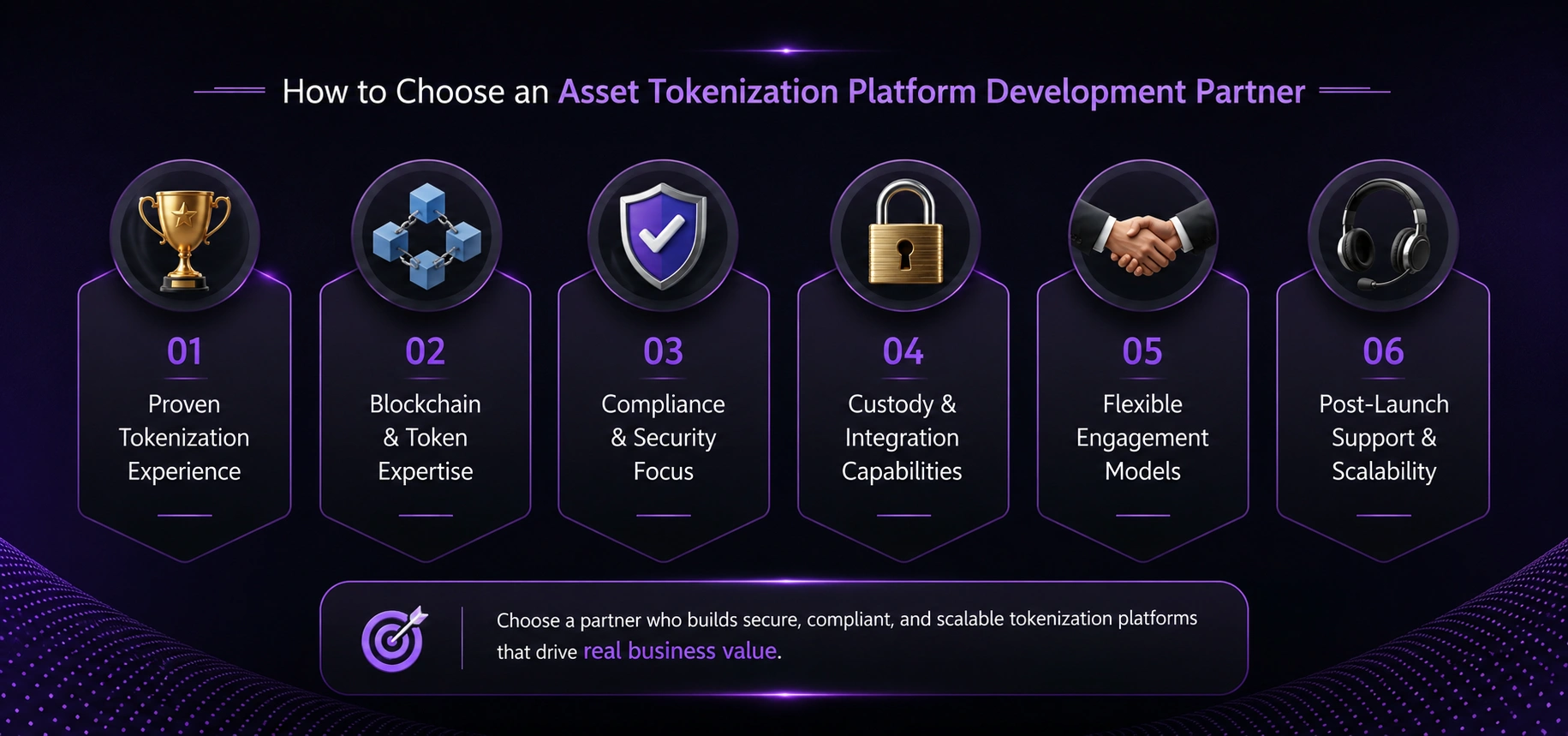
Look for evidence of production deployments in the relevant asset classes and jurisdictions – not pilots. Ask about experience with things like ERC-3643, custodial integrations and prior audit histories. It should center around whether or not the partner has done independent smart contract audits on tokenization platforms that are live today and not still in development. A good partner reduces schedule and compliance risk, and the incremental cost of a higher hourly rate is offset by fewer delays and a platform that gets regulatory approval on the first submission, rather than multiple rounds of feedback. The strongest signal is from a partner who can point to platforms that are currently running live deals with real investors, because that track record shows the kind of production-grade engineering that demos and testnets cannot.
Concluding Note
Tokenization platform spend in 2026 represents a market that is coalescing into distinct tiers, single asset MVPs at one end and multi-jurisdiction enterprise platforms at the other. The winners here will make compliance, custody and architecture interrelated from day one, and that discipline will be reflected in asset tokenization platform development cost estimates that remain flat once a project is underway, rather than ballooning with every new regulatory requirement unearthed mid-sprint.
Frequently Asked Questions
1. What is the asset tokenization platform development cost in 2026?
A single-asset-class MVP costs $80,000 to $180,000, a multi-asset platform with secondary trading and institutional custody costs $250,000 to $600,000 or more. Cost will depend on the number of asset classes involved, the jurisdictions, the complexity of the custody arrangements and whether the construct is custom or white label.
2. What core features does an asset tokenization platform need?
A production-ready platform includes six features: a token issuance engine, investor onboarding with KYC/AML, automated compliance reporting, a secondary marketplace for order matching, institutional custody connection and an investor dashboard. The degree of complexity of features is largely determined by whether the underlying asset is real estate, commodities, bonds or shares.
3. How does platform architecture affect development cost and risk?
The most expensive and risky layer is the smart contract layer. Permissioned token standards, such as ERC-3643, embed compliance checks into transfer actions, and require an independent smart contract audit before mainnet. Cross-border distribution logic must be built-in from the beginning, as retrofitting later often requires a complete redeployment.
4. What drives the difference between MVP and enterprise platform costs?
The largest cost drivers are the asset classes offered, the jurisdictions covered, the custody complexity and whether the platform has a secondary marketplace and cross-border distribution. Multi-asset systems require extra regulatory-compliant token design effort up front as each asset class can have different regulatory treatment.
5. Should I build a custom platform or use white-label tokenization?
Custom construction gives you the power to call the shots but it costs more and takes longer. White-label tokenization enters the market faster, cheaper and with less differentiation. A hybrid approach combining white-label core + custom integrations compresses both. The choice depends on whether speed or differentiation is more important in your market.
