




Key Takeaways
- Crypto exchange development involves much more than building a trading interface; it requires a secure ecosystem covering trading, wallets, liquidity, compliance and backend infrastructure.
- Businesses can choose from different models, including spot, derivatives, margin, P2P, hybrid, prediction marketplaces and white-label exchanges.
- A robust exchange should include a matching engine, internal ledger, wallet infrastructure, liquidity management, KYC/AML, admin dashboard and API layer.
- Crypto exchange development cost varies significantly based on exchange type, features, integrations, custody model, security requirements, supported blockchains and regulatory scope.
Introduction
The cryptocurrency market has evolved from simple digital-asset trading into a sophisticated financial ecosystem supporting spot trading, derivatives, margin, peer-to-peer transactions and decentralized finance. As the market expands, businesses are exploring how to build a crypto exchange platform that can provide secure trading, deep liquidity, high performance and regulatory compliance.
However, developing an exchange is considerably more complex than creating a trading website. A production-ready platform requires a matching engine, custody and wallet infrastructure, internal ledger, liquidity integrations, security controls, compliance systems, APIs and scalable backend architecture.
This guide explains the major exchange types, essential features, architecture, development process, security requirements and factors that influence crypto exchange development cost.
What is the Concept Behind Crypto Exchange Platform Development
A crypto exchange platform is a digital marketplace where users can buy, sell, swap or trade cryptocurrencies and other digital assets. Depending on the business model, the exchange may operate as a centralized platform, decentralized protocol, peer-to-peer marketplace or hybrid system.
Businesses planning to develop a crypto exchange generally have two approaches: build the core technology from scratch or use a pre-built/white-label infrastructure and customize it according to their brand, market and regulatory requirements.
A successful crypto exchange platform development project must balance four critical areas: trading performance, liquidity, security and compliance. The architecture should therefore be planned before development begins because changing the custody, ledger or matching-engine architecture after launch can be expensive and disruptive.
Planning to Build a Crypto Exchange Platform?
Types of Crypto Exchange Platforms
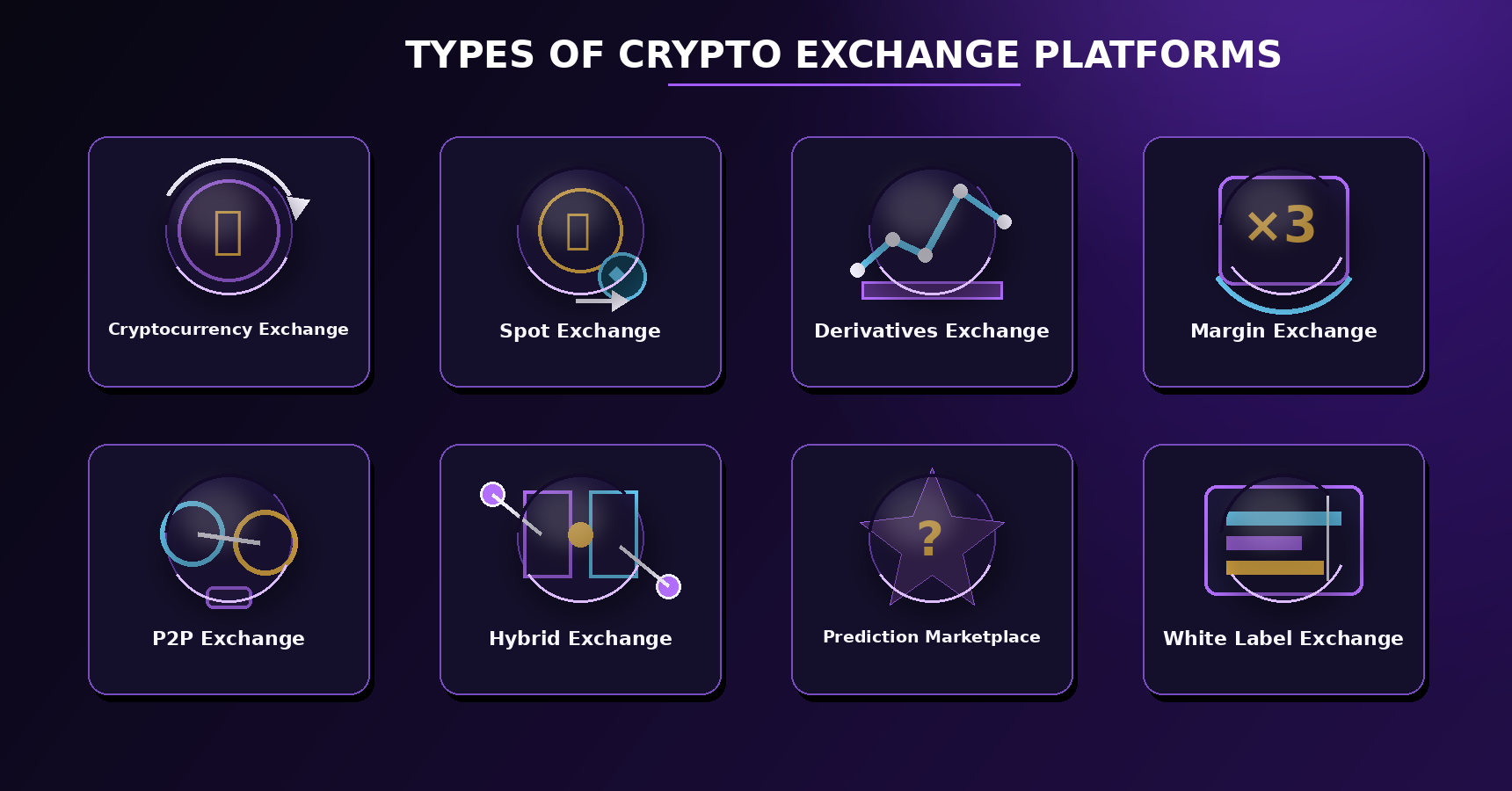
1. Cryptocurrency Exchange
A cryptocurrency exchange provides a marketplace for trading digital assets. Centralized exchanges typically maintain user accounts, custody assets, operate order books and execute trades through an internal matching engine.
2. Spot Exchange
A spot exchange allows users to buy and sell assets at current market prices, with settlement occurring according to the platform’s trading and custody model. Spot trading is generally the foundation on which more advanced exchange products are built.
3. Derivatives Exchange
A derivatives exchange enables products such as futures and perpetual contracts. These platforms require additional components, including margin management, position tracking, funding calculations, risk management and, where applicable, liquidation mechanisms.
4. Margin Exchange
Margin trading allows users to trade with borrowed funds or leverage. Consequently, the platform needs collateral management, borrowing mechanisms, interest calculations, leverage controls and liquidation systems.
5. P2P Exchange
A peer-to-peer exchange connects buyers and sellers directly. An escrow mechanism can hold assets while payment takes place, while dispute-management and payment verification systems support transaction completion.
6. Hybrid Exchange
A hybrid exchange combines elements of centralized and decentralized infrastructure. For example, order matching may occur off-chain while settlement or custody uses blockchain-based infrastructure. This model can provide greater flexibility but introduces additional architectural complexity.
7. Prediction Marketplace
A prediction marketplace allows users to trade positions associated with the outcome of future events. Depending on the jurisdiction and product structure, this model can introduce additional legal and regulatory considerations beyond conventional spot trading.
8. White Label Exchange
A white label exchange uses pre-built exchange infrastructure that can be customized with a company’s branding, supported assets, user interface and selected integrations. This approach can reduce initial development time compared with building every component from scratch, although licensing, compliance, security and operational responsibilities still need to be addressed.
Key Features of a Crypto Exchange Platform
The feature set should be determined by the exchange’s business model rather than simply copying features from competing platforms.
Essential features generally include:
- User registration and authentication: Account creation, password management, MFA/passkeys and account recovery.
- KYC/KYB: Identity or business verification based on the applicable customer and jurisdiction requirements.
- Trading dashboard: Real-time prices, charts, order books, balances and trading history.
- Order management: Market, limit and stop orders, depending on the product scope.
- Matching engine: Matches compatible buy and sell orders according to the exchange’s execution rules.
- Wallet management: Deposit addresses, transaction monitoring, withdrawals and supported blockchain networks.
- Internal ledger: Records balances, trades, fees, transfers and other financial movements.
- Liquidity management: Connects to market makers, liquidity providers or external venues where appropriate.
- Admin dashboard: User management, asset management, trading controls, fees, reporting and compliance workflows.
- Notifications: Email, SMS, push and in-platform alerts.
- API infrastructure: REST/WebSocket APIs for applications, automated traders and institutional clients.
- Reporting and analytics: Trading activity, revenue, fees, user activity and operational metrics.
Advanced exchanges may also add derivatives, margin trading, copy trading, staking, fiat on/off-ramps, institutional APIs and multi-chain support. These additions increase both development scope and operational complexity.
The Architecture Behind Crypto Exchange Platform
A scalable exchange should be designed as a collection of specialized services rather than treating the application as only a web interface.
1. Order Matching Engine
The order matching engine is the core trading component. It receives orders, maintains order books and determines which buy and sell orders can be executed.
For a high-performance exchange, the engine should be isolated from non-critical services and designed for deterministic processing, predictable latency and high availability. In-memory data structures are commonly used for active order-book state, while completed trades and audit information are persisted separately.
2. Liquidity Management
Liquidity determines how easily users can execute trades without excessive price impact or slippage. A new exchange may obtain liquidity through market makers, external liquidity providers or aggregated connections to other venues.
A liquidity management system connect the trading system with external providers while monitoring spreads, volumes and available depth. Without sufficient liquidity, even a technically strong exchange can deliver a poor trading experience.
3. Trading Engine & Wallet Infrastructure
The trading engine manages order processing, account balances, fees and trade execution around the matching engine. A reliable internal ledger is particularly important because the exchange needs an accurate record of user assets and financial movements.
The wallet layer connects users’ balances with blockchain networks. It may include deposit detection, address management, transaction monitoring, withdrawal queues and fee estimation.
For custodial exchanges, wallet architecture should normally separate online operational funds from longer-term storage and introduce appropriate authorization controls. MPC or multisignature mechanisms can be used as part of a broader custody architecture.
Compliance, monitoring, risk management and security should operate across these layers rather than as isolated modules.
Security & Compliance Requirements
Security is one of the most important considerations when you build a crypto exchange platform, because the platform may manage valuable customer assets and sensitive identity information.
Important security controls can include:
- Multi-factor authentication and strong account security
- Role-based access control
- Encryption in transit and at rest
- API authentication and rate limiting
- Web application firewalls and DDoS protection
- Hot/cold wallet segregation where applicable
- MPC or multisignature transaction authorization
- Withdrawal limits and risk-based controls
- Continuous monitoring and anomaly detection
- Secure key management
- Detailed audit logs
- Penetration testing and vulnerability assessments
- Disaster recovery and backup infrastructure
Compliance requirements depend on the exchange’s jurisdiction, products and operating model. KYC/AML, transaction monitoring, sanctions screening, Travel Rule requirements and jurisdiction-specific licensing may all become relevant. Compliance should be incorporated into the architecture and data model from the beginning rather than added immediately before launch.
Development Process to Follow to Build A Crypto Exchange Platform
1. Planning
The first stage defines the business model, target users, supported assets, trading products, jurisdictions, custody approach and monetization strategy. This stage should also establish technical requirements such as expected trading volume, supported blockchain networks, availability targets and API requirements.
2. UI/UX Design
The interface should make complex trading operations understandable without hiding important information. Trading screens typically include charts, order books, order-entry panels, balances, open orders and trade history.
3. Development
Developers build or configure the frontend, backend, matching engine, ledger, wallet infrastructure, admin panel and security components. A modular architecture allows individual services to scale and evolve independently.
4. Integration
The exchange may need integrations with KYC/AML providers, blockchain nodes, custody providers, liquidity providers, payment gateways, market-data providers and notification services.
5. Testing
Testing should cover functional behavior as well as financial correctness and security. Load testing, API testing, wallet testing, blockchain transaction testing, penetration testing, failure recovery and order-matching validation are important before production deployment.
6. Deployment
The final stage includes production infrastructure, monitoring, backups, security controls, operational procedures and launch preparation. Post-launch monitoring is essential because exchange operations continue long after the software goes live.
Custom vs White-Label Crypto Exchange Platform Development Solutions
Custom development provides greater control over the architecture, codebase, product roadmap and integrations. It is suitable for businesses that require specialized trading functionality, institutional infrastructure or extensive customization. However, custom development requires more engineering resources, testing and capital.
White-label development uses an existing exchange infrastructure that is customized for the business. It can reduce time to market and initial engineering requirements. White-label solutions may include components such as trading engines, wallets, KYC/AML integrations, liquidity connectivity and administrative functionality.
The right choice depends on the required level of control, budget, regulatory requirements, technical expertise and long-term product strategy.
Crypto Exchange Development Cost & Timeline
There is no universal crypto exchange development cost because scope differs significantly between projects.
For example, recent industry estimates put white-label implementations in the tens of thousands of dollars, while custom centralized exchanges can extend into several hundred thousand dollars or more. Antier’s published 2026 estimates place custom mid-scale CEX development around 230k-470K including its stated security additions, while institutional CEX projects can exceed $1 million. These are vendor estimates, not fixed industry prices.
The primary factors affecting cost include:
- Exchange type
- Custom vs white-label architecture
- Number of trading pairs
- Matching-engine requirements
- Wallet and custody architecture
- Number of blockchain networks
- KYC/AML integrations
- Liquidity integrations
- Fiat payment infrastructure
- Mobile applications
- Derivatives or margin functionality
- Security testing and audits
- Regulatory requirements
- Post-launch maintenance
Development timelines can range from several weeks for a heavily pre-built white-label implementation to 6-18 months or more for a sophisticated custom CEX, depending on scope.
A reliable project quotation should therefore provide a component-level scope instead of presenting a single headline price.
Need an Accurate Crypto Exchange Development Cost Estimate?
How to Choose a Crypto Exchange Development Company
Choosing the right crypto exchange development company is as important as selecting the technology stack. Look for a provider with demonstrated experience in:
- Matching-engine development
- Exchange wallet and custody architecture
- Liquidity integration
- KYC/AML implementation
- Blockchain integration
- Security engineering
- High-performance APIs
- Trading and financial ledgers
- Cloud and DevOps infrastructure
- Exchange testing and audits
Ask potential providers for architecture documentation, project references, development methodology, security practices, source-code ownership terms and post-launch support arrangements.
You should also distinguish between generic blockchain development and specialized Crypto exchange development services. An exchange requires financial-system engineering, real-time processing, asset custody and operational controls that go beyond conventional smart contract or website development.
A capable provider should also be able to explain what is included in its crypto exchange platform development solutions, which components are third-party dependencies and which systems your business will actually own.
Conclusion
To develop a crypto exchange, businesses need much more than a trading interface. The platform requires a carefully engineered combination of matching technology, liquidity, internal accounting, wallet infrastructure, blockchain connectivity, security and compliance.
Custom development offers greater control, while white-label infrastructure can accelerate deployment. Regardless of the approach, security and compliance should be built into the platform from the beginning.
Ultimately, successful crypto exchange platform development depends on choosing the right partner like Techfyte that helps defining realistic performance requirements and working with an experienced crypto exchange development company capable of supporting both technology and ongoing operations.
Frequently Asked Questions
1. How much does it cost to build a crypto exchange platform?
The cost varies according to exchange type, features, architecture, security, liquidity, compliance and integrations. White-label projects can start in the tens of thousands of dollars, while sophisticated custom exchanges can require several hundred thousand dollars or more.
2. How long does crypto exchange development take?
A pre-built white-label platform may be deployed relatively quickly, while a fully customized exchange can take approximately 6–18 months depending on scope and regulatory requirements.
3. What are the most important components of a crypto exchange?
The core components include the matching engine, order-management system, internal ledger, wallet/custody infrastructure, liquidity layer, blockchain integrations, user-management system, compliance engine and administrative backend.
4. Is white-label crypto exchange development better than custom development?
They serve different requirements. White-label development can reduce development time and initial engineering work, while custom development provides greater control over functionality, architecture and long-term product evolution.
5. What security features should a crypto exchange have?
Security can include MFA, encryption, access controls, secure key management, wallet segregation, MPC or multisignature authorization, withdrawal controls, monitoring, penetration testing, backups and disaster recovery.
6. Why is liquidity important for a crypto exchange?
Liquidity allows users to execute orders with less price impact and lower slippage. Exchanges commonly work with market makers, liquidity providers or external venues to establish sufficient market depth.
7. How do I choose a crypto exchange development company?
Evaluate the company’s exchange-specific technical experience, security practices, architecture capabilities, blockchain expertise, liquidity integrations, compliance knowledge, previous implementations and post-launch support. A provider should clearly explain its crypto exchange development services and what is included in the proposed solution.
Ready to Launch Your Crypto Exchange Platform?
