



Key Takeaways
- Custom AI agents plan, reason, use tools, and execute multi-step workflows, moving enterprise automation beyond traditional chatbot capabilities.
- AI agent development typically follows seven stages, covering discovery, architecture, integrations, memory, evaluation, deployment, monitoring, and continuous improvement.
- Custom AI agent development costs range from $15,000 for focused workflows to $400,000+ for complex enterprise deployments.
- Enterprise AI agents deliver strong value across customer support, sales, finance, compliance, operations, and software development workflows.
- Production-ready AI agents require robust governance, human oversight, audit trails, security controls, continuous evaluation, and post-launch monitoring.
Introduction
You ask a chatbot a question and it answers. Tell a custom AI agent to reconcile a vendor invoice against a purchase order, highlight the discrepancy and send it for approval, and the agent figures out the processes, reaches out to the required tools and does the work without a human typing in each command. This dichotomy – reasoning and acting vs just replying – explains the move of company funds from chatbot pilots to production-grade bots. By the end of 2026, Gartner predicts that close to 40% of corporate applications will feature task-specific agents and the underlying agent economy will grow to meet that demand.
For CTOs, product executives and founders considering custom AI agent development services, the main questions are practical: What do these systems do differently? How are they developed? How much do they cost? Where do they pay off fastest? This guide covers agent capabilities, the development process, realistic cost ranges in 2026, proven use cases and how to select the right development partner.
What Are Custom AI Agents?
The chatbot answers a question in one turn, based on the context in its prompt window. A custom AI agent development effort makes something that is structurally unique. Here’s what agents do differently:
- Plan and act, not just react: An agent develops a multi-step plan, chooses what tools or API to call, calls them, checks its own output, and modifies the plan when something goes wrong – all without human approval.
- LLM directed tool use and memory: The LLM will not be driven by a pre-defined script but will decide when and how to use retrieval, tools, and memory following Anthropic’s engineering guidance on building effective agents. That autonomy allows custom AI agents for business automation to be applied to workflows too variable for rule-based automation, such as exception-heavy processes, multi-system lookups, and jobs where the next step is determined by the previous one.
- Custom vs. off-the-shelf: Off-the-shelf copilots do specific tasks that are defined by the vendor. Custom development lets you customize the agent’s tools, guardrails, and decision boundaries for your specific systems and risk appetite – the difference between a general assistant and a purpose-built operator.
Core Capabilities of Enterprise AI Agents
Enterprise AI agents are built on a common set of capabilities that can be applied to many use cases. So, what makes a production grade agent:
1. Tool Use and Multi-Step Reasoning
Instead of just saying what a human should do next, the agent can use tools to call internal APIs, query databases and trigger downstream systems. It can break down a goal into sub-tasks and re-plan if a tool call fails or returns an unexpected result, enabling multi-step reasoning. These features set custom agents apart from enterprise AI assistants, which are mainly meant to answer questions over papers.
2. Memory, Multi-Agent Orchestration, and Infrastructure
The memory and context management enables the agent to keep focused on the long-term goal, not losing track of previous actions. Multi-agent orchestration, for workflows too complex for a single agent, distributes work over specialized agents, a pattern documented by Anthropic’s engineering team in its own production research system. That means you have a lead agent that works with parallel subagents, instead of a single model doing it all sequentially. This approach builds on top of a strong AI agent infrastructure, including logging, retries and rate restriction and monitoring to deal with non-deterministic outputs.
3. Human-in-the-Loop and Audit Trails for Regulated Environments
In regulated situations, two skills are particularly important: human-in-the-loop checkpoints before irreversible actions, and audit trails documenting what the agent decided and why. Grand View Research projects the AI agents market to grow from about $10.9 billion in 2026 to $182.9 billion in 2033, highlighting the shift from single pilots to production-grade capability.
Build a Custom AI Agent to Automate Complex Enterprise Workflows
The AI Agent Development Process
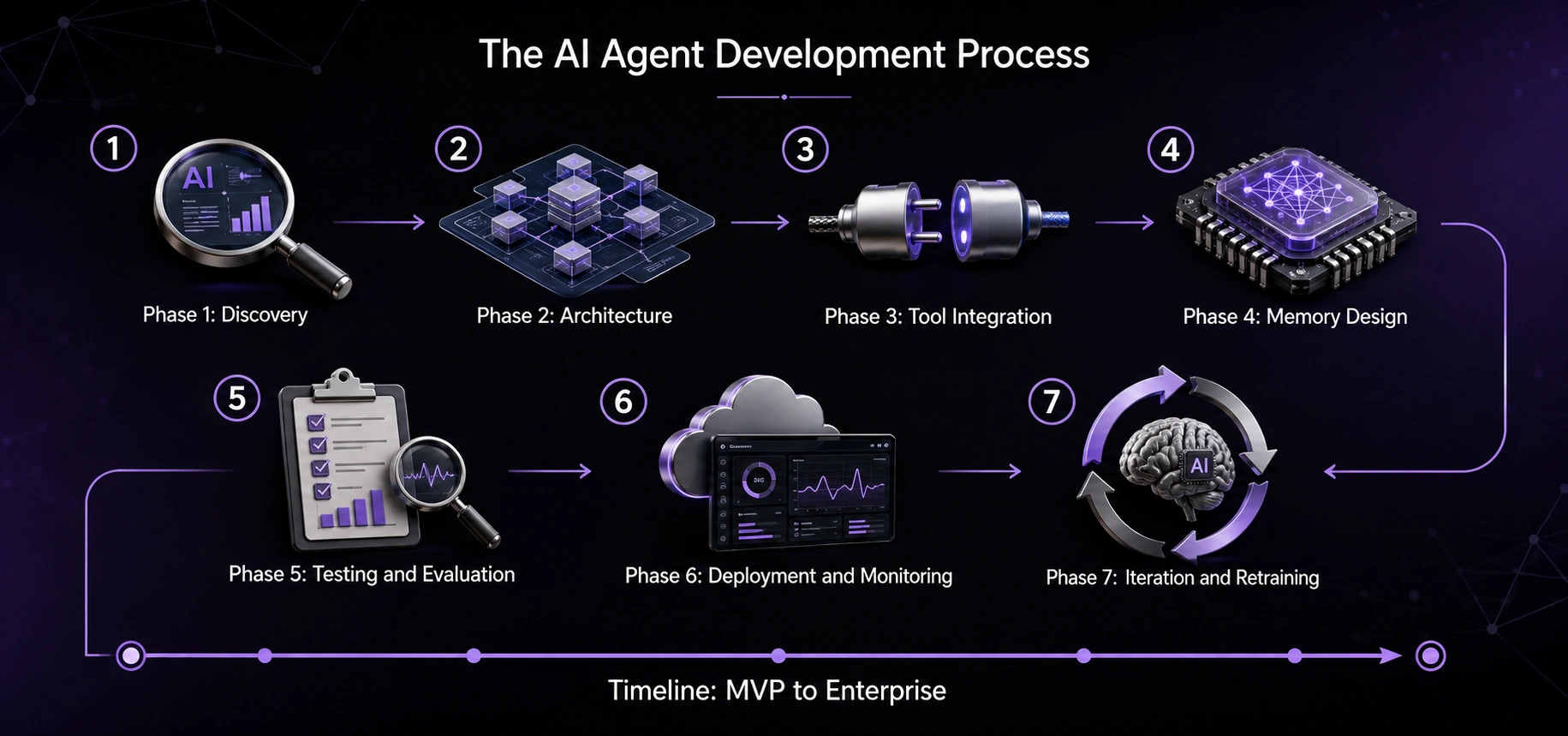
The AI agent development process is a disciplined process that has seven stages. Each phase builds on the one before it, and missing any of them often means costly rework later down the line. Here is the build.
Phase 1: Discovery
The discovery map displays the flow, decisions and systems that the agent must interact with. In this phase, the tasks for the autonomy are identified, when human checkpoints are needed, and the metrics of success that the agent should have. The cheapest phase to get wrong, but the most expensive to fix later.
Phase 2: Architecture
Architecture decides the orchestration pattern (single agent, orchestrator-worker, pipeline) and picks a model based on reasoning quality, latency, price. The orchestration pattern selection sets everything downstream. A simple workflow could only require one agent. A multi-step process with concurrent branches could require multi-agent orchestration from the beginning.
Phase 3: Tool Integration
Tool integration creates and documents APIs for the agent to use to access internal systems, databases, CRMs and third party services. Every tool needs to have explicit input/output contracts, error handling, and rate limiting so that the agent can use it consistently, rather than guessing how it works.
Phase 4: Memory Design
Memory design defines what context carries over from stage to stage, and how it is stored: short term session state vs long term knowledge bases. During this phase, the agent either maintains context over a long-running task or loses sight of previous decisions.
Phase 5: Testing and Evaluation
In terms of testing, agentic AI development services are the most different from traditional QA. Deterministic unit tests are replaced with evaluation sets, adversarial prompts, and failure-mode logging. ML pipeline development work often runs in parallel, pushing clean, versioned data to the agent, not ad hoc queries. An agent making judgments on outdated or faulty data fails in ways that are difficult to trace to the root cause.
Phase 6: Deployment and Monitoring
Model deployment links the agent to staging and production, watching for drift, cost, and weird tool-call patterns. Most teams find that post-launch monitoring is not optional; and that testing alone could not reveal edge cases.
Phase 7: Iteration and Retraining
Once live, the agent is tuned using evaluation feedback, automated retraining when usage patterns change, and periodic evaluation runs. This phase never ends: an agent in production is a continuously improving system, not a one-time deliverable.
Timeline: MVP to Enterprise
A focused MVP (one workflow, 1-2 tools) usually takes 4-8 weeks. Multi-agent enterprise system with orchestration, specialized tools, and compliance assessment. One thing to think about early on is model pricing, as token rates reported on Anthropic’s official pricing page vary dramatically by model tier and have a significant impact on per-task cost at scale.
Maica: Voice AI Agent in Production
Maica demonstrates what a production-grade voice AI agent looks like in practice. Built by Techfyte, Maica replaces traditional IVR systems with conversational AI that understands intent, executes tasks, and scales across 20+ languages without human involvement.
What Maica Automates
- Appointment scheduling – Books, confirms, and updates appointments across integrated calendars
- Lead qualification – Captures intent, qualifies prospects, and routes warm leads to sales
- Customer support – Answers FAQs, retrieves CRM data, and resolves routine requests
- Seamless handoffs – Escalates complex calls to humans with full conversation context preserved
Architecture Highlights
Maica exemplifies core capabilities from this guide:
- Tool Integration: Connects to CRMs and help desks to execute real workflows, not just answer questions.
- Memory and Context: Maintains session state across multi-turn conversations for coherent dialogues.
- Enterprise Governance: Built with compliance, data protection, and audit trails for regulated environments.
Outcomes
Organizations report zero missed calls, reduced cost per interaction, elastic scalability during peak periods, and centralized conversation intelligence through unified dashboards.
Why It Matters
Maica illustrates three principles from this guide:
- Narrow, high-volume workflows yield fastest ROI;
- Integration depth determines value; and
- Production-ready agents require governance from day one, not as an afterthought.
For businesses evaluating custom AI agent development, Maica serves as a reference architecture for combining conversational intelligence, system integrations, and enterprise safeguards into a scalable platform.
Cost to Build a Custom AI Agent in 2026
AI agent development costs vary widely since “agent” can mean anything from a simple single-tool helper to a multi-agent system coordinating a dozen internal APIs. Building a limited single-workflow agent with one LLM, one or two tool connectors, and basic logging typically costs $15,000 to $40,000. A department-level agent with multi-step reasoning, lots of integrations, and a human-review interface costs roughly $50,000-$120,000. Enterprise multi-agent systems with orchestration, custom LLM development, heavy compliance tooling, high availability infrastructure, etc., usually cost $150,000 to $400,000+ USD. These are indicative estimates, the cost of building a custom AI agent is mostly driven by the complexity of the integration and data readiness and not the model.
1. Ongoing Costs and Build-vs-Platform Trade-offs
The build vs platform decision needs to consider not just the costs of the build but also the ongoing costs. Each API call costs token usage. Anthropic API published rates range from $1 to $10 per million input tokens depending on the model tier, output tokens cost much more. Add monitoring, automated retraining as usage patterns change, periodic evaluation runs, and the ongoing cost for an active enterprise agent can easily be a few thousand dollars a month before staffing. The other big trade-off is build vs platform: agent platforms purchased off-the-shelf are cheaper to begin with, but limit access to tools and data governance, which is a big problem for regulated processes.
Use Cases for Custom AI Agents
Here are six areas where custom AI agents are most commonly used for business automation. Customer service agents triage tickets, pull account data, and resolve routine requests without escalation. According to American Banker, Bank of America’s employee-facing Erica assistant now offloads work equivalent to roughly 11,000 full-time employees while reducing internal help-desk call volume by more than half. Salespeople qualify leads, update CRM data, and write outreach based on the history of the account.
Six Proven Enterprise Use Cases
- Internal operations agents that index knowledge bases and answer employee questions
- Financial analysis agents that draft variance reports and flag unusual transactions
- Compliance monitoring agents that scan communications against policy rules
- Code generation agents that write, test, and open pull requests for review
- Customer support agents that triage, resolve, and escalate based on account context
- Sales qualification agents that enrich CRM data and prioritize outreach
Financial analysts are increasingly using anomaly detection that is customized to the normal activity of each account. Compliance agents are using the same pattern-matching to automatically find exceptions to regulations. In all of these cases, agents are most effective in high volume, well-defined tasks with low error rates, and the most effective AI automation systems combine agent autonomy with a clear human checkpoint. That mix is reflected in the numbers: Anthropic’s 2026 survey of enterprise technical leaders found nearly eight out of ten firms are now seeing measurable ROI from AI agents, with the majority expecting it soon.
Get a Custom AI Agent Cost Estimate for Your Business
Security, Compliance, and Governance
Security and governance are the differentiators between agent pilots that pass procurement review vs. those that do not. Every enterprise AI agent deployment must consider these five layers:
1. Data Privacy and Input/Output Control
Data privacy starts with how the agent handles inputs and outputs: what is sent to a third-party LLM, what stays on your infrastructure, and how long you keep logs. A security assessment will want a clear data flow map first, because an agent accidentally sending sensitive customer data to an external API is a compliance risk waiting to happen.
2. Explainability and Audit Trails
Explainability is important too; reviewers should be able to see not just an agent’s final answer, but the reasoning and tool calls that led to it. Every decision made should be traceable back to the inputs, prompts, and tool results that led to it. Audit trails in regulated businesses are not some optional documentation; they are the evidence that authorities will look for when a decision is challenged.
3. Bias Monitoring and Fairness Testing
As tools, prompts, and underlying models change, agent behavior can drift. Bias monitoring and fairness testing should therefore be continuous rather than at launch. A fairness evaluation that succeeds at deployment may fail three months later when new input distributions result from new tool integration.
4. Neuro-Symbolic AI for Regulated Decisions
When decisions are constrained by tight regulatory restrictions, such as in credit decisions, medical triage support, and other high-stakes decisions, neuro-symbolic AI combines the flexibility of the LLM with rule-based logic for imposing rigid constraints, providing auditors with a deterministic layer for verification. The LLM is used for reasoning and understanding language. The rule layer makes sure that the policies are always followed.
5. Federated Learning for Privacy-Sensitive Deployments
Federated learning enables models to improve on distributed data without centralizing sensitive records, in cases where data can’t leave a jurisdiction or a healthcare system. Each site trains locally and only shares the model updates (not raw data) thereby enabling data residency while allowing the agent to learn from cross-organization patterns.
Choosing an AI Agent Development Company
The track record is more important than marketing copy. When looking for an AI agent development company, ask them for production examples instead of demos. Also ask them what went wrong and how they measured success. The real differentiator is depth across the stack: can the team operate LLM-agnostically, design multi-agent orchestration when a single model is not enough, and build human-in-the-loop safeguards without over-engineering a task that just needed a simple workflow? Here’s a checklist to use when evaluating candidates, in order:
- What do you do about tool failures and hallucinated tool invocations? A credible partner explains fallback logic, retry techniques, and validation levels, not “the model usually gets it right”.
- What are the tests and assessments that are conducted prior to production? Ask about evaluation sets, adversarial prompts, fail-mode logging. If they only talk about unit tests, they have never built an agent.
- Who monitors & retrains post launch? The build is important, but so is ownership after launch. Who watches for drift? Who retrains? What are the response SLAs ?
- Are there any production examples that show the results? If you’ve implemented in the past with real numbers (cost savings, resolution rates, automation percentages) they always trump polished demos.
A company that answers concretely, with specifics rather than a generic slide deck, is worth six figures more than one that can’t – regardless of which AI agent development services line item it falls under.
Concluding Note
They are different from chatbots in exactly the ways that matter for commercial workflows: they plan, they use tools, they remember context, they act – with the safeguards that a business really needs. Costs can range from tens of thousands for a focused single-workflow agent to several hundred thousand for an orchestrated enterprise solution, with restricted, high-volume, well-instrumented use cases yielding the fastest returns against ambitious all-in-one installations. The technology is out of the pilot phase, it’s execution that will separate the winners. An experienced custom AI agent development services team will make tough architectural decisions ahead of time, instead of finding them after production.
Frequently Asked Questions
1. What are custom AI agent development services?
Custom AI agent development services create stand-alone systems that produce multi-step processes, consume tools and APIs, take action, assess outputs and pivot without human intervention at every step. Unlike chatbots that reply in a single turn, custom agents manage exception-heavy workflows, multi-system lookups, and tasks where the next step depends on the previous one.
2. How do custom AI agents differ from chatbots?
A chatbot answers questions in a single turn from a prompt window. A custom AI agent creates a sequence, selects tools to use, makes those calls, examines the outputs and re-plans if there are any failures. The custom AI agents for business automation are based on workflows that are not consistent enough for rule-based automation, while chatbots answer questions on documents and simple conversational tasks.
3. What is the AI agent development process?
The process consists of seven stages: Discovery (mapping workflows and decision points), Architecture (selecting orchestration pattern and model), Tool Integration (API contracts and error handling), Memory Design (context persistence), Testing and Evaluation (evaluation sets and adversarial prompts), Deployment and Monitoring (drift and cost tracking), and Iteration with Automated Retraining. MVP is four to eight weeks. Enterprise multi agent systems are three to six months.
4. How much does AI agent development cost?
A narrow, single-workflow agent with one or two tools typically costs between $15,000 and $40,000. Multi-step reasoning and multiple integrations in a department-level agent cost $50,000–$120,000. For enterprise multi-agent systems with custom LLM development, compliance tooling, and high-availability infrastructure, the cost is between $150,000 and $400,000+. Ongoing expenses include token use, monitoring, and retraining.
5. What are the most common use cases for enterprise AI agents?
The six most proven use cases are customer support triage and resolution, sales qualification and CRM enrichment, internal operations and knowledge management, financial analysis with anomaly detection, compliance monitoring against policy rules, and code generation with pull request creation. The fastest ROI comes from narrow, high-volume, well-instrumented workflows.
Launch Secure AI Agents with Human Oversight, Governance, and Scalable Infrastructure
