



Key Takeaways
- DEX architecture directly affects development cost, security requirements, scalability, and project timelines.
- AMM DEX platforms are faster and more affordable than order-book or hybrid exchanges.
- Production-ready DEXs require liquidity management, multi-chain support, governance, and secure wallet connectivity.
- Smart contracts require extensive testing and independent audits before mainnet deployment.
- A basic single-chain AMM DEX typically costs $80,000–$180,000 and takes three to five months.
- Advanced order-book or hybrid DEXs may cost $250,000–$600,000 or more.
- Ongoing audits, bug bounties, and monitoring help protect user assets after launch.
Introduction
DEX weekly trading volumes have held in the tens of billions of dollars through mid-2026, and the DeFi market itself is on track to roughly double in size before 2031, according to Mordor Intelligence’s latest market sizing. Institutional desks are increasingly routing size through on-chain venues once reserved for retail. That shift is pulling more fintech founders into a budgeting conversation they haven’t had before: what does decentralized exchange development cost look like once you move past the marketing page and into real architecture decisions? This guide covers DEX types, core features, architecture, a realistic cost range by scope, and the timeline to plan around.
Types of DEX Platforms: AMM, Order Book, and Hybrid
Most DEX projects start with a choice of model and that choice dictates pretty much everything after, including the complexity of the contracts, scope of the audit, and size of the tech team needed. Here are the three architectures compared.
1. Automated Market Maker (AMM)
AMM prices are not set by individual buy and sell orders but are algorithmically traded against pooled liquidity. This is also why a spot DEX based on the AMM model can usually be launched faster and with a smaller contract surface than an order-book equivalent covering the same asset pairs. This method works well for retail swap traffic where simplicity and quick fills are most important and consumers rarely care whose contracts they are dealing with under the hood.
2. Order Book DEX
Order book DEXs mimic the bid-ask mechanics that traders are used to in centralized platforms, and are the preferred choice for a derivatives DEX that trades perpetuals or futures, where price-time priority and deep order books are more important than pooled liquidity depth. Protocols like dYdX take this concept and make it a distributed off-chain order book that lives on top of validator nodes, with matched trades being resolved on-chain; an architecture pattern worth knowing regardless of what chain you eventually build on.
3. Hybrid DEX
More and more platforms are not only using one model. A hybrid DEX combines AMM pools for spot liquidity with an on-chain or hybrid off-chain matching engine for derivatives trading, offering entrepreneurs a single platform that caters to both casual swappers and professional traders under one roof. The trade-off is real: hybrid architecture is much more expensive to build, test and audit than either model alone. So it’s critical to ensure that your target user population really needs both before you commit engineering resources to it.
Build a Secure and Scalable Decentralized Exchange Platform
Core DEX Platform Features
Beyond the trading mechanism itself, a competitive set of DEX platform features is what separates a functional prototype from something users and liquidity providers actually trust with real capital. Here is what defines a production-grade DEX in 2026:
1. Token Swapping with Configurable Fee Tiers
Variable fee levels are required for token swapping, allowing liquidity providers to price risk differently across pairs. The latest AMMs even have custom liquidity ranges, a concept popularized by Uniswap v3 and expanded in v4, allowing providers to deploy capital with way more efficiency than was ever possible with uniform pool distribution.
2. Multi-Chain Wallet Connectivity
Wallet connectivity needs to be cross-chain from day one. Multi-chain wallet integration is mandatory in most target markets, it’s not optional because users want to join from wherever they have assets, without friction or arduous bridging operations.
3. Liquidity Management
A strong liquidity management infrastructure, including incentive design, market-maker onboarding, and rebalancing logic, determines whether pools remain deep enough to avoid significant slippage during volatile periods. It is often here that a well-designed platform silently gains or loses a trader’s trust.
4. Cross-Chain Liquidity Routing
Cross-chain liquidity routing is all about getting the best price available across multiple chains, instead of locking up capital in isolated pools that never get enough activity to be really efficient over time.
5. Governance and DAO Tooling
Governance and DAO tech allow token holders to vote on fees parameters and treasury decisions. Built-in analytics dashboard to give traders and their teams access to historical data on volume, TVL and pool health.
6. DeFi Staking and Yield Farming
Native DeFi staking or yield-farming modules incentivize users to deposit their assets on your platform rather than holding them elsewhere. It is this retention mechanism that makes a popular venue a long term investment destination.
DEX Architecture: How the Components Fit Together
DEX architecture falls down into a bunch of levels that need to operate together cleanly. The smart contract layer contains the pool contracts, swap logic, and fee distribution rules, and it is where the majority of your development budget and security risk are concentrated. Per Uniswap’s own protocol documentation, even a mature, thoroughly audited AMM continues to develop how its core pricing and accounting logic handles bespoke curves and fee structures, which gives a sense of how much continual technical attention this layer takes.
Order Matching, Governance, and Smart Contract Quality
For order-book models, dYdX’s public documentation describes an in-memory order book replicated across validator nodes, with matching handled by price-time priority before settlement is committed on-chain – a useful reference architecture for teams weighing off-chain matching against a fully on-chain book. The frontend layer is often developed in React or Next.js with WalletConnect or similar frameworks handling wallet sessions, and it needs to stay in sync with on-chain state without introducing latency that irritates active traders. Underneath sits either order matching or AMM routing logic, depending on the model chosen, plus a liquidity layer regulating market-maker incentives and farming rewards. A governance layer, commonly a DAO voting module with parameter-control capabilities, sits on top and enables the community to alter fees or whitelist new pools over time. Getting smart contract development right at this stage, rather than retrofitting security after launch, is consistently what divides a DEX that survives its first year from one that doesn’t.
The DEX Development Process:
The DEX development process follows seven stages as usual. Missing or skimping on any of these usually results in expensive rework down the line.
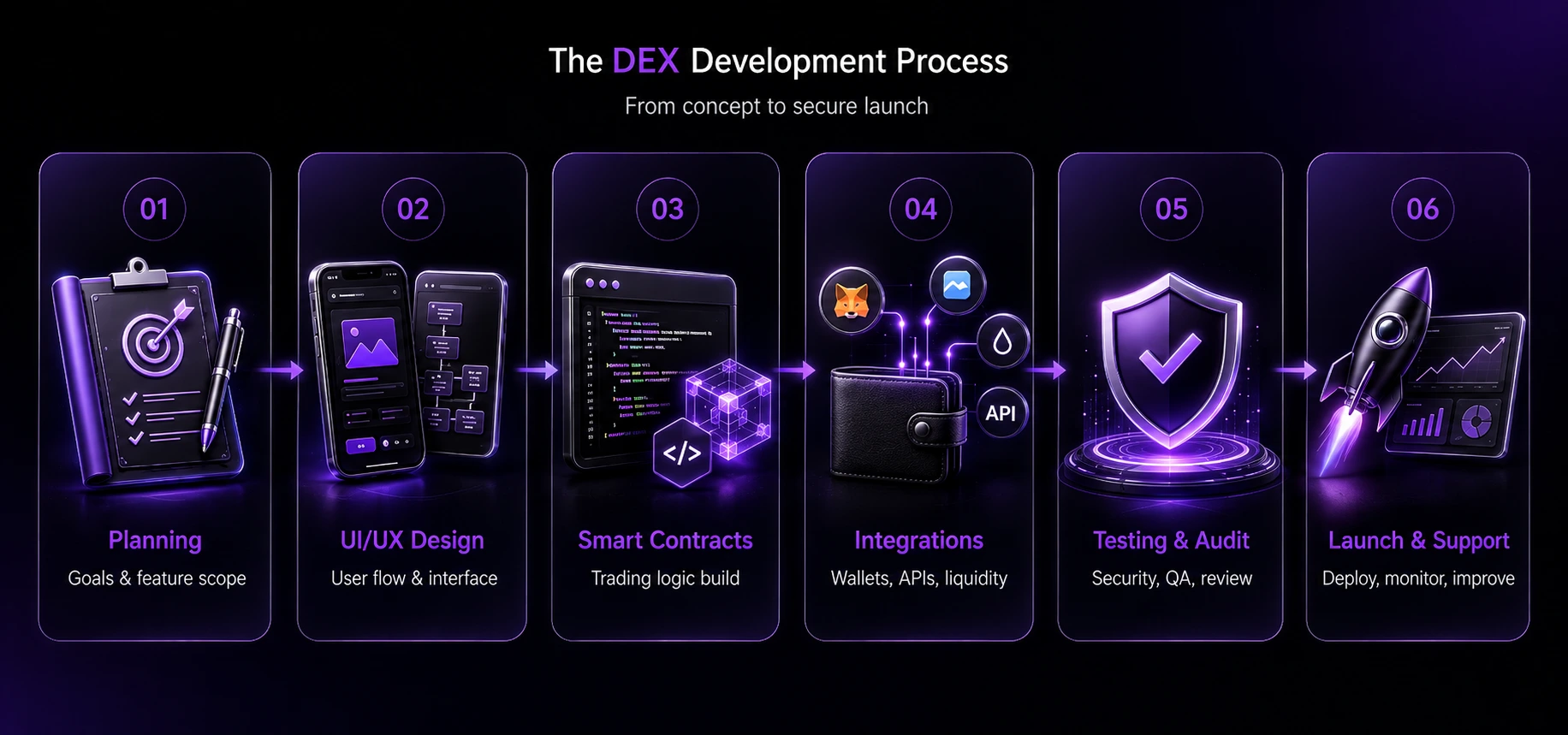
This is how the build process operates:
Step 1: Architecture Design
Choose AMM vs order book, pick a chain, and set the compliance scope. This stage dictates the contract complexity, audit scope and team size for each subsequent stage.
Step 2: Smart Contract Development
Develop pool logic, fee mechanics, and governance contracts. This is the longest phase, where most of the budget and security risk is contained.
Step 3: Frontend Development
Build the trader interface with React or Next.js with WalletConnect. Contract interfaces can stabilize and let frontend work happen in parallel.
Step 4: Testing
Run unit tests, integration tests, testnet deployment on a virtual volume. Every function has to be resilient to hostile environments. There is no backend team that quietly patches the holes.
Step 5: External Audit
A full smart contract audit against a feature frozen codebase is non-negotiable. Most engagements go through many review passes and a written report before mainnet.
Step 6: Deployment
Push audited contracts to mainnet with verified source code Before you expose it to users, define parameters, control of access, and governance.
Step 7: Liquidity Bootstrapping
Seed initial pools, incentivize market makers via incentive programs. An empty pool platform is DOA; plan this step as carefully as the contract job.
Why DeFi Exchange Development Differs from Centralized Builds
DeFi Exchange Development differs from Centralized Builds by allowing for parallel frontend work once core contract interfaces solidify, resulting in a shorter schedule. What distinguishes it from a centralized build is not just the smart contract layer; every function must assume adversarial conditions from the start; there is no backend staff quietly repairing bugs overnight. This is why teams developing a decentralized exchange spend more time for audit and testnet cycles than they initially anticipate, and major DeFi exchange work rarely ships on the first date it is recorded.
Decentralized Exchange Development Cost: 2026 Breakdown
The honest answer to “what does this cost” is that it varies widely based on scope, but the following ranges reflect what founders typically budget for smart contract, front end, liquidity tooling, audit, and deployment for a production grade build. These are indicative estimates, not firm quotes, and actual numbers vary depending on chain choice, compliance needs, and how much of the feature set you’re building in house versus integrating from existing gear. Following factors have an impact on the DEX development cost:
- Basic single-chain AMM DEX: typically cost between $80,000 and $180,000 and includes basic swap functionality, standard liquidity pools, a lightweight frontend and limited single-firm audit scope. Timeline: 3 to 5 months.
- Full-featured order book or hybrid DEX with governance: generally $250k-$600k+, because of matching engine complexity, multi-chain support, DAO tooling, and more rigorous, multi-firm audit process, plus bug bounty program. Timeline: 6 to 10 months.
The most expensive factor is DEX type: order book and hybrid models require far more contract logic and testing than a pure AMM. Adding chain support is roughly linear in cost as each new chain needs to be individually deployed and tested, and sometimes liquidity incentives are required. Budgets often grow for significant scope and audit depth after a preliminary review finds issues, such as KYC gating, geofencing and reporting compliance requirements.
Some teams with more limited timetables or budgets often compare white-label DEX solutions, which trade off some customisation for a much faster time to market, versus a fully custom design, which is more costly in the beginning but gives you total control over contract logic, fee structure, and future feature roadmap. Neither of these options is objectively better. It all depends on how different your trading mechanics need to be from day one, and how quickly you need to be live in front of users and liquidity providers.
Get an Accurate Cost Estimate for Your Decentralized Exchange
Security and Audits: The Non-Negotiable Layer
DEX contracts, unlike centralized backends, hold user cash directly, and cannot be patched after deployment, so the scope of audit is more important here than in most other smart contract categories. Common classes of vulnerabilities include reentrancy attacks, in which a malicious contract calls back into a function before it has finished executing its first time, Oracle manipulation, which distorts pricing to drain pools, and flash loan attacks, which take advantage of price differences in a single transaction. The Smart Contract Weakness Classification registry is a complete catalogue of reentrancy and related patterns and continues to be a valuable resource for companies developing an internal audit checklist.
Any contract that touches finances or governance logic should be audited. Timeliness matters: audits work best against feature-frozen codebases, not ones that are actively changing. Instead of treating it as a one-time gate before launch, many teams add a bug bounty program and ongoing monitoring to the first audit, since serious smart contract audit engagements often involve many review passes in addition to a formal report.
How to Choose a DEX Development Partner
Track record is more important here than in most software areas, because a DEX partner’s previous work is typically provable directly on-chain. Look for a team with experience in both AMM and order book structures, rather than one that has only launched one model, because the optimal option for your use case may not be the one they are most familiar with. When Uniswap Labs introduced its own Layer 2, Unichain, The Block reported that the release relied on a new block builder and validator network designed expressly to improve security and reduce MEV, which is the type of infrastructure-level thinking that any prospective partner should inquire about directly.
According to recent volume data, DEXs still account for close to 30% of trading activity compared to centralized venues, thus the partner you choose should be aware of this. Ask about audit partners, previous findings, and post-launch monitoring, not just what they’ll construct. A few targeted inquiries; which audit companies have they worked with, and what happens if a vulnerability is discovered after launch, tend to reveal more information than a portfolio evaluation alone.
Concluding Note
decentralized exchange development costs are mostly influenced by DEX type, chain support, and audit depth. Architecture decisions made in week one impact the budget and timetable for the remainder of the project. A basic single-chain AMM launches faster and costs less in the $80K-$180K range; a hybrid, multi-chain platform with full governance costs $250K-$600K or more but supports a larger trading base over time. Whatever option best suits your goals and runway, treat security scope as set rather than changeable, and base the rest of the budget around it.
Frequently Asked Questions
1. How much does decentralized exchange development cost in 2026?
A simple single-chain AMM DEX costs $80,000 to $180,000 with a single firm audit and 3-5 month timeline. The price of a full-featured order book or hybrid DEX with governance and multi-chain support will be $250,000 to $600,000 or more, including a multi-firm audit and a 6- to 10-month schedule.
2. What are the three types of DEX platforms?
AMM’s price is traded algorithmically against pooled liquidity for a fast launch. Order book DEXs connect buyers and sellers directly and are good for derivative trading. Hybrid DEXs are a combination of the two concepts, catering to retail swappers and professional traders on a single platform but at a much higher cost to create and audit.
3. What features does a production-grade DEX platform need?
A production-grade DEX is characterized by six core features: adjustable fee tiers with concentrated liquidity, multi-chain wallet connectivity, liquidity management with market-maker incentives, cross-chain liquidity routing, governance and DAO tooling, and DeFi staking or yield-farming modules for user retention.
4. What is the DEX development process?
The process is architecture design, smart contract programming, frontend build, testing, external auditing, deployment and liquidity bootstrapping. The smart contract development is the most time consuming phase. Unlike centralized builds, each function has to work under adversarial conditions; there’s no backend team quietly fixing bugs overnight.
5. What drives DEX development cost the most?
The DEX type is the biggest cost driver, hybrids being more expensive than AMMs. chain support increases the cost per additional chain. The scope increases with compliance requirements like KYC gating. Budgets tend to grow in depth of audit after the results of the initial review.
Launch a Secure, Scalable DEX Built for Long-Term Growth
