



Key Takeaways
- Building a DEX in the USA requires balancing technical architecture with regulatory compliance, as SEC, CFTC, FinCEN, and state-level requirements influence platform design from the very beginning.
- The choice between AMM, order book, and hybrid architectures determines liquidity management, trading experience, development complexity, and overall project cost.
- Core capabilities such as multi-chain wallet support, liquidity incentives, DAO governance, analytics, and cross-chain trading are now essential features for competitive DEX platforms.
- Development costs range from the low six figures for a basic AMM to over $1 million for enterprise-grade hybrid exchanges, with security audits, compliance engineering, and cross-chain infrastructure driving much of the investment.
- Choosing a DEX development partner with proven mainnet deployments, audited smart contracts, and US regulatory expertise significantly reduces technical risk, accelerates time-to-market, and improves long-term platform sustainability.
Introduction
US-based DeFi projects still face the toughest regulatory environment in the world, even with all the ups and downs of decentralized exchange traffic in 2026. The DEX development company in the USA can either choose between an AMM, order book or hybrid structure while taking SEC, CFTC and FinCEN regulation into account from the outset. The article discusses various types of DEX, basic features of DEX, development process, cost estimates and compliance requirements for a build in the US.
Types of DEX Platforms: AMM, Order Book, and Hybrid
The architecture of a DEX determines everything from the cost of development to regulatory exposure. Here are the three models that govern US-based DEX projects in 2026:
- Automated Market Maker (AMM): AMMs price assets using liquidity pools and a constant product formula, enabling liquidity providers to earn passively without the need for a matched counterparty on each trade. That means it remains the quickest way to launch and the easiest to audit, so it dominates simple spot exchange use cases where users want to swap tokens quickly and cheaply. Of the three models, development costs are the lowest, and the audit surface is narrower since pool math is well understood by security reviewers.
- Order Book DEX: Order book DEXs match buyers and sellers directly, on-chain or with an off-chain matching engine that settles trades on-chain. The model gives up some decentralization in exchange for faster execution and more accurate price discovery than pool-based systems, making it appealing to sophisticated traders and institutional users. When the platform supports leveraged or perpetual products, there is greater engineering complexity; the matching engine has to deal with order placement, cancellation and partial fills, and increased regulatory scrutiny.
- Hybrid DEX: Hybrid architectures blend the liquidity depth of AMMs with the precision that order books offer. Such combinations are increasingly prevalent in platforms created for derivatives and leveraged trading, where tighter spreads and predictable execution are essential. But a hybrid exchange with a custom matching layer has a lot more engineering and legal-review overhead than a standard AMM deployment, due to the extra logic needed to keep both liquidity sources in sync and priced consistently. A team thinking through this design should consider the trade-offs in technical depth, and the Uniswap protocol documentation is a helpful starting point before committing resources.
Core Features of a DEX Platform
Every production DEX needs token swapping with configurable fee tiers and liquidity pools that offer concentrated price ranges instead of spreading capital thinly over a curve.
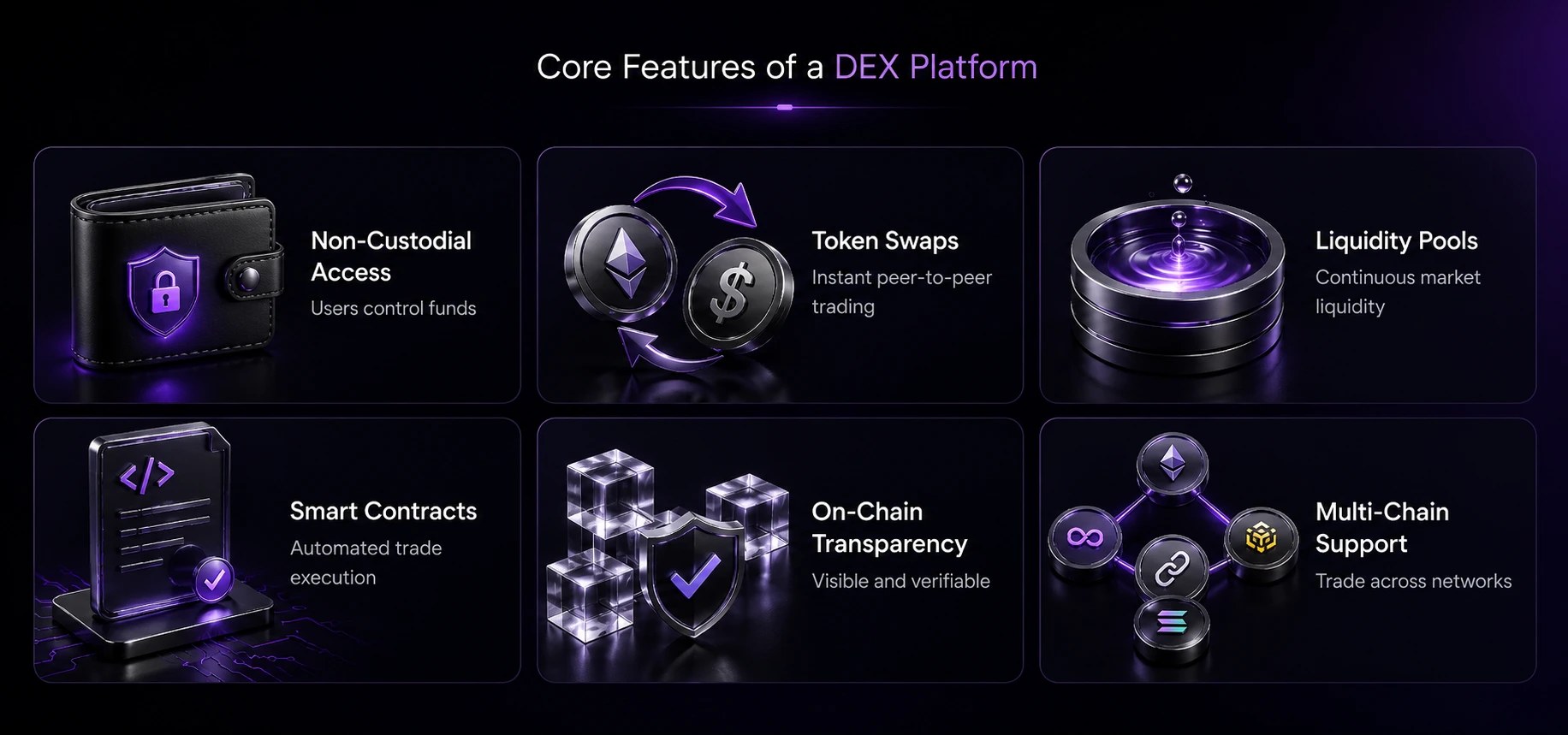
These are five characteristics of a competitive DEX platform in 2026.
- Multi-chain wallet connectivity: Enables users to connect from any supported network without any friction or manual bridging procedures to prevent trades, via a suitable multi-chain wallet layer. The reliability of the wallet layer is just as important as the interface itself, as users leave platforms when a swap fails or a quote looks old and untrustworthy.
- Liquidity management and market maker incentives: Good liquidity management tools such as market maker incentives, farming rewards, and real-time depth monitoring reduce slippage as demand exceeds the initial launch commitments.
- DAO-based governance: Token holders vote on fee structures & protocol upgrades applied on-chain . The governance design has a direct impact on the extent of regulatory exposure in the United States, where the voting rights of tokens could trigger securities law considerations under the Howey test.
- Analytics dashboard: TVL, volume and portfolio performance tracking for both traders and liquidity providers, providing visibility that is rarely available on centralized venues.
- Cross-chain liquidity aggregation: Many US platforms now offer cross-chain liquidity aggregation, allowing users to bridge assets and trade against pooled depth across multiple chains from a single interface, without needing to juggle wallets or physically transfer cash between networks. More chains are adopting this pattern in their competition for the same pool of liquidity, a trend current DeFi market research has identified as a growing differentiator among competing protocols this year.
DEX Development Process USA
The architecture is selected before writing a single line of code: the type of DEX, target blockchains, tokenomics etc. The second phase is smart contract creation, which includes pool logic, swap execution, fee distribution and governance. This is typically performed by a specialized smart contract development team rather than by general developers who are not familiar with DeFi attack patterns. Then frontend and wallet development, usually with React or Next.js with WalletConnect and multi-chain compatibility from the get-go.
Testing, Audit, and Deployment: The Compliance Checkpoints
And then there’s extensive testing: unit tests, integration tests, deployment on testnet and stress testing with simulated volume spikes that replicate real-world launch conditions. If you’re building any platform that faces US users and involves real user cash, you need to have a full smart contract audit. A tiny logic error in the pool math can drain the liquidity within minutes of the exploit going live. No reputable US launch skips this step, even if they’re under deadline pressure. Contracts should be designed for gas optimization from the beginning and not optimized after being deployed, besides security review. The last step is implementation, monitoring and liquidity bootstrapping. The difference between the US DEX development process and an offshore build is that compliance checkpoints are built into every stage, not tacked on at the end.
DEX Platform Development Cost USA: 2026 Estimates
The cost breakdown includes architecture, intelligent contracts, frontend, audit, deployment and liquidity bootstrapping. A basic single chain AMM may cost the low to mid six figures, while a full featured order book DEX with governance, cross-chain support and derivatives capacity may cost in the seven figures. These are just estimates, and pricing is a function of scope and audit depth. DEX platform development cost USA is more expensive than offshore. Compliance work is built into the design and a legal analysis is done from the beginning.
When considering how to build a decentralized exchange in the USA, founders should consider a fully custom build vs a white-label DEX platform USA alternative. The white-label approach can help accelerate time-to-market by leveraging infrastructure that’s already passed security audits, but it can lock a team into someone else’s roadmap, pricing structure and audit cadence for years. Once the criteria, the chain support and the target launch date are agreed, a specialist crypto exchange development partner can provide a quote for either approach.
DEX Regulatory Compliance USA: What Founders Must Know
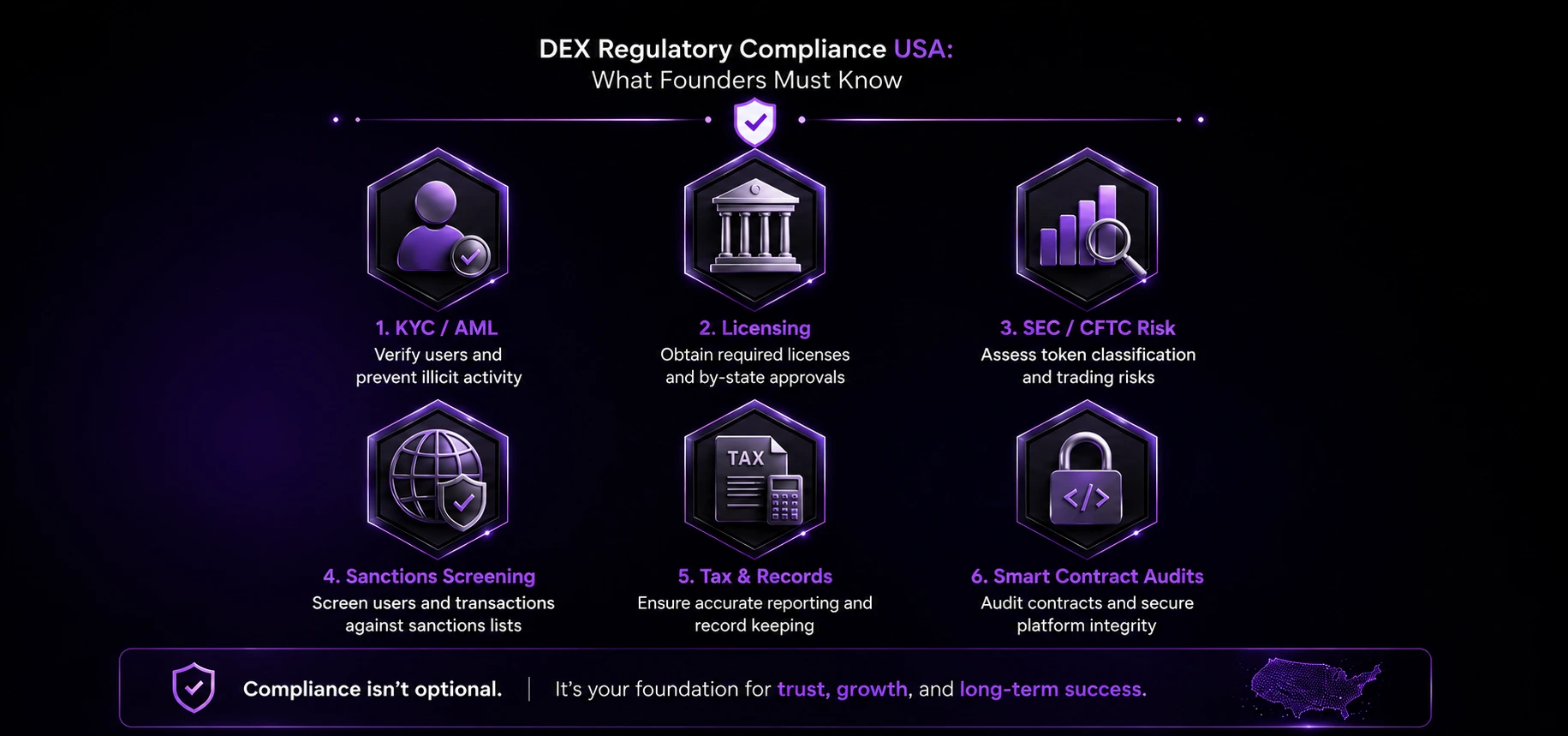
The SEC’s joint interpretive guidance with the CFTC in March 2026 created a more concrete framework for when a token or governance model would run afoul of securities law under the Howey test, but founders still need counsel to apply it to their particular design. That’s what the current SEC guidance; which replaces the agency’s older, enforcement-heavy approach to electronic assets in general, sets out. The CFTC has separate jurisdiction over digital commodity derivatives, as detailed in CFTC digital asset guidance and related staff statements published earlier this year in conjunction with the SEC release, for any platform that offers leveraged or perpetual products to US users.
Building Compliance into the Architecture, Not Bolting It On
Any exchanger-style function that handles user funds, including a front end that routes swaps on behalf of a user, is subject to FinCEN money services business registration and BSA/AML obligations, including suspicious activity reporting, under current FinCEN MSB requirements regardless of how decentralized the front end claims to be. And then there’s another barrier that most teams don’t think about: state money transmitter licenses, like New York’s BitLicense regime. The real cost of failing to get DEX regulatory compliance USA right is enforcement actions and forced shutdowns, and any serious fintech compliance program must manage this risk. US compliant DEX development means building these checkpoints into the architecture itself, not as legal bolt-ons added just before launch.
Choosing a DEX Development Company in USA
Rather than a general blockchain background, consider a history of audited DEX contracts in production and practical experience with US regulatory needs. Technical depth matters too: AMM and order book competence, cross-chain integration and gas optimization skills separate serious teams from template companies. Ask about previous launches, security measures, and what support they provide after launch.
When you are choosing USA DEX development services, you need to think about the regulatory risk reduction offered by a decentralized exchange development company USA that has successfully completed FinCEN registration and SEC token analysis. When shortlisting, it’s always better to choose a DeFi exchange development company that has production deployments and a culture of compliance-first engineering rather than the lowest price with a similar track record.
Concluding Note
Building a DEX in the US is a compliance-driven engineering effort that involves architecture, security reviews, and regulatory integration from the first sprint to deployment. The best systems consider SEC, CFTC, and FinCEN requirements as early-stage decisions, rather than labor added under duress. That need becomes a shippable platform by partnering with an experienced DEX development company in the USA.
Frequently Asked Questions
1. How much does it cost to build a DEX in the USA?
A regular single-chain AMM DEX costs $80K to $150K. A mid-range multi-chain AMM with governance costs between $150,000 and $350,000. A full-featured order book or hybrid DEX will usually cost between $350,000 and $750,000. Enterprise platforms with multiple state licenses can run over $1.5 million.
2. How long does DEX development take in the USA?
You can launch a basic AMM DEX in 3-4 months. Developing a mid-level multi-chain platform typically takes between 5 and 8 months. Full-featured hybrid DEXs with compliance infrastructure takes 8-14 months. Timelines are longer when state money transmitter licenses are required, as approvals are separate from development.
3. What are the main regulatory requirements for a DEX in the USA?
US DEX systems are subject to SEC securities rules under the Howey test, CFTC regulation of digital commodity futures, FinCEN MSB registration with BSA/AML, and state money transmitter licenses such as the NY BitLicense. Compliance architecture has to be built in from the ground up.
4. How do DEX platforms generate revenue?
DEX platforms generate revenue through swap fees (0.05% to 1% on each trade), governance token incentives for liquidity providers, premium feature tiers with lower slippage, and institutional liquidity-as-a-service for regulated counterparties. The choice of business model is directly correlated with the technological stack and regulatory risk.
5. What should I look for in a DEX development company in the USA?
Look for proven production track record with verifiable mainnet deployments, US regulatory experience, audit history with respected organizations, AMM and order book competence, cross-chain and gas optimization capacity, and stated post-launch support commitments. If a partner can’t share audit results or show live installations, it’s not ready.
