



Key Takeaways
- 2026 marks the transition from voluntary crypto guidance to enforceable global regulation, with frameworks such as MiCA, SEC/CFTC oversight, VARA, and MAS making compliance a business-critical function.
- Enterprise crypto compliance now extends beyond exchanges, impacting treasury operations, payments, tokenization projects, governance, audit processes, and cross-border financial activities.
- A scalable compliance strategy combines governance with technology, leveraging automated reporting, AML/KYC controls, anomaly detection, continuous monitoring, and permissioned blockchain infrastructure.
- Managing multi-jurisdiction compliance has become a strategic capability, requiring organizations to navigate overlapping regulations, data privacy obligations, Travel Rule requirements, and evolving licensing regimes.
- Organizations that embed compliance into their technology architecture from the outset gain a competitive advantage, unlocking institutional partnerships, regulated markets, and long-term operational resilience in the digital asset economy.
Introduction
2026 marks the year cryptocurrency regulation stopped being a patchwork of guidance and became enforceable law. The EU’s MiCA regime is now fully in force, the US SEC and CFTC have issued a joint interpretation on how federal law treats electronic assets, and the licensing regimes in Dubai and Singapore have evolved into a supervision-first infrastructure.
This trend is very important to enterprise compliance officers, CFOs, general counsel, and risk managers. Cryptocurrency regulation 2026 is not a matter for legal memos to be filed away for later, but operational infrastructure that affects treasury, payments, tokenization, and audit.
This article examines what has changed, how businesses are responding, and what the coming year will require of risk teams dealing with crypto exposure.
The Global Crypto Regulatory Landscape in 2026: A Tipping Point
There are no grace periods anymore. Under MiCA, the transitional period for crypto-asset service providers ended on July 1, 2026, and companies servicing EU consumers must now obtain full CASP permission or completely cease operations.
A single passportable authorisation under the European Commission’s MiCA framework now covers custody, trading, and disclosure duties across all twenty-seven member states, ending the previous patchwork of national VASP regimes.
Dubai’s VARA has issued more than fifty licenses to virtual asset service providers, while Singapore’s MAS and Hong Kong’s SFC have their own narrower, reputation-centric regulatory regimes.
Central to this shift is a heightened AML/KYC compliance baseline for businesses, largely driven by the FATF’s Travel Rule guidance. It mandates verified originator and beneficiary information on cross-border transfers as a rule rather than an exception.
The global crypto regulatory landscape has transitioned from guidance to enforcement. Businesses operating across multiple jurisdictions now face compliance obligations that overlap, clash, and compound with each new market entry.
What Changed in 2026: From Voluntary Best Practice to Mandatory Compliance
Before this year, many jurisdictions treated crypto compliance as aspirational, with firms operating in sandboxes and gray zones where enforcement was inconsistent. That era is over.
Mandatory licensing, enforceable penalties, and, in several jurisdictions, personal liability for named compliance officers have replaced ambiguity with hard deadlines.
Fintech regulatory requirements now reach beyond exchanges into corporate treasury operations, settlement rails, and tokenization projects involving EU, US, or Gulf clients.
Non-compliance is now a documented path to enforcement. The SEC’s March 2026 joint interpretation with the CFTC makes it clear that US regulators expect proactive classification.
This development formalizes corporate blockchain compliance as a standing obligation rather than a one-time project milestone.
Enterprise Crypto Risk Management: Building the Compliance Stack
Effective crypto risk management for businesses starts with an honest map of exposures across treasury, payments, and tokenization pilots. Each area has its own regulatory profile and cannot be addressed through a single generic policy.
Formal crypto governance frameworks are increasingly used for board-level monitoring. They establish risk appetite, escalation paths, and control ownership before any transaction is initiated.
These frameworks transform abstract policy into an auditable chain of decisions that can endure leadership transitions. The framework is effective only when it is documented and reproducible rather than dependent on the knowledge of one or two employees.
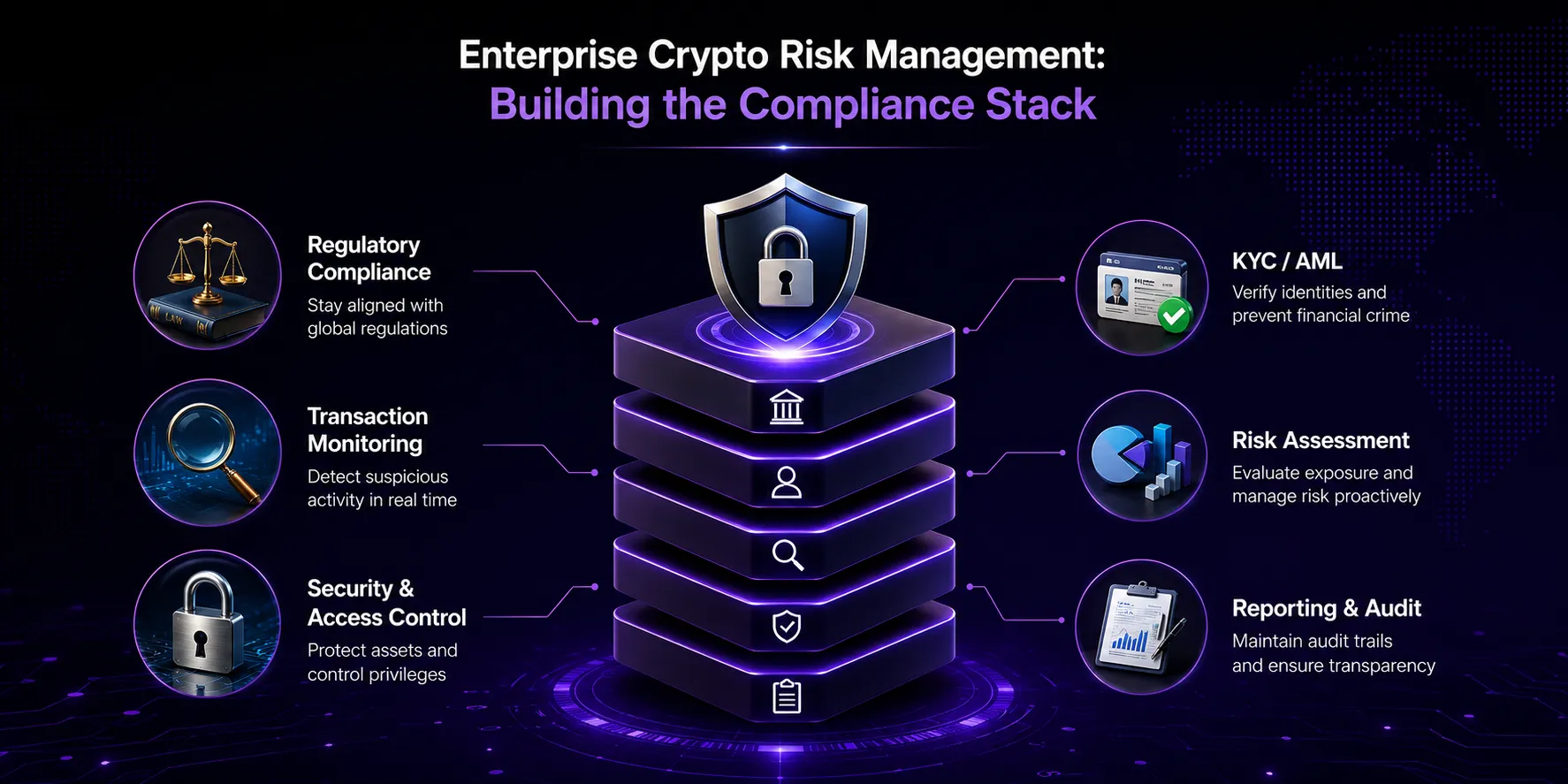
Beneath the governance layer is the technology that makes policy practical to enforce daily. This includes automated compliance reporting that keeps pace with regulatory changes instead of rebuilding records after an audit request.
Regulators increasingly expect reporting to be almost continuous rather than an annual exercise completed under deadline pressure.
PwC’s research into this shift indicates that organizations making progress are those that treat digital asset compliance as core infrastructure rather than a bolt-on function added only when a regulator comes calling.
The Technology Layer That Enforces Policy
Beneath the governance layer sits the technology that makes policy enforceable on a day-to-day basis. This includes automated compliance reporting that keeps pace with regulatory change instead of reconstructing records after an audit request arrives.
Regulators increasingly expect reporting to be near-continuous rather than an annual exercise assembled under deadline pressure.
Anomaly detection flags suspicious on-chain activity before it becomes a regulatory problem, identifying patterns that manual review could miss at enterprise transaction volumes.
The organizations gaining ground are those treating digital asset compliance as core infrastructure rather than a function assembled after regulatory scrutiny begins.
AML/KYC, Data Privacy, and Cross-Border Compliance
The Travel Rule’s premise is simple: every transfer needs verified sender and recipient information.
In practice, meeting that requirement in a world where data retention regulations and limitations vary between jurisdictions has become one of the most resource-intensive aspects of organizational compliance.
Data privacy and cryptocurrency legislation add another challenge. GDPR was not designed for an immutable ledger, and the question of how to reconcile erasure rights with on-chain permanence remains unresolved.
Navigating Multi-Jurisdiction Complexity
Cross-border crypto regulation becomes particularly challenging when a single settlement involves an EU counterparty, a US intermediary, and a Gulf-based custodian. Each participant may have a different regulator and documentation requirement.
A strong investor onboarding compliance infrastructure allows organizations to manage this complexity while maintaining deal velocity and avoiding duplication of verification efforts across jurisdictions.
This is especially important for firms operating across multiple regulatory centres rather than within a single home market.
Dubai’s VARA licensing regime demonstrates how far activity-specific regulation has progressed. It includes separate rulebooks for custody, exchange, and advisory services, each with its own capital requirements and ongoing reporting duties.
These requirements must be maintained continuously rather than addressed only at the point of licensing. Common standards across overlapping regulatory regimes continue to be advocated by global coordination bodies, including the Bank for International Settlements.
Audit, Reporting, and Internal Compliance Strategy
Auditors are asking tougher questions about crypto exposure on business balance sheets than they were two years ago. These questions cover custody segregation, asset valuation, and key management controls throughout the holding period.
The enterprise blockchain audit process is becoming similar to a conventional financial audit. It requires documented control testing rather than a one-time assessment conducted during deployment.
A smart contract audit is no longer a voluntary differentiator for larger fundraising initiatives. It is becoming a standard requirement from counterparties and regulatory bodies.
Building an Internal Compliance Strategy That Scales
One unaudited contract supporting a treasury workflow can undermine months of governance work through a single exploit.
Formal verification provides mathematical assurance that manual code review alone cannot deliver. It is particularly valuable for treasury-facing contracts that move real capital at scale and contain logic carrying material financial risk.
An in-house compliance team or specialized legal counsel can be selected based on transaction volume and regulatory exposure.
Both teams benefit from a regulatory-compliant token design that is defined during the architecture stage rather than added after launch in response to regulatory pressure.
Federated learning can help firms with multiple entities monitor compliance without exposing sensitive transaction data across subsidiaries.
The most effective internal compliance strategy treats regulatory change as a constant input rather than an occasional disruption.
Technology Infrastructure for Enterprise Crypto Compliance
Manual compliance processes cannot handle the transaction volumes that enterprise treasury and payment operations now generate across jurisdictions.
Automated screening, regulatory filings, and continuous audit trails have moved from being competitive advantages to minimum requirements for regulated businesses.
Purpose-built AI and blockchain solutions support pattern recognition, risk scoring, and regulatory change monitoring at a scale that compliance teams cannot match manually.
These technologies allow legal and risk teams to focus on complex judgment calls rather than spending their time on repetitive data reconciliation.
Permissioned Networks and Compliant Payment Infrastructure
Automated infrastructure becomes particularly important when transaction volumes exceed the capacity of a human review cycle.
Compliance is easier to manage on a permissioned enterprise blockchain than on many public-chain equivalents because access restrictions and counterparty identities are defined at the network level.
Once the underlying network is permissioned and access-controlled, the same regulatory discipline can be extended to customer-facing transactions.
This architecture can support crypto payment gateways with compliance controls integrated directly into the checkout cycle rather than added as a separate layer.
The same payment compliance infrastructure can be used by enterprises managing regulated digital assets across multiple asset classes, including tokenized carbon credits, securities, and other regulated instruments.
This approach prevents organizations from having to duplicate their compliance stack for each new digital asset product.
Strategic Implications: Why Compliance Is a Competitive Advantage
Early adopters of compliance infrastructure are gaining access to institutional finance, banking relationships, and regulated marketplaces that remain unavailable to enterprises operating in gray zones.
Building genuinely compliant infrastructure creates a substantial barrier to entry. It can become a competitive moat rather than simply another cost centre.
Enterprises using regulatory clarity as a foundation can confidently introduce tokenized assets and compliant payment rails that were difficult to launch only two years ago.
Organizations that approached the transition to 2026 as an opportunity rather than a burden are well positioned to capture a disproportionate share of the markets now available to regulated participants.
Concluding Note
2026 is the year when cryptocurrency regulation moves from advisory guidance to operational infrastructure.
The enforcement of MiCA, the SEC-CFTC interpretation, and the development of licensing regimes in Dubai and Singapore all point in the same direction: compliance is now the foundation on which digital asset businesses are built.
Organizations that approach cryptocurrency regulation 2026 as a core design requirement rather than an afterthought will be better positioned to capture market share as the regulatory landscape evolves.
Frequently Asked Questions
1. What is the state of cryptocurrency regulation in 2026 for enterprises?
Cryptocurrency regulation in 2026 has moved from informal guidelines to enforceable legislation. MiCA requires full CASP authorisation for EU activities, while the SEC and CFTC have issued a joint interpretation covering digital asset classification. VARA and MAS have also moved toward supervision-first regulatory regimes.
Companies may now face mandatory licensing, enforceable penalties, and, in some jurisdictions, personal liability for designated compliance officers.
2. How should enterprises approach crypto governance frameworks?
Crypto governance frameworks should establish the board’s risk appetite, escalation paths, and control ownership before any transaction is executed.
Enterprise crypto risk management should begin with an exposure map covering treasury, payments, and tokenization pilots. The governance layer should be documented, repeatable, and supported by automated compliance reporting and anomaly detection.
3. What are the key enterprise AML/KYC compliance requirements in 2026?
The FATF Travel Rule requires businesses to verify originator and beneficiary information for qualifying cross-border payments.
Strong investor onboarding compliance connects identity verification, sanctions screening, and politically exposed person checks across jurisdictions. Data privacy and cryptocurrency laws add complexity because GDPR’s erasure rights can conflict with blockchain immutability.
4. What do enterprise blockchain audit practices require in 2026?
Enterprise blockchain audit practices increasingly resemble conventional financial audits and require documented control testing rather than one-time deployment evaluations.
A smart contract audit should be considered a minimum requirement. Formal verification can provide additional mathematical assurance for treasury-facing contracts. Regulatory-compliant token design should also be established during the architecture stage rather than retrofitted after launch.
5. Why is an internal compliance strategy a competitive advantage?
Establishing an internal compliance strategy from the beginning can open access to institutional finance, regulated markets, and banking partnerships that may otherwise remain unavailable.
The cost and complexity of compliance infrastructure create a barrier to entry that can become a competitive advantage. Companies that design for compliance from the outset can launch tokenized assets more confidently, while organizations treating compliance as an afterthought risk being excluded from regulated markets.
