



Key Takeaways
- ERC-4337 enables programmable wallets with gas sponsorship, social recovery, transaction batching, and flexible authentication.
- MPC distributes key shares, removing the security risks associated with a single private key.
- Account abstraction supports seedless onboarding, passkeys, and gasless transactions for smoother wallet experiences.
- Smart contract wallets manage security rules on-chain, while MPC protects signing authority off-chain.
- Hybrid AA-MPC wallets combine programmable controls with distributed, institution-grade key security.
- Modern wallet development requires multi-chain support, chain abstraction, compliance, and security audits.
Introduction
For over a decade, crypto wallets have run on a single fragile premise: whoever holds the twelve-word seed phrase controls the funds, and losing that phrase means losing everything, permanently. In 2026, that premise is finally being replaced. Two technologies, ERC-4337 account abstraction and Multi-Party Computation, have matured from experimental proposals into production infrastructure that founders and CTOs can build on with confidence. Together they define the 2026 crypto wallet standards that institutions, wallet developers, and enterprises are now evaluating. This piece breaks down what account abstraction is, how MPC works, where the two approaches diverge, and why the most resilient wallet architectures in 2026 are quietly converging on both at once.
The Problem with Traditional Crypto Wallets
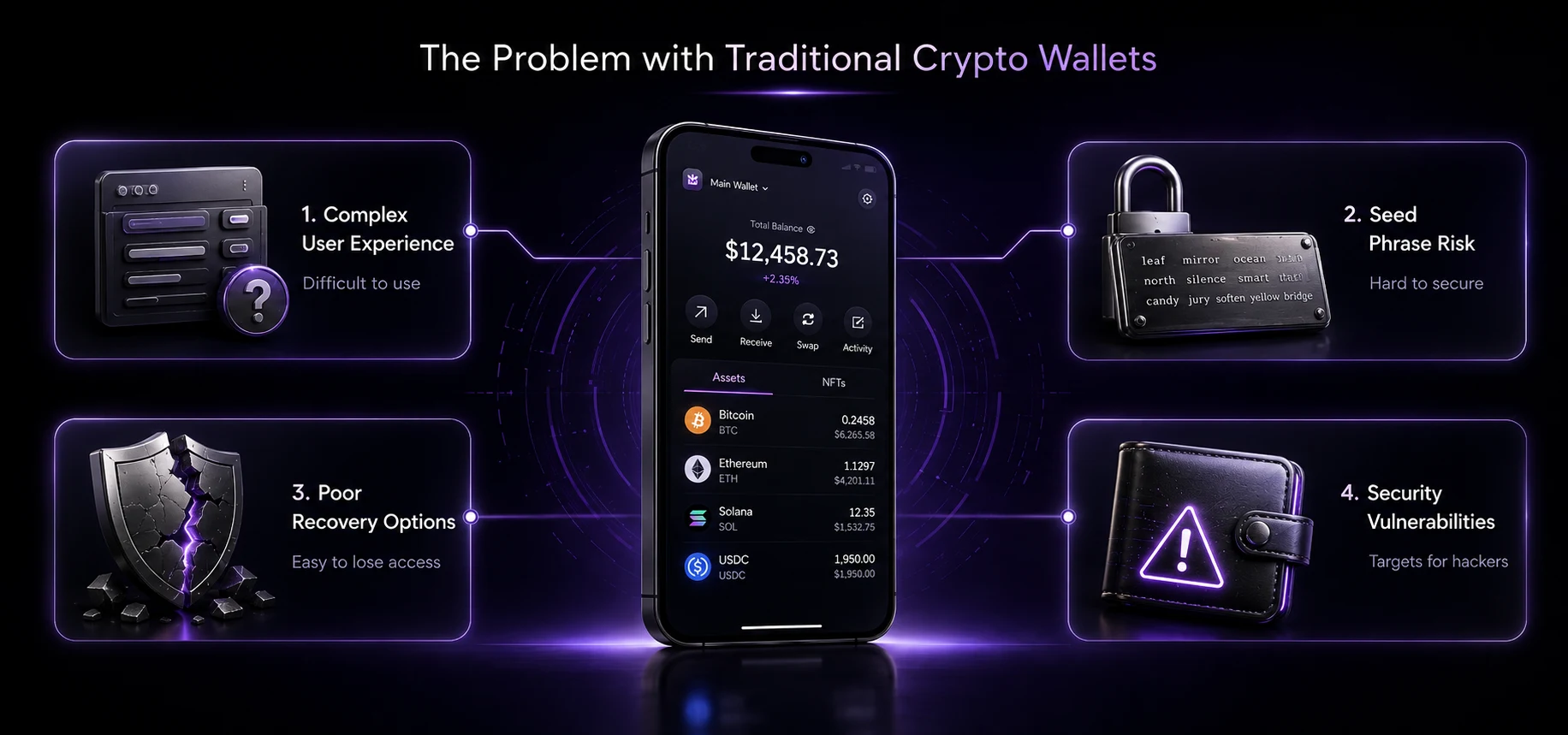
The externally owned account, secured by a single private key and its corresponding seed phrase, has always had a structural flaw: one point of failure controls everything. Chainalysis data puts real numbers behind that risk, recording roughly 158,000 personal wallet compromise cases in 2025 alone, with private key and seed phrase exposure driving a growing share of the losses. Here are the four structural gaps that 2026 wallet standards are designed to close:
-
- Single point of failure: Lose the seed phrase, and the funds are gone forever — no password reset, no fraud department, no recovery flow. Expose that phrase through phishing, malware, or a careless screenshot, and an attacker gains full, silent control of the account. That fragility has made mainstream users understandably reluctant to hold their own keys, pushing much of the industry back toward custodial exchanges, which is the opposite of what a genuine non-custodial wallet is supposed to deliver.
- No native transaction flexibility: Native transaction flexibility is lacking, as each transaction requires native gas tokens, and if you only have USDC but no ETH, you can’t trade without first purchasing gas tokens through a separate exchange or bridge. The architecture of the account doesn’t allow for combining multiple activities into one transaction, so customers have to sign and pay for each step individually.
- Fragmented cross-chain experience: Instead of a single multi-chain wallet experience, moving across chains frequently requires managing distinct addresses and key sets for each network. Each new chain adds another seed phrase to protect, another address to manage and another chance for user error.
- No programmable security: Traditional EOAs cannot impose spending limits, rotate signers or set time-locked withdrawal rules. There is no middle ground in risk management. The key works or it doesn’t. These are the core deficiencies that 2026 wallet standards are designed to address, by mandating programmable accounts and distributed key security, rather than a single static keypair.
What Is Account Abstraction?
Account abstraction, known as ERC-4337, converts a wallet from a simple keypair to a programmable smart contract account without requiring any changes to Ethereum’s core consensus system. Instead of broadcasting a raw transaction, a user submits a UserOperation, a structured object detailing intended activities, which a bundler retrieves from an alternate mempool and routes through a singleton EntryPoint contract, which validates and executes the transaction. An optional paymaster can sponsor the gas on the user’s behalf, allowing them to transact without holding a native token at all, removing one of the most significant onboarding barriers in crypto.
Build a Next-Generation Crypto Wallet With Account Abstraction & MPC
Programmability, Gas Optimization, and the Smart Contract Layer
Because the account validation procedure is entirely in code rather than a fixed protocol rule, an Account Abstraction crypto wallet can impose a number of programmable security measures that regular EOAs cannot. A smart account enables the following:
- Multi-signature by default: Every transaction may require several approvals without the use of an external multisig contract. Social recovery allows users to rotate signers through trusted guardians rather than a single permanent key, eliminating the all-or-nothing risk of seed phrase loss.
- Automated spending controls: Smart accounts can limit spending per transaction or per day, enforce time-locked withdrawal rules, and combine many activities into a single UserOperation, reducing recurrent approvals and per-transaction gas costs.
- Smart contract development at the core: Every rule that the account imposes must be documented, evaluated, and maintained up to date. This is what makes smart contract development critical to modern wallet engineering. Poorly optimized validation logic soon makes an account more expensive than a standard EOA.
- Gas optimization as a budget line item: Disciplined gas optimization is just as important for wallets as any production contract. Teams now allocate genuine technical time to it rather than considering it as an afterthought late in the development process.
The full technical flow, including EntryPoint semantics, validation rules, and paymaster design, is defined in the ERC-4337 specification on ethereum.org, the definitive reference for implementers.
What Is MPC (Multi-Party Computation)?
Multi-Party Computation uses a different approach to achieving the same goal: eliminating a single point of failure. Rather than enclosing a key in smart contract logic, MPC never allows a complete private key to exist in one place at any time during its existence. During distributed key creation, the key is mathematically divided into shares that are dispersed between multiple parties or devices, with none of them ever seeing the entire key.
Threshold Signing and Institutional-Grade Key Management
When a transaction requires signing, a threshold of those shares collectively compute a valid signature via threshold signing, rather than rebuilding the whole key on any single workstation. The resulting signature is indistinguishable from a typical single-signer transaction, hence it can be used on almost any chain without requiring that chain to implement multisig contracts. This is why an MPC wallet is often the default choice for regulated custodians: the cryptography is chain-agnostic and entirely off-chain, and there is no visible governance structure on the blockchain for an attacker to target or study, as opposed to a public multisig contract, whose signer set and threshold are readable by anyone. The combination of limited visibility and strong dispersed control is exactly what institutional custody providers require to satisfy internal risk committees, external auditors, and increasingly demanding insurance underwriters that price coverage based on key-management architecture. Teams assessing suppliers in this field should focus on the underlying protocol rather than the marketing surrounding it. This MPC wallet technical guide provides a more in-depth technical discussion of threshold signature techniques and distributed key generation protocols, which can be beneficial for assessing vendors.
ERC-4337 Onboarding: The End of Seed Phrases
The most obvious benefit of account abstraction is onboarding, which is strong enough that industry experts now see it as the single most powerful lever for mainstream adoption. A well-designed ERC-4337 onboarding flow eliminates the twelve-word seed phrase entirely, allowing a new user to form a smart account protected by a device passkey or biometric, with guardians or a recovery service available to restore access if a device is lost. Nothing in that experience requires the user to grasp gas, bundlers, or key management on the first day.
Web2 Login with Self-Custody
This is the essence of self-custody web2 login: a user authenticates as they would on any consumer app, using an email, phone number, or fingerprint, while maintaining actual, non-custodial control over their assets on-chain. For product teams, this means fewer drop-offs during signup and a wallet experience that can finally compete with finance apps rather than assuming crypto-nativeness from every new user. This is also why an embedded wallet SDK has become a near-default component of any consumer-facing Web3 product introduced this year, rather than an optional add-on.
Future-Proof Your Crypto Wallet With Advanced Security
MPC Wallet vs Smart Contract Wallet: Comparing the Two Approaches
Choosing between MPC wallet and smart contract wallet architectures boils down to where a team wants its security logic to reside. Here’s how the two approaches compare in the dimensions that are most important in production:
Where Security Logic Lives: On-Chain vs. Off-Chain
Smart contract wallets built on ERC-4337 keep validation on-chain, which means that every rule is auditable and composable by other contracts. However, this also means that there are real gas costs to deploy and execute, as well as chain-by-chain deployment labor for each network supported. MPC wallets keep the signing layer entirely off-chain and cryptographic, which reduces per-transaction costs and works identically across any chain that accepts standard signatures; however, the security of the off-chain signing infrastructure itself is more important than a public, inspectable contract that anyone can review.
Recovery Models: Social Recovery vs. Key Resharing
Recovery also differs: smart accounts often rely on on-chain guardians and social recovery, whereas MPC wallets reshare key fragments among parties when a device or team member changes, with no on-chain transaction necessary. Coinbase’s implementation of a passkey-based smart account on Base is a concrete example of the on-chain path reaching production scale for consumer use, processing real transactions rather than remaining a testnet demo, and its adoption curve since launch is a useful indicator of how quickly users accept passkey-based signing over a seed phrase they must write down.
Why 2026 Standards Are Converging on Hybrid Stacks
In practice, teams developing a comprehensive DeFi wallet are increasingly not choosing between these two options, because customers routing big positions through lending and trading protocols value both on-chain auditability and the low, predictable signature costs provided by MPC on frequent actions. That rationale rises even higher when a product’s ambition extends beyond a particular app category. A larger Web3 super app, one that combines payments, trading, and social functions into a single account, typically requires the strengths of both approaches at the same time, and 2026 standards are converging on hybrid stacks to accommodate this rather than requiring an either-or option at the architecture stage.
How Account Abstraction and MPC Work Together
The most resilient wallet architectures developing in 2026 do not see account abstraction and MPC as conflicting approaches; instead, they combine them into a single design. A smart account built on ERC-4337 manages programmable on-chain restrictions like spending limits, session keys, and batched execution, whilst an MPC-based signer replaces the owner’s single private key with a distributed threshold signature beneath it. The contract layer gains the auditability of on-chain logic, while the signature layer gains the resilience of a key that never exists in a single location for an attacker to take.
Chain Abstraction and Audit Requirements
This hybrid structure is also fueling momentum for chain abstraction, since a single MPC-secured smart account can exhibit a consistent identity and balance across several chains without users having to store distinct addresses for each network. None of this eliminates the need for rigorous review before launch; every account implementation, regardless of the combination of technologies used, requires a complete smart contract audit before it touches real user cash. As more teams ship hybrid AA-MPC wallets into production through 2026, audit patterns for these architectures become more standardized: reviewers now expect to see both the on-chain validation logic and the off-chain MPC protocol documented together, as a flaw in either layer can compromise the entire account.
What This Means for Wallet Development in 2026
For wallet developers, exchanges and fintechs, the practical question is not if certain standards should be adopted, but when. Four decisions that will define the wallet roadmaps this year are:
- Build vs. integrate: When you build from the ground up, you make all of the security assumptions yourself. Faster time to market by integrating existing bundler, paymaster and MPC infrastructure. The trade-off is between real scrutiny of vendor key management methods and complete architectural control.
- The adoption opportunity: According to a16z crypto’s State of Crypto 2025 report, the defining potential of this cycle is to bridge the gap between crypto’s asset holders and its far smaller number of active on-chain users. The most obvious lever available to builders is highlighted as wallet-level abstraction.
- Compliance is moving in parallel: The Financial Action Task Force’s guidance on virtual assets still influences how AML regimes across the globe view self-custody wallets. Technical standards should underpin any credible plan.
- Architecture decisions: Enterprises looking at 2026 wallet standards should consider both technologies production-ready, but not interchangeable. Build architecture around real users’ demands for custody, compliance and UX, not the loudest trending technology.
Concluding Note
Seed words created a single point of failure that no one user or institution could ever fully control. Account abstraction and MPC tackle this problem from two angles: programmable, on-chain smart accounts and distributed, off-chain key security. The wallets that will be popular in 2026 are neutral, they combine the flexibility of ERC-4337 and the durability of MPC in a hybrid architecture. The architecture to aim for is convergence, not either technology in isolation. For any founder or CTO looking at 2026 crypto wallet standards. By 2027, the conversation will not be whether to adopt AA and MPC, but whether a wallet that doesn’t have both can still compete for customers who now expect passkey recovery and gasless transactions as standard.
Frequently Asked Questions
1. What are the 2026 crypto wallet standards?
In 2026, the standards for crypto wallets will be driven by two converging technologies: ERC-4337 account abstraction, which transforms wallets into programmable smart contracts, and Multi-Party Computation (MPC), which removes the single private key by splitting it among multiple parties. They work together to offer gasless transactions, social recovery, onboarding with passkeys, and distributed key security.
2. What is an Account Abstraction crypto wallet?
An Account Abstraction wallet is a wallet built on ERC-4337 that replaces static keypairs with programmable smart contract accounts. It has multisig out of the box, social recovery with guardians, automatic spending limits, batched transactions with UserOperations and gas sponsorship via paymasters. None of this changes Ethereum’s consensus mechanism.
3. How does ERC-4337 onboarding work?
ERC-4337 onboarding replaces the 12-word seed phrase with passcodes or biometrics on your device. Smart accounts Users build smart accounts protected by phone or fingerprint. If a device is lost, guardians or a recovery service can help recover access. This allows self-custody web2 login, with authentication like any consumer app, but still having true non-custodial control of on-chain assets.
4. What is the difference between MPC wallet vs smart contract wallet?
The difference between MPC wallets and smart contract wallets lies in their security logic. Validation in smart contract wallets is on-chain, making rules auditable and composable, but they require gas. MPC wallets continue to sign off-chain and cryptographic transactions, working the same way on any chain, and at lower per-transaction costs, but relying on the security of off-chain infrastructure. Recovery is also different: smart accounts rely on on-chain guardians and MPC wallets re-share parts of the key.
5. How do account abstraction and MPC work together?
The most robust wallet architectures in 2026 are a hybrid of both: a smart account that manages programmable on-chain rules (i.e. spending limits, session keys, batch execution), and an MPC-based signer that replaces the single private key with distributed threshold signatures. The signing layer is strong and the contract layer is auditable. This hybrid structure also enables chain abstraction, which means a single account can have a consistent identity across many networks.
Launch a Secure Smart Wallet That Users Actually Love
