




Key Takeaways
- White-label blockchain clone scripts can significantly reduce launch time and development costs, making them suitable for founders who want to validate a business idea without building an entire platform from scratch.
- The type of platform is a major cost driver, with exchange, wallet, NFT marketplace, DeFi, and payment gateway scripts requiring different levels of customization, integrations, and security testing.
- White-label solutions typically cost less and launch faster than custom development, but they offer less architectural control and may involve ongoing licensing, upgrade, and customization costs.
- Security, code ownership, and upgradeability matter as much as the initial price, making audit history, IP rights, vulnerability management, and post-launch support essential factors when evaluating a provider.
- The right solution depends on the business model and long-term goals – white-label works well for speed and market validation, while custom development is better suited to proprietary functionality, complex compliance requirements, and highly scalable platforms.
Introduction
For founders who see a narrow window of market opportunity, a white label blockchain clone script is often the fastest legal path from idea to product. Instead of developing a matching engine, wallet layer and compliance stack from scratch, teams license pre-built, rebrandable code and launch in weeks, not years. But “fast” doesn’t mean “one price.” Prices range from the low five figures to well over six figures, depending on the type of script, the level of customization and the scope of the audit. This book dives into what powers that range, explains white-label vs. custom development, and offers founders real-world stats to help inform their launch budget.
What Is a White-Label Blockchain Clone Script?
A white-label blockchain clone script is a ready-to-launch, customizable platform code that is created based on the architecture of a successful product such as a centralized exchange, DeFi protocol, or NFT marketplace. Vendors build the underlying blockchain clone software and then ship a codebase for clients to rebrand, configure and deploy under their own name. This is where the models differ and why the technical base is important:
- Clone script vs. true white-label: A clone script is like a licensed software package that the client can run by himself. White-label blockchain development usually involves partner-managed infrastructure and ongoing support. Both are white label solutions for blockchains and use the same underlying primitives.
- Real blockchain fundamentals underneath: A white label blockchain platform still depends on accounts, transactions, intelligent contracts, and consensus. With knowledge of the stack, consumers can see what a provider actually delivers, not what it appears to be delivering. The Ethereum Foundation’s developer documentation is a good overview of how these pieces fit together.
- Technical foundation determines long-term value: The speed at which a script can be renamed and released is not the measure of long-term value; it’s the quality of the technical underpinning. A script which cannot be patched or extended is a liability in a year.
- Market demand is accelerating: According to Grand View Research, the global blockchain technology industry is forecast to be worth more than $100 billion by 2026, with business adoption accelerating in financial services. This growth has made many entrepreneurs choose short launch timelines over long and specialized constructions.
Types of White-Label Blockchain Clone Scripts
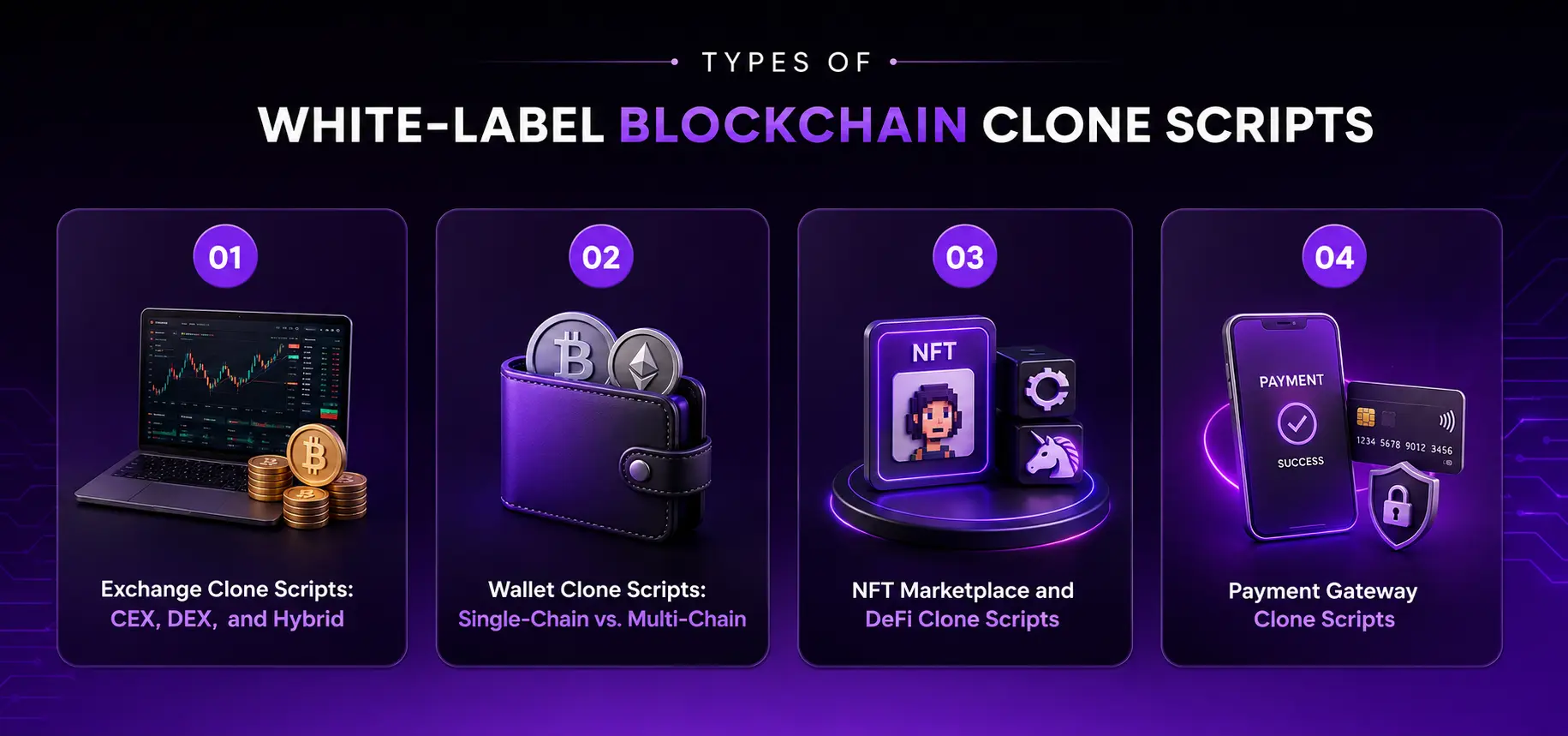
Not all clone scripts serve the same purpose, and the type you choose is the single biggest driver of cost. Here is how the categories break down:
1. Exchange Clone Scripts: CEX, DEX, and Hybrid
Centralized, decentralized and hybrid are the most popular exchange builds. A founder looking for crypto exchange development will find that costs can differ dramatically based on whether the script comes with a matching engine, liquidity routing and institutional order types, or just a basic spot-trading interface and limited depth.
2. Wallet Clone Scripts: Single-Chain vs. Multi-Chain
A wallet clone script is cheaper if it supports only one chain, but costs balloon when you add multi-chain support because building a multi-chain wallet requires cross-chain bridging logic, and separate key-management flows for each network supported, not to mention the testing overhead of every additional chain.
3. NFT Marketplace and DeFi Clone Scripts
NFT marketplace clones vary in royalty logic, auction dynamics and storage architecture, so a creator targeting a specific niche should plan for unique minting flows, rather than assuming a generic NFT marketplace template will meet all use cases out of the box. DeFi staking and lending scripts have their own cost layer because intelligent contracts directly control real user cash and no middleman can undo a mistake once it’s on-chain. A DeFi staking platform clone will often cost more to audit than it did to build in the first place.
4. Payment Gateway Clone Scripts
Payment gateway clones round out the category. Organizations looking at crypto payment gateways should consider the cost of settlement integrations and merchant-facing tooling in addition to the base license charge, as those integrations are rarely pre-built.
Get a Custom Blockchain Clone Script for Your Business
Cost Breakdown: What You’re Actually Paying For
A clone script quote bundles several distinct cost components, and understanding each one helps founders avoid surprise change orders mid-project.
1. Base License, Customization, and Smart Contract Work
The base script license typically covers the core codebase and a limited customization allowance. Beyond that, buyers pay separately for frontend rebranding, backend configuration, and any smart contract development work needed to adjust tokenomics, fee structures, or staking logic to match the client’s specific business model and revenue design.
2. Security Audits and Illustrative Cost Ranges
Security work is a line item unto itself, and anything with user finances is a non-negotiable item that should not be cut to meet a launch date no matter how tight the runway feels. Here’s a look at the costs:
- Audit cost range: A smart contract audit can cost anywhere from a few thousand dollars for a basic audit to over twenty thousand dollars for a multi-firm audit of a complex DeFi protocol.
- Basic clone (exchange or wallet with standard features): A basic clone (exchange or wallet with the standard functionality) will cost from $10,000 to $35,000. Includes base license, limited modification and light audit.
- Mid-complexity build (custom modules + single audit): $35,000 to $60,000. Includes rebranding of the front end, configuration of the backend, and a full security audit.
- Fully customized multi-chain platform: Multi-chain platform with full customization costs $80K+ It features multi-chain support, extensive custom features and multi-firm audits across the entire attack surface.
- Market context: As per Statista, the global cryptocurrency market sales are projected to hit $85.3 billion by 2026, and this increase in the cryptocurrency sales worldwide is pushing more founders to choose faster launch options rather than multi-year custom builds.
- Cost drivers beyond the base tier: Additional cost factors include the quality of the code and the previous audit history of the underlying script, the number of blockchains supported, the level of bespoke features desired and the level of security audit required based on the risk profile of the platform.
White-Label vs. Custom Build: Cost and Timeline Comparison
The trade-off between white-label and custom development comes down to speed versus control. Here is how the two paths compare:
- White-label clone script: The cost of white-label clone scripts starts from $10,000 to $80,000 and can be launched in 2-6 weeks. Most of the engineering work is done, the rest is configuration, branding and integration testing.
- Custom build: $100,000 to $500,000 or more, taking six to twelve months. Every component from the matching engine to the compliance layer is custom built to fit the client’s specific requirements and regulatory footprint.
- When white-label makes sense: Speed to market is more important than completely proprietary architecture. The business model is related to an existing successful product. The founding team wants to validate demand before they build out.
- When custom development earns its cost: The platform needs proprietary trading logic, special regulatory architecture or size that off-the-shelf code cannot support without a subsequent rewrite.
- Total cost of ownership: As the company expands, consider whether to continue license payments, upgrade cycles and how easily the platform integrates into the larger fintech infrastructure. Scripts that can’t connect to payment rails or KYC providers may need to be replaced sooner than their price tag would suggest.
- The year-two cost test: Open, well documented integration hooks cost more up front but are usually the cheaper option in year two. Deloitte’s analysis of embedded banking implementations found that white-label agreements can support faster revenue timelines if the platform architecture corresponds to the business’s planned expansion.
White-Label Vs. Custom Build – Cost, Timeline, and Trade-Offs
| Factor | White-Label Clone Script | Custom Build |
| Cost Range | $10,000 – $80,000 | $100,000 – $500,000+ |
| Timeline | 2 – 6 weeks | 6 – 12 months |
| Architecture Control | Limited – works within vendor’s template | Full – built to exact specifications |
| Security Audit Scope | Single audit, often included | Multi-firm audits, comprehensive |
| Customization Depth | Configuration and rebranding | Proprietary logic, unique features |
| Best For | Speed to market, validating demand, familiar business models | Proprietary trading logic, unusual regulatory structures, scale requirements |
| Total Cost of Ownership | Lower upfront, licensing fees and upgrade costs ongoing | Higher upfront, full ownership and control |
Hidden Costs and Risks of Clone Scripts
The price advertised for a clone script rarely includes all the costs a customer will eventually incur and it is this diligence that entrepreneurs skip, getting burned later. The five biggest risks are:
Risk 1: Unvetted Code
The biggest risk is unreviewed code. Scripts that have been copied or slightly modified from open source may contain previously unknown vulnerabilities that only become apparent after real money is at stake. Without an independent audit trail, buyers are essentially running un-audited code in production.
Risk 2: Licensing and IP Issues
That is only second to licensing and IP issues. Some sellers offer scripts that they do not fully own the copyright to, leaving consumers vulnerable to future takedown risk. Before any contract is signed there must be a clear agreement in writing on transfer of intellectual property rights.
Risk 3: Upgrade Limitations
Also important upgrades to limitations. The low-cost script, unpatchable as the underlying blockchain evolves, becomes a burden within a year of release. Or the platform will have to be replaced sooner than its price tag suggests if the vendor falls behind on a cadence of upgrades or the code base is too stiff to adapt.
Risk 4: Compliance Gaps
In the fast-moving world of cryptocurrency law, compliance loopholes are especially costly. According to the SEC’s guidance on crypto assets and federal securities laws, the type of tokens a platform deals with determines whether it falls under securities regulation. If you build a clone script without considering this framework, you may have to undergo a costly redesign later.
Risk 5: Backdoor Risks
Backdoor hazards are administrative operations made to look like unaudited code. They are the last thing to check before signing a contract. These can be hidden withdrawal functions, admin override keys, or data exfiltration paths that only work under certain conditions.
Mitigating all five risks starts with sourcing from a vendor with a verifiable audit history and a clear IP transfer agreement in writing. Ask for actual audit reports, not marketing summaries, and confirm the code has been deployed in live production environments without major incidents.
Start Your Blockchain Platform With the Right Clone Script
How to Choose a White-Label Blockchain Clone Script Provider
The right type of script is as important as the right provider and doing the work up front to assess them is key. Here’s a structured checklist to evaluate applicants:
- Track record: How many platforms have they launched and are any of them still running without major issues? A vendor with live, production installations surviving in real market conditions is much more valuable than one with just demo sites.
- Verifiable code quality and audit history: Code quality and audit history should be validated, not just a sales deck. Don’t take a marketing summary, demand the actual audit reports. The OWASP Smart Contract Top 10 is a good benchmark to see whether a vendor’s security policies cover the vulnerability categories that result in the most losses in the industry.
- Customization depth: Some “white-label” services are much more limiting in practice than they appear in a sales demo. Ask the vendor directly if they allow you to modify the tokenomics, fee structure, smart contract logic, and frontend UX – or are you stuck with their template.
- Post-launch support terms: What happens if a serious vulnerability is discovered six months after launch and who will fix it? Ask about patching frequency, upgrade cycles, and whether security fixes are included with the original license or charged separately.
- Code ownership and Intellectual Property Transfer: Who owns the code after buying? If the vendor’s claims to the license are later challenged, a clean, written IP transfer agreement protects you from the risk of a takedown.
- Client references: Does the vendor have references from clients using similar platforms today? If a provider is not willing to give you references, that’s telling you something very important before you sign the deal.
Concluding Note
The price is just one of the factors in the decision and a white label blockchain clone script can bring the build time down from years to weeks. Founders who take script type, audit scope and vendor track record into account against their actual timeframe and risk tolerance are more likely to select a build that will last long after launch. Whether that means a lean white-label deployment or a fully customized platform, the numbers above should give you a good base for budgeting the next step.
Frequently Asked Questions
1. What is a white label blockchain clone script?
A white label blockchain clone script is a readymade platform code that can be rebranded to your requirements and built on the lines of a successful product, like a centralized exchange, DeFi protocol, NFT marketplace or wallet. The blockchain clone script is created by the vendors, and then they offer a codebase that the clients can configure, rebrand, and deploy on their own names. It’s the fastest legitimate way to get from idea to live product.
2. How much does a white label blockchain clone script cost in 2026?
A basic clone swap or wallet with standard features cost between $10,000 to $35,000. Mid-complexity setup, unique modules, one audit: $35,000-$60,000. A good, multi-chain, well-audited platform could be $80,000 and upwards. Partner-managed infrastructure white-label blockchain development engagement is more expensive than a pure licensed script.
3. What types of blockchain clone scripts are available?
The main types are exchange clone scripts (CEX, DEX and hybrid), wallet clone scripts (single and multi-chain), NFT marketplace clone scripts, DeFi staking and lending clone scripts and crypto payment gateway clone scripts. The different types have different cost drivers, and DeFi clones are typically more expensive to audit than to build, as smart contract clones are dealing directly with real-user cash.
4. How does white label blockchain development differ from custom builds?
White-label costs range from $10,000 to $80,000 and can be deployed in two to six weeks. Custom construction starts at $100,000 and up, and takes 6-12 months. White-labeling is the answer when performance matters more than proprietary architecture. If the platform requires unique trade logic, special regulatory architecture or scaling off-the-shelf code that can’t be supported, custom development is expensive.
5. What are the hidden risks of clone scripts?
The five big risks are unvetted code with unknown vulnerabilities, licensing and intellectual property issues from vendors who don’t own what they are selling, upgrade limitations that become liabilities as blockchains evolve, compliance gaps that lead to costly redesigns under securities regulation, and backdoor risks from hidden admin functions in unaudited code. Mitigation starts with a vendor with a verifiable audit history and a signed intellectual property transfer agreement.
6. How do I choose a white-label blockchain clone script provider?
Test the vendor’s history of live production deployments, not demos. Ask for real audit findings, not marketing brochures. See how much you can customize it – some white-label services are rigid in practice. Clarify who owns the code after purchase, the patching schedule, and who will do post-launch security fixes. The OWASP Smart Contract Top 10 provides a good benchmark for their security processes.
Launch Faster With a White Label Blockchain Clone Script
