



Key Takeaways
- AI agents like Skywork AI are fundamentally different from chatbots, combining reasoning, tool usage, memory, web access, and multi-agent orchestration to execute complex workflows autonomously.
- Development costs are driven by LLM integration, tool connectivity, memory architecture, orchestration, and security, with production-ready enterprise agents requiring significantly higher investment than conversational bots.
- A hybrid build strategy often delivers the best balance of cost and flexibility, combining commercial AI platforms with custom tools, enterprise data integrations, and proprietary workflows.
- Long-term operational expenses; including model inference, monitoring, vector databases, retraining, and observability, must be budgeted alongside initial development costs.
- Choosing an AI development partner with proven production deployments, LLM-agnostic architecture, multi-agent expertise, and strong post-launch support is essential for building scalable, reliable, and enterprise-ready autonomous AI agents.
Introduction
Skywork AI and other autonomous AI agents are the next step up from chatbots. Answer multiple questions, reason over multiple steps, call external tools, explore the web, remember, and do workflows with little supervision. If you want a similar system, you need LLM integration, tool-use capabilities, memory architecture, and a multi-agent orchestration layer. Companies thinking about how to build AI agent like skywork AI should have a realistic budget in mind before committing engineering resources. This guide explores what Skywork AI does, the cost of each part, a build versus buy analysis and how to plan a budget for 2026.
What Makes Skywork AI a Benchmark: Capabilities That Define the Category
Skywork AI, created by Kunlun Tech, has established a popular benchmark for autonomous agents. Instead of trying to do everything at once, its framework chooses from a curated library of tools: online search, code execution, chart production, citation formatting, on the fly to plan and complete the requests. That architecture is detailed on the Skywork AI platform itself.
The difference between an agent and a chatbot is planning, error recovery, stateful memory and the ability to act on an external environment, not just respond in text. The cost of a Skywork AI agent alternative only makes sense once the use case is clear. Companies are building similar solutions for support, research, data analysis and workflow automation, often combined with enterprise AI assistants already running across the business.
Breaking Down the Cost to Build an AI Agent Like Skywork AI
The first and most obvious cost driver is LLM integration . Teams can choose between paid APIs or fine-tuning an open-source model, and both options will have ongoing inference costs that scale with usage, rather than a one-time fee. Published API pricing from major providers shows that per-token charges vary widely by model tier, so an agent’s monthly bill is highly dependent on which model does which task.
1. Tool-Use Architecture, Memory, and Planning
The tool-use design adds a second layer: API integrations, web surfing, sandboxed code execution, and database queries need secure wrappers before an agent can work with them safely. Memory and context management budgets are often underestimated. Short term session memory is inexpensive, but long term memory with vector databases and retrieval augmented generation adds infrastructure that will outlive launch. Planning and reasoning logic, such as chain-of-thought decomposition and error recovery, is mostly a software engineering cost, not an API cost. And it’s often the most time-consuming part of the build.
2. Multi-Agent Orchestration and the Build-vs-Buy Decision on LLMs
Multi-agent orchestration is an additional layer on top of whatever the base agent already does by itself – most notably coordination logic, message routing and shared state management. This layer alone can double the timeline on complex enterprise workflows that require multiple handoffs between cooperating agents before a task is considered done. Teams also weigh the trade-offs between custom LLM development versus using commercial APIs. A fine-tuned model offers greater control and lower per-token costs at scale, but it requires an upfront training investment. Cost estimates should break out one time construction costs and ongoing inference costs for custom AI agent development.
AI Agent Development Like Skywork: Component-by-Component Cost Breakdown
As an illustrative estimate, a simple tool use and short-term memory MVP-level agent would normally cost mid-five to low-six figures in dev work, plus a moderate monthly API spend. A production-ready agent with enterprise SLAs, persistent memory, multiple integrated tools, and multi-agent orchestration can cost substantially more when security reviews and uptime guarantees are factored in. These are estimates; actual costs will depend on team rates, geography, and scope.
Most importantly, the diversity is driven by the number of tools the agent has to call, the depth of the reasoning chains, the need for persistent memory and the scale of deployment it has to support. No matter how good the demo, Model deployment infrastructure, API use and monitoring are still there after the launch. Developing an AI agent platform like skywork is a lot more expensive than a simple chatbot because the agent has to plan, act, verify and recover in a lot more states than a conversational interface.
These ongoing costs are predictable and not reactive as usage scales, due to the disciplined ML pipeline development. Poorly instrumented pipelines tend to surface cost overruns after the invoice hits, versus before, when the fix is far more expensive than catching it earlier. That same underlying discipline is what makes automated retraining a manageable, recurring line item instead of an unforeseen emergency project as the scope of responsibilities of the agent grows.
Skywork AI Agent Alternative Cost: Build vs. Buy vs. Hybrid
Creating an agent from the ground up gives you the most control over data, behavior and integrations, but it also has the longest timeline and biggest upfront cost. White-label or commercial agent platforms can get to market faster and with a smaller initial investment, but they do carry customisation and vendor lock-in costs. Most companies use a hybrid approach that combines a commercial platform with links to custom tools and internal data.
Grand View Research estimates that the global AI agents market will be worth tens of billions of dollars in 2026, with strong growth expected over the next decade. That’s how much of the business budget is now going into this particular build-or-buy decision; rather than staying in exploratory pilots.
The ultimate cost analysis of Skywork AI agent alternative is determined by how differentiated the agent has to be. AI agent infrastructure systems can dramatically shorten construction time, but license and usage-based costs ramp up over the product’s life cycle instead of vanishing after the initial launch and monthly invoices start coming in. This is the accumulation that makes it worthwhile for companies that consider both options to do predictive analytics on predicted consumption before dedicating engineering resources to one or the other.
Technology Stack: What Powers an Autonomous AI Agent
Most production agents are using a commercial LLM such as GPT-4o, Claude, or Gemini, or an open source model such as Llama that has been selected for a reasonable trade-off between reasoning quality and cost. Additionally, there is a tool use framework for function calling and sandboxed code execution, and a memory architecture based on vector databases or knowledge graphs, which is well documented in Anthropic’s agent architecture guidance.
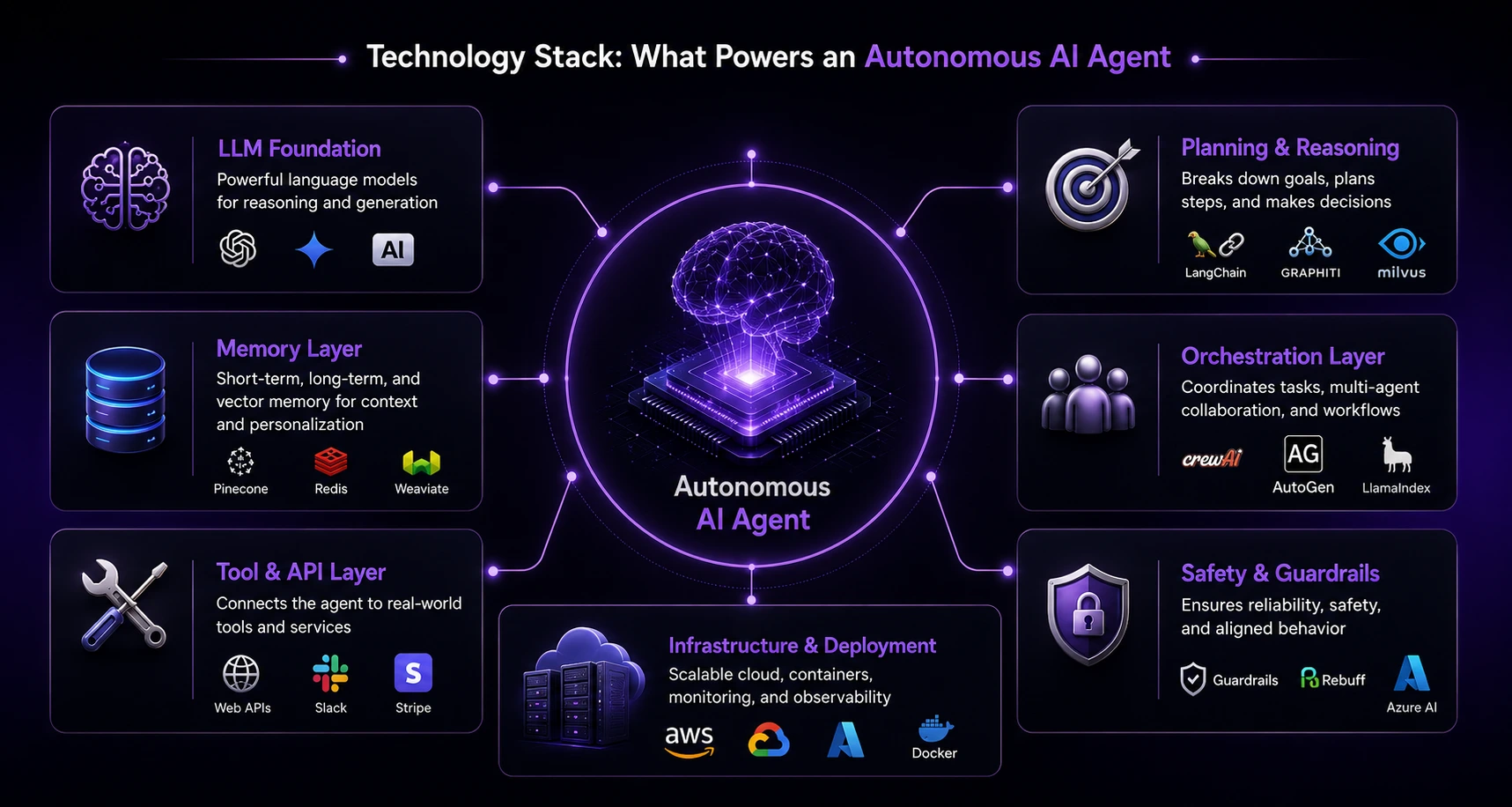
The orchestration layer is responsible for planning, job decomposition and error management and agent-agent communication when multiple agents are working on the same problem in parallel. Monitoring is just as important as the autonomous agent needs safeguards that a passive chatbot does not.
- Anomaly detection: Identify unexpected agent behavior before it affects a client.
- Human-in-the-loop fallbacks: Handle edge cases an agent can’t solve alone.
- Neuro-symbolic AI is increasingly combining rule-based logic with learned reasoning for jobs requiring strict, auditable compliance.
- If sensitive data cannot leave a restricted environment, regulated deployments might use federated learning.
- In the case of agents handling financial transactions or performing identity verification, AI and blockchain can offer tamper-proof audit trails for each agent decision and tool call.
Hiring an AI Agent Development Company: What to Look For
History matters more than a well-polished pitch deck. Instead, seek a partner who has deployed agents in production, not just for demos, and can share data from real-world usage, such as Salesforce’s Agentforce, which has reported enterprise deployment results at scale. Technical depth should include LLM-agnostic design and true multi-agent orchestration experience, not just a single-agent wrapper marketed as a whole platform.
Before you sign a contract, ask about previous deployments, how the team manages safety and alignment, and what post-deployment monitoring looks like once the agent is in place. Having a trusted partner helps to reduce the risk of cost overruns and launch delays by setting realistic expectations up front – teams that leverage AI agent development firm support tend to move faster assuming the vendor has AI automation systems expertise, not just model access.
Concluding Note
Building an AI agent such as Skywork AI is not a single line item, but a multi-part project that includes LLM integration, tool usage, memory, and orchestration. Successful platforms get the architecture and safety right out of the gate. Enterprises planning to build AI agent like Skywork AI in 2026 should prepare for the upfront and ongoing costs, as the adoption will only grow in 2027, like Skywork AI.
Frequently Asked Questions
1. How much does it cost to build an AI agent like Skywork AI in 2026?
An MVP-grade agent, with primitive tool use, and short term memory, costs in the five to six figures to develop, plus ongoing API charges. Add in security reviews and availability guarantees, and the cost of a production-grade agent with enterprise SLAs, persistent memory and multi-agent orchestration skyrockets.
2. What is the skywork ai agent alternative cost compared to building from scratch?
The price of an alternative Skywork AI agent will be dependent on whether it is built or bought. White-label systems provide faster access to the market at a lower initial investment, but generate revenue through license fees over time. Most companies take a hybrid approach combining a commercial platform with custom tool integrations and on-premise data.
3. What components drive custom AI agent development cost the most?
The most significant cost drivers are LLM integration and ongoing inference expenses, tool-use architecture, memory infrastructure, (including vector databases), and multi-agent orchestration. Long term storage lasts long after launch. This makes memory and context management the most overlooked budget items.
4. How does AI agent development like Skywork differ from building a chatbot?
Skywork is an AI agent rather than a chatbot and, therefore, significantly more expensive to develop because agents must plan, act, verify and recover across multiple states. They are not just conversational response generators. They need tool-use frameworks, persistent memory, error recovery logic and orchestration layers.
5. When should I hire an AI agent development company instead of building in-house?
In case your team lacks experience in production deployment and multi-agent orchestration, hire an AI agent development company. By scoping realistically, a trusted partner reduces the risk of cost overruns. Ask about previous deployments, safety procedures and post-deployment monitoring before signing.
