



Key Takeaways
- Private equity tokenization digitizes fund ownership while automating capital calls, distribution waterfalls, and compliant investor transfers.
- PE platforms are more complex than standard tokenization solutions due to accreditation checks, lock-up periods, side letters, and GP/LP fund structures.
- A single-fund MVP may cost $180,000–$350,000, while multi-fund enterprise platforms can exceed $1.2 million.
- Fund complexity, investor jurisdictions, waterfall logic, custody, and audit requirements are the main cost drivers.
- Compliance-ready token design helps enforce investor eligibility, transfer restrictions, and ongoing reporting requirements.
- Choose a partner with proven fund tokenization experience, including ERC-3643, capital-call automation, waterfall logic, and fund administrator integrations.
Introduction
Private equity has proven the most difficult asset class for blockchain to penetrate, and the fastest to gain institutional interest upon doing so. Indeed, there is a rising institutional appetite for digital assets, with recent institutional research from Callan showing that nearly three in five institutional investors intend to grow their digital asset allocations in 2026. Already companies like Hamilton Lane and KKR are tokenizing feeder funds with partners like Securitize, bringing the minimum investment down from millions of dollars to around twenty thousand. Yet private equity tokenization is no mere wrapper around a fund. Before any single LP investment was made on-chain, investor accreditation checks, multi-year lock-ups, capital calls, and distribution waterfalls had to be accurately written down. It is that which, with that complexity, feeds the budget. Realistic cost breakdown to build PE tokenization platforms in 2026, and why.
What is Private Equity Tokenization?
The process converts interests in limited partnerships, fund shares or co-investment stakes into digital tokens that are recorded on a blockchain. The ownership records are on-chain, rather than a static cap table that is maintained by a fund administrator. Capital calls can be made with automated wallet alerts and distribution waterfalls can be executed by smart contracts at the close of a liquidity event. Secondary transfers can be as easy as an on-chain trade between two approved verified investors. Historically, this took weeks to accomplish through legal means.
The main difference between private equity and real estate tokenization is the underlying asset is a governance-heavy fund structure, not a static physical asset. Tokenized structure has one owner class and a deed and once that deed is authenticated the transfer logic is rather easy through the life of the token. A tokenized PE fund is an entirely different beast. GPs, LPs, side letters, accredited investor requirements under regulation D or similar, and 5-10 year lock in periods. This analogy is also true for commodity tokenization, as there are no investor eligibility requirements for a bar of gold or a barrel of oil. All of the governance constraints on the PE side need to be baked into the token logic, not slapped on later.
Key Features of a Private Equity Tokenization Platform
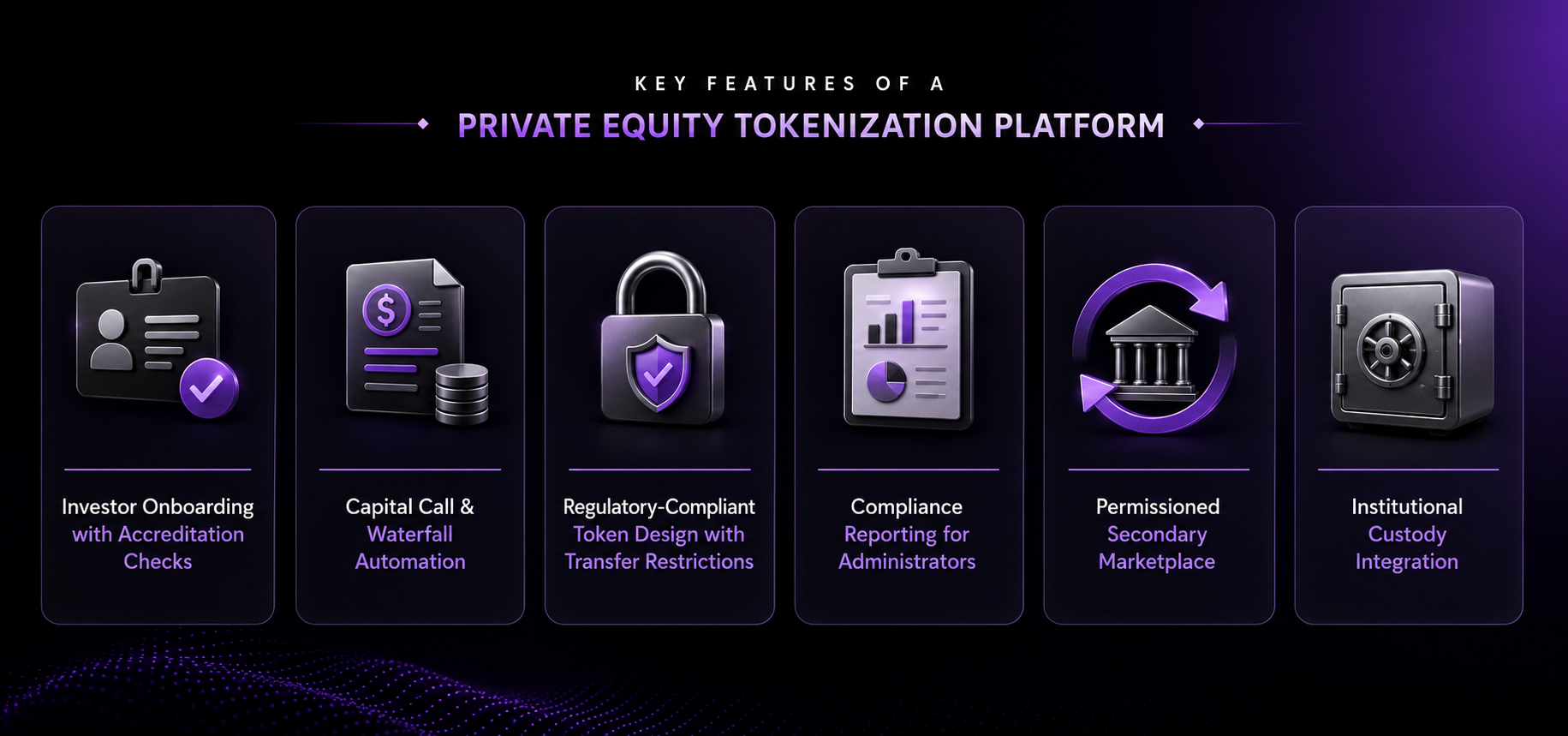
PE tokenization platform is not just a token minting platform. It must recreate the operating back-bone of fund administration on-chain with each transaction defensible to regulators. The six hallmarks of a production-grade platform are:
- Investor onboarding with accreditation checks: Automated investor onboarding ensures that a wallet can only hold fund tokens if it is held by an approved or qualified purchaser. It’s a gate-keeping layer that decides who is allowed to play and get it wrong and the fund is open to regulatory action in each jurisdiction it covers.
- Capital call and waterfall automation: Smart contracts to automate capital call notices and execute distribution waterfalls as per the terms established for the fund. This is where PE tokenization most differs from simpler asset classes. The waterfall logic needs to account for multiple tiers, catch-up provisions, and side-letter variations that can vary from LP to LP.
- Regulatory-compliant token design with transfer restrictions: Regulatory-compliant token design with transfer restrictions that automatically enforce lock-ups and rules for eligible holders consistent with the SEC Staff’s 2026 statement on tokenized securities that federal securities laws apply equally whether ownership is recorded on-chain or off-chain.
- Compliance reporting for administrators: Compliance reporting tooling that produces the audit trails required by fund administrators, auditors and regulators throughout the lifecycle of the fund, not only at the date of issue.
- Permissioned secondary marketplace: A secondary marketplace where LP interests can be transferred once lock-up windows have expired and without the need to manually route each transaction through outside counsel and a fund administrator.
- Institutional custody integration: Institutional custody for protection of fund assets and to fulfill the custodian’s obligations under the Investment Advisers Act.
Private Equity Tokenization Platform Development Process
The typical build-out of a private equity tokenization platform includes seven phases: fund structuring and legal review, token design, smart contract development, investor onboarding integration, compliance and reporting integration, secondary marketplace build-out, and finally deployment with a third-party audit. Fund structure and legal advice are sometimes started weeks before any code is created, as each phase depends on decisions made in the previous phase.
Build a Compliance-Ready Private Equity Tokenization Platform?
Why PE Platform Development Differs from General Asset Tokenization
The scope and sequencing are different from conventional asset tokenization builds. A tokenization effort for a commodity or bond can typically progress directly from token design to deployment. This is much closer to the engineering depth necessary for a complete RWA tokenization platform construction than a single-asset project. A PE platform has to model GP/LP connections, waterfall stages, multi-jurisdiction investor eligibility and more before the smart contracts are ever formed.
Development Cost Breakdown: 2026 Estimates
Costs vary by fund complexity, but the following ranges reflect what institutional teams are budgeting for PE tokenization builds in 2026. Industry analysis of institutional tokenization trends notes that private equity remains a smaller, more operationally complex slice of the broader tokenized asset market than liquid instruments like treasuries, which is part of why development budgets skew higher. These are illustrative estimates, not quotes, and actual pricing depends heavily on legal structuring costs, jurisdictions covered, and audit depth.
Cost Tiers and Key Drivers
A single fund MVP, in a single jurisdiction, with minimal accreditation checks, simple 2 tier waterfall, will generally cost somewhere in the $180,000-$350,000 range and take 5–9 months to create. This tier usually includes legal structure support, creation of ERC-3643 type tokens, a simple investor site and a smart contract audit before launch, but no secondary marketplace.
A multi-fund enterprise platform: supporting numerous funds, multi-jurisdiction investor onboarding, complicated waterfall logic, fund administrator connections, and a live secondary marketplace. These typically cost between $500,000 and over $1.2 million and take between 10 and 16 months. The extra cost is from compliance tooling across jurisdictions, wider audit scope, custody connectors vs basic token contracts themselves.
Key cost drivers are the complexity of the fund (number of waterfall levels, side letter variations), the number of jurisdictions where LPs are onboarded, the estimated number of investors and the depth of the security assessment required considering the value at stake. Partnering with an established asset tokenization development business or established asset tokenization services provider can dramatically cut these timelines, since much of the compliance and custody integration work doesn’t need to be re-built from scratch for every fund client.
Choosing an Asset Tokenization Development Partner for PE
Track record matters more here than in other tokenization areas. A development partner with good overall blockchain experience but no fund tokenization deployments is likely to underestimate the legal and regulatory workload, which shows up later as budget overruns or delayed launches. Ask prospective partners: How many PE or fund-specific tokenization projects have they shipped? Which fund administrators have they integrated with? What does post-launch support look like after capital calls and dividends start operating in production?
Regulatory Expertise and Technical Depth
Regulatory knowledge across jurisdictions is just as crucial – a fund with LPs in the US, EU and Asia needs a technology that can apply varied eligibility criteria per investor without fragmenting the cap table. The differentiator between the partners that can take on PE-specific complexity and those that have simply tokenized simpler assets will include technical depth such as ERC-3643, the permissioned token standard developed for regulated securities, as well as proven waterfall and capital call automation.
Launch Your Private Equity Tokenization Platform Faster
Concluding Note
Tokenizing a fund is more expensive than other tokenization efforts since it automates fund operations, not just ownership information. Accreditation checks, lock-up enforcement, waterfall logic and compliance reporting all bring engineering and legal breadth that a basic asset wrapper doesn’t need. The difference between PE tokenization solutions that pass institutional due diligence and those that stall before launch is budgeting properly for those layers up front, rather than considering them as an afterthought. The platforms worth constructing for fund managers interested in private equity tokenization are those built around fund mechanics from day one. And the partners worth hiring are those that inquire about waterfall logic before they ask about token standards.
Frequently Asked Questions
1. What is private equity tokenization?
Private equity tokenization is the conversion of restricted partnership interests, fund shares or co-investment holdings into digital tokens on a blockchain. It automates capital calls, distribution waterfalls and secondary transfers with smart contracts, but keeps the investor accreditation checks and lock-up enforcement that PE funds want.
2. How does tokenization for private equity differ from other asset classes?
The difference with tokenization for private equity is that the underlying asset is a governance-heavy fund structure, not a static physical asset like real estate or commodities. It involves GPs, LPs, side letters, accredited-investor requirements and multi-year lock-ups. Each governance limitation must be integrated into the token logic itself, which requires more legal and compliance engineering than simpler asset wrappers.
3. What features does a private equity tokenization platform need?
A PE tokenization platform needs investor onboarding with accreditation checks, capital call and waterfall automation, regulatory-compliant token design with transfer restrictions, compliance reporting for fund administrators, a permissioned secondary marketplace for LP interest transfers, and institutional custody integration for fund assets.
4. How much does a private equity tokenization platform cost in 2026?
The basic MVP for a single fund, single jurisdiction, simple accreditation checks and a simple 2-tier waterfall will cost between $180,000 and $350,000 and take between 5 and 9 months. Complex waterfall logic, investor onboarding across multiple jurisdictions, and live secondary markets on a multi-fund enterprise platform. $500,000 to more than $1.2 million. 10-16 month period.
5. What drives private equity tokenization platform development costs?
The key cost drivers are fund complexity (waterfall tiers and side-letter variations), number of jurisdictions where LPs are onboarded, expected investor count, and depth of security audit. Compliance tooling across jurisdictions, custody integrations and legal structuring are often bigger drivers of expenses than core token contracts.
6. How do I choose an asset tokenization development company for PE?
Ask about previous experience tokenizing PE or funds specifically, about integration with fund admins, and about support after launch. Ensure regulatory competence across countries and technical depth in ERC-3643, waterfall automation and capital call logic. If a partner doesn’t have fund tokenization experience they’ll probably underestimate the legal and compliance effort.
Save Up to 30% on Development with a Scalable Tokenization Solution
