



Key Takeaways
- Prioritize technical expertise across Ethereum, Hyperledger, Corda, Polkadot, and smart contracts.
- Choose industry experience relevant to your sector and regulatory requirements.
- Verify security capabilities through audits, formal verification, penetration testing, and secure key management.
- Look for proven deployments and experience integrating enterprise systems and legacy infrastructure.
- Assess scalability and interoperability for long-term, multi-network growth.
- Evaluate post-launch support including monitoring, SLAs, incident response, and upgrades.
Introduction
Enterprise blockchain has moved past the pilot-project stage. Production deployments now span supply chain traceability, financial services settlement, and asset tokenization programs run by organizations with billions in revenue on the line. Choosing the right enterprise blockchain development company is no longer a decision made by a single team: it requires evaluating technical depth, integration experience, security discipline, and regulatory fluency at once. This guide covers the evaluation framework, technical requirements, security considerations, cost factors, and a selection checklist for buyers.
What Enterprise Blockchain Development Companies Actually Deliver
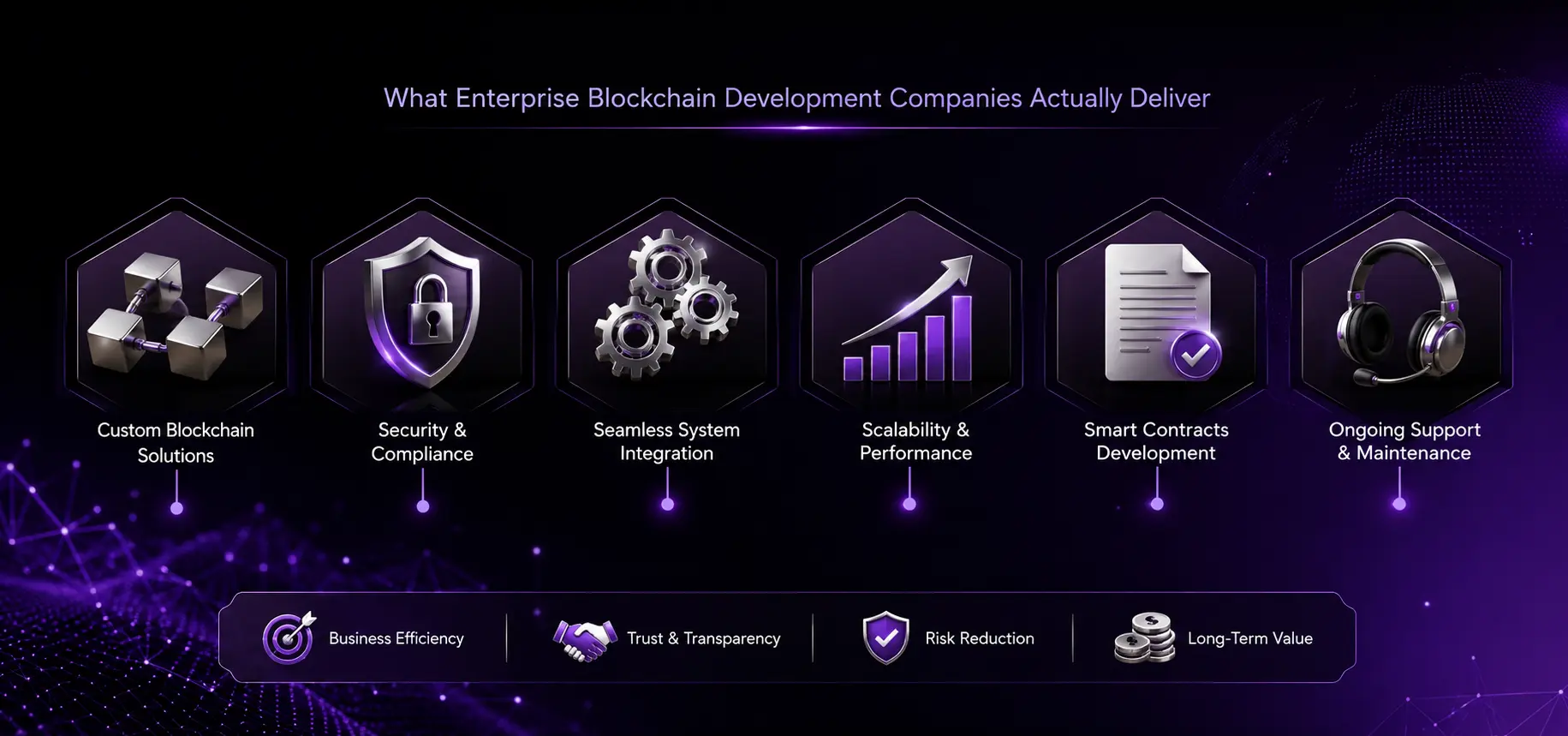
A capable enterprise blockchain app development company delivers far more than code: architecture consulting, ERP and CRM integration, compliance tooling, and ongoing maintenance after go-live. These projects differ from consumer dApp builds: enterprise clients demand strict SLAs, audited compliance trails, and integration into legacy infrastructure a typical Web3 startup never touches.
Multi-party consortium deployments raise the stakes further, which is why blockchain governance frameworks matter as much as the underlying code. When competing organizations share a ledger, decision rights, dispute resolution, and node permissions need to be defined before a single contract line is written, or the project stalls in committee.
Mature Hyperledger enterprise solutions and other enterprise blockchain development solutions span both permissioned networks, such as Hyperledger Fabric and Quorum, and public chains like Ethereum and Polygon. The Hyperledger Foundation maintains the open-source frameworks behind much of this permissioned tooling, and a partner’s familiarity with that ecosystem is a reasonable proxy for enterprise readiness. The right choice depends on who needs to see the data, how many parties are involved, and how much regulatory scrutiny the use case will face.
Key Technical Capabilities to Evaluate
Platform expertise across Ethereum, Hyperledger Fabric, Corda, and Polkadot signals a provider capable of matching architecture to use case rather than defaulting to a familiar stack. Enterprise-grade smart contract development should follow disciplined coding standards from day one, since contract logic deployed to a live network is far harder to patch than a typical application bug.
1. Security, Audits, and Formal Verification
Once code is written, it needs independent scrutiny: a rigorous smart contract audit process, run by reviewers outside the original engineering team, catches logic flaws before they reach production. For high-value systems, formal verification adds a mathematical guarantee that code behaves exactly as specified, which matters enormously where a single logic error can move millions. Integration skill with SAP, Oracle, and legacy data pipelines determines whether a blockchain layer actually plugs into how the business runs day to day, based on published architecture guidance such as NIST’s blockchain technology overview.
2. Scalability, Interoperability, and Future-Proofing
Throughput requirements and consensus mechanism selection drive scalability at production volume, and cost-efficient contract design through gas optimization keeps ongoing transaction fees predictable as usage grows across business units. As enterprises adopt multiple networks for different lines of business, robust cross-chain interoperability becomes essential for moving assets and data between them without friction or manual reconciliation between teams. Related to this is chain abstraction, which lets end users and internal systems interact with a unified experience regardless of which underlying network handles a given transaction. Forward-looking teams are also planning for quantum-resistant security alongside penetration testing and disciplined key management practices.
Launch Your Enterprise Blockchain Project with Trusted Experts
Industry-Specific Expertise: Why It Matters
But generic blockchain competence does not equal industry-ready know-how. Each vertical has different requirements that a generalist team will always underestimate. The price for learning on the job is in the form of delayed go-live dates and architectural rework. Here’s how expertise requirements differ across the four sectors where enterprise blockchain adoption is most accelerated:
1. Supply Chain: Traceability, Provenance, and Multi-Party Trust
Supply chain blockchain work demands deep familiarity with traceability, provenance, and inventory reconciliation across trading partners who may not trust each other’s data by default. Real-world deployments illustrate the payoff of sector fluency. In one widely cited rollout, a major grocery retailer’s blockchain-based food traceability platform, documented by the World Economic Forum, cut the time needed to trace a contaminated product’s origin from days to seconds. That outcome only happens when the partner understands the operational workflow, not just the protocol.
2. Financial Services: Settlement, Trade Finance, and KYC/AML
That familiarity looks different when it comes to banking, where financial services blockchain projects add settlement logic, trade finance workflows and KYC/AML requirements that a generalist team will always underestimate. Compliance is harder from day one, with higher stakes from a regulatory perspective, more difficult integration points with legacy financial systems and lots of jurisdictions to comply with.
3. Asset Tokenization: Legal Ownership Structures and Regulatory Compliance
Asset tokenization for real estate, commodities and bonds is governed by a similar discipline, where the tech has to be built around legal ownership structures, not the other way around. Getting the regulatory compliance right at the design stage means avoiding costly retrofits down the line, as structures that violate securities legislation in one jurisdiction can be difficult to unwind once investors are already on the cap table.
4. Healthcare: Patient Data, Drug Traceability, and Clinical Integrity
Healthcare deployments also have their own set of burdens: managing patient data, tracking drugs, ensuring the integrity of scientific trials, where a single blunder has financial and human ramifications. Deloitte’s research reveals that the majority of surveyed businesses expect to invest in blockchain solutions over the next year, which is why industry-specific expertise separates reputable partners from trend-chasing generalists. Vendors with experience in solving these problems can help reduce time-to-value and avoid costly architectural mistakes that are difficult to unwind after launch.
Security and Compliance: The Enterprise Non-Negotiables
Meeting enterprise-scale security needs requires more than a single code review, but also periodic audits, independent penetration testing, and safe key storage techniques that are compatible with the principles in NIST’s blockchain guidance above. Add on compliance layers: Immutability clashes uncomfortably with data privacy rules: a ledger designed never to be changed must still accommodate a user’s right to erasure under rules like the EU’s General Data Protection Regulation.
Privacy, Formal Verification, and Production Security
And this is where formal verification gets its place again, verifying the contract logic works as intended before deployment reduces the chances of an expensive event. These teams are increasingly leveraging zero-knowledge proofs and off-chain storage to balance privacy and on-chain transparency. Smart contracts also interact with wallets, oracles and APIs and the OWASP Smart Contract Top 10 lists the most common classes of vulnerability in production, from access-control issues to oracle manipulation. A good hire will be fluent in the regulatory duties across all the jurisdictions your organization operates in, understanding how immutable ledgers, cross-border data transfers and industry norms interrelate before they become production incidents. This level of security and compliance planning is what differentiates real enterprise blockchain software development from experimental builds that tack on compliance later.
How to Evaluate Enterprise Blockchain Development Companies
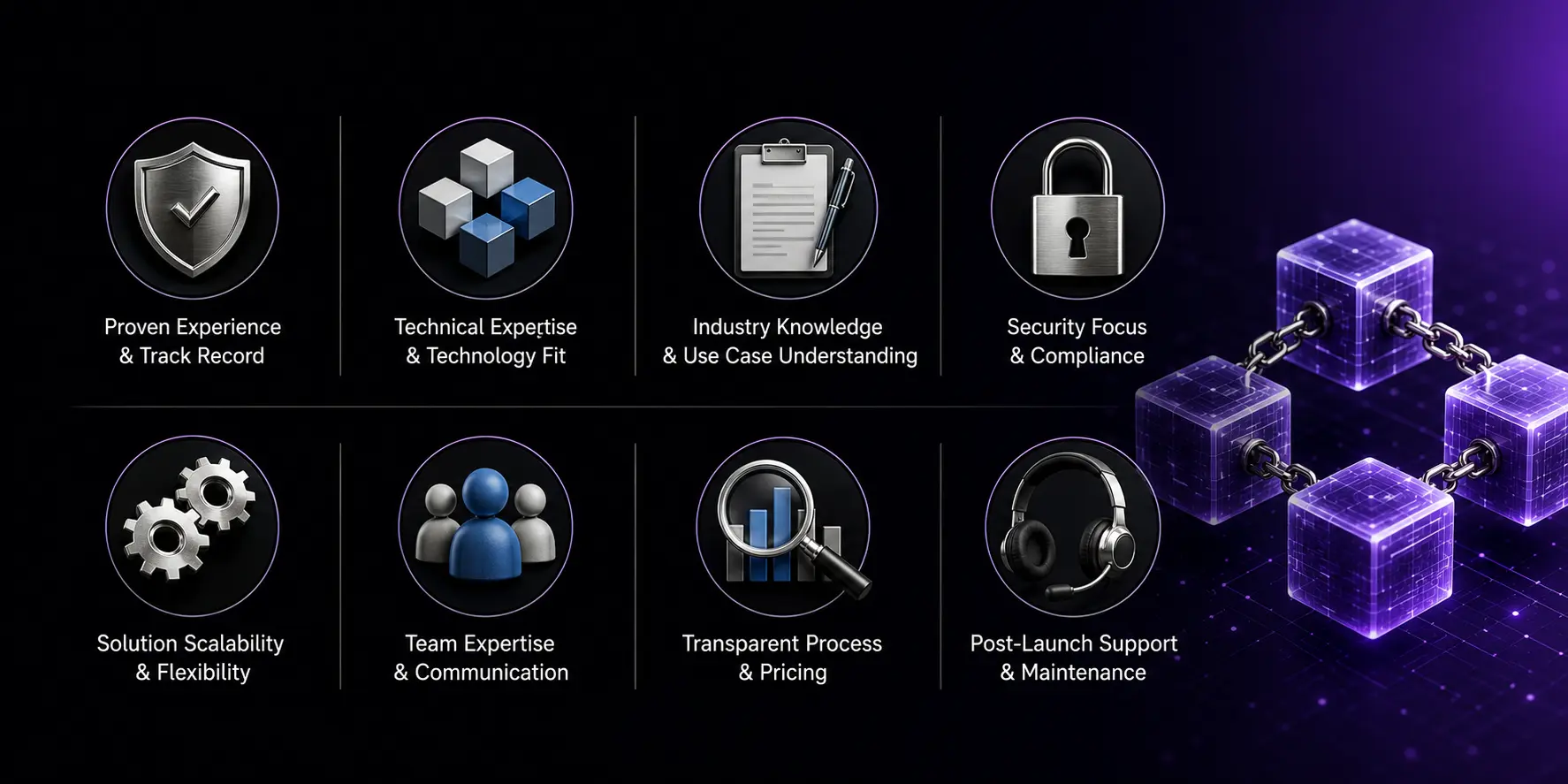
You can’t just pick on price or polish with a rigorous process evaluation. Before you sign a statement of work, consider these:
- Callable references, not proof-of-concept demos with verifiable production deployments
- A bench of enterprise blockchain development specialists, not generalists learning on the company dime
- Documentation standards, deployment checklists, and a documented test procedure.
- Post launch commitments: SLA, monitoring, incident response and upgrade management
- Security certifications and proof of team retention from previous projects
Ask specifically about prior experience deploying or integrating, particularly with systems like yours. A company that develops enterprise blockchain apps and is reluctant to share references and details is saying something important before signing the contract. Ask if the people who scope the project are the people who construct it. The main cause of scope drift is the turnover between sales and delivery.
Cost Considerations: Budgeting for Enterprise Blockchain Development
Platform complexity, integration level, security needs, team composition and timeframe influence costs. Enterprise blockchain software costs are significantly higher than consumer dApps due to compliance tooling, audit cycles, and legacy integration. Some organizations say the consortium model is more cost effective than building it on their own, while others say buying and adapting an existing platform is the superior option.
The bill is not the cost risk, it’s the bad partner. Rework, security issues and delayed go-live dates are generally more expensive than the initial engagement. A reliable business blockchain app development company will offer you transparent milestone-based pricing so you can monitor the value against budget at each stage.
Start Your Enterprise Blockchain Development with Techfyte Today
Concluding Note
There are four things that matter when choosing a partner: technical depth, industry expertise, rigorous security standards and true post-launch assistance. This is not an experiment you can walk away from if it gets stuck. Treat it like any other large acquisition of infrastructure. Work with seasoned enterprise blockchain development companies that can demonstrate to you, not just tell you, how they have tackled problems similar to yours before. Start with a clear evaluation framework. As organizations continue to leverage blockchain through 2026 and beyond, the trusted partners to run the most important enterprise infrastructure will be those that combine strong vertical expertise with production-grade security.
Frequently Asked Questions
1. What do enterprise blockchain development companies deliver?
They provide architecture consulting, smart contract development, ERP/CRM integration, compliance tooling and ongoing maintenance. Enterprise engagements are different than consumer dApp builds in that they require strict SLAs, audited compliance trails, legacy infrastructure integration etc.
2. How do I choose an enterprise blockchain app development company?
Assess vendors on their technical capabilities, domain experience, security standards (audit history and post-launch support with defined SLAs). Request production deployments with callable references, not proof-of-concept demos.
3. What technical capabilities should I look for in a blockchain development partner?
Look for expertise in: Ethereum, Hyperledger Fabric or Corda platforms, smart contract development with independent audit processes, formal verification for high-value applications, ERP integration skills, gas optimization and cross-chain interoperability.
4. Why does industry-specific expertise matter for enterprise blockchain?
Supply chain knowledge trace needs. Financial services adds settlement and KYC/AML needs. To tokenize assets you need to understand the legal arrangements of the ownership. Healthcare needs patient data and clinical trials. No previous vertical experience necessary, a partner learns at your expense.
5. What security practices should an enterprise blockchain provider follow?
Formal verification for high value systems Secure key storage Independent penetration testing Regular smart contract audits Providers should be aware of OWASP Smart Contract Top 10 vulnerabilities and the interaction of GDPR and blockchain immutability.
6. What are blockchain development experts for enterprise vs. generalist developers?
Enterprise professionals with experience in production deployment, SAP/Oracle integration, consortium governance and regulatory compliance awareness. Generalists may know smart contract code but not corporate SLA, compliance trails, and multi-party stakeholder management.
7. How much does enterprise blockchain software development cost?
Compliance tooling, audit cycles and legacy integration mean that enterprise dApp builds are significantly more expensive than consumer dApp builds. The real risk cost is the bad partner choice. The cost of rework and delayed go-live is often higher than the original cost of the engagement.
8. How do I evaluate a blockchain app development company for enterprises?
Verify production deployments with callable references, confirm enterprise specialists not generalists, review documented development processes, check post-launch SLAs and incident response commitments, and ask whether the people who scope the project are the ones who build it.
Hire Techfyte for End-to-End Blockchain Development Today
