



Key Takeaways
- No-code tokenization platforms can launch compliant assets within weeks while reducing development costs and technical requirements for issuers.
- Built-in KYC connects investor verification with onchain transfer restrictions, ensuring only approved wallets can hold or transfer tokens.
- No-code platforms suit standard asset structures, while complex corporate actions, fee waterfalls, and jurisdictions often require custom development.
- Tokenization costs range from 5K–25K for no-code setups to 80K–250K+ for fully custom platforms.
- Hybrid approaches combine configurable issuance with custom modules, balancing faster deployment, compliance requirements, flexibility, and long-term control.
Introduction
Not launching a token anymore is the difficult part. A no-code asset tokenization platform enables asset managers and real estate organizations to launch a compliant token in weeks, not quarters, without hiring blockchain engineers. The real barrier is elsewhere: confirming to investors, making sure who can own what, and demonstrating everything to a regulator. In this book you’ll see what no-code platforms do well, where custom development still wins, how built-in KYC integration works and how much each option costs, so you can make an informed decision instead of relying on vendor promises.
The real challenge to real-world launches is usually compliance, not smart contract programming. You can buy a token but you can’t sell it, and a platform that circumvents investor checks is just passing the risk to you. Modern no-code platforms have done away with much of the capability gap that once justified custom builds, but only to certain constraints you should understand before signing a vendor agreement.
What Is a No-Code Asset Tokenization Platform?
No-code platforms are customizable software that lets non-developers issue digital securities through forms, templates and dashboards. You don’t write contracts, you pick an asset type, set investor rules and deploy. It is a hosted asset tokenization platform, with the underlying code already written, tested and regularly reviewed by the vendor. As an implementation, configuration without coding is asset tokenization, not development.
That’s a far cry from custom development, where engineers build the contracts, identity logic and integrations from the ground up. The trade-off is speed and cost versus flexibility. McKinsey’s base case sees tokenized assets, excluding stablecoins and deposits, reaching about $2 trillion by 2030, a pace that few internal teams can match.
Ready to Build a Secure, KYC-Enabled Tokenization Platform?
Why KYC and Compliance Are the Hard Part of Tokenization
Issuing the token takes a few minutes. There needs to be a compliance procedure in place to ensure that only approved investors are able to purchase, hold and resell securities. An asset tokenization platform with KYC embeds these checks in the issuance pipeline, so the quality of compliance, not the mechanics of the token, should be the determinant of the platform you choose.
- Every Investor Needs Verification Before They Can Hold
- Every Transfer Needs the Same Scrutiny
- Jurisdiction Determines Which Rules Apply
- What Automation Actually Changes
How Built-In KYC Integration Actually Works
KYC integration is not a single feature, but a pipeline that ties offchain verification and onchain enforcement together. Knowing how the pieces fit together makes it easier to judge whether a platform’s compliance claims hold up.
1. The Verification Pipeline
KYC integration to the tokenization platform usually goes in a certain way. The investor submits documentation to the verification provider, clears AML and sanctions screening and shows accreditation as appropriate. The program then registers the approved status and attaches it to the investor’s wallet. Only then that wallet will be able to receive tokens. The checks are done offchain, while the enforcement is onchain; this separation is important to the design, as it keeps personal data out of the blockchain, while still gating every transaction.
2. What Gets Verified and Managed
The pipeline has four distinct functions, each addressing a different aspect of compliance.
- Identity Verification: Validates investor’s identity with government issued documents and biometrics.
- Investor accreditation verification: Confirm the status of a qualified purchaser or accredited investor, as required under the offering.
- Whitelist Management for Investors: The approved status is tied to a specific wallet address, so only verified investors can get tokens.
- Transfer restriction automation: Enforces lock-ups, limitations and jurisdictional limits on all subsequent transfers, not just the onboarding.
3. How ERC-3643 Enforces Compliance Onchain
These functions are interconnected by the ERC-3643 token standard. It stores verified claims within an onchain identity, and it verifies these claims against a registry of identities to prevent any transfers that break rules. Onchain identity validation keeps personal data offchain, capturing only the assertions that are needed. ERC-3643 is compatible with existing ERC-20 wallets and tools, which means tokens can be used in existing infrastructure, rather than requiring a bespoke one.
4. How the Modular Compliance Engine Works
The compliance engine is made up of modules. ERC-3643 platforms use a Compliance contract which runs pluggable rules through post-operation hooks, so a rule can reject and revert an operation atomically. Some examples are the CountryRestrictModule that limits transfers to specific countries, the MaxBalanceModule that limits the number of tokens an address can hold, and the SupplyLimitModule to prevent endless minting.
These modules are already built and programmable through a dashboard, so no-code platforms can use sophisticated constraints without writing new code. The practical difference is that compliance rules are configuration decisions, not engineering projects, and changing a rule does not require redeploying the token contract.
5. Why Whitelists Need Ongoing Maintenance
Whitelists must be kept up to date. Investor status changes over time so credentials expire, sanctions lists are updated, accreditation expires. A good platform does not consider onboarding a one-off, but checks regularly and can freeze or deny access when a status changes. Platforms that bypass re-verification are vulnerable to compliance drift, which is the difference between the people who are currently approved and the people the platform thinks are approved.
Core Features of a No-Code Tokenization Platform
A good platform covers the full lifecycle, not just minting. Tokenized asset issuance is the core, with onboarding, compliance, custody and reporting. No-code token deployment means selecting a template, configuring parameters such as supply, transfer rules and investor eligibility, and deploying. These characteristics are a connected system, because the gaps between modules are where manual effort and compliance risk can come back.
- Issuance templates
- Investor onboarding compliance
- Automated compliance rules
- Custody integration
- Investor dashboard
- Distribution and payouts
This is important as shown by real deployments. When BlackRock launched its BUIDL fund on Ethereum, a tokenization platform acted as the transfer agent, a bank was the custodian and investors were secured through a registered placement agent. These responsibilities map nicely to the modules above, and your security token issuance platform should provide the equivalents at your size.
What No-Code Handles Well vs. Where Custom Development Wins
No-code works well for standard issuance but it is challenged by anything truly unique. Knowing where your offering sits on that spectrum helps you decide whether to set up a platform, commission a bespoke build or both.
1. Where No-Code Performs Best
A no-code RWA tokenization platform is best used for standard structures such as single-class equities or debt, fund interests and real estate instruments, based on typical investor norms. If your product is similar to what many issuers have done before, configuration will usually be cheaper, faster and less risky than construction.
2. What Modern Platforms Now Support
Basic templates are not the only thing offered by modern platforms. The OpenZeppelin RWA Wizard provides a guided UI to set nation limitations, balance caps, supply constraints and lockup periods and generates a ready-to-deploy ERC-3643 project. Injective Mint embeds compliance into the protocol, enabling issuers to set jurisdiction rules, freeze controls and administrative roles without the need for new contracts. TokenFi provides an enterprise-grade RWA module, integrated with ERC-3643 and automatic KYC/AML. These platforms have removed much of the capability gap that once warranted special builds.
3. Where Custom Development Still Wins
Limits arise in non-standard settings. Templates and workarounds are burdened with tailored corporate events, complex fee waterfalls and multi-jurisdiction edge cases, often costing more than the platform saved. No-code contracts also tether your product velocity to the vendor’s roadmap, supported chains and upgrade schedule, which is a strategic limitation when token mechanics are a competitive differentiator.
4. How to Decide Which Path Fits
Write down your five hardest requirements. If a platform meets four or five out of the box, use it. If it meets two or fewer, you are paying for customization either way. The middle ground – three of five – is where hybrid builds usually make sense. Gartner’s forecast valued the low-code market at $26.9 billion for 2023, and the same logic applies: templates win on standard workflows, code wins on exceptions.
Technology Behind No-Code Tokenization Platforms
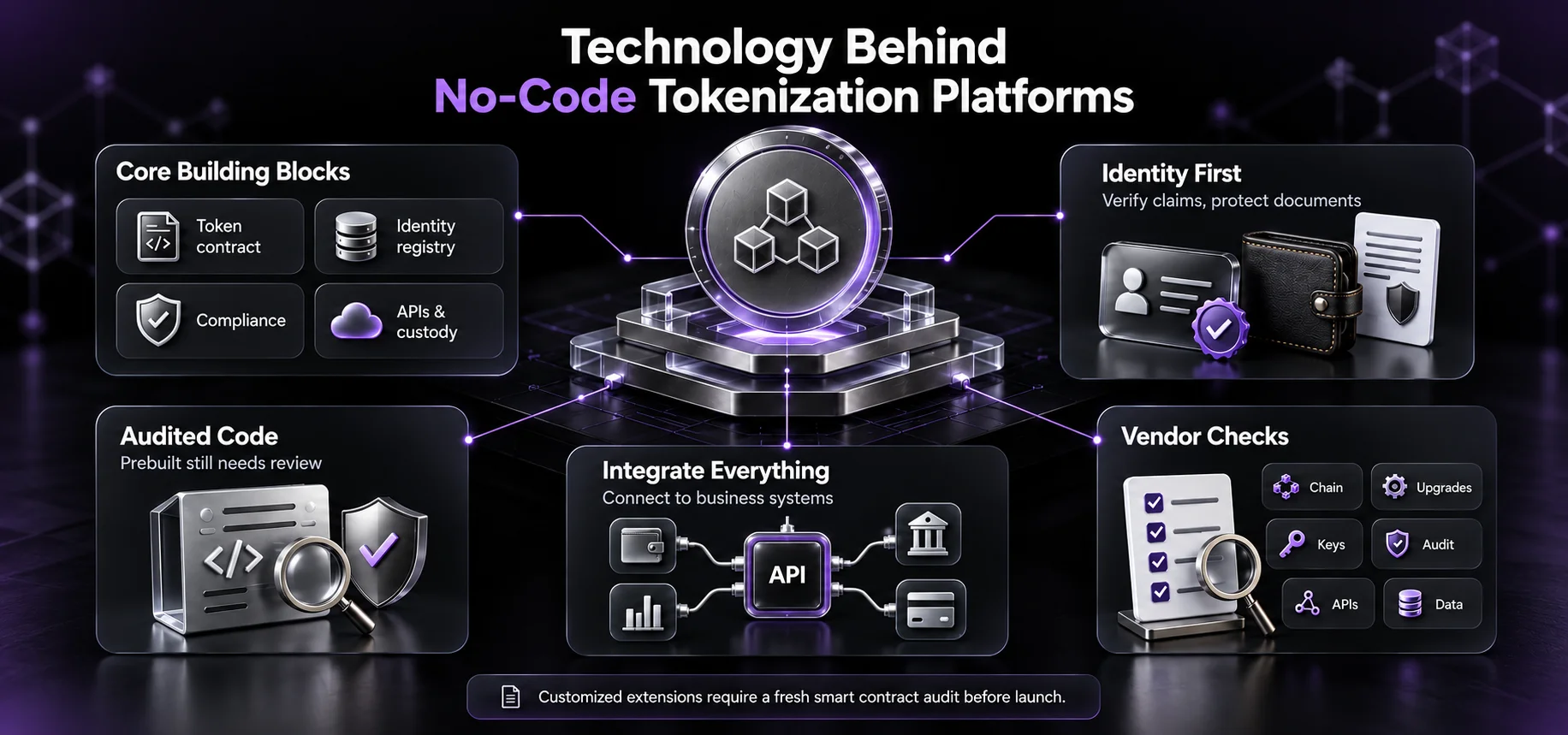
Most no-code platforms use the same basic building blocks for building their interfaces. If you know what they are and where the risk is concentrated, you will know whether a vendor’s platform will hold up when real money is at stake.
1. The Core Building Blocks
Four components form the technical foundation:
- Token contract: Enforces transfer rules.
- Identity registry: Maps wallets to verified investors.
- Compliance modules: Apply caps, lock-ups, and country restrictions.
- Custody connectors and APIs: Link the stack to wallets, banks, and your existing systems.
Each component carries its own failure modes if implemented poorly.
2. Why Identity Is the Most Delicate Layer
Regulatory exposure is concentrated in identity. Ethereum’s decentralized identity overview shows how verifiable credentials allow a verifier to verify claims without revealing the underlying documents. ERC-3643 platforms apply the same approach using onchain claims. If the identification layer is not good enough, no rules engine above it can make up for it.
3. Code Quality Still Matters With Prebuilt Contracts
Prebuilt contracts reduce, but not eliminate, the risk of failure. Ask if the vendor has had its contracts independently reviewed and by whom. If your product needs extensions, spend money on smart contract development by specialists. Extensions are high risk areas since your changes are not audited as part of the audit of a template.
4. Integration Is the Other Variable
Good platforms have APIs for investor data, cap table sync and payment rails so tokenized assets can be integrated rather than separate from fund administration. The token itself is now completely commoditized. What differentiates suppliers is how well their stack talks to the systems that run your business today.
5. Vendor Due Diligence Questions to Ask
Before committing, get clear answers in writing on:
- Chain support
- Upgrade handling
- Admin key custody
- Audit scope for extensions
- API coverage
- Investor data residency
Then require a fresh smart contract audit for anything customized before launch. The vendor’s audit history is a starting point, not a substitute for reviewing your own changes.
Cost Comparison: No-Code vs Hybrid vs Custom Tokenization Platform
Costs for an asset tokenization platform split into three tiers, and the right tier depends on how much of your structure fits standard templates. The table below compares the three paths side by side.
| Factor | No-Code | Hybrid | Fully Custom |
| Setup cost | 5K–25K plus monthly fees | 25K–80K | 80K–250K+ |
| Timeline | Weeks | 2–4 months | 4–8 months |
| Best for | Standard structures, single-class equity or debt, fund interests | Standard issuance with 1–2 bespoke requirements | Complex corporate actions, fee waterfalls, multi-jurisdiction edge cases |
| Compliance logic | Prebuilt and configurable | Prebuilt plus custom modules | Fully custom-built |
| Flexibility | Limited to vendor roadmap | Moderate – custom on the gaps | Full control |
| Vendor dependency | High | Moderate | Low |
| Maintenance burden | Vendor-managed | Shared | In-house or partner-managed |
Need a Clear Cost Estimate for Your Tokenization Platform?
Choosing the Right Platform or Development Partner
Begin with your own structure, not the vendor’s demo. Write down your asset classes, investor types, jurisdictions and non-standard economics and compare each contender to your list. A good partner will give you a straight answer, even if your needs are better suited to a standard platform rather than a custom build.
1. What to Verify Before Committing
Get clear answers in writing on five points:
- KYC responsibility: Who performs KYC?
- Investor data: Where does investor data live?
- Token standard: Which token standard is used?
- Transfer restrictions: How are transfers blocked?
- Admin key custody: Who holds the administrative keys?
2. Where Hybrid Approaches Make Sense
Many projects combine the two: no-code for the issuance and onboarding, with specialized modules where the business needs them. DeFi development, such as permissioned liquidity pools, may be required for a secondary market but only after a legal analysis has determined what trading activities your investor base is allowed to do.
3. Cash Flow Integration
Investors need to get rental income, interest and profits from redemptions on a regular basis. Stable-value settlement is the preferred method of settlement for some issuers over bank transfers. If your counsel is on board with the settlement design, stablecoin development can run parallel to the tokenization platform.
4. Where Investors Hold Their Tokens
Most of the platforms allow third-party custodians, while some other projects require branded wallets with in-built compliance checks. This is where crypto wallet development comes in. Any wallet has to be whitelisted, as transfers to non-verified addresses will fail on contract level.
5. Adjacent Ideas That Carry Different Regulatory Weight
Beware of neighboring ideas with different rules. Some teams question if fractional claims should be traded via an NFT marketplace development effort. It’s possible, but collectible-style NFTs and regulated securities have different rules, so they keep investor-grade assets on permissioned rails.
6. Confirm Classification Before Marketing
Before any marketing starts, have your team confirm how each token is classified in each target country. Classification determines the applicable exemptions, the required disclosures and who can legally hold the asset. Getting this wrong post launch costs a lot more than validating it before.
Concluding Note
For issuers with common structures, tight schedules and little technical capacity, a no-code asset tokenization platform is a realistic solution. The token itself is not valuable – it’s the built-in KYC, investor accreditation checks and automated transfer limits that are valuable. Need bespoke corporate activities, complex waterfalls or multi-jurisdiction rules for your service? Expect custom work or a hybrid build. No matter which approach you take, consider who is responsible for compliance, where investor data is stored and how rules are enforced onchain. The ideal scenario for tokenization is when the technology is in the background. Treat the platform as infrastructure, compliance as the product.
Frequently Asked Questions
1. What is a no-code asset tokenization platform?
Configurable software enables non-developers to issue digital securities using forms, templates and dashboards. The underlying contracts have already been created, tested and often audited by the vendor.
2. Can I tokenize assets without writing any code?
Yes, for typical structures such as single class equities, fund interests and traditional real estate entities. Custom corporate actions, complex fee waterfalls and edge cases across multiple jurisdictions still require bespoke creation.
3. How does built-in KYC work on these platforms?
Investors will have to provide documentation, undergo AML and sanctions screening and prove their accreditation where applicable. The platform links their wallet with the approved status. Off-chain checks, on-chain enforcement.
4. What is ERC-3643 and why does it matter?
A token standard for regulated securities. It stores validated claims onchain, crossreferences it with an identity registry and blocks transfers that don’t comply. It’s compatible with ERC-20 wallets and tools.
5. How much does a no-code tokenization platform cost?
Initial setup costs can be as low as $5,000 to $25,000, in addition to monthly fees. To set up DigiShares Launch it costs €5,000 + €300 per month. Scintilla costs around $15,000 to get up and running and then $3,000 each month. Free access to OpenZeppelin’s RWA Wizard, the contract scaffold.
Need a Faster Way to Launch a Compliant Tokenized Asset?
